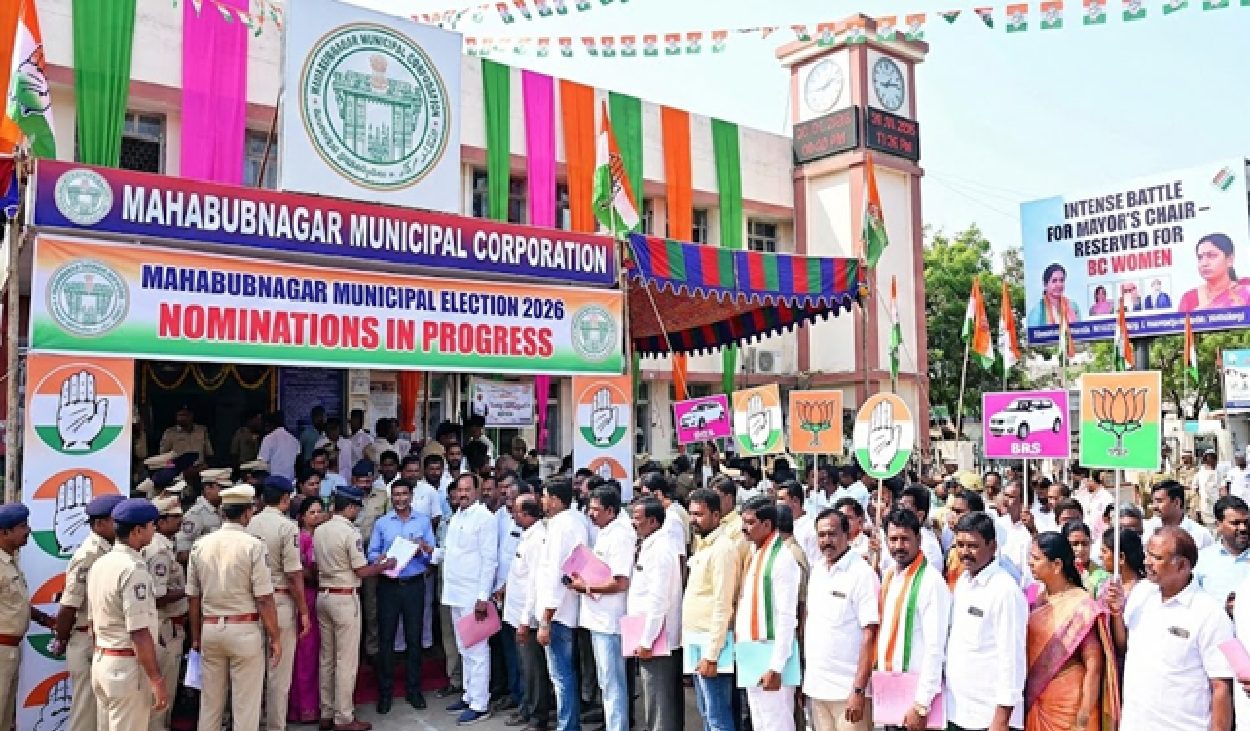
Mahabubnagar, a bustling district headquarters in Telangana, India, pulses with political energy as the 2026 municipal elections unfold. Residents and aspirants alike gather at the corporation office, where the air buzzes with anticipation. Candidates file nominations in droves, marking the final push before polling on February 11, 2026, and vote counting on February 13.
This year, the stakes soar high, especially for the inaugural mayor’s position in the newly upgraded Mahabubnagar Municipal Corporation. With 60 divisions at play, major parties like Congress, Bharat Rashtra Samithi (BRS), and Bharatiya Janata Party (BJP) lock horns in a fierce contest.
Nominations, running from January 28 to 30, see a surge today, the last day, as hopefuls finalize their bids. This election not only tests party strengths but also highlights local issues like urban development, water supply, and infrastructure in this rapidly growing region.
As Telangana’s political landscape evolves under Chief Minister Revanth Reddy’s Congress government, these polls serve as a litmus test. The ruling Congress aims to consolidate power, while opposition BRS seeks a comeback after recent setbacks.
BJP, riding on national momentum, eyes gains in urban pockets. Mahabubnagar’s transformation from a municipality to a corporation in recent years amplifies the excitement, drawing attention from across the state. In this article, we delve into the nomination process, key contenders, party strategies, and what this means for the future of Mahabubnagar.
Nomination Process in Full Swing: A Day of High Activity at Mahabubnagar Corporation Office
Candidates swarm the Mahabubnagar Municipal Corporation office, transforming it into a hub of activity. Officials set up 20 dedicated counters to handle the influx, with each counter managing nominations for three divisions. Aspirants arrive prepared, clutching essential documents like no-dues certificates and caste verifications. The process demands precision: candidates head to assigned counters, submit forms, and await scrutiny.
Yesterday’s filings paled in comparison to today’s rush. Only nine nominations came in for the corporation’s 60 divisions, with four in Devarakadra Municipality and one in Bhoothpur Municipality. But today, contenders step up en masse, knowing tomorrow seals the deal. Parties encourage their members to file promptly, avoiding last-minute hiccups. Visuals from the ground show long queues and animated discussions, as supporters rally behind their favorites.
This structured setup ensures efficiency, but the pressure mounts. With just one more day left, many who prepared in advance now act. The election commission’s guidelines emphasize transparency, requiring affidavits on assets and criminal records. For locals in Lal Bahadur Nagar and surrounding areas, this spectacle underscores democracy at work, where everyday citizens transform into potential leaders.
Expanding on the logistics, the corporation spans urban and semi-urban zones, incorporating areas like old town markets and new residential colonies. This diversity influences nomination strategies, as candidates tailor appeals to specific voter bases. Women, in particular, gain prominence due to reservations, empowering more female voices in governance. As nominations wrap up, scrutiny begins on February 1, followed by withdrawals until February 3, setting the stage for campaigns.
The Structure and Significance of Mahabubnagar Municipal Corporation
Mahabubnagar Municipal Corporation oversees 60 divisions, a setup that reflects its upgrade from a municipality. This change, initiated under the previous BRS regime and finalized by Congress, aims to boost administrative efficiency and attract investments. The corporation covers approximately 100 square kilometers, serving over 200,000 residents with services like sanitation, roads, and public health.
For the first time, voters elect councilors across these divisions, culminating in the mayor’s selection. The mayor’s role involves chairing council meetings, overseeing budgets, and driving development projects. Reserved for a Backward Class (BC) woman, this post promotes inclusivity, aligning with Telangana’s reservation policies. Such reservations ensure representation for marginalized groups, fostering balanced growth.
Mahabubnagar’s strategic location in southern Telangana, bordering Andhra Pradesh and Karnataka, makes it a key economic node. Agriculture, textiles, and emerging IT sectors fuel its economy, but challenges like water scarcity and unemployment persist. The corporation’s formation addresses these by enabling larger-scale planning, such as integrated water management and smart city initiatives.
In the broader Telangana context, this election joins others in corporations like Karimnagar and Nizamabad, where similar dynamics play out. With 10 municipal corporations and 121 municipalities in the fray, the outcomes could reshape local power structures. For Mahabubnagar, success hinges on addressing local needs, from improving drainage in flood-prone areas to enhancing public transport.
Reservation Dynamics: Empowering BC Women in the Mayor’s Race
The mayor’s chair reservation for a BC woman sparks intense interest. This policy, part of Telangana’s commitment to social justice, allocates top posts based on demographics. In Mahabubnagar, it opens doors for women from BC communities, traditionally underrepresented in leadership.
Critics argue reservations sometimes lead to proxy candidacies, where family members front for influential men. Yet, proponents highlight how they break barriers, bringing fresh perspectives to urban governance. In this race, eligible women from reserved divisions compete fiercely, with parties scouting talent through surveys and applications.
The reservation stirs discussions among residents, who eagerly speculate on who will occupy the chair. It also influences party tickets, prioritizing winnable BC women candidates. Across Telangana, similar reservations for mayors and chairpersons vary by category, with SCs, STs, and OBCs getting shares. In Mahabubnagar, this setup ensures the mayor addresses issues like women’s safety and education, vital in a district with diverse socio-economic layers.
Congress Party’s Strong Contenders: Profiles and Strategies in the Mayor’s Contest
Congress leads the charge, leveraging its ruling status to field strong candidates. Party leaders, under CM Revanth Reddy, finalize lists amid high expectations. For the mayor’s race, several names emerge, often involving family members of prominent leaders due to the BC woman reservation.
Anand Goud stands out, a former municipality chairman who switched from BRS to Congress. He engineered a council merger that secured the chairman post for Congress previously. Now, he positions his wife as a frontrunner, banking on his local influence and organizational skills.
NP Venkatesh, a key BC leader and lawyer, eyes the race through his daughter Nehasri. As a young advocate, Nehasri could become one of Telangana’s youngest mayors if successful. Venkatesh’s clout in the Mudiraj community bolsters her chances, emphasizing youth and legal expertise.
Raghavendra Raju and Amarendra Raju also vie, with the latter’s wife holding a position in the women’s wing of Congress. Their anti-BRS campaigns in past elections give them edge, focusing on development promises.
Mythri Yadav, from the Mudiraj group, brings a fighter’s spirit, having opposed the previous BRS government. Munnuru Ravi, a Telangana movement veteran, plans to field his wife, drawing on his activist legacy despite no prior posts.
Lakshman Yadav, current MUDA chairman, rounds out the list, potentially nominating his wife. These contenders unite under Congress’s banner, aiming for majority wards through grassroots mobilization and welfare schemes like free bus travel for women.
Congress’s strategy involves door-to-door campaigns, highlighting state achievements, and countering opposition narratives. With BC voters forming a significant bloc, the party tailors messages to empowerment and economic upliftment.
BRS’s Comeback Bid: Key Candidates and Tactical Approaches
BRS, formerly TRS, refuses to fade, drawing on its decade-long rule to challenge Congress. Under former minister Srinivas Goud, the party conducts surveys to select winnable candidates, collecting applications and forming committees for evaluations.
Srinivas Goud leads the effort, finalizing some names already. His family might enter the fray, leveraging his ministerial legacy in excise and tourism. Erra Shekhar, ex-MLA, brings experience, potentially fielding a relative.
Koremoni Venkataiah, former DCCB chairman and senior leader, eyes the race, with his ward under general category but adaptable for family. Kishore, ex-councilor who briefly joined BJP before returning, adds depth.
BRS focuses on its past contributions, like initiating the corporation upgrade. The party aims for majority wards, promising continued development. Visuals show BRS candidates filing nominations confidently, signaling readiness.
Despite recent defections to Congress and BJP, BRS retains grassroots strength. Strategies include criticizing Congress on unfulfilled promises and highlighting KCR’s vision for Telangana. In Mahabubnagar, BRS targets rural-urban voters with agriculture and infrastructure pledges.
BJP’s Emerging Role: Potential Players and Growth Ambitions
BJP positions itself as a third force, though transcripts suggest limited mayor prospects. The party builds on 2020 GHMC gains, where it surged in urban areas. In Mahabubnagar, leaders like Anjaneyulu and Yadaya from Ganjikunta aim to capture wards.
BJP’s strategy emphasizes national schemes like PM Awas Yojana and anti-corruption drives. While not frontrunners for mayor, winning key divisions could influence coalitions. The party critiques both Congress and BRS on governance failures, appealing to youth and business communities.
Alliances, like past ties with Jana Sena, might boost visibility. BJP eyes expansion in southern Telangana, where Mahabubnagar offers fertile ground.
Other Parties and Independent Candidates: Adding Diversity to the Race
Beyond the big three, parties like Telangana Rajya Adhikar Party (TRP), founded by Teenmar Mallanna for BC empowerment, enter the fray. TRP focuses on social justice, potentially splitting BC votes.
Independents, often local influencers, file nominations too, addressing hyper-local issues like street lighting or waste management. Their presence complicates predictions, as they might sway close contests.
Historical Context: Evolution of Politics in Mahabubnagar
Mahabubnagar’s political history traces back to pre-Telangana statehood, with Congress dominating early years. BRS rose post-2014, winning assembly seats and local bodies. The 2023 assembly polls saw Congress resurgence, ousting BRS.
The municipality’s upgrade to corporation in 2020-2021 aimed at better funding. Past elections highlighted issues like migration due to drought, earning the moniker “Palamuru.” Today’s polls build on this, with parties promising irrigation projects like Palamuru-Rangareddy Lift Scheme.
Key Issues Facing Mahabubnagar: What Voters Demand
Voters prioritize water security, given the Krishna River proximity yet persistent shortages. Infrastructure, including roads and hospitals, tops agendas. Employment, education, and women’s empowerment resonate, especially with BC focus.
Urban expansion brings challenges like traffic and pollution, demanding sustainable planning. Parties pledge smart initiatives, but implementation remains key.
Campaign Strategies and Voter Outreach in 2026
Parties ramp up digital and ground campaigns. Congress uses state machinery for rallies; BRS leverages KCR’s charisma; BJP taps Modi wave. Door-to-door visits, social media, and town halls engage voters.
In Lal Bahadur Nagar, local leaders address community-specific needs, building trust.
Predictions and Potential Outcomes: Who Will Claim the Mayor’s Chair?
Analysts predict a Congress edge due to incumbency, but BRS’s local roots pose threats. BJP might play spoiler. Turnout, expected high, could favor organized parties.
If Congress secures majority, it cements control; BRS victory signals revival. The BC woman mayor will symbolize progress, influencing Telangana’s politics.
As nominations conclude, Mahabubnagar braces for an electrifying campaign. These elections not only elect leaders but shape the district’s trajectory toward prosperity.