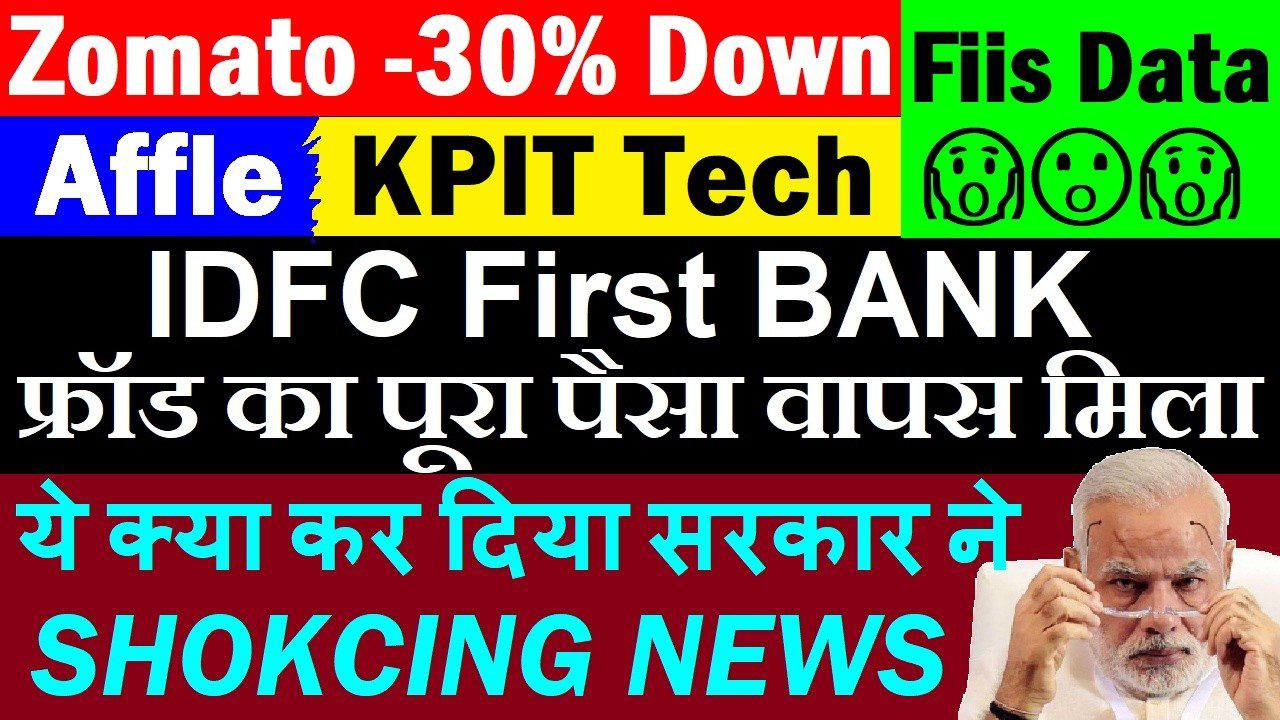
The Indian financial ecosystem witnessed several high-profile shifts today, ranging from a major fraud recovery at IDFC First Bank to a shocking regulatory decision impacting the textile sector. As global trade tensions persist, these domestic triggers are redefining investor sentiment. This comprehensive analysis deconstructs the latest developments involving IDFC First Bank, the textile export crisis, and the ongoing correction in Zomato.
IDFC First Bank Fraud: Haryana Government Recovers All Lost Capital
The banking sector remained on high alert following reports of a significant fraud at IDFC First Bank involving approximately ₹590 crore. Unlike typical retail scams, this fraud targeted the Haryana Government’s institutional account, where funds were illicitly diverted.
- The Recovery: In a swift turn of events, the Chief Minister of Haryana confirmed that the authorities recovered the entire amount within 24 hours. The bank returned approximately ₹556 crore of the principal along with ₹22 crore in interest.
- The Forensic Audit: Despite the recovery, the case remains active. KPMG is currently conducting a forensic audit to determine the exact nature of the fraud. Preliminary evidence suggests an “Employee-Level Fraud” rather than a “Management-Level Fraud.”
- Institutional Integrity: While employee-level errors occur even in giants like HDFC Bank and Tata Motors, management-level fraud (similar to the Yes Bank crisis) poses a systemic threat. Investors should monitor the audit report to confirm that the bank’s core leadership remains untainted.
The Textile Sector Shock: Government Slashing RoDTEP Benefits by 50%
The Indian textile industry faced a brutal sell-off today after the government announced a shocking reduction in export incentives. Major players, including Gokaldas Exports and Arvind Limited, hit their lower circuits as the market reacted to the news.
- RoDTEP Reduction: The government has reduced the benefits under the Remission of Duties and Taxes on Exported Products (RoDTEP) scheme by 50%. This scheme serves as a vital lifeline for exporters, compensating them for various embedded taxes and duties.
- Bad Timing: The textile industry is already struggling with aggressive international tariffs and global trade wars. Slashing incentives by 50% at this juncture significantly erodes the competitive edge of Indian garments in Western markets.
- Contagion Fear: Exporters now fear that the government might also target other schemes, such as the RoSCTL (Rebate of State and Central Taxes and Levies). If further cuts occur, the export-oriented textile sector could face a prolonged downturn.
Zomato’s 30% Correction: Analyzing the Leadership Shift and Competition
Zomato (now Eternal) has seen its share price decline by nearly 30% from its recent peaks. While the company remains a dominant player in the food delivery and quick-commerce space, several factors are contributing to this sustained pressure.
- Founder Focus Shift: Investors are increasingly concerned about Deepinder Goyal’s shifting focus toward L-A-T Aerospace. His interest in developing short-distance air travel solutions suggests that his primary attention may be moving away from the core Zomato/Blinkit ecosystem.
- Leadership Restructuring: Goyal recently stepped down from his role leading Zomato, with the head of Blinkit taking over the reins. While this promotes synergy within the group, the transition has unsettled some long-term shareholders.
- Aggressive Competition: The entry of Swiggy into the public markets and its aggressive growth strategies are forcing Zomato to defend its market share, potentially impacting near-term margins.
FII and DII Activity: Institutional Sentiment in the IT Sector
Foreign Institutional Investors (FIIs) continue to show a mixed trend, particularly within the IT space. Today, FIIs engaged in heavy selling within the tech sector, contributing to a 4.5% to 5% decline in several IT stocks, including KPIT Tech and Affle (3i).
- FII Net Sales: While FIIs purchased ₹5,501 crore worth of equities, they sold ₹5,603 crore, resulting in a net sale of approximately ₹102 crore. Most of this selling concentrated on IT companies due to the ongoing trade war rhetoric in Europe and America.
- DII Support: Conversely, Domestic Institutional Investors (DIIs) continue to provide a strong floor to the market, engaging in robust buying to absorb the FII sell-off.
- Sectoral Outlook: KPIT Tech is facing pressure because nearly 60% of its revenue originates from the U.S. and Europe—regions currently embroiled in unofficial trade disputes. Similarly, Affle is seeing “collateral damage” as the entire tech basket undergoes a valuation reset.
Conclusion: Navigating a Period of Volatility
The current market phase is characterized by rapid regulatory changes and geopolitical uncertainty. While IDFC First Bank has successfully neutralized its immediate financial risk, the textile sector is entering a period of margin compression due to reduced government support. Similarly, Zomato’s correction reflects a transition in leadership and founder priorities.
Investors should focus on sectors with strong domestic demand and limited exposure to the ongoing “Trade War” between the West and Asia. As institutional players rebalance their portfolios, high-quality companies with transparent management remain the safest bets for long-term capital preservation.
Primary SEO Keywords: IDFC First Bank Fraud Recovery, Zomato Share Price Decline, Textile Export RoDTEP Benefit Cut, FII DII Data Latest, KPIT Tech Share News, Government Shocking Decision Textile, Indian Stock Market Volatility 2026.
Disclaimer: This report is for educational and informational purposes only. The stock market involves significant risks. Please consult a certified financial advisor or conduct thorough independent research before making any investment decisions.