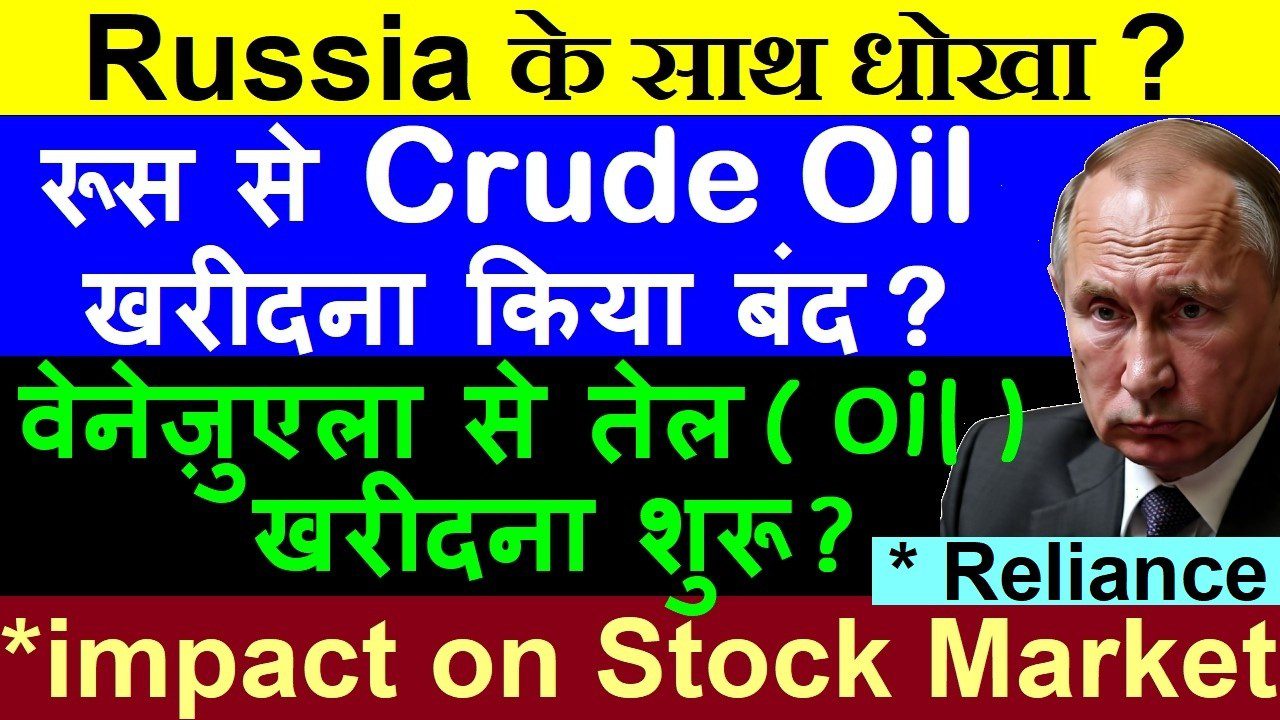
India’s energy policy has quietly entered a new chapter. As trade negotiations with the United States intensified and tariff pressure mounted, data and industry reports now suggest that India — led by its largest crude oil buyer, Reliance Industries is gradually reducing its dependence on Russian crude oil while simultaneously beginning to source oil from Venezuela. This strategic pivot carries significant consequences for India’s energy security, corporate profitability, fuel prices at the pump, and its evolving relationship with both Washington and Moscow.
The 50% Tariff That Started It All
The story begins with former US President Donald Trump’s decision to impose a sweeping 50% tariff on Indian goods. To understand this number clearly, it was not a single flat tariff. The actual base tariff stood at 25%, with an additional 25% penalty layered on top specifically targeting India. The reasoning behind this extra punitive measure was straightforward: Trump’s administration accused India of indirectly funding the Russia-Ukraine war by purchasing large volumes of discounted Russian crude oil.
From Washington’s perspective, every dollar India spent on Russian oil helped sustain Russia’s war machine. Trump made this argument loudly and publicly, turning India’s energy purchases into a geopolitical flashpoint. The tariff was not just an economic tool — it was leverage designed to force a behavioral change in India’s procurement strategy.
This pressure created enormous uncertainty, particularly among investors and companies that had grown accustomed to benefiting from heavily discounted Russian crude. The tariff announcement sent shockwaves through Indian stock markets, and companies like Reliance Industries faced sudden valuation pressure as analysts began questioning whether the discounted oil era was coming to an end.
India-US Trade Deal: What Was Actually Agreed?
As diplomatic negotiations progressed, both sides moved toward an announcement of a bilateral trade deal. While officials had not officially signed the agreement as of the time of this report, the announcement itself carried substantial weight. The expected signing was projected for the end of March.
The most critical condition America attached to the trade deal was non-negotiable from Washington’s side: India must reduce — and eventually halt — its purchases of Russian crude oil. The US made it explicitly clear that no trade agreement would move forward unless India demonstrated a credible commitment to unwinding its dependence on Russian energy.
In exchange, the US offered a significant concession. It agreed to reduce India’s effective tariff burden from 50% all the way down to 18%. This represented a dramatic reduction and signaled that Washington was genuinely willing to reward India for compliance. However, American officials also issued a stark warning alongside this offer — they stated they would actively monitor both direct and indirect purchases of Russian oil, and they reserved the right to reimpose elevated tariffs if India violated the spirit of the agreement.
To sweeten the deal further and give India practical alternatives, the US offered two substitutes: American crude oil and Venezuelan crude oil. The Venezuela angle deserves special attention because Venezuela — despite its political reputation — effectively operates under significant US influence and oversight.
Three Sides, Three Statements — and Deliberate Silence
Once news of the trade deal framework broke, journalists and analysts immediately asked the obvious follow-up question: had India actually stopped buying Russian oil?
The responses from three key parties reveal just how carefully everyone was choosing their words.
The United States took the most assertive stance, claiming that India had committed to winding down Russian oil purchases. American officials publicly credited this commitment as the reason for lowering tariffs to 18%. Washington framed this as a done deal, even before India formally confirmed anything.
Russia, on the other hand, adopted a notably calm posture. Russian officials pointed out that no official statement, notification, or communication had come from New Delhi indicating any intention to stop or reduce oil purchases. Moscow essentially said there was nothing on paper, and until there was, business would continue as usual. Russian officials also added that India would buy oil from wherever it chose — a diplomatic acknowledgment of India’s sovereign purchasing decisions.
India’s Ministry of External Affairs (MEA) offered perhaps the most diplomatically crafted non-answer in recent memory. When pressed at a press conference about whether India had committed to stopping Russian oil purchases, MEA officials neither confirmed nor denied the commitment. Instead, they offered a policy philosophy: national interest comes first. With 1.4 billion citizens depending on affordable energy, India would purchase oil from wherever it found the best price. Diversification, they noted, was always part of the strategy. If Middle Eastern suppliers or Venezuelan suppliers offered competitive pricing, India would consider those options. The MEA refused to give a binary yes-or-no answer.
This deliberate ambiguity served India’s interests on multiple fronts simultaneously — it avoided antagonizing Russia, it satisfied American expectations just enough to secure tariff reductions, and it preserved India’s strategic flexibility.
The Data Tells the Real Story
While official statements remained carefully vague, crude oil import data began painting a clearer picture of what was actually happening on the ground.
Country-wise crude oil import data revealed the following trend:
- Russia: November imports stood at 35% of total crude purchases. December dropped to 24.9%. January fell further to 21.5%.
- Iraq: Figures fluctuated between 18% and 24%, reflecting normal variation rather than strategic shifts.
- Saudi Arabia: Purchases from Saudi Arabia increased, suggesting India was actively diversifying toward Middle Eastern suppliers.
- UAE: Numbers remained relatively stable with minor fluctuations.
- United States: American crude oil purchases hovered around 136 thousand barrels per day with typical variation.
- Venezuela: This is where the data becomes most striking. Venezuela had been sitting at zero for an extended period because US sanctions previously prohibited Indian companies from purchasing Venezuelan crude. However, the latest data shows Venezuela inching toward approximately 1% of India’s total crude imports — a small number that carries enormous symbolic and strategic significance.
The trajectory is unmistakable. Russia’s share of India’s crude imports has declined by nearly 14 percentage points in just three months. Meanwhile, Venezuelan crude has moved from absolute zero to a measurable percentage. These numbers do not lie, and they align perfectly with the political commitments — however unspoken — that India made to secure the trade deal with the United States.
The February data, which will become available in March, will be crucial. If Russia’s share slips below 20%, it will confirm that India is genuinely accelerating its transition away from Russian crude, not merely making cosmetic adjustments to satisfy American optics.
Reliance Industries: The Company at the Center
No discussion of India’s crude oil strategy is complete without examining Reliance Industries, the Mukesh Ambani-led conglomerate that operates one of the world’s largest oil refining complexes at Jamnagar in Gujarat.
Reliance is by far India’s largest buyer of crude oil. The company purchases raw crude, refines it into petrol, diesel, and other petroleum products, and sells those products both domestically and internationally. When the Russia-Ukraine war began and Western sanctions pushed Russian crude prices down, Reliance emerged as one of the biggest beneficiaries of discounted Russian oil. The company secured Russian crude at prices well below market rates, boosting its refining margins significantly.
This arrangement drew criticism from multiple angles. Political opponents questioned why the benefit of cheaper crude was not passed on to ordinary Indian consumers through reduced petrol and diesel prices. Instead, retail fuel prices remained stubbornly high while Reliance’s refining margins expanded. The controversy became a significant political flashpoint in India, with opposition parties demanding answers about who truly benefited from the Russian oil discount.
Now, the situation is changing in two important ways.
First, a news report from early 2025 revealed that Reliance had acquired a US government license to import Venezuelan crude oil. This was a critical legal step because Venezuelan oil had been off-limits for most Indian companies due to American sanctions. Obtaining a special license meant Reliance gained official authorization to resume Venezuelan crude purchases.
Second, and more recently, credible industry reports indicate that Reliance has actually bought Venezuelan crude for the first time since 2023. This marks a concrete operational shift, not merely a licensing formality. Reliance has moved from paperwork to actual procurement, signaling that its sourcing strategy has meaningfully evolved.
What This Means for Reliance’s Profitability
The shift from Russian crude to Venezuelan crude raises an immediate and important financial question: does Venezuela offer comparable discounts to what Russia was providing?
The honest answer is — probably not. Russia was offering crude at dramatically reduced prices during the height of the war, sometimes at discounts of $20 to $30 per barrel below market benchmarks. Venezuelan crude does carry some discount relative to benchmark prices due to its heavier quality and the logistical complexity involved in transporting it to India. However, that discount is unlikely to match what Russia was offering at peak discount levels.
This cost differential matters enormously for Reliance’s bottom line. If the company is now paying more for crude than it was a year ago, that additional cost must go somewhere. There are essentially two possibilities:
- Reliance absorbs the higher cost internally, which would compress its refining margins and reduce profitability. This would show up in upcoming quarterly earnings reports.
- Reliance passes the higher cost to consumers through increases in petrol and diesel prices at retail pumps.
The exact magnitude of Venezuela’s pricing relative to Russia will only become clear once Reliance publishes its next quarterly results. Investors and analysts are watching closely, and the company’s stock price will likely respond sharply to whatever the numbers reveal. For ordinary consumers, the question of whether fuel prices will rise adds yet another dimension of uncertainty to an already complex situation.
The Geopolitical Chessboard
Stepping back from the corporate and market specifics, India’s oil sourcing transition reflects a sophisticated and calculated geopolitical maneuver.
India has simultaneously managed to:
- Maintain a warm enough relationship with Russia to avoid provoking Moscow into any retaliatory measures
- Satisfy American demands sufficiently to secure meaningful tariff relief
- Preserve its own strategic autonomy by never making an explicit public commitment to ending Russian oil purchases
- Begin diversifying its energy supply chain in a way that reduces vulnerability to any single supplier
This balancing act is characteristic of India’s broader foreign policy approach — what analysts sometimes call “strategic autonomy” or “multi-alignment.” India refuses to be locked into any single geopolitical camp, and its oil purchasing strategy embodies this philosophy in practical terms.
The trade deal itself, even as it awaits official signing, represents a significant milestone in India-US economic relations. The tariff reduction from 50% to 18% will benefit Indian exporters across multiple sectors, from pharmaceuticals to textiles to technology services. The oil concession was essentially India’s payment for this benefit — a payment made quietly through shifting procurement data rather than through bold public announcements.
What Investors and Market Watchers Should Track
For anyone invested in Indian energy companies or tracking the broader market implications of this story, several key developments deserve close monitoring:
- Monthly crude import data: Watch Russia’s percentage share. A drop below 20% in February data would confirm the downtrend is accelerating.
- Reliance Industries quarterly results: The company’s refining margins will reveal whether Venezuelan crude is genuinely cost-competitive with Russian crude.
- India-US trade deal official signing: The final signed document may include specific language about crude oil sourcing commitments.
- Venezuelan crude license terms: The duration and volume limits of Reliance’s US license to import Venezuelan oil will shape how aggressively the company can scale up this new supply relationship.
- Retail fuel prices in India: Any upward movement in petrol and diesel prices could signal that higher crude costs are being passed to consumers.
- Trump administration statements on India tariffs: Washington has warned it will reimpose tariffs if it detects any renewed Russian oil purchases. Any such statement would immediately impact Indian stock markets.
The Road Ahead
India’s energy strategy is undergoing a quiet but consequential transformation. The country is navigating extraordinarily complex competing pressures — economic self-interest, geopolitical alignment demands, corporate profitability, consumer welfare, and energy security — all simultaneously.
The data is already telling us what politicians and corporate leaders are unwilling to say directly: Russia’s share of India’s crude oil imports is falling, and Venezuela is stepping in as a partial replacement. Reliance Industries, the company that sits at the center of this entire story, is adapting its procurement strategy in real time.
Whether this transition ultimately benefits India’s energy consumers, corporate shareholders, or geopolitical standing with the United States depends on variables that will only become clear in the coming months. The quarterly earnings season, the official signing of the India-US trade deal, and February’s import data will each add crucial pieces to this puzzle.
What is already clear, however, is that the era of India quietly enjoying deeply discounted Russian crude while deflecting American criticism with diplomatic ambiguity is drawing to a close. The new era — defined by Venezuelan crude, American pressure, and carefully managed diversification — has already begun.
This article is based on publicly available data, industry reports, and geopolitical analysis as of early 2026. Crude oil import figures are approximate and subject to revision as official monthly data becomes available.