Ashok Leyland, a venerable pillar of India’s commercial vehicle sector, recently unveiled its financial results for the fourth quarter of fiscal year 2026. These figures offer a compelling narrative of resilience, strategic foresight, and a determined push towards market leadership amidst evolving industry dynamics. As the nation’s second-largest commercial vehicle manufacturer, Ashok Leyland’s performance not only reflects its operational efficiency but also provides a crucial barometer for the broader Indian automotive landscape, particularly within the Medium and Heavy Commercial Vehicle (M&HCV) segment. The detailed analysis of these results is paramount for stakeholders, including investors, industry analysts, and potential customers, seeking to understand the company’s trajectory and its pivotal role in India’s economic growth.
The company’s Q4 FY26 results underscore a period of robust revenue growth and commendable profit expansion, aligning closely with market expectations. This performance is particularly significant given the competitive intensity, the ongoing transition towards sustainable mobility solutions, and the dynamic regulatory environment. Investors and industry analysts keenly observe these outcomes, seeking insights into the company’s capacity to capitalize on India’s burgeoning infrastructure development, the expanding logistics sector, and the increasing demand for efficient transportation solutions. Furthermore, the announcement of a dividend payout reinforces Ashok Leyland’s unwavering commitment to shareholder value, a critical factor for long-term investment appeal and market confidence. This comprehensive overview delves into the nuances of Ashok Leyland’s Q4 FY26 performance, its strategic imperatives, and its future outlook within the vibrant Indian commercial vehicle market.
Financial Highlights: A Deep Dive into Q4 FY26 Performance
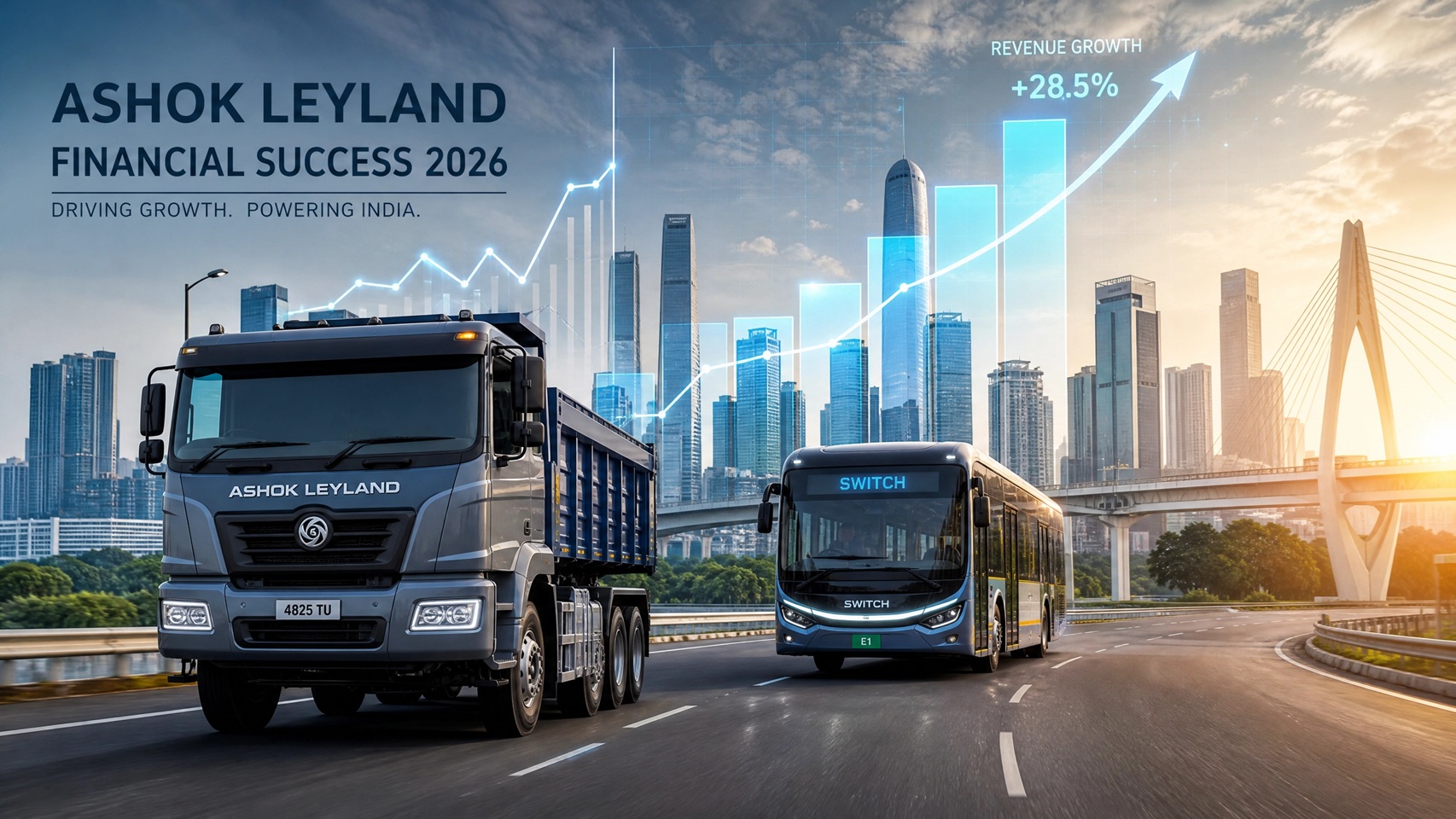
Ashok Leyland’s financial statements for the fourth quarter of 2026 reveal a strong operational showing, demonstrating the company’s ability to navigate a complex economic landscape while delivering impressive growth. The company reported a consolidated revenue of approximately ₹14,075 crore, marking a substantial increase from the previous year’s figures. This impressive top-line growth, which saw an 18-19% year-on-year (YoY) jump and a 23% quarter-on-quarter (QoQ) surge, largely met the market’s revenue estimates, which ranged between ₹14,000 crore and ₹14,200 crore. Such consistent growth in revenue streams highlights the company’s effective sales strategies, its robust product portfolio, and its ability to capture market demand across various segments of the commercial vehicle industry. This growth is particularly noteworthy given the cyclical nature of the commercial vehicle market and the prevailing global economic uncertainties.
Profitability also demonstrated a positive trend, with the company posting a Profit After Tax (PAT) of ₹1,404 crore. This represents a significant 13% increase compared to the same quarter last year. While the PAT figure was largely in line with analyst predictions of ₹1,400 crore to ₹1,460 crore, it indicates a stable and healthy profit-generating capability. The company’s ability to maintain and grow profitability amidst rising operational costs, including raw material prices and supply chain disruptions, is a testament to its stringent cost management practices, operational efficiencies, and strategic pricing initiatives. This robust profit performance is crucial for funding future growth initiatives, including research and development in electric vehicles and expansion into new markets.
However, a closer examination of the margins reveals a slight contraction, a common challenge faced by manufacturers in a competitive environment. The operating margin for Q4 FY26 stood at 14.59%, a marginal decrease from 15.04% in the corresponding period last year. Similarly, the net margin experienced a slight dip, settling at 9.92% compared to 10.46% previously. This subtle compression in margins can be attributed to various factors, including increased input costs, particularly for steel and other commodities, and heightened competitive pressures within the commercial vehicle segment, which often necessitate strategic pricing adjustments. Additionally, increased investments in new technologies, such as electric vehicle development, and expansion of sales and service networks could also contribute to short-term margin pressures. Despite this, the overall financial health remains robust, supported by strong sales volumes, effective market penetration, and a diversified product mix that caters to various customer needs across India.
Operational Efficiency and Expense Management
Effective expense management plays a crucial role in sustaining profitability, especially when facing external cost pressures. Ashok Leyland’s total expenses for Q4 FY26 amounted to ₹12,319 crore, reflecting an increase of approximately 20% year-on-year. This rise in expenses is largely commensurate with the growth in revenue, indicating that the company has maintained a disciplined approach to cost control relative to its sales expansion. The ability to scale operations and increase revenue without a disproportionate increase in expenses underscores the company’s operational efficiency. This includes optimizing manufacturing processes, leveraging economies of scale, and implementing supply chain efficiencies. The company’s focus on localization and strategic sourcing also helps mitigate the impact of global commodity price fluctuations, contributing to overall cost stability.
Shareholder Returns and Dividend Announcement: A Mark of Confidence
In a move that underscores its unwavering commitment to shareholders, Ashok Leyland announced a dividend of ₹2.5 per share for the fiscal year 2026. The record date for this dividend has been set for June 3, 2026, allowing investors ample time to participate. This consistent return to shareholders, coupled with the company’s solid financial performance, reinforces investor confidence and positions Ashok Leyland as an attractive investment in the dynamic Indian automotive sector. A stable dividend payout signals financial health and a positive outlook from the management, making the stock appealing to long-term investors seeking both capital appreciation and regular income. It is also worth noting that in May 2025, the company approved a 1:1 bonus issue, a strategic move that effectively doubles the number of shares held by existing shareholders, thereby enhancing liquidity and making the stock more accessible to a broader investor base. Such corporate actions reflect a strong balance sheet and a management team focused on creating sustainable shareholder value.
Strategic Market Positioning and Growth Vectors: Dominating the Indian CV Landscape
Ashok Leyland’s strategic initiatives extend far beyond mere financial reporting; they encompass ambitious goals for market share expansion and diversification, solidifying its position as a leader in the Indian commercial vehicle market. The company currently holds the position of the second-largest commercial vehicle manufacturer in India, a testament to its extensive product portfolio, robust distribution network, and deep understanding of customer needs. A key strategic objective is to increase its M&HCV market share from the current 25-26% to a formidable 30% by 2028. This aggressive target reflects the company’s confidence in its product development pipeline, its technological prowess, and its ability to penetrate deeper into various market segments through targeted marketing and sales strategies. Achieving this market share growth will involve continuous innovation, expanding dealer and service networks, and strengthening customer relationships through superior after-sales support.
Geographically, Ashok Leyland is executing a focused push into North India, a region that contributes significantly to the total industry volumes (TIV) for commercial vehicles, accounting for approximately 30-32%. The company currently holds about 25% market share in this crucial region and aims to strengthen its presence further. This regional focus is critical for capturing untapped growth opportunities, given the rapid infrastructure development and industrialization occurring in states like Uttar Pradesh, Punjab, and Haryana. By tailoring its product offerings and service solutions to meet the specific demands of this region, Ashok Leyland seeks to consolidate its national footprint and enhance its competitive edge. This localized strategy allows for a more nuanced approach to market penetration, addressing regional preferences and operational requirements.
Beyond traditional M&HCVs, Ashok Leyland is actively exploring new growth vectors, recognizing the evolving needs of the logistics and transportation sectors. The Light Commercial Vehicle (LCV) segment has emerged as a significant area of expansion, driven by the increasing demand for last-mile connectivity, the proliferation of e-commerce, and the growth of small and medium enterprises (SMEs) across India. The company’s diversified product offerings in the LCV category, including various payload capacities and fuel options, are poised to capitalize on this burgeoning market trend, contributing significantly to overall sales volume and revenue growth. The LCV segment offers a different growth dynamic compared to M&HCVs, often characterized by higher volume sales and a broader customer base, making it a crucial component of Ashok Leyland’s long-term growth strategy.
Embracing Electric Mobility: The Switch Mobility Vision for a Sustainable Future
Perhaps one of the most forward-looking and transformative aspects of Ashok Leyland’s strategy is its aggressive foray into electric mobility through its subsidiary, Switch Mobility. This dedicated electric vehicle (EV) arm is at the forefront of developing zero-emission buses and e-LCVs, aligning with global sustainability mandates, India’s ambitious climate goals, and the increasing demand for green transportation solutions. Switch Mobility aims to achieve breakeven in FY26, a significant milestone that would validate Ashok Leyland’s substantial investment in future-proof technologies and its commitment to leading the charge in the electric commercial vehicle segment. This target underscores the rapid progress and market acceptance of Switch Mobility’s innovative products.
Switch Mobility’s focus on electric buses and e-LCVs positions Ashok Leyland to be a key player in the evolving EV landscape, not just in India but globally. The company is not merely adapting to change but actively shaping the future of commercial transportation by offering innovative, energy-efficient, and environmentally friendly solutions. This strategic pivot towards electric vehicles is crucial for long-term growth, maintaining a competitive edge, and contributing to a cleaner environment in a rapidly transforming industry. The development of advanced battery technologies, charging infrastructure, and intelligent fleet management systems are integral to Switch Mobility’s success, ensuring that its offerings are not only sustainable but also economically viable for operators. The potential for export markets for Switch Mobility’s products also presents a significant growth opportunity, leveraging Ashok Leyland’s global presence and manufacturing capabilities.
Industry Outlook and Future Growth Drivers: Propelling India’s Economy
The Indian commercial vehicle industry is currently experiencing a period of sustained growth, primarily fueled by massive government investments in infrastructure projects, a booming e-commerce sector, and increasing demand for efficient logistics across the nation. Ashok Leyland is exceptionally well-positioned to benefit from these powerful macroeconomic tailwinds. Government initiatives such as the Bharatmala Pariyojana, which aims to develop and upgrade national highways, directly translate into higher demand for M&HCVs for construction and material transport. Similarly, the rapid expansion of e-commerce platforms necessitates a robust logistics network, driving demand for LCVs and specialized vehicles for last-mile delivery.
Analysts project continued earnings and revenue growth for Ashok Leyland in the coming years, driven by these favorable market conditions and the company’s proactive strategies. The emphasis on expanding its M&HCV market share, coupled with the promising prospects of Switch Mobility in the electric vehicle segment, suggests a robust outlook for the company. Furthermore, the increasing focus on fleet modernization, stricter emission norms, and the implementation of the vehicle scrappage policy are expected to stimulate demand for newer, more efficient commercial vehicles, directly benefiting established players like Ashok Leyland. The company’s ability to innovate, manage costs effectively, adapt to changing market demands, and continuously enhance its product offerings will be critical in sustaining its growth momentum and reinforcing its leadership position in the Indian commercial vehicle market.
Geographical Expansion and Market Penetration Strategies
Ashok Leyland’s growth strategy is not solely reliant on product innovation but also on meticulous geographical expansion and market penetration. The focus on North India, as previously mentioned, is a prime example of this. This region, with its vast agricultural belts, burgeoning industrial hubs, and extensive road networks, offers immense potential for commercial vehicle sales. By strengthening its dealer network, enhancing service accessibility, and offering region-specific product variants, Ashok Leyland aims to capture a larger share of this lucrative market. This strategy involves not just selling vehicles but also building strong relationships with local businesses, transport operators, and government agencies.
Beyond domestic expansion, Ashok Leyland also maintains a significant international presence, particularly in SAARC, Middle East, and African markets. While the Q4 results primarily reflect domestic performance, the company’s global footprint provides diversification and additional revenue streams. Export markets often serve as a testing ground for new technologies and product concepts before their wider introduction. The company’s ability to adapt its products to diverse international operating conditions and regulatory environments further enhances its competitive advantage.
Product Innovation and Technological Advancements
Innovation remains at the core of Ashok Leyland’s strategy. The company consistently invests in research and development to introduce new products and upgrade existing ones, ensuring they meet evolving customer demands and regulatory standards. This includes advancements in engine technology for better fuel efficiency and lower emissions, improvements in vehicle ergonomics for driver comfort and safety, and the integration of telematics and digital solutions for enhanced fleet management. The development of modular platforms allows for greater flexibility in manufacturing and quicker adaptation to market trends, enabling the company to offer a wide range of customizable solutions to its customers. These technological advancements are crucial for maintaining a competitive edge and attracting new customers in a market that increasingly values efficiency, reliability, and advanced features.
Challenges and Opportunities in the Indian CV Market
While the outlook for Ashok Leyland and the Indian CV market remains largely positive, certain challenges persist. Fluctuations in commodity prices, particularly for steel and rubber, can impact manufacturing costs and, consequently, profit margins. Intense competition from both domestic and international players necessitates continuous innovation and aggressive market strategies. Additionally, the availability of financing for vehicle purchases and the overall economic sentiment can influence sales volumes. However, these challenges are often accompanied by significant opportunities. The government’s continued focus on infrastructure development, the push for cleaner fuels and electric vehicles, and the increasing professionalization of the logistics sector present substantial growth avenues. Ashok Leyland’s diversified product portfolio, strong brand recognition, and strategic investments in future technologies position it well to convert these opportunities into sustained growth.
Conclusion: A Resilient Path Forward for Ashok Leyland in the Indian Commercial Vehicle Market
Ashok Leyland’s Q4 FY26 results paint a comprehensive picture of a resilient and strategically agile company. Despite minor margin pressures, the strong revenue and profit growth, coupled with a steadfast commitment to shareholder returns, highlight its robust financial health and operational prowess. The company’s ambitious market share targets, focused regional expansion, particularly in North India, and pioneering efforts in electric mobility through its subsidiary, Switch Mobility, underscore a clear and compelling vision for future growth. As India continues its rapid economic expansion and unprecedented infrastructure development, Ashok Leyland is poised to remain a dominant force, driving innovation and sustainable solutions within the commercial vehicle sector. Its performance serves as a testament to its enduring legacy, its proactive approach to navigating the complexities of a dynamic global market, and its pivotal role in shaping the future of transportation in India. The strategic investments in technology, market penetration, and sustainable mobility solutions ensure that Ashok Leyland is not just participating in the growth of the Indian economy but actively leading it, cementing its position as a leader in the Indian Commercial Vehicle Market and a key player in the global automotive industry.