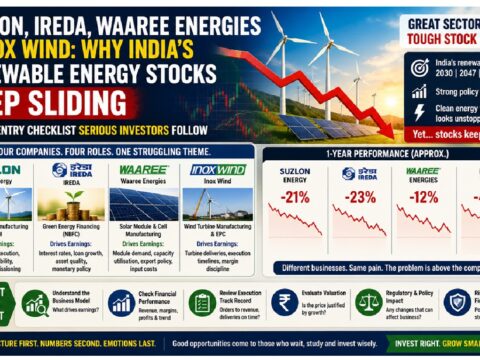
India’s renewable energy sector continues to attract significant investor attention despite ongoing market volatility and global geopolitical uncertainties. Among the most closely watched renewable energy companies is Suzlon Energy, a leading wind energy solutions provider that has undergone a remarkable transformation over the past few years.
Recently, Suzlon Energy’s stock witnessed a decline alongside weakness in the broader energy sector. However, industry analysts and brokerage firms continue to maintain a largely positive long-term outlook on the company. The key question now is whether Suzlon’s strategic expansion beyond wind energy can help sustain growth and create long-term value for investors.
This article explores the latest developments surrounding Suzlon Energy, the reasons behind the recent stock correction, the changing dynamics of India’s renewable energy market, and what investors can expect from Suzlon’s future growth strategy.
Why Did Suzlon Energy Shares Fall?
Suzlon Energy shares recently came under pressure as broader market sentiment weakened. The decline was not limited to Suzlon alone. The entire energy sector experienced selling pressure, leading to a notable drop in the Nifty Energy Index.
Global uncertainties have played a major role in creating volatility across financial markets. Ongoing geopolitical tensions and disruptions in global energy supply chains have increased investor caution. Rising concerns over crude oil availability, transportation routes, and energy security have further impacted market sentiment.
As a result, investors shifted toward a risk-averse approach, leading to profit booking in several sectors, including renewable energy stocks.
Despite the recent weakness, many analysts believe the decline reflects short-term market sentiment rather than any significant deterioration in Suzlon’s business fundamentals.
Broader Market Weakness Weighed on Energy Stocks
The overall stock market has been facing pressure after witnessing strong rallies over previous months. Major indices have corrected significantly from their highs, dragging several high-growth sectors lower.
Energy stocks were among the hardest hit as investors reassessed valuations and global economic risks. Since renewable energy companies are often viewed as growth-oriented investments, they tend to experience higher volatility during periods of uncertainty.
Suzlon Energy was no exception.
Although the company’s stock price declined, its fall largely mirrored the weakness seen across the broader energy segment rather than being driven by company-specific negative developments.
Suzlon Energy Stock Performance Remains Under Watch
Suzlon Energy continues to trade between its recent 52-week high and low levels, indicating that investors are waiting for the next major catalyst.
The stock has experienced periods of strong momentum followed by consolidation. Such behavior is common among companies operating in rapidly evolving industries where future growth expectations play a significant role in valuation.
Market participants are closely monitoring several factors, including:
- New project announcements
- Order book growth
- Renewable energy policy developments
- Expansion into energy storage solutions
- Financial performance improvements
- Institutional investor participation
Any positive developments in these areas could potentially reignite investor interest in the stock.
Declining Trading Volumes Signal Investor Caution
One notable trend observed in Suzlon Energy shares is the decline in trading volumes over recent sessions.
Lower trading volumes often indicate that large institutional investors are adopting a wait-and-watch approach. Rather than aggressively buying or selling shares, major market participants prefer to evaluate future developments before making substantial investment decisions.
This trend suggests that foreign institutional investors (FIIs) and domestic institutional investors (DIIs) may currently be assessing broader market conditions and the company’s long-term growth prospects.
When trading volumes remain below average levels, stock prices often move within a limited range until a significant trigger emerges.
For retail investors, this situation highlights the importance of patience and careful observation rather than making emotionally driven investment decisions.
Renewable Energy Sector Is Entering a New Phase
India’s renewable energy industry is undergoing a major transformation.
Historically, renewable energy projects focused primarily on either solar or wind power generation. Today, customers increasingly prefer integrated energy solutions that combine multiple technologies.
Large industrial consumers and utility companies now seek:
- Wind energy generation
- Solar energy generation
- Battery energy storage systems (BESS)
- Round-the-clock renewable power supply
- Hybrid renewable energy projects
This shift is changing the competitive landscape for renewable energy companies across the country.
As a result, businesses that rely solely on a single renewable energy source may face greater challenges in maintaining growth over the long term.
Why Brokerage Firms Are Watching Suzlon Closely
Several market experts have recently analyzed the future outlook for wind energy companies.
According to industry assessments, wind energy is expected to continue growing over the next few years. However, the pace of growth may moderate beyond the latter part of this decade as hybrid renewable projects gain greater market share.
The primary concern is that solar-plus-storage solutions are becoming increasingly attractive to customers due to their ability to provide consistent energy supply throughout the day.
This evolving trend could intensify competition within the renewable energy sector.
Despite these concerns, analysts remain largely positive about Suzlon Energy’s prospects because the company has already begun adapting to these changes.
Suzlon 2.0: The Company’s Next Growth Phase
Perhaps the most important development for Suzlon Energy is the launch of what many industry observers describe as “Suzlon 2.0.”
Rather than focusing exclusively on wind energy, Suzlon is actively expanding into broader renewable energy solutions.
The company’s future strategy includes:
Wind Energy Expansion
Wind power remains Suzlon’s core business and a major source of future growth. India continues to have significant untapped wind energy potential, particularly in states with favorable wind conditions.
Suzlon’s extensive industry experience and established market presence provide a competitive advantage in this segment.
Solar Energy Integration
Recognizing the increasing popularity of solar projects, Suzlon has begun positioning itself to participate in solar energy opportunities.
By combining solar and wind capabilities, the company can offer more comprehensive solutions to customers.
Battery Energy Storage Systems
Energy storage is emerging as one of the most important components of renewable energy infrastructure.
Battery storage systems help address one of the biggest challenges associated with renewable energy—intermittency.
Storage solutions allow surplus electricity generated during peak production periods to be stored and used later when demand increases.
Suzlon’s move into energy storage aligns with global renewable energy trends.
Hybrid Renewable Projects
The future of renewable energy increasingly lies in hybrid projects that combine multiple technologies.
Such projects can deliver more reliable and consistent power output, making them attractive for commercial and industrial customers.
Suzlon’s strategic shift toward integrated solutions demonstrates management’s awareness of changing market requirements.
Rising Electricity Demand Supports Long-Term Growth
One of the strongest arguments in favor of India’s renewable energy sector is the country’s rapidly growing electricity demand.
Several factors are contributing to this trend:
Increasing Urbanization
As cities expand and economic activity grows, electricity consumption continues to rise across residential, commercial, and industrial segments.
Growing Use of Cooling Equipment
Higher temperatures and longer heatwaves have significantly increased the adoption of:
- Air conditioners
- Coolers
- Refrigeration systems
- Industrial cooling equipment
These devices require substantial electricity consumption, boosting overall power demand.
Industrial Expansion
India’s manufacturing sector continues to expand under various government initiatives aimed at increasing domestic production.
Industrial growth directly translates into higher energy requirements.
Digital Infrastructure Growth
Data centers, telecommunications networks, and digital infrastructure projects consume large amounts of electricity.
As India’s digital economy expands, energy demand is expected to grow further.
Renewable Energy Demand Continues to Surge
The renewable energy sector benefits from both environmental and economic factors.
Governments, corporations, and consumers increasingly prioritize clean energy solutions due to:
- Carbon reduction goals
- Energy security concerns
- Falling renewable energy costs
- Sustainability commitments
- Regulatory support
India has established ambitious renewable energy targets, creating significant opportunities for industry participants.
Companies capable of delivering integrated renewable energy solutions may be particularly well positioned to benefit from these long-term trends.
Competitive Challenges Remain
While the long-term outlook remains encouraging, investors should also consider potential challenges.
These include:
Intensifying Competition
The renewable energy industry continues attracting new participants, increasing competitive pressures.
Technology Evolution
Rapid technological advancements require companies to continually invest in innovation and product development.
Policy Changes
Government policies play a critical role in renewable energy adoption. Any significant regulatory changes could impact project economics.
Execution Risks
Large-scale infrastructure projects involve operational, financial, and execution-related risks that companies must manage effectively.
Why Analysts Still See Potential in Suzlon Energy
Despite short-term concerns, many analysts continue to maintain a constructive outlook on Suzlon Energy.
Several factors support this view:
- Strong order book visibility
- Improving balance sheet strength
- Strategic diversification initiatives
- Growing renewable energy demand
- Expansion into energy storage
- Hybrid project opportunities
- Established industry reputation
Most importantly, Suzlon appears to be proactively adapting to market changes rather than reacting after disruptions occur.
This forward-looking approach may help the company remain competitive as the renewable energy landscape evolves.
The Future of Wind Energy in India
Although solar energy receives significant attention, wind power remains an important component of India’s clean energy strategy.
Wind energy offers several advantages:
- High generation efficiency in suitable locations
- Complementary production patterns relative to solar
- Large-scale deployment opportunities
- Reduced carbon emissions
When combined with solar and storage technologies, wind energy can contribute significantly to reliable renewable power generation.
Companies that successfully integrate these technologies may emerge as long-term industry leaders.
Investment Perspective: What Should Investors Watch?
Investors evaluating Suzlon Energy should closely monitor several key indicators:
Order Book Growth
A growing order pipeline typically indicates strong future revenue visibility.
Execution Performance
Successful project execution demonstrates operational strength and management capability.
Expansion into New Segments
Progress in solar, storage, and hybrid energy solutions will provide valuable insights into Suzlon’s diversification strategy.
Institutional Participation
Renewed interest from institutional investors could act as a positive signal for market confidence.
Financial Performance
Revenue growth, profitability improvements, and cash flow generation remain critical metrics.
Conclusion
Suzlon Energy’s recent stock decline appears to reflect broader market weakness rather than fundamental business deterioration. While concerns exist regarding the evolving competitive landscape in renewable energy, the company has already begun transforming itself through its Suzlon 2.0 strategy.
By expanding beyond traditional wind energy into solar power, battery energy storage systems, and integrated renewable energy solutions, Suzlon is positioning itself for the next phase of industry growth.
India’s rising electricity demand, increasing renewable energy adoption, and long-term sustainability goals continue to create substantial opportunities for clean energy companies. Although short-term volatility may persist, Suzlon’s strategic initiatives, strong industry presence, and focus on future-ready energy solutions provide reasons for optimism.
For investors, the coming years will likely depend on how effectively Suzlon executes its diversification plans and capitalizes on the rapidly evolving renewable energy ecosystem. If the company successfully delivers on its vision, Suzlon Energy could remain one of the most closely watched renewable energy growth stories in India.