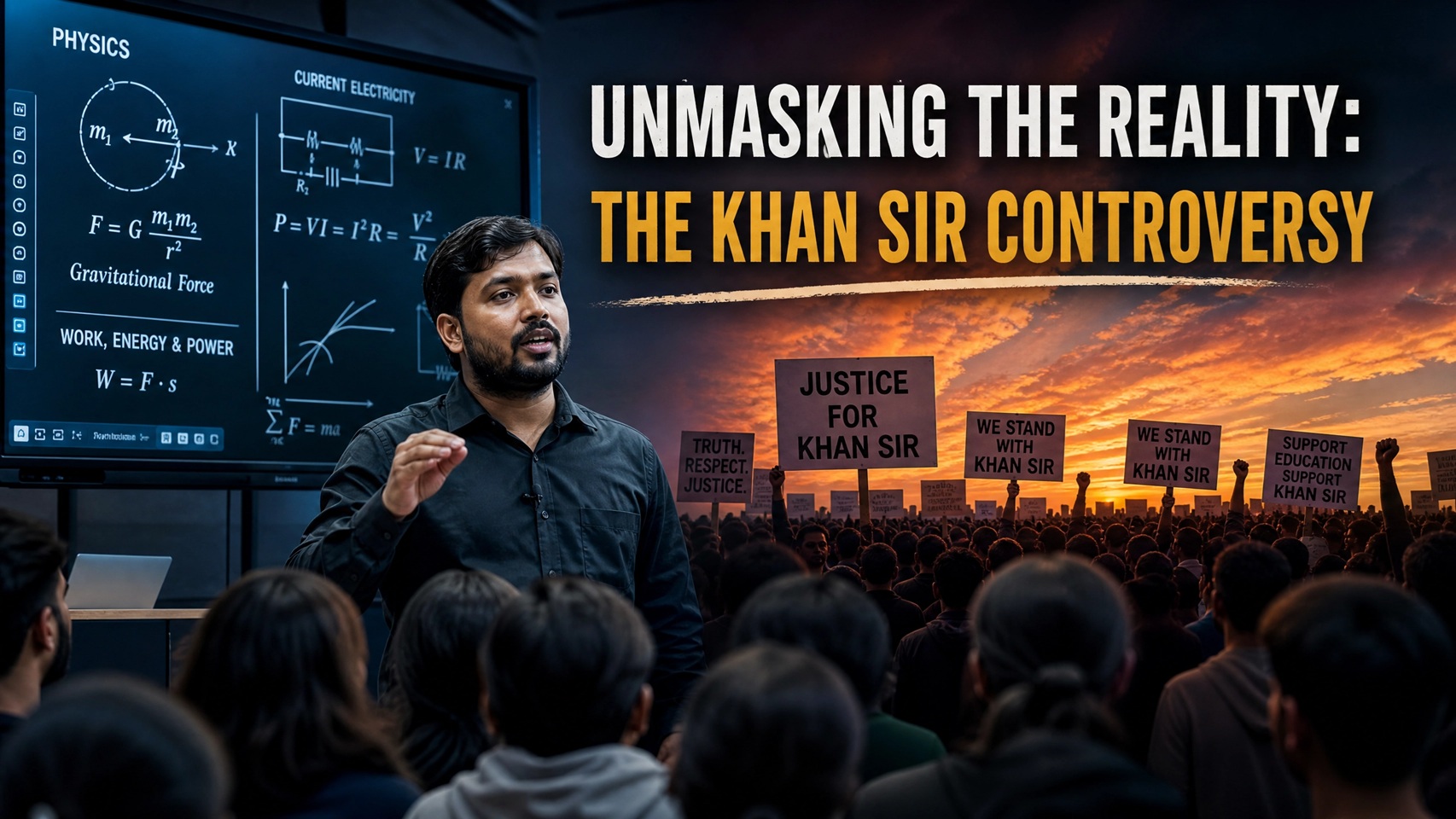
In the bustling educational hub of Musallapur-Hat, Patna, a name resonates with millions of aspiring government employees: Khan Sir. His coaching center, a beacon of hope for countless students from Bihar, became the epicenter of a shocking incident on June 2nd, 2026. This event, far from being an isolated act of violence, quickly unraveled into a complex narrative involving accusations, media trials, and a deeper struggle for educational justice in India. This article delves into the multifaceted reality of Khan Sir, examining the attack on his institution, the subsequent legal and media storm, and its intricate connection to the widespread NEET paper leak controversy that has gripped the nation.
The Night of June 2nd: An Attack on Education in Patna
The tranquility of Musallapur-Hat was shattered on the night of June 2nd, 2026. An organized assault targeted a prominent coaching center, with reports indicating 15-20 individuals pelting stones, destroying office property, and tearing down hoardings. The violence escalated to a point where a security guard sustained severe injuries, necessitating hospitalization. What made this incident particularly alarming was the identity of the target: the coaching center belonged to Khan Sir, one of India’s most celebrated educators, boasting a massive following of over 2.5 million subscribers on YouTube. The attack itself was a significant event, but the subsequent turn of events proved even more perplexing.
Attempt to Murder and the Arms Act, were levied against Khan Sir himself. The victim, in a bizarre twist, became the accused. This marked the beginning of a relentless campaign that sought to dismantle his reputation and influence.
The Swift Turn of Events: From Victim to Accused
The nine days following the attack on Khan Sir’s coaching center unfolded with alarming speed and precision. On June 5th, Khan Sir’s name appeared in the First Information Report (FIR), implicating him in serious offenses. Concurrently, the Bihar Fire Services initiated a fire safety audit of his coaching center, identifying numerous violations and issuing a repair notice within a week. This simultaneous legal and administrative pressure suggested a coordinated effort rather than mere coincidence.
Adding fuel to the fire, a segment of the media, often referred to as ‘Godi Media,’ launched a scathing attack. Khan Sir, once a celebrated figure, was suddenly rebranded as ‘Faizal Khan,’ with reports claiming he had absconded. News channels propagated stories of an ongoing operation to apprehend him, citing the Special Investigation Team (SIT) and suggesting imminent arrest. Some outlets went as far as labeling him a ‘mafia,’ alleging he had forcibly acquired coaching centers and amassed billions through illicit means. One particularly outlandish claim involved a village elder accusing him of land grabbing, while another interview asserted that Khan Sir had initially used the name Amit Singh and feigned religious affiliation to gain trust. This barrage of negative publicity culminated on June 7th, when news anchor Anjana Om Kashyap filed a defamation case against Khan Sir in the Delhi High Court.
The Real Story Behind the Headlines: Khan Sir’s Rise and Impact
To understand the intensity of the backlash, one must first appreciate Khan Sir’s meteoric rise and profound impact on Indian education. In 2019, he launched the Khan GS Research Centre on YouTube from a modest room, equipped only with a camera, a whiteboard, and an unwavering passion for teaching. His unique ‘Desi style,’ characterized by humor, relatable anecdotes, and simplified explanations of complex topics, quickly resonated with a vast audience. His channel rapidly grew, amassing an astounding 26 million subscribers, making him one of India’s most influential educators.
What truly set Khan Sir apart was his commitment to affordable education. In a country where coaching centers often charge exorbitant fees, he offered high-quality instruction at a fraction of the cost, making it accessible to economically disadvantaged students. This dedication extended beyond academics; he recently established a hospital in Patna, providing essential medical services at minimal charges—a blood test for ₹7 and an ECG for ₹25. For years, these philanthropic endeavors and his widespread popularity garnered positive media attention, with news channels frequently inviting him for interviews. During this period, no one questioned his name or religious identity; he was simply ‘Mr. Khan,’ a revered teacher, social worker, and founder making a tangible difference in the lives of India’s youth.
The Catalyst: The NEET Paper Leak Controversy
The sudden shift in narrative and the coordinated attacks against Khan Sir did not begin with the June 2nd incident. The true catalyst emerged a month earlier, on May 3rd, with the widespread leak of the NEET examination paper. This national-level entrance exam, taken by over 2.2 million students, was subsequently canceled on May 12th due to the leak. The incident ignited a firestorm of protest, with numerous educators and student bodies demanding accountability from the National Testing Agency (NTA) and the government.
Khan Sir emerged as one of the most vocal critics, fearlessly questioning the NTA’s integrity and the government’s handling of the crisis. He openly labeled the NTA as corrupt, highlighting the immense financial and emotional burden placed on students and their families. He articulated the plight of students traveling long distances, often from impoverished backgrounds, whose dreams were shattered by systemic failures. His impassioned pleas resonated deeply, leading to widespread calls for the Education Minister, Dharmendra Pradhan, to resign. When the government announced the potential use of the Air Force to transport exam papers, Khan Sir critically pointed out that the issue was not transportation but the leaks occurring at the printing stage, directly challenging official narratives.
Media’s Role: Shifting Blame and Suppressing Dissent
The media’s response to the NEET paper leak and Khan Sir’s activism revealed a troubling pattern. On May 29th, during a debate on the paper leak, anchor Anjana Om Kashyap, instead of scrutinizing the government, redirected blame towards
teachers, accusing them of being ‘YouTube star teachers’ who only cared about views and money. This blatant attempt to deflect criticism from the government and discredit educators sparked outrage among the teaching community and students alike. Many teachers, who had previously been platformed and promoted by these very channels, felt betrayed by the sudden U-turn.
Khan Sir, known for his direct and unfiltered communication, did not shy away from confronting this narrative. He publicly denounced Anjana Om Kashyap as a
seizure of three major coaching centers in Uttar Pradesh, whose teachers had joined student protests, further underscored this chilling message. The message was clear: dissent, and face suppression.
The Power of Social Media: A Double-Edged Sword
Khan Sir’s journey from a small room with a camera to a YouTube phenomenon with 26 million subscribers exemplifies the transformative power of social media as an equalizing platform. YouTube, in particular, offers an unprecedented opportunity for individuals to achieve widespread recognition and influence based solely on the quality of their content, irrespective of their financial backing or media connections. Khan Sir leveraged this platform to democratize education, making complex subjects accessible and affordable to millions.
However, the same platform that propelled him to stardom also became a battleground for character assassination. The rapid dissemination of information, both factual and fabricated, meant that accusations and negative narratives could spread like wildfire. The media’s attempts to rebrand him as ‘Faizal Khan’ and link him to various illicit activities highlight the vulnerability of public figures to targeted disinformation campaigns. This incident serves as a potent reminder of social media’s dual nature: a powerful tool for empowerment and a fertile ground for manipulation and defamation.
The Unfolding Crisis in Indian Education: Paper Leaks and Systemic Failures
The NEET paper leak, which served as the backdrop to the Khan Sir controversy, is not an isolated incident but a symptom of a deeper, systemic crisis plaguing India’s education sector. Paper leaks have become a recurring nightmare for students, undermining their trust in the examination system and jeopardizing their futures. The emotional and financial toll on students and their families is immense, with many taking loans or making significant sacrifices to pursue their educational aspirations. Khan Sir’s passionate advocacy for these students brought to light the human cost of these systemic failures.
The government’s response, often characterized by defensive posturing and attempts to deflect blame, has further eroded public confidence. The suggestion of using the Air Force for paper transport, while seemingly a logistical solution, failed to address the root cause of the leaks—corruption and security lapses at the printing and distribution stages. This incident underscores the urgent need for comprehensive reforms to ensure the integrity and fairness of India’s examination system.
The Politics of Division: Hindu-Muslim Angle and Deflection Tactics
One of the most disturbing aspects of the Khan Sir controversy was the deliberate attempt to inject a communal angle into the narrative. The media’s sudden emphasis on his alleged Muslim identity, rebranding him as ‘Faizal Khan,’ was a transparent tactic to polarize public opinion and discredit him. This strategy of using Hindu-Muslim division as a political weapon is not new in India, often employed to distract from pressing issues and consolidate power.
In this context, the communalization of the Khan Sir narrative served a dual purpose: to delegitimize his criticism of the NEET paper leak and to send a chilling message to other educators who might consider speaking out. By portraying him as an ‘outsider’ or a ‘threat,’ the aim was to isolate him and undermine his credibility. This tactic highlights the dangerous interplay between media, politics, and education, where genuine concerns about systemic failures can be overshadowed by divisive rhetoric.
The Student Movement: A Rising Tide of Dissent
Despite the attempts to suppress dissent and deflect attention, the student community in India is increasingly vocal and organized. The protests against the NEET paper leak, amplified by figures like Khan Sir, demonstrate a growing awareness and collective resolve to demand accountability and reform. The incident at Jantar Mantar, where a provocateur attempted to derail a student protest by making inflammatory statements, further illustrates the challenges faced by these movements.
However, the students’ ability to identify and expose such tactics, as seen in the unmasking of the provocateur, signifies a maturing and resilient movement. Their demands for justice, transparency, and a fair education system are gaining momentum, transcending regional and communal divides. The slogan
‘Educate, Agitate, Organize’ encapsulates their resolve, highlighting the fundamental tools for societal change. This slogan, deeply rooted in India’s social reform movements, serves as a powerful reminder that education is not merely about acquiring knowledge but also about fostering critical thinking and empowering individuals to challenge injustice. The act of agitation, or peaceful protest, becomes a necessary means to voice grievances and demand accountability from those in power. Finally, organization provides the collective strength required to sustain movements and effect lasting change. The targeting of educators and organizers, as witnessed in Khan Sir’s case and the seizure of coaching centers, underscores the establishment’s fear of an informed, united, and vocal youth.
The Broader Implications: A Warning to Dissenters
The Khan Sir episode transcends a mere local dispute; it serves as a chilling precedent for anyone daring to challenge the status quo in India. The coordinated efforts to discredit, legally harass, and publicly malign a popular educator who dared to speak truth to power send an unequivocal message: dissent comes at a cost. This incident highlights the vulnerability of independent voices in an increasingly polarized media landscape, where narratives can be manufactured and amplified to serve political agendas.
The swiftness with which Khan Sir transitioned from a celebrated figure to an accused criminal, coupled with the aggressive media campaign against him, suggests a well-oiled machinery designed to silence critical voices. The attempt to communalize his identity further reveals a cynical strategy to divide and conquer, diverting attention from substantive issues like educational reform and governmental accountability. This pattern of targeting influential figures who resonate with the youth is a dangerous trend, as it stifles intellectual discourse and discourages future generations from engaging in meaningful social and political activism.
The Role of Independent Investigation: A Call for Transparency
The conflicting accounts surrounding the June 2nd incident—Khan Sir’s claims of an attack and self-defense versus the police’s allegations of staged firing—underscore the urgent need for an independent and impartial investigation. The police’s shifting narrative, initially denying any firing and then implicating Khan Sir, raises serious questions about the integrity of the inquiry. In a climate where media narratives are often manipulated and judicial processes can be influenced, a transparent investigation becomes paramount to uncover the truth and restore public trust.
An independent probe would not only clarify the events of that night but also examine the broader context of the attacks, including potential links to Khan Sir’s activism against the NEET paper leak. Such an investigation would be crucial in determining whether the legal actions against him were legitimate or part of a concerted effort to silence a prominent critic. Without transparency and accountability, the perception of injustice will persist, further eroding faith in democratic institutions.
Reclaiming the Narrative: The Battle for Truth in the Digital Age
In the digital age, where information spreads rapidly and narratives can be easily constructed or deconstructed, the battle for truth is constant. Khan Sir’s experience exemplifies how a powerful individual, even with a massive online following, can become the target of a sophisticated disinformation campaign. The attempts to redefine his identity, question his motives, and attribute malicious intentions to his actions demonstrate the potency of narrative control.
However, the incident also highlights the resilience of an informed public. The ability of students and supporters to discern fabricated narratives, expose provocateurs, and rally behind their educators signifies a growing media literacy and a collective commitment to seeking truth. The widespread condemnation of the media’s biased reporting and the calls for accountability from both governmental bodies and news organizations indicate a societal demand for journalistic integrity and ethical reporting. Reclaiming the narrative, therefore, becomes a collective responsibility, requiring vigilance, critical thinking, and a steadfast commitment to factual accuracy.
The Future of Education and Activism in India
The Khan Sir controversy and the NEET paper leak are not isolated incidents but rather interconnected threads in the larger tapestry of India’s socio-political landscape. They reflect the ongoing struggle for equitable education, governmental accountability, and the right to dissent. The youth of India, increasingly aware of systemic injustices, are emerging as a powerful force for change, demanding a future free from corruption and characterized by opportunity.
The lessons learned from this episode are profound. They underscore the importance of independent media, the need for robust legal protections for activists, and the power of collective action. As India navigates its complex developmental trajectory, the voices of educators like Khan Sir and the aspirations of millions of students will continue to shape its future. The battle for educational justice and democratic values is far from over; it is an ongoing process that requires sustained engagement, unwavering commitment, and a collective belief in the power of truth and justice.
Conclusion: A Call for Unity and Vigilance
The saga surrounding Khan Sir, the attack on his coaching center, and the subsequent legal and media onslaught serves as a powerful microcosm of the challenges facing India today. It is a story of courage in the face of adversity, of the struggle for truth against manufactured narratives, and of the enduring power of education as a catalyst for social change. The incident, while deeply troubling, has also galvanized a generation of students and activists, reminding them of the importance of unity, vigilance, and the unwavering pursuit of justice.
As the nation moves forward, it is imperative that citizens, media, and governmental bodies reflect on the implications of such events. Protecting independent voices, ensuring transparency in public institutions, and fostering an environment where dissent is not only tolerated but also valued, are crucial for the health of any democracy. The legacy of Khan Sir’s struggle will undoubtedly resonate for years to come, serving as a beacon for those who dare to educate, agitate, and organize for a better future.
References:
•Dhruv Rathee – Reality of Khan Sir | Who is Really After Him? – This YouTube video forms the primary source material for this article, providing a detailed account of the events and analysis of the situation.n and Activism in India
The Khan Sir controversy and the NEET paper leak are not isolated incidents but rather interconnected threads in the larger tapestry of India’s socio-political landscape. They reflect the ongoing struggle for equitable education, governmental accountability, and the right to dissent. The youth of India, increasingly aware of systemic injustices, are emerging as a powerful force for change, demanding a future free from corruption and characterized by opportunity.
The lessons learned from this episode are profound. They underscore the importance of independent media, the need for robust legal protections for activists, and the power of collective action. As India navigates its complex developmental trajectory, the voices of educators like Khan Sir and the aspirations of millions of students will continue to shape its future. The battle for educational justice and democratic values is far from over; it is an ongoing process that requires sustained engagement, unwavering commitment, and a collective belief in the power of truth and justice.
The Enduring Legacy of Khan Sir: A Symbol of Resistance
Khan Sir, despite the concerted efforts to silence him, has emerged as an enduring symbol of resistance against systemic corruption and media manipulation. His unwavering commitment to providing affordable education and his fearless advocacy for students have cemented his place in the hearts of millions. The controversy surrounding him has not diminished his influence but rather amplified his message, drawing greater attention to the critical issues he champions. His story serves as an inspiration for other educators and activists, demonstrating that even in the face of immense pressure, the pursuit of truth and justice can prevail.
His journey also highlights the evolving role of educators in the 21st century. Beyond imparting knowledge, modern educators are increasingly becoming social commentators, advocates, and community leaders. They leverage digital platforms to reach wider audiences, challenge established narratives, and mobilize public opinion. This expanded role, while empowering, also exposes them to new forms of scrutiny and attack, as evidenced by Khan Sir’s experience. However, it also underscores the critical importance of their voice in shaping public discourse and driving social change.
Strengthening Democratic Institutions: A Path Forward
The events surrounding Khan Sir and the NEET paper leak underscore the urgent need to strengthen India’s democratic institutions. A robust democracy relies on a free and independent press, an impartial judiciary, and a government accountable to its citizens. When these pillars are weakened, the space for dissent shrinks, and the potential for injustice grows. The coordinated attacks on Khan Sir, the attempts to communalize his identity, and the efforts to suppress student protests are all symptoms of a system under strain.
To safeguard democratic values, it is imperative to foster a media environment that prioritizes truth and journalistic ethics over political agendas. Legal frameworks must protect activists and whistleblowers from harassment and intimidation. Furthermore, governmental bodies responsible for critical sectors like education must operate with transparency and integrity, ensuring that the aspirations of millions are not compromised by corruption or inefficiency. The collective demand for accountability, as demonstrated by the student movement, is a vital force in pushing for these necessary reforms.
The Global Context: Education, Activism, and Digital Disinformation
The challenges faced by Khan Sir and the Indian education system are not unique to India; they resonate with global trends in education, activism, and the spread of digital disinformation. Across the world, educators and activists are increasingly using digital platforms to mobilize communities and challenge established powers. Simultaneously, they face sophisticated campaigns of character assassination, legal harassment, and online abuse, often orchestrated by state or corporate actors.
This global context highlights the universal struggle for truth and justice in an increasingly interconnected world. The lessons from Khan Sir’s experience can inform strategies for protecting independent voices, combating disinformation, and strengthening democratic resilience in other nations. It underscores the importance of international solidarity among educators, activists, and civil society organizations in defending fundamental freedoms and promoting equitable access to education.
Conclusion: A Call for Unity and Vigilance
The saga surrounding Khan Sir, the attack on his coaching center, and the subsequent legal and media onslaught serves as a powerful microcosm of the challenges facing India today. It is a story of courage in the face of adversity, of the struggle for truth against manufactured narratives, and of the enduring power of education as a catalyst for social change. The incident, while deeply troubling, has also galvanized a generation of students and activists, reminding them of the importance of unity, vigilance, and the unwavering pursuit of justice.
As the nation moves forward, it is imperative that citizens, media, and governmental bodies reflect on the implications of such events. Protecting independent voices, ensuring transparency in public institutions, and fostering an environment where dissent is not only tolerated but also valued, are crucial for the health of any democracy. The legacy of Khan Sir’s struggle will undoubtedly resonate for years to come, serving as a beacon for those who dare to educate, agitate, and organize for a better future.