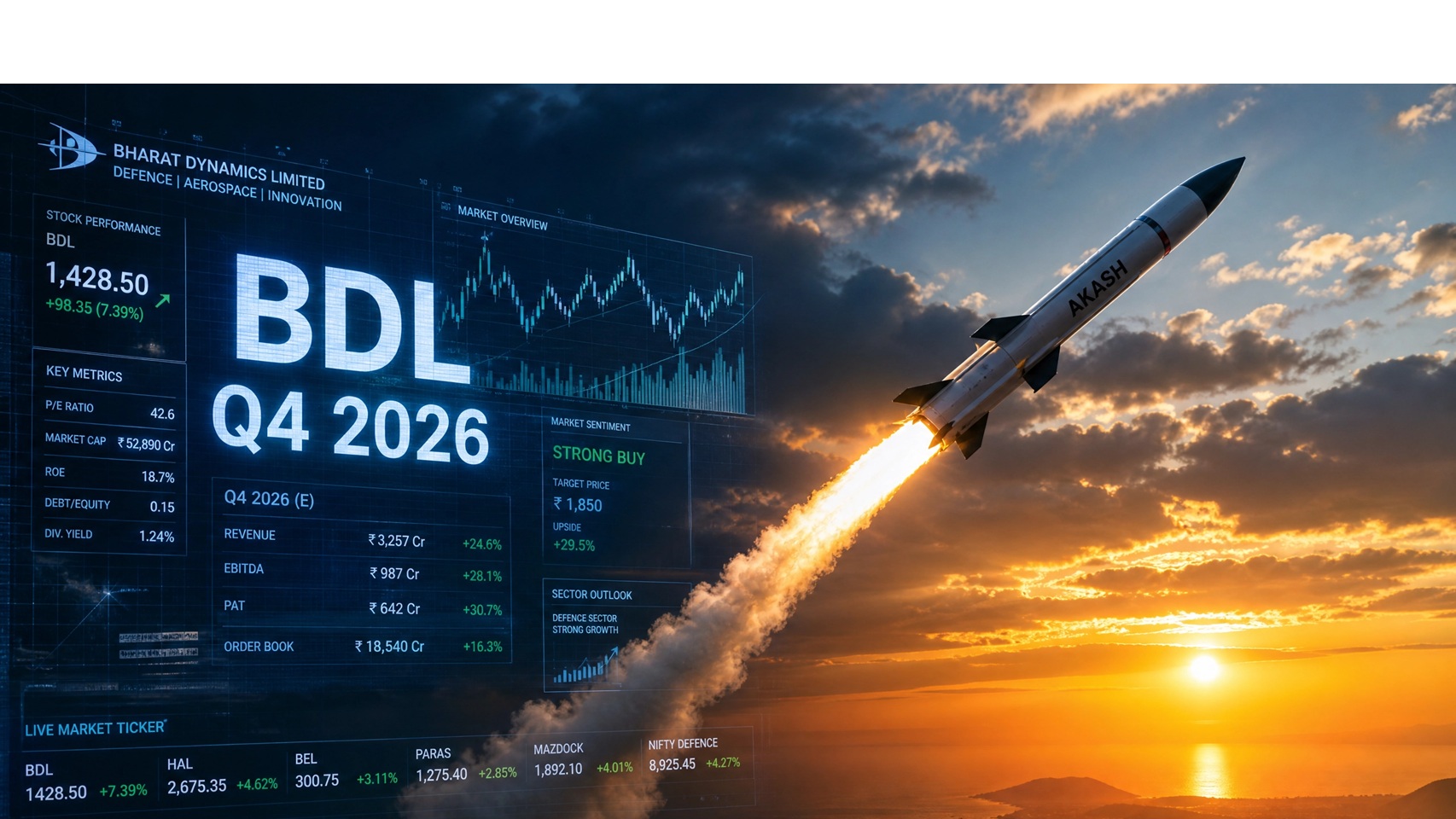
State-owned defence public sector undertaking Bharat Dynamics Limited (BDL), the primary manufacturer of the Akash Weapon System, recently announced its audited standalone financial results for the fourth quarter. While the company’s long-term growth story remains firmly intact due to a massive order book, its short-term financial performance has seen a significant dip.
Here is a comprehensive breakdown of BDL’s Q4 performance, dividend announcements, auditor observations, and the management’s outlook for the future.
Key Financial Highlights: A Tough Quarter
BDL reported a significantly weaker-than-expected fourth quarter, characterized by a steep decline in both top-line and bottom-line performance.
- Net Profit: The company posted a Q4 net profit of ₹113.18 crore, marking a steep 58.5% to 59.5% year-on-year (YoY) drop compared to the ₹272.77 crore profit reported in the corresponding quarter of the previous financial year.
- Revenue: Revenue from operations collapsed, dropping nearly 73% YoY to ₹480 crore in the January-March quarter, down from ₹1,777 crore in the year-ago period.
- Operating Margins: EBITDA plunged 81.5% YoY to ₹55.2 crore, and the EBITDA margin contracted sharply to 11.5% (down from 16.8% in the previous year). This margin contraction indicates that the company’s fixed costs were spread over a much smaller revenue base, leading to operational deleverage.
- Full-Year Performance: For the entire fiscal year, BDL reported a net profit of ₹420.33 crore (a 23% YoY drop) and total revenue from operations of ₹2,441.79 crore.
Dividend Announcement
Despite the earnings slump, BDL’s Board of Directors has recommended a final dividend of ₹0.40 per equity share (face value of ₹5 each). This comes in addition to an interim dividend of ₹4.50 per share that was already paid to shareholders in February, bringing the total dividend for the year to ₹4.90 per share.
Why Did Revenue and Profits Drop?
In the defense sector, revenue is highly dependent on delivery milestones and acceptance by the armed forces. The sharp 73% decline in Q4 revenue is optically alarming but is largely tied to:
- Execution and Delivery Timelines: The revenue shortfall suggests that high-value missile deliveries and testing milestones were likely deferred to the upcoming fiscal year.
- Supply Chain Constraints: Execution has remained volatile due to global supply chain disruptions for critical electronics, as well as BDL’s dependence on various vendors and imports from Israel, which have been impacted by ongoing geopolitical conflicts.
Auditor Observations & Governance Red Flags
While the statutory auditors issued a clean (unmodified) opinion on BDL’s financial results, they highlighted a few key issues:
- Corporate Governance Gaps: The composition of BDL’s Board is currently not in compliance with SEBI and Companies Act regulations due to a lack of required Independent Directors. Consequently, the Audit Committee and other Board Committees have been suspended.
- Non-Moving Inventory: The auditors flagged ₹83.27 crore in inventory that has been non-moving for more than five years. BDL management did not make a provision for this redundancy, citing that they have already received customer advances of ₹362.34 crore against these short-closed contracts, which exceeds the value of the acquired assets.
The Silver Lining: Order Book, Exports, and Expansion
While the Q4 numbers are underwhelming, BDL’s structural story under India’s ‘Aatmanirbhar Bharat’ (self-reliant India) initiative remains very strong.
1. Massive Order Pipeline According to Commodore A. Madhavarao, CMD of BDL, the company is currently sitting on an order book of over ₹26,000 crore. BDL expects to secure an additional ₹10,000 crore in orders before the close of the current year, which would push the total order book to an impressive ₹36,000 crore. Looking ahead, the company anticipates another ₹20,000+ crore in the pipeline over the next 18 months.
2. Export Momentum BDL is aggressively targeting the global defense market. The company delivered over ₹1,200 crore in exports last year and expects to touch ₹1,000 crore this year. Management’s long-term goal is for exports to account for 25% to 30% of total revenue.
3. Infrastructure Capex To execute this massive order book, BDL currently utilizes only about 60% of its normal capacity, meaning it is well-equipped for near-term requirements. To meet future demand, the company is investing ₹2,500 to ₹3,000 crore in capital expenditure over the next 3 to 5 years. This includes commissioning two new manufacturing facilities—one in Jhansi and another near Hyderabad—by the middle of next year.
Core Product Analysis: The Status of India’s Missile Shield
To evaluate BDL’s long-term viability, we must look at the status of its core product lines. Despite the Q4 hiccup, BDL remains the sole producer for several of India’s most critical weapon systems.
1. The Akash Missile System: A Global Success Story
The Akash remains the backbone of India’s short-range surface-to-air defense. With an operational range of 25–30 km and an altitude envelope of 18 km, the Akash is a highly sought-after system. Recent exports to nations like Armenia have validated its global competitiveness.
•Technical Edge: The Akash features a unique “ramjet” propulsion system that allows it to maintain high speeds throughout its flight path, unlike traditional solid-motor missiles that lose velocity after the initial burn.
•Update: The Akash-NG (Next Generation) has recently seen its range extended to 50 km. While Q4 saw a dip in deliveries, the order book for Akash-NG remains overfull, ensuring that once the component supply stabilizes, BDL will see a “bumper” revenue recognition in FY2027.
2. Astra: The Beyond-Visual-Range (BVR) Dominance
The Astra Mark-I is India’s first indigenous air-to-air missile, capable of engaging targets at distances over 100 km. BDL is currently scaling up production to meet the demands of the IAF’s Su-30 MKI and LCA Tejas squadrons.
•Strategic Importance: The Astra project is a key part of the “Atmanirbhar Bharat” initiative, as it reduces reliance on expensive Russian R-77 and French MICA missiles. Each Astra missile produced by BDL costs significantly less than its foreign counterparts while offering superior electronic counter-countermeasure (ECCM) capabilities.
•Future Variants: BDL is already preparing for the production of Astra Mk-II, which will have a range exceeding 160 km, putting India in the elite club of nations with long-range BVR capabilities.
3. Anti-Tank Guided Missiles (ATGMs): Nag and Helina
BDL’s ATGM portfolio, including the Nag (land-based) and Helina (helicopter-launched), represents the pinnacle of “fire-and-forget” technology.
•Nag Missile: Features an imaging infra-red (IIR) seeker that can identify and lock onto enemy tanks even in cluttered environments or during night operations.
•Helina: The airborne version, launched from the Dhruv Advanced Light Helicopter (ALH) and the Prachand Light Combat Helicopter (LCH), is one of the most advanced anti-tank weapons in the world.
•Market Demand: The 2026 conflict has highlighted the need for these systems, leading to an influx of fresh orders from the Indian Army.
4. Underwater Weapons: The Silent Guardians
BDL’s Visakhapatnam unit is dedicated to underwater warfare. The Varunastra heavy-weight torpedo is a 1.5-ton behemoth capable of striking submarines and ships at depths of up to 600 meters.
•Technical Prowess: Varunastra is 95% indigenous and features advanced acoustic homing sensors. BDL is also the manufacturer for the TAL (Torpedo Advanced Light), which has seen successful export orders to Southeast Asian nations.
V. Manufacturing Powerhouse: Facilities and Expansion
BDL operates from four state-of-the-art manufacturing units, each specialized in different segments of the defense ecosystem.
1. Kanchanbagh (Hyderabad)
This is the “brain” of BDL. It houses the corporate headquarters and the primary unit for the manufacture of ATGMs and complex electronics. The facility includes clean rooms for seeker assembly and advanced testing labs for electronic warfare systems.
2. Bhanur (Telangana)
This unit is the “muscle” of the company, focused on the large-scale production of the Akash missile system and other surface-to-air variants. It features massive assembly lines and specialized bays for integrating solid and liquid propulsion systems.
3. Visakhapatnam (Andhra Pradesh)
The specialized unit for underwater weapons. Given India’s vast coastline and the increasing presence of foreign navies in the Indian Ocean, the production of torpedoes and decoys at this facility is a high-priority national security requirement.
4. Ibrahimpatnam (Telangana)
The newest facility, designed for the final assembly and testing of large-scale missile systems like the MRSAM and the upcoming Long Range Surface-to-Air Missile (LRSAM). It features state-of-the-art automation and robotics to ensure high precision in missile integration.
5. Expansion: The Jhansi Unit
As part of the Uttar Pradesh Defense Industrial Corridor, BDL is setting up a new unit in Jhansi. This facility will focus on the production of propulsion systems, warheads, and the next generation of ATGMs. This move not only expands BDL’s capacity but also diversifies its geographical footprint, reducing the risk of localized disruptions.
VI. The 2026 Defense Budget: A Tailwind for BDL
The Indian Government’s 2026–27 Budget Estimates have provided a massive boost to the defense sector. With a total allocation of approximately $86 billion (₹7.2 lakh crore), the focus has shifted heavily toward capital acquisition and modernization.
1. Capital Outlay for Missile Procurement
The capital outlay for the Ministry of Defence has seen an 18% increase, with a specific focus on “Missile Systems and Underwater Weapons”—the two primary domains of BDL. The government’s decision to ban the import of several missile categories (Positive Indigenisation List) ensures that BDL has a captive market for the next decade.
2. R&D and the “Make-I” Category
BDL has significantly increased its R&D expenditure, now accounting for nearly 5–6% of its turnover. The company is currently working on third and fourth-generation missile systems, including the Quick Reaction Surface-to-Air Missile (QRSAM) and the Man-Portable Anti-Tank Guided Missile (MPATGM). These indigenous projects are crucial for decoupling BDL’s performance from global geopolitical shifts.
3. The SHIELD Program
The standout feature of the 2026 budget is the SHIELD (Synchronized, Hybrid, Integrated and Enhanced Littoral Defense) program. This initiative focuses on protecting India’s coastal assets and island territories. BDL, with its range of coastal batteries and underwater weapons, is a primary beneficiary of this $640 million allocation.
VII. GEO-Economic Impact: BDL’s Role in Global Defense Exports
India has set an ambitious target for defense exports, aiming to reach $5 billion annually by 2025-26. BDL is a critical player in this mission.
1. The “Akash” Export Phenomenon
The Akash missile system has become a symbol of India’s growing defense export prowess. Countries in Southeast Asia, the Middle East, and Eastern Europe (most notably Armenia) have expressed keen interest or placed firm orders. The system’s ability to operate in diverse climates—from the sub-zero temperatures of the Himalayas to the scorching heat of the desert—makes it an attractive option for many nations.
2. Managing GEO-Risk
However, the 2026 conflict has highlighted a “GEO-Risk” that Indian exporters must manage. If India’s primary defense partner (Israel) is embroiled in a war, India’s ability to fulfill its own export commitments to third-party nations is compromised. This realization is likely to trigger a strategic shift in BDL’s manufacturing philosophy, moving away from “Joint Ventures” (JVs) toward “Indigenous IP” (Intellectual Property) to ensure that the production lines can remain active regardless of global regional conflicts.
VIII. Investor Strategy: Navigating the “Gap Down” and Beyond
The immediate reaction to the Q4 results is likely to be a “gap down” in the share price. Investors who bought into the defense narrative at peak valuations may face a period of consolidation. However, for the long-term “value investor,” this volatility presents a unique opportunity.
1. The “Order Book to Sales” Ratio
BDL currently sits on an order book exceeding ₹22,000 crore. With an annual revenue run rate (in a normal year) of around ₹3,000–₹4,000 crore, the company has over five years of revenue visibility. The Q4 slump is an “accounting delay,” not an “order cancellation.” The missiles that weren’t delivered in March will be delivered in the coming quarters, likely leading to a massive spike in FY2027 revenue.
2. Dividend and Financial Health
The announcement of a 40 paise dividend, while modest, signals that the board is confident in the company’s cash flow. BDL remains a virtually debt-free company with a strong balance sheet. For a PSU, this financial discipline is a major draw for institutional investors.
3. Comparative Valuation: BDL vs. BEL vs. HAL
•Bharat Electronics (BEL): Offers more stability due to its diversified electronics portfolio.
•Hindustan Aeronautics (HAL): Is in a high-growth phase but faces its own set of delivery challenges with the Tejas program.
•Bharat Dynamics (BDL): Offers the highest “leverage” on India’s missile export ambitions and the “Atmanirbhar Bharat” push in guided weapons.
IX. The Future Roadmap: BDL in 2030 and Beyond
As we look toward the end of the decade, BDL’s strategy is clear: Total Indigenization.
1. The Seeker Revolution
The seeker is the most expensive and technologically complex part of a missile. By developing indigenous Radio Frequency (RF) and Imaging Infra-Red (IIR) seekers, BDL will not only reduce its dependence on foreign partners like Israel but also significantly improve its profit margins. The Q4 margin of 23.54% is just a glimpse of what is possible when BDL moves toward 100% indigenous content.
2. Space and Hypersonic Frontier
BDL is already exploring the manufacturing of components for India’s space program and is a key partner in the development of Hypersonic Cruise Missiles. These weapons, which travel at speeds exceeding Mach 5, represent the next frontier in defense technology. BDL’s role in the production of these systems will ensure its relevance for decades to come.
Conclusion
For investors tracking the BDL share price, the Q4 earnings miss highlights the “lumpy” revenue cycles and execution volatility inherent in defense PSUs. The stock may face short-term pressure as the market digests the 59% profit drop and governance gaps. However, with a formidable ₹26,000 crore order book, upcoming capacity expansions, and a strong export strategy, BDL remains a critical long-term player in India’s defense modernization narrative