India’s Union Budget 2026-27, presented by Finance Minister Nirmala Sitharaman on February 1, 2026, marks a significant milestone in the nation’s economic journey. With total expenditure pegged at ₹53.5 lakh crore and strategic allocations across infrastructure, manufacturing, and social sectors, this budget aims to accelerate India’s growth trajectory while maintaining fiscal discipline. This comprehensive analysis breaks down every critical aspect of the budget and its impact on India’s economy, markets, and citizens.
Understanding India’s Budget 2026-27: The Foundation of Economic Planning
The Union Budget operates on the same principle as household finances but at a national scale. Just as families calculate expected income and expenses to determine savings or borrowing needs, the government estimates revenue and expenditure to chart the country’s financial course. For 2026-27, India projects non-debt receipts of ₹36.5 lakh crore against total expenditure of ₹53.5 lakh crore, resulting in a fiscal deficit that requires careful management.
Key Macroeconomic Indicators: Fiscal Deficit and Debt Management
Fiscal Deficit Analysis
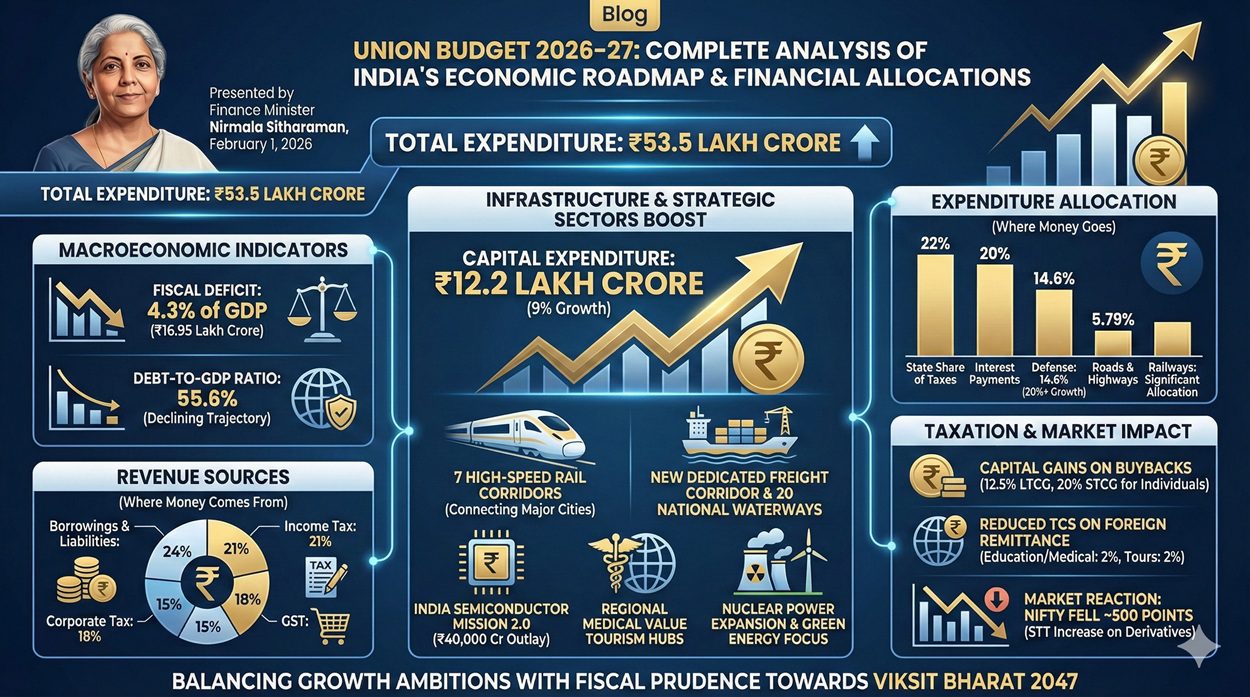
India’s fiscal deficit represents the gap between government expenditure and revenue, excluding borrowings. For the financial year 2025-26 (Revised Estimate), the fiscal deficit stands at approximately ₹15.5 lakh crore, translating to 4.4% of GDP. Looking ahead to 2026-27, the budgeted estimate projects a fiscal deficit of ₹16.95 lakh crore, representing 4.3% of GDP.
This gradual reduction demonstrates the government’s commitment to fiscal consolidation without compromising growth or essential welfare spending. Lower fiscal deficit percentages signal stronger economic health and better debt management capacity. The government has consistently delivered on fiscal commitments, having successfully met the target of reducing fiscal deficit below 4.5% of GDP by 2025-26, as promised in FY 2021-22.
Debt-to-GDP Ratio: India’s Financial Strength
The debt-to-GDP ratio serves as a crucial indicator of a nation’s ability to service its debt obligations. For 2025-26 (Revised Estimate), India’s debt-to-GDP ratio stands at 56.1%, with projections showing improvement to 55.6% in 2026-27. This declining trajectory carries significant implications for India’s economic future.
A lower debt-to-GDP ratio enhances international confidence in India’s creditworthiness, potentially enabling the country to secure loans at more favorable interest rates. When global lenders and institutions observe a nation’s GDP growing faster than its debt accumulation, they perceive reduced default risk. This improved financial position gradually frees up resources for priority sector expenditure by reducing interest payment obligations, currently consuming approximately 20% of total government outflow—the second-highest expenditure category after state tax shares.
Revenue Sources and Expenditure Distribution: Follow the Money
Where Does India’s Revenue Come From?
Understanding government revenue sources provides insight into the economy’s structure. Out of every ₹100 received by the government:
Primary Revenue Streams:
- Borrowings and other liabilities: ₹24 (24%)
- Income tax from individuals: ₹21 (21%)
- Corporate tax: ₹18 (18%)
- Goods and Services Tax (GST): ₹15 (15%)
Individual taxpayers contribute more to government coffers than corporations, highlighting the critical role of salaried and self-employed professionals in funding national development. This revenue distribution underscores why taxation policies affecting middle-class citizens generate significant public debate.
Major Expenditure Categories: Where Does the Money Go?
The budget allocates resources across various ministries and sectors based on national priorities:
Top Expenditure Areas:
- State share of taxes: 22% (funds transferred to state governments)
- Interest payments: 20% (servicing existing debt)
- Defense: 14.6%
- Roads, transport, and highways: 5.79%
- Railways: Significant allocation for infrastructure modernization
- Agriculture and farmers’ welfare: Supporting rural economy
- Education: Building human capital
- Health and family welfare: Strengthening healthcare infrastructure
The substantial interest payment burden (20% of total expenditure) emphasizes the importance of maintaining fiscal discipline and reducing the debt-to-GDP ratio. As this ratio improves, funds currently allocated for interest payments can be redirected toward development initiatives.
Infrastructure Development: Building the Foundation for Growth
Massive Capital Expenditure Boost
Infrastructure receives the most significant push in Budget 2026-27, with capital expenditure (capex) allocation increasing to ₹12.2 lakh crore, up from ₹11.1 lakh crore in the previous year. This represents approximately 9% growth and continues the government’s infrastructure-led development strategy that has seen capex multiply from ₹2 lakh crore in 2014-15 to the current allocation.
Higher infrastructure spending creates a multiplier effect across the economy, generating employment, boosting demand for construction materials, and improving connectivity that facilitates trade and commerce. The stock market initially responded positively to this announcement, recognizing infrastructure development as a growth catalyst, though market sentiment later shifted due to taxation concerns.
Major Infrastructure Initiatives
Dedicated Freight Corridors
The budget announces a new dedicated freight corridor connecting Dankuni in the east to Surat in the west. This strategic corridor will significantly reduce logistics costs and transit times for goods movement, particularly benefiting manufacturing clusters along this route. Efficient freight transportation remains critical for India’s competitiveness in global trade.
National Waterways Expansion
Twenty new national waterways will be operationalized over the next five years, connecting mineral-rich areas, industrial centers, and ports. This initiative addresses the current underutilization of inland water transport, which accounts for only 6% of cargo movement compared to potential capacity. The government targets increasing this share to 12% by 2047 through coastal cargo promotion schemes.
States like Kerala, with abundant mineral resources, stand to benefit significantly from improved waterway connectivity, enabling cost-effective transportation of heavy minerals and raw materials to industrial hubs and ports.
High-Speed Rail Corridors
Seven high-speed rail corridors have been announced, connecting major economic centers:
- Mumbai to Pune
- Pune to Hyderabad
- Hyderabad to Bangalore
- Hyderabad to Chennai
- Chennai to Bangalore
- Delhi to Varanasi
- Varanasi to Siliguri
These corridors aim to connect financial hubs, technology centers, manufacturing clusters, and emerging cities, enabling faster, cleaner, and more efficient mobility. High-speed rail will reduce travel time between major metros, facilitating business connections and regional integration.
City Economic Regions (CERs)
The budget allocates ₹5,000 crore per City Economic Region over five years to develop Tier-II and Tier-III cities with populations exceeding 5 lakh as specialized growth engines. This challenge-based, reform-linked financing model encourages urban local bodies to implement governance reforms while accessing development funds.
The focus on smaller cities addresses regional imbalances and prevents excessive pressure on major metropolitan areas. As India’s urbanization accelerates, developing intermediate cities becomes crucial for balanced, sustainable growth.
Infrastructure Risk Guarantee Fund
A new Infrastructure Risk Guarantee Fund will provide prudentially calibrated partial credit guarantees to lenders, reducing risks during construction and early project phases. This mechanism addresses a major concern of private developers and financial institutions, potentially crowding in private capital to complement public investment.
Sectoral Analysis: Ministry-wise Budget Allocations
Top Ministry Allocations
Ministry of Finance: 37%
The Ministry of Finance receives the largest allocation, primarily due to interest payment obligations on existing debt. This highlights the fiscal burden carried forward from previous borrowings and reinforces the need for debt reduction strategies.
Ministry of Defense: 14.6%
Defense spending has surged by more than 20% in response to evolving geopolitical tensions and border security requirements. This substantial increase reflects India’s commitment to military modernization, indigenous defense manufacturing, and strategic preparedness.
Ministry of Roads, Transport, and Highways: 5.79%
Continued emphasis on road infrastructure supports connectivity improvements across the country, reducing logistics costs and enabling faster movement of goods and people.
Ministries with Highest Growth in Allocations
Ministry of Power: 37.3% growth
The power sector receives the highest percentage increase in budgetary allocation, reflecting India’s energy transition priorities and the need to expand electricity generation capacity to support industrial growth and rising consumption.
Ministry of Fisheries, Animal Husbandry, and Dairy: 18.18% growth
This significant increase acknowledges the sector’s role in rural livelihoods, nutrition security, and export potential. India’s aquaculture and dairy industries have substantial growth opportunities.
Ministry of Railways
Railways receive enhanced funding to support high-speed corridor development, infrastructure modernization, and capacity expansion. The transformation of Indian Railways into a world-class transportation system remains a government priority.
Emerging Sectors and Strategic Initiatives
Medical Tourism: Building Regional Healthcare Hubs
The budget proposes establishing five regional medical value tourism hubs in partnership with the private sector. These integrated healthcare complexes will combine advanced medical and surgical services, medical education and research institutions, diagnostics, post-treatment care, rehabilitation infrastructure, and dedicated facilitation centers for international patients.
India’s competitive advantage in healthcare—skilled medical professionals, advanced facilities, and cost-effectiveness compared to Western countries—positions the nation as an attractive destination for medical tourists. The budget allocates resources to train 1.5 lakh caregivers specifically for this sector, creating employment while enhancing service quality.
Medical tourism can generate significant foreign exchange earnings while also improving healthcare infrastructure that serves domestic patients. Successful implementation could position India as a global healthcare destination, competing with Thailand, Singapore, and other established players.
Semiconductor Manufacturing: ISM 2.0
The India Semiconductor Mission 2.0 (ISM 2.0) receives an outlay of ₹40,000 crore for electronic components manufacturing. This initiative aims to move India beyond being merely an assembly hub to becoming a significant player in high-end component manufacturing and intellectual property ownership.
The global semiconductor shortage experienced in recent years exposed supply chain vulnerabilities across industries, from automobiles to consumer electronics. By developing domestic semiconductor manufacturing capabilities, India reduces dependence on foreign suppliers while creating high-value employment and strengthening technological sovereignty.
The budget also doubles the Electronics Components Manufacturing Scheme allocation, signaling serious commitment to building a comprehensive semiconductor ecosystem encompassing chip design, fabrication, assembly, and testing.
Atomic Energy: Nuclear Power Expansion
Recognizing nuclear energy’s role in India’s clean energy transition, the Finance Minister proposed extending basic customs duty exemption on imports of goods required for nuclear power projects until 2035. This exemption now applies to all nuclear plants irrespective of capacity, removing previous restrictions.
Nuclear power provides baseload electricity without carbon emissions, complementing renewable energy sources like solar and wind that face intermittency challenges. The duty exemptions reduce project costs, potentially accelerating nuclear plant construction timelines and helping India meet growing electricity demand while pursuing climate commitments.
Biopharma Manufacturing: Global Hub Ambitions
The Biopharma SHAKTI scheme receives an outlay exceeding ₹10,000 crore over five years to develop India as a global biopharma manufacturing hub. This initiative focuses on ecosystem-led capacity creation for biologics and biosimilars production.
Biologics represent the fastest-growing segment of the pharmaceutical industry, including monoclonal antibodies, vaccines, and gene therapies. India’s existing pharmaceutical manufacturing prowess, skilled workforce, and cost advantages position the country well for capturing a larger share of the global biopharma market.
Successful implementation could transform India from a generic drug producer to a high-value biopharmaceutical manufacturer, generating premium export revenues and establishing India as a critical node in global healthcare supply chains.
Container Manufacturing: Supply Chain Independence
A dedicated container manufacturing scheme with a budgetary allocation of ₹10,000 crore over five years aims to create a globally competitive container manufacturing ecosystem. Currently, India imports a significant portion of shipping containers, creating supply chain vulnerabilities and foreign exchange outflows.
Developing domestic container manufacturing capabilities addresses this gap while creating employment in manufacturing and related sectors. Self-sufficiency in container production supports India’s export ambitions and reduces logistics costs for domestic manufacturers.
MSME Support: Nurturing Future Champions
Micro, Small, and Medium Enterprises (MSMEs) represent a critical growth engine for the Indian economy, contributing significantly to employment generation and industrial output. The budget allocates ₹10,000 crore for a dedicated SME Growth Fund to incentivize enterprise development, with an additional ₹2,000 crore supporting microenterprises through the Self-Reliant India Fund.
MSMEs often struggle with access to finance, technology adoption, and market linkages. Targeted financial support helps these enterprises scale operations, adopt modern technologies, and compete effectively in domestic and international markets. The budget’s emphasis on MSMEs recognizes them as “future champions” capable of driving innovation and economic dynamism.
Taxation Changes: Impact on Individuals and Markets
Capital Gains Treatment for Buybacks
A significant change affects how share buybacks are taxed. Previously, gains from share buybacks were treated as dividend income and taxed according to individual income tax slab rates, potentially reaching 30% for high-income earners. Under the new provisions, buyback gains will be treated as capital gains.
For Individual Shareholders:
- Long-Term Capital Gains (LTCG): 12.5% tax rate
- Short-Term Capital Gains (STCG): 20% tax rate
This change benefits high-income investors who previously paid 30% on buyback proceeds. However, promoters participating in buybacks face different rates:
- Domestic company promoters: 22%
- Other promoters: 30%
The differential treatment aims to prevent tax arbitrage while providing relief to regular investors participating in corporate buyback programs.
Tax Collected at Source (TCS) Reductions
The budget significantly reduces TCS rates on foreign remittances under the Liberalized Remittance Scheme (LRS), particularly benefiting education and healthcare payments abroad.
Previous vs. New TCS Rates:
Education expenses:
- Earlier: 5%
- New: 2%
Medical expenses:
- Earlier: 5%
- New: 2%
Overseas tour packages:
- Earlier: 20%
- New: 2%
These reductions substantially reduce upfront cash outflow requirements. For example, booking a foreign tour package worth ₹20 lakh previously required ₹4 lakh additional TCS payment (20%). Under new rates, this drops to just ₹40,000 (2%), though the amount remains claimable as a refund when filing income tax returns.
While the TCS amount can be claimed back, timing differences matter. Families sending children abroad for education or undertaking medical treatment often face liquidity constraints. Lower TCS rates provide immediate cash flow relief, even though the eventual tax liability remains unchanged.
Tax Holiday for Data Center Services
Foreign companies providing cloud services using data center infrastructure in India receive a tax holiday extending until 2047. This incentive aims to position India as a global data center and digital services hub, attracting foreign investment in critical digital infrastructure.
The exemption applies specifically to foreign companies providing services to global markets (outside India) while procuring data services from Indian data centers. This structure encourages foreign firms to establish or expand operations in India, creating employment and technology transfer opportunities without directly competing with domestic service providers in the Indian market.
Market Reaction: Why Did Stock Markets Fall?
Despite positive announcements on infrastructure spending and sectoral initiatives, the Nifty index fell approximately 500 points on budget day. The primary trigger was increased Securities Transaction Tax (STT) on derivatives trading.
STT Rate Increases
Futures Trading:
- Current rate: 0.02%
- New rate: 0.05%
Options Premium:
- Current rate: 0.10%
- New rate: 0.15%
These changes, effective from April 1, 2026, disproportionately impact active traders and investors who frequently trade in futures and options segments. While STT applies per transaction, frequent traders executing multiple trades daily face substantially higher costs.
Impact on Broking and Exchange Stocks
Market intermediaries and exchanges experienced sharp declines:
- BSE (Bombay Stock Exchange): fell 7.8%
- MCX (Multi Commodity Exchange): fell 11.6%
- Groww and other broking platforms: fell approximately 5%
These companies derive revenues from trading volumes and transaction processing. Higher STT potentially reduces trading activity as costs increase, directly impacting broker and exchange revenues.
Market Sentiment Analysis
The negative market reaction reflects investor concerns about additional tax burdens. Traders and investors already pay capital gains tax, dividend distribution tax, and existing STT. The increase, while seemingly modest, amplifies costs for high-frequency traders and active investors.
However, market reactions immediately following budget announcements often prove short-lived. Historical patterns suggest markets stabilize once investors digest the complete budget implications and focus on fundamental growth drivers like infrastructure spending, sectoral initiatives, and earnings growth prospects.
Budget 2026-27: Long-term Implications for India’s Economy
Fiscal Consolidation Success
The budget demonstrates continued fiscal discipline while maintaining growth-supporting expenditure. Achieving fiscal deficit targets consecutively builds credibility with credit rating agencies, potentially leading to sovereign rating upgrades. Higher credit ratings reduce borrowing costs for both government and private sector entities, creating a virtuous cycle of lower interest rates and improved investment climate.
Infrastructure-led Growth Strategy
The sustained emphasis on infrastructure development—with capex increasing from ₹2 lakh crore in 2014-15 to ₹12.2 lakh crore in 2026-27—reflects long-term commitment to building foundational assets. Quality infrastructure reduces business costs, improves productivity, and enhances quality of life, creating conditions for sustained economic growth.
Manufacturing Push and Self-Reliance
Multiple initiatives—semiconductor manufacturing, container production, biopharma capacity, and MSME support—collectively advance India’s self-reliance agenda. Reducing import dependence strengthens economic security while creating domestic employment and building technological capabilities.
Regional Development Focus
Emphasis on Tier-II and Tier-III cities through City Economic Regions, combined with improved connectivity via high-speed rail and waterways, promotes balanced regional development. Preventing excessive concentration in major metros while developing emerging urban centers creates more inclusive growth patterns.
Energy Transition Commitment
Allocations for nuclear power expansion, the proposed ₹20,000 crore outlay for Carbon Capture Utilisation and Storage (CCUS), and power sector prioritization demonstrate India’s commitment to clean energy transition while ensuring energy security for industrial growth.
Challenges and Considerations
Execution Capacity
Large budget allocations do not automatically translate into completed projects. India’s infrastructure sector has historically faced challenges including land acquisition delays, environmental clearances, contractor capacity constraints, and coordination issues between central and state governments. Effective implementation mechanisms determine whether announced projects deliver intended benefits within reasonable timeframes.
Private Investment Response
Government capital expenditure aims to “crowd in” private investment rather than permanently substitute for it. The budget introduces mechanisms like the Infrastructure Risk Guarantee Fund to de-risk projects for private developers. However, private sector investment response depends on multiple factors including regulatory stability, ease of doing business, return expectations, and global economic conditions.
Middle-Class Expectations
The budget offers limited direct tax relief for middle-class taxpayers, drawing criticism from those expecting rate cuts or increased exemption limits. While TCS reductions provide some relief, the absence of changes to income tax slabs or standard deductions disappointed many salaried professionals.
Balancing fiscal consolidation targets with demands for tax relief presents a persistent challenge. Lower tax rates reduce government revenues, potentially compromising infrastructure spending or widening fiscal deficits. The government appears to prioritize long-term capacity building through infrastructure investment over short-term tax relief.
Global Economic Uncertainty
India’s growth trajectory depends partly on global economic conditions affecting exports, foreign investment flows, and commodity prices. Geopolitical tensions, trade policy shifts in major economies, and global financial market volatility create external uncertainties that domestic policy cannot fully insulate against.
Sector-wise Winners from Budget 2026-27
Infrastructure and Construction
Companies involved in road construction, railways, ports, and urban infrastructure development benefit directly from enhanced capex allocations. Increased order flows support revenue growth for established players and create opportunities for emerging contractors.
Power Sector
The 37.3% growth in power ministry allocation benefits power generation companies, transmission infrastructure developers, and equipment manufacturers. India’s electricity demand continues growing as industrialization accelerates and household consumption rises.
Healthcare and Pharmaceuticals
Medical tourism initiatives, biopharma manufacturing support, and healthcare infrastructure expansion create opportunities across the healthcare value chain—from hospital operators to pharmaceutical manufacturers to medical devices companies.
Semiconductor and Electronics
ISM 2.0 and Electronics Components Manufacturing Scheme allocations benefit semiconductor fabrication plants, assembly and testing facilities, equipment suppliers, and supporting ecosystem players. Companies with capabilities or ambitions in chip design and manufacturing particularly benefit.
Defense Manufacturing
Increased defense spending, particularly the 20%+ allocation growth, supports defense manufacturers, especially those focused on indigenous production. The Make in India emphasis in defense procurement creates opportunities for domestic players.
Logistics and Transportation
Freight corridor development, waterway expansion, and high-speed rail projects benefit logistics companies, port operators, shipping firms, and companies providing transportation infrastructure and equipment.
Conclusion: Balancing Growth Ambitions with Fiscal Prudence
Union Budget 2026-27 attempts to balance multiple objectives: maintaining fiscal discipline through deficit reduction and debt management, investing heavily in infrastructure to drive long-term growth, supporting strategic sectors like semiconductors and biopharma to build technological capabilities, and promoting inclusive development through MSME support and regional initiatives.
The budget’s success depends less on announcement magnitudes than on implementation effectiveness. Converting capital allocations into completed, functional infrastructure requires overcoming execution challenges. Catalyzing private investment alongside public spending determines whether the infrastructure-led model generates sustainable productivity gains and broad-based prosperity.
For individual taxpayers and investors, the budget offers mixed outcomes—limited direct tax relief but potential long-term benefits from improved infrastructure, enhanced economic competitiveness, and strengthened growth foundations. Short-term market reactions to STT increases reflect immediate concerns, but long-term wealth creation depends on India’s economic trajectory, which the budget’s infrastructure and manufacturing initiatives aim to strengthen.
As India progresses toward its Viksit Bharat (Developed India) vision for 2047, Budget 2026-27 represents one step in a multi-year journey requiring sustained policy focus, effective implementation, and adaptation to evolving global and domestic conditions. The budget’s true measure will emerge not in immediate reactions but in infrastructure commissioned, employment generated, and inclusive prosperity created over coming years.