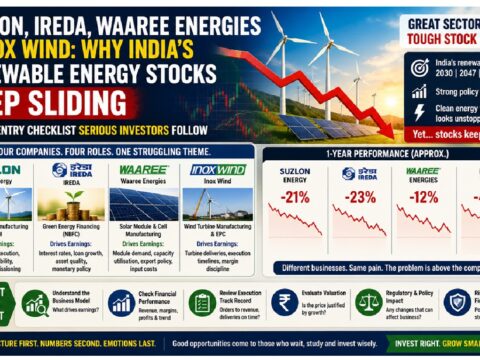
The global energy landscape shifted violently on February 25, 2026, as the Trump administration dropped a regulatory “bombshell” on the international solar market. Under the resolute banner of “America First,” the U.S. Department of Commerce announced staggering preliminary anti-subsidy duties on solar imports from several nations, with India facing a brutal 126% tariff. This move has sent shockwaves through Dalal Street, causing a massive sell-off in renewable energy stocks and raising existential questions about the viability of Indian solar exports to the United States.
For investors in titans like Waaree Energies and Premier Energies, the news represents a high-stakes challenge. While the judicial system recently struck down “blanket” global tariffs, the administration is now utilizing specific, industry-targeted trade laws to protect domestic U.S. manufacturers. This article provides a comprehensive breakdown of the 126% tariff, the geopolitical motivations behind it, and a detailed analysis of which Indian stocks face the highest risk.
Decoding the 126% Tariff: Numbers, Nations, and Nuances
The Trump administration’s decision is not a broad-brush tax but a surgical strike against specific Asian manufacturing hubs. The U.S. Department of Commerce has set “preliminary countervailing duties” to neutralize what it perceives as unfair government subsidies.
The Regional Breakdown of Tariffs
While India grabbed the headlines with a 126% figure, it is not the only nation in the crosshairs. The administration has targeted several countries with varying degrees of severity:
- India: Preliminary duties set at 126% on solar cells and modules.
- Indonesia: Tariffs ranging from 86% to 143%.
- Laos: A duty of 81% on solar-related goods.
- Cambodia and Vietnam: These nations also face significant scrutiny, though the specific percentages vary based on the manufacturer’s level of cooperation with the U.S. investigation.
Preliminary vs. Final: The Timeline of Uncertainty
Investors must note that these are preliminary findings. The Department of Commerce is currently conducting a deep-dive investigation into the financial records of these companies and the subsidy structures provided by their respective governments.
- The Final Verdict: The definitive decision regarding these duties is scheduled for July 6, 2026.
- The Gap Period: Between now and July, importers must post cash deposits or bonds based on these preliminary rates. This effectively makes Indian solar products twice as expensive as American-made panels overnight.
The “Why” Behind the Tax: Protecting the American Solar Heartland
The fundamental justification provided by the White House is the protection of domestic U.S. solar panel manufacturers from “predatory foreign competition.” However, the reasoning goes deeper than mere protectionism.
The Allegation of “Dumping” and Subsidies
The U.S. administration alleges that Asian countries are engaging in “unfair trade practices.” According to the U.S. side:
- Government Backing: Indian and Southeast Asian solar firms receive massive subsidies, tax breaks, and low-interest loans from their governments.
- Artificial Pricing: These subsidies allow foreign firms to produce solar panels at a fraction of the cost—roughly $60 for a unit that costs $100 to produce in the U.S.
- Market Dumping: These “cheap” panels are then dumped into the American market, capturing nearly 60% of the market share and driving American firms out of business.
By imposing a 126% tariff, the Trump administration aims to artificially inflate the price of imported panels, forcing U.S. developers to buy from domestic companies like First Solar or Qcells.
Stock Market Carnage: Waaree Energies and the 14% Crash
The most visible impact of the tariff announcement was the bloodbath in the Indian stock market. Solar and renewable energy stocks, which were previously the “darlings” of the market, saw double-digit declines within minutes of the news breaking.
Waaree Energies: A 33% Revenue Risk
Waaree Energies, India’s largest solar module manufacturer, bore the brunt of the sell-off. The stock plummeted nearly 14% to 15%, hitting its lower circuit during intraday trading.
- The Exposure: Roughly 33% of Waaree’s total revenue comes from exports, with the vast majority of those exports heading to the United States.
- The Reaction: The market panic reflects a fear that Waaree’s most profitable market has effectively been closed off by a massive price wall.
Management’s Defense: The Hitesh Doshi Clarification
In an effort to calm the markets, Waaree Energies Chairman Hitesh Doshi issued a formal clarification. He argued that the 126% tariff might not apply to Waaree’s specific business model.
- The “Cell vs. Module” Argument: Doshi noted that the tariff targets “subsidized Indian solar cells.” He clarified that Waaree often imports its solar cells from non-targeted countries and merely assembles the “modules” and “panels” in India.
- The Subsidy Claim: He further stated that the company does not rely on the specific government subsidies mentioned in the U.S. investigation, potentially exempting their products from the highest duty brackets.
Collateral Damage: Premier Energies and the Ripple Effect
The tariff news did not just hurt those with direct U.S. exposure; it created a “contagion” effect across the entire renewable sector.
Premier Energies: Hit by Sentiment, Not Substance
Premier Energies saw its stock drop by 14% despite having a relatively smaller direct export footprint to the U.S. compared to Waaree. This is a classic example of “collateral damage” where a negative sentiment in the lead stock (Waaree) pulls down the entire sectoral basket.
Vikram Solar and the International Order Book
Vikram Solar, another major player, saw its valuation dip by 8%. With nearly 16% to 20% of its order book tied to international exports—specifically to North America—the company faces significant logistical and pricing hurdles. Management has since claimed that these duties “won’t dent” their long-term finances, but the market remains skeptical.
The “Double Whammy”: Tariff Layers and Geopolitical Strategy
Investors are currently confused about how this 126% tariff interacts with the previous 10% or 15% global tariffs discussed in earlier Trump speeches. It is vital to understand that these are cumulative.
1. The Global Blanket Tariff: A general 10-15% tax on all goods entering the U.S. 2. The Sector-Specific Anti-Subsidy Duty: The 126% tax specifically for solar goods.
If both are applied, Indian solar manufacturers would face an effective barrier of nearly 140%. This is part of a larger strategy to force manufacturing to move onshore to the United States. Trump has repeatedly hinted that if Indian companies want to sell to Americans, they should build their factories in Ohio or Texas, not Gujarat.
Conclusion: The Future of the “Solar Dream”
The 126% tariff is a brutal reality check for the Indian renewable energy sector. While the final decision in July 2026 might see a reduction in these rates, the period of “unhindered export growth” for Indian solar firms appears to be over. Companies will now have to choose between finding new markets in Europe and the Middle East or investing heavily in setting up manufacturing units within the United States to bypass these tariffs.
For the retail investor, the “Solar Gold Rush” has entered a phase of extreme volatility. While the fundamental demand for green energy remains high, the “Trump Factor” has introduced a level of political risk that can wipe out double-digit gains in a single afternoon.
Primary SEO Keywords: Trump Solar Tariff 126%, Waaree Energies Share News, Premier Energies Stock Crash, Indian Solar Export Duties, U.S. Department of Commerce Solar Ruling, Renewable Energy Stocks India, Solar Subsidy Investigation 2026.