India’s Market Outlook Gets a Major Boost from Citi Research
Global financial institutions regularly publish research reports that help investors understand emerging opportunities, risks, and long-term market trends. One of the latest reports from leading global brokerage firm Citi has generated significant interest among investors due to its optimistic outlook on India.
According to Citi’s latest assessment, India’s economic fundamentals remain strong despite ongoing geopolitical uncertainties, global trade tensions, and market volatility. The brokerage believes that Indian equities continue to offer compelling opportunities for long-term investors and has outlined several sectors and companies that could benefit from the country’s next phase of economic growth.
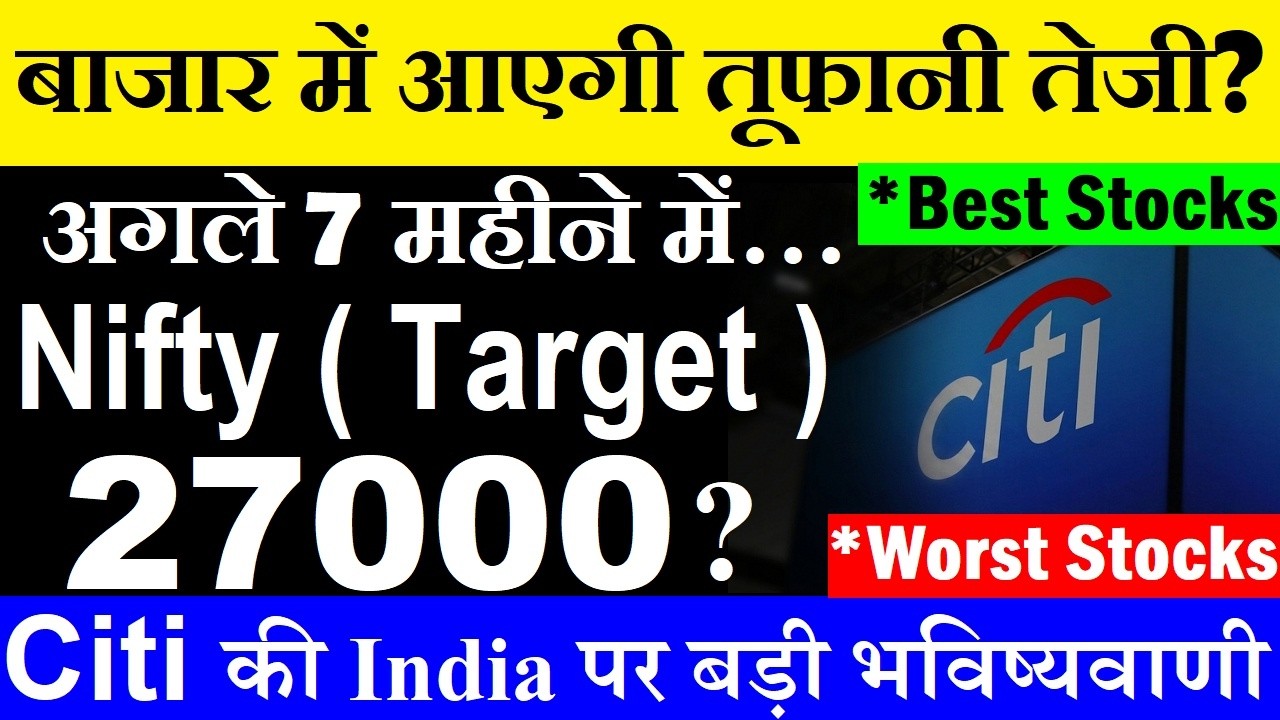
Most notably, Citi expects the Nifty 50 index to potentially reach 27,000 by December 2026 under its optimistic scenario. This projection reflects confidence in India’s economic resilience, policy support, and long-term structural growth drivers.
In this article, we explore Citi’s outlook on the Indian stock market, the sectors it favors, the industries it believes may underperform, and the key themes likely to shape India’s investment landscape in the coming years.
Citi’s Nifty 50 Target: Why 27,000 Is Within Reach
At present, the Nifty 50 trades significantly below Citi’s projected target of 27,000. The brokerage’s forecast suggests meaningful upside potential over the coming months if economic conditions continue to improve and corporate earnings remain strong.
Key Reasons Behind Citi’s Optimism
Citi’s bullish stance is based on several factors:
- Continued economic expansion in India
- Improving domestic consumption trends
- Strong infrastructure spending
- Supportive monetary policies
- Growing foreign and domestic investments
- Expansion of emerging industries such as artificial intelligence and digital infrastructure
Despite concerns surrounding global conflicts and geopolitical tensions, Citi believes Indian equities remain well-positioned for long-term growth.
Geopolitical Risks Are Becoming Part of the New Normal
One of the most interesting observations in Citi’s report is its view on geopolitical uncertainty.
For years, markets reacted sharply to events such as:
- International conflicts
- Trade wars
- Supply chain disruptions
- Regional political instability
However, Citi argues that investors and businesses are increasingly adapting to these challenges.
Market Adaptation to Global Uncertainty
As geopolitical events occur more frequently, markets have become more resilient. Investors now factor many of these risks into their decision-making processes.
Rather than creating long-lasting disruptions, many geopolitical events are producing shorter-term volatility before markets stabilize and continue focusing on economic fundamentals.
This evolving market behavior is one reason Citi remains optimistic about India’s long-term growth prospects despite ongoing global uncertainties.
Long-Term Investment Themes That Could Shape India’s Future
Citi identifies several structural growth themes that investors should monitor closely over the next decade.
These themes are not short-term trading opportunities. Instead, they represent long-term investment trends that could create substantial value over time.
Data Centers: A Powerful Growth Opportunity
One of Citi’s strongest long-term themes is the rapid growth of data centers in India.
Why Data Centers Matter
The rise of:
- Artificial Intelligence (AI)
- Cloud computing
- Digital services
- Big data analytics
- Internet usage
is creating massive demand for data storage and processing infrastructure.
As businesses increasingly move operations online and AI adoption accelerates, demand for high-performance data centers is expected to surge.
India’s Competitive Advantage
India offers several advantages:
- Large digital population
- Expanding internet penetration
- Growing enterprise technology adoption
- Government support for digital infrastructure
- Increasing demand for cloud services
According to Citi, companies involved in data center infrastructure, power management, networking, and related services could benefit significantly from this trend.
MSME Financing: An Underrated Opportunity
Another area highlighted by Citi is MSME financing.
Micro, Small, and Medium Enterprises (MSMEs) form the backbone of India’s economy. These businesses generate employment, support innovation, and contribute significantly to economic activity.
Why Financing Matters
Many MSMEs struggle to access affordable credit.
This creates a substantial opportunity for:
- Banks
- NBFCs
- Digital lending platforms
- Financial service providers
Institutions capable of effectively serving MSMEs can benefit from a rapidly expanding market.
While lending to smaller businesses carries higher risks, it also offers attractive growth potential and stronger margins compared to traditional lending segments.
Research and Development Will Drive India’s Next Growth Phase
Citi also emphasizes the importance of Research and Development (R&D) investment.
The Innovation Challenge
India has made remarkable progress in technology and digital services, but the country still spends a relatively small percentage of GDP on research and development compared to many advanced economies.
Without meaningful investment in innovation, India may struggle to create globally competitive technologies and intellectual property.
Why R&D Investment Matters
Greater spending on research can help:
- Develop indigenous technologies
- Strengthen AI capabilities
- Improve manufacturing competitiveness
- Create higher-value industries
- Generate long-term economic growth
Citi believes both the government and private sector should play a larger role in supporting innovation and technological advancement.
Top Stocks Preferred by Citi
The report also highlights several companies that Citi believes are well-positioned to benefit from India’s growth story.
Banking and Financial Services
Among private banks, Citi favors:
- Axis Bank
- ICICI Bank
These institutions are expected to benefit from strong credit growth, improving asset quality, and expanding financial inclusion.
Automobile Sector
Within the auto industry, Citi remains positive on:
- Mahindra & Mahindra
The company continues to gain market share across multiple vehicle categories while benefiting from India’s growing mobility demand.
Industrial and Infrastructure Plays
Citi also favors:
- CG Power and Industrial Solutions
- Polycab India
These businesses could benefit from infrastructure investments, industrial expansion, and data center growth.
Healthcare and Pharmaceuticals
The brokerage remains constructive on:
- Torrent Pharmaceuticals
Healthcare remains a defensive sector with strong long-term growth potential.
Cement and Infrastructure
Citi also sees opportunities in:
- JSW Cement
The ongoing infrastructure boom and urban development initiatives could support demand in the sector.
Sectors Citi Is Most Bullish On
The report identifies four sectors where Citi has an “overweight” stance.
An overweight rating indicates that the brokerage expects these sectors to outperform the broader market.
1. Financial Services
Financial services remain one of Citi’s strongest convictions.
Growth drivers include:
- Rising credit demand
- Expanding banking penetration
- Digital financial services
- Improving economic activity
2. Healthcare
Healthcare continues to benefit from:
- Aging populations
- Rising healthcare spending
- Growing insurance coverage
- Strong pharmaceutical exports
3. Defense
India’s defense sector has become a major focus due to:
- Government support
- Domestic manufacturing initiatives
- Increasing defense budgets
- Export opportunities
4. Utilities
Utilities offer:
- Stable earnings
- Infrastructure exposure
- Energy transition opportunities
- Long-term demand growth
These characteristics make the sector attractive in uncertain market environments.
Sectors Citi Is Less Positive About
Not every sector receives a favorable outlook.
Citi has assigned an underweight stance to several industries.
Information Technology
Despite being a key contributor to India’s economy, Citi remains cautious about the IT sector.
Reasons include:
- Slower global technology spending
- Increasing competition
- Artificial Intelligence disruption
- Margin pressures
Companies that fail to adapt to emerging technologies may face challenges in sustaining growth.
Consumer Staples
Citi is also less enthusiastic about consumer staples.
Although these businesses remain stable, valuation concerns and slower growth expectations may limit upside potential.
Examples include:
- Packaged foods
- Personal care products
- Household goods
Metals
The brokerage also maintains a cautious view on the metals sector.
Challenges include:
- Commodity price volatility
- Global demand uncertainty
- Economic slowdown risks in major markets
While cyclical opportunities may arise, Citi believes better risk-reward opportunities exist elsewhere.
A Major Shift in India’s Balance of Payments Outlook
One of the most significant updates in Citi’s report relates to India’s Balance of Payments (BoP) outlook.
Previously, Citi projected a deficit of approximately $5 billion for FY27.
However, the firm has now revised its outlook dramatically.
From Deficit to Surplus
The latest forecast expects a surplus of approximately $5 billion.
This represents a positive swing of nearly $10 billion.
Such a revision reflects improving confidence in India’s external financial position.
RBI’s Policy Decisions Are Supporting Growth
A major reason behind Citi’s improved outlook is the Reserve Bank of India’s recent policy initiatives.
The RBI has introduced measures aimed at:
- Improving liquidity
- Supporting financial institutions
- Enhancing access to foreign funding
- Strengthening financial stability
These measures are expected to benefit the banking system significantly.
Which Financial Institutions Could Benefit Most?
According to Citi, several financial institutions may gain from the RBI’s supportive policies.
Banking Beneficiaries
Among banks, Citi believes:
- HDFC Bank
could be one of the biggest beneficiaries.
Government-Owned NBFCs
The report also highlights:
- Power Finance Corporation
- REC Limited
- Indian Railway Finance Corporation
These institutions could benefit from improved funding conditions and enhanced financial flexibility.
Outlook for the Indian Rupee
Citi also shared its view on the Indian currency.
While exchange rate forecasts remain subject to global developments, the brokerage expects the rupee to remain relatively stable within its projected range.
Currency stability is important because it supports:
- Foreign investment inflows
- Import-export planning
- Corporate profitability
- Economic confidence
Final Thoughts
Citi’s latest research report presents a constructive outlook on India despite global uncertainties. The brokerage sees India as one of the most attractive long-term investment destinations and believes several structural growth drivers remain intact.
The firm’s forecast of Nifty 50 potentially reaching 27,000 by December 2026 highlights confidence in India’s economic resilience and corporate growth prospects.
Among the most promising opportunities identified are financial services, healthcare, defense, utilities, data centers, and MSME financing. At the same time, Citi remains cautious on information technology, consumer staples, and metals.
While no forecast is guaranteed, the report provides valuable insights into how one of the world’s leading financial institutions views India’s future. Investors can use these perspectives as a starting point for further research while building a diversified, long-term investment strategy.
Frequently Asked Questions
What is Citi’s Nifty 50 target?
Citi expects the Nifty 50 to potentially reach 27,000 by December 2026 under its optimistic scenario.
Which sectors does Citi prefer?
Citi is most bullish on financial services, healthcare, defense, and utilities.
Why does Citi like data centers?
The growth of artificial intelligence, cloud computing, and digital infrastructure is expected to drive significant demand for data centers in India.
Which banks are among Citi’s preferred picks?
Axis Bank, ICICI Bank, and HDFC Bank are among the financial institutions highlighted in Citi’s outlook.
Which sectors does Citi view cautiously?
The brokerage remains less positive on information technology, consumer staples, and metals.