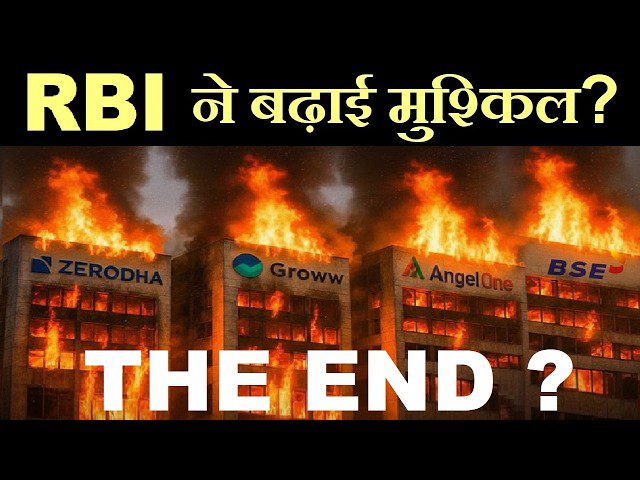
The Indian financial ecosystem witnessed a significant tremor recently as the Reserve Bank of India (RBI) introduced stringent new guidelines targeting the funding mechanisms of stock brokerage firms. This regulatory shift has cast a shadow over the “Capital Market” sector, sending stocks like BSE Limited, Angel One, and other listed brokerages into a downward spiral. As the industry grapples with the transition, many are questioning whether this marks the beginning of the end for the “cheap leverage” era that has fueled retail trading volumes over the last decade.
The Triple Attack on the Indian Trading Community
To understand the current market anxiety, one must view the RBI’s intervention as the third part of a “triple attack” on active traders and market intermediaries. The regulatory landscape has shifted rapidly through three distinct phases:
- SEBI’s Structural Overhaul: The Securities and Exchange Board of India (SEBI) recently introduced six new rules aimed at curbing excessive speculation in the Futures and Options (F&O) segment. These rules increased contract sizes and tightened the criteria for weekly expiries, directly impacting trading frequency.
- Government Taxation: The Union Government increased the Securities Transaction Tax (STT) on F&O trades, raising the cost of every transaction for high-frequency and intraday traders.
- RBI’s Credit Tightening: The latest blow comes from the RBI, which has moved to restrict how banks provide liquidity and credit to stockbrokers. By tightening the “money tap,” the RBI ensures that systemic risks within the banking sector remain contained, even if it comes at the expense of market liquidity.
Understanding the RBI’s New Mandates: Deciphering the Impact on Brokers
The RBI holds authority over commercial banks, and its latest directives specifically instruct these banks on how to manage their exposure to the stockbroking industry. The central bank has moved from a “flexible” oversight model to a “strict” enforcement model.
The Ban on Bank-Funded Proprietary Trading
In the previous regulatory regime, many brokerage firms engaged in “Proprietary Trading”—trading using the firm’s own capital to generate profits. Brokers often secured low-interest loans from banks to fund these trades. The RBI has now strictly prohibited banks from lending money to brokers for their own trading activities. Brokers must now rely exclusively on their internal accruals and equity capital to fund house trades. This move prevents a scenario where a broker’s trading loss could jeopardize a bank’s balance sheet.
The 100% Mandatory Collateral Rule
Historically, banks provided “unsecured” or “partially secured” loans to reputed brokerages based on their market standing and cash flows. The RBI has now mandated 100% collateral for all loans provided to brokers. This means for every rupee borrowed, the broker must provide an equivalent amount in high-quality security.
Furthermore, the RBI has increased the “Cash Component” requirement. A significant portion of this collateral must now be in the form of cash or government bonds, locking up a broker’s liquid resources and reducing their ability to offer aggressive margin facilities to their clients.
The 40% “Haircut” on Pledged Shares
When brokers pledge their holdings (shares) to banks to secure funding, the RBI has directed banks to apply an automatic 40% “haircut.” For instance, if a broker pledges shares worth ₹1 crore, the bank will only provide a loan of ₹60 lakh. This mandatory discount reduces the “borrowing power” of the broker’s assets, making capital significantly more expensive and harder to come by.
Why BSE and Market Exchanges are Feeling the Pressure
While the rules target brokers, the secondary impact on stock exchanges like the BSE (Bombay Stock Exchange) has been severe. The exchange business model is built on volume. Exchanges are essentially the “stadiums” where the game of trading is played. They earn revenue from every “ticket” (transaction) sold.
If brokers find it harder to get funding, they will inevitably pass these restrictions on to their clients. This leads to a contraction in trading volume. When the “stadium” sees fewer spectators and fewer players, its revenue inevitably drops. This fundamental link explains why BSE’s stock price plummeted by over 7.5% following the announcement, as investors factored in a sustained decline in transaction-based income.
The Ripple Effect on Retail Investors: Will Zero-Brokerage End?
Many retail investors believe they are immune to these changes because they do not use high leverage. However, the brokerage business is an interconnected ecosystem.
- The Decline of Marginal Benefits: For the past few years, brokers have offered incredibly low or “zero” brokerage on delivery trades because they made substantial profits from F&O volumes, proprietary trading, and bank-funded arbitrage.
- The Potential for New Charges: As these high-margin revenue streams dry up due to RBI and SEBI restrictions, brokers may be forced to look elsewhere to maintain their bottom lines. This could lead to a reintroduction of delivery charges, higher Account Maintenance Charges (AMC), or increased fees for value-added services.
- MTF and Intraday Funding: For those who use Margin Trading Facilities (MTF), the cost of borrowing is set to rise. As banks charge brokers more for capital, brokers will pass that cost directly to the trader.
The “End of Cheap Leverage” and Future Outlook
Industry leaders, including Nithin Kamath of Zerodha, have highlighted that the era of “cheap leverage” is officially over. The RBI’s move is a preemptive strike against systemic instability. By ensuring that brokers are 100% secured and preventing banks from fueling speculative house trades, the regulator is prioritizing the safety of the banking system over the growth of market volumes.
For the stockbroking industry, the next few quarters will be a period of consolidation. Firms with strong balance sheets and diversified revenue streams (such as wealth management and insurance distribution) will likely survive and thrive. However, smaller firms that rely exclusively on bank-funded leverage and F&O volumes may face significant existential threats.
Conclusion: A New Reality for the Indian Capital Markets
The RBI’s directives represent a “reset” for the Indian capital markets. While the immediate reaction is one of pain—reflected in the red screens of BSE and Angel One—the long-term goal is a more stable, less leveraged market. For traders and investors, the key takeaway is that the cost of participation is rising. Success in this new environment will depend on fundamental research and disciplined capital management, rather than the “crutch” of easy bank funding.