In today’s fast-evolving global landscape, opportunities for wealth creation, international mobility, and market growth are reshaping economies and individual aspirations. The UAE’s groundbreaking lifetime Golden Visa program, priced at just AED 100,000 (approximately INR 23 lakhs), has sparked widespread interest among India’s upper-middle-class families. Meanwhile, financial markets are navigating volatility, trade tensions, and transformative business developments. This comprehensive article dives into the UAE Golden Visa’s impact, key market updates, and emerging investment opportunities, offering actionable insights for investors and global citizens.
The UAE Golden Visa: A Game-Changer for Global Mobility
What is the UAE Golden Visa?
The UAE Golden Visa has emerged as a revolutionary pathway for professionals, entrepreneurs, and skilled individuals seeking long-term residency in the United Arab Emirates. Unlike the previous requirement of a AED 10 million (approximately INR 4.66 crores) investment in real estate for a 5-10 year visa, the new program offers lifetime residency for a one-time payment of AED 100,000. This dramatic reduction eliminates the need for property investments, making it accessible to a broader demographic, including educators, YouTubers, and skilled professionals.
Why the UAE Introduced the Lifetime Golden Visa
The UAE’s decision to lower the Golden Visa threshold reflects a strategic pivot to diversify its economy beyond oil dependency. By attracting global talent and boosting population growth, the UAE aims to strengthen its real estate sector, enhance business ecosystems, and foster innovation. The influx of skilled individuals is expected to drive demand for housing, services, and investments, creating a ripple effect across the economy.
Impact on India’s Upper-Middle Class
For India’s upper-middle-class families, the Golden Visa presents an unprecedented opportunity to relocate to a global hub like Dubai. The affordability of the program, coupled with the UAE’s tax-free environment and world-class infrastructure, is prompting many to consider permanent residency. However, this migration trend raises questions about its potential impact on India’s consumption-driven economy and stock market.
Will Migration Hurt India’s Economy?
Concerns about brain drain and reduced domestic consumption have surfaced. As affluent families move abroad, sectors like retail, real estate, and consumer goods may face short-term challenges. However, reports from PricewaterhouseCoopers (PwC) project India’s GDP to reach $9.82 trillion by 2035, driven by a robust 9.27% CAGR. This suggests that while migration may create localized impacts, India’s macroeconomic growth remains resilient, supported by strong domestic demand and policy reforms.
Global Trade Dynamics: US-India Mini Trade Deal and BRICS Tensions
The US-India Mini Trade Deal
A significant development on the global stage is the anticipated mini trade deal between the US and India, expected to finalize within the next 48 hours as of July 7, 2025. Unlike a comprehensive trade agreement, this deal focuses on specific sectors, excluding sensitive areas like agriculture and dairy. India’s Commerce Minister, Piyush Goyal, has emphasized that any agreement must align with national interests, ensuring a win-win scenario for both nations.
Trump’s Tariff Threats and BRICS Nations
Former US President Donald Trump’s warnings to BRICS nations (Brazil, Russia, India, China, South Africa, and new members like the UAE and Egypt) have intensified trade tensions. Trump has threatened a 10% tariff on countries acting against US interests, particularly those exploring alternatives to the US dollar in global trade. This move, set to take effect from August 1, 2025, has been postponed from an earlier July 9 deadline, reducing immediate market uncertainty.
China’s Foreign Ministry has criticized these tariffs as counterproductive, arguing that they harm global trade without serving a constructive purpose. India, however, is proactively engaging in trade discussions with the US, European Union, Oman, Chile, and New Zealand to secure favorable terms and mitigate tariff impacts.
India’s Counter-Tariff Strategy
In a bold move, India has proposed tariffs on $724 million worth of US imports at the World Trade Organization (WTO), targeting sectors like steel and automotive. This retaliatory stance underscores India’s growing assertiveness in global trade, positioning it as a key player alongside China in challenging US policies.
Stock Market Insights: Volatility, SEBI Actions, and Sector Updates
Market Performance Snapshot
On July 7, 2025, Indian markets closed flat, with the Sensex marginally up by 10 points at 83,442 and the Nifty unchanged at 25,461. The Bank Nifty, however, declined by 83 points to 56,949. Since June 26, markets have exhibited low volatility, consolidating within a 200-300 point range, signaling a cautious investor sentiment.
SEBI’s Crackdown on Algo-Based Volatility
The Securities and Exchange Board of India (SEBI) has taken decisive action against firms like Jane Street, accused of creating market volatility through algorithmic trading. SEBI’s statement, “This is just the beginning,” indicates a broader crackdown on manipulative trading practices. This move is expected to stabilize markets by reducing sudden price swings, benefiting long-term investors.
Impact on BSE and Wealth Management Firms
A report by Jefferies suggests that SEBI’s actions will significantly reduce options market volumes and premium turnover. For BSE, the impact is minimal, with only 3-4% of its turnover linked to foreign portfolio investors (FPIs), and Jane Street’s contribution estimated at less than 1%. However, wealth management firms like Navama may face a 7-8% earnings hit due to reduced trading activity.
Jio Finance and BlackRock’s Mutual Fund Venture
Jio Finance, in collaboration with BlackRock, has made a strong entry into the mutual fund market, raising INR 17,800 crores through three debt schemes. With 90 institutional and 67,000 retail investors, this venture has quickly positioned itself among the top 15 asset management companies (AMCs) in the debt category. Investors eyeing Jio Finance should monitor its growth trajectory as it expands into new financial products.
Jammu & Kashmir Bank: An Investment Opportunity?
Recent volatility in Jammu & Kashmir Bank’s stock, triggered by an incident in Pehalga, has caught the attention of investor Mukul Mahavir Agarwal, who increased his stake to over 1%. His portfolio, valued at INR 7,300 crores, reflects a strong track record, but investors should exercise caution. Blindly following prominent investors without thorough analysis can lead to significant risks, especially for retail investors with limited capital.
Defense Sector: A $2 Trillion Opportunity
India’s Defense Secretary, RK Singh, announced plans to allocate INR 2 lakh crores for defense contracts, accelerating procurement decisions to bolster the sector. Companies like Hindustan Aeronautics Limited (HAL), Bharat Electronics Limited (BEL), and Bharat Dynamics are poised to benefit from this spending spree, making them attractive investment options.
Renewable Energy: JSW Energy and Borosil Renewables
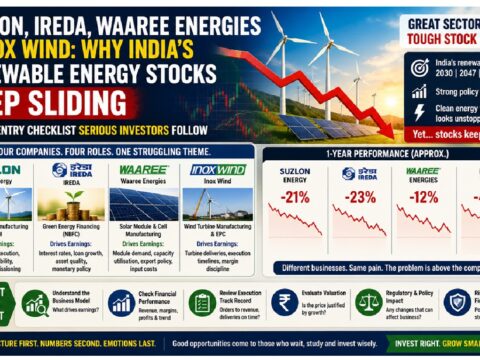
JSW Energy has commissioned a 261 MW renewable energy project, increasing its total installed capacity to 12.8 GW. With 56% of its portfolio now derived from renewables, JSW aims to reach 30 GW in power generation and 40 GW in storage by 2030. Similarly, Borosil Renewables is capitalizing on India’s solar boom, exiting a loss-making German subsidiary to focus on domestic manufacturing. With a planned INR 950 crore expansion in solar glass capacity, Borosil is well-positioned for growth.
Telecom Tariff Hikes: A Sector in Transition
Telecom operators are set to raise mobile recharge tariffs by 10-12% by year-end, reflecting rising operational costs. This move could boost revenues for companies like Bharti Airtel and Reliance Jio but may impact consumer spending in the short term.
Retail and Consumer Goods: Mixed Signals
- Kalyan Jewellers: Reported a 31% revenue increase, with 18% same-store sales growth in India and 26% in the Middle East. The company opened 10 new showrooms in India and one in the US, targeting 170 stores by FY26.
- Jubilant FoodWorks: Achieved a 17% revenue growth, with Domino’s India reporting 11-12% growth. However, its Turkey operations faced a slowdown, and the stock remains under pressure despite adding 73 new stores.
- Dabur: Recorded a 3% stock increase despite mixed data. Strong growth in oral, home, and skincare segments was offset by single-digit beverage revenue due to a short summer season.
Emerging Trends and Investment Opportunities
Digital Innovation: DigiPin and Map My India
The introduction of DigiPin, a unique address identification system, is set to revolutionize logistics and delivery services. Map My India’s integration of DigiPin into its platform enhances its appeal for investors, as it aligns with the growing demand for precise location-based services.
UPI and BHIM UPI App Enhancements
The BHIM UPI app, backed by NPCI, RBI, and the Government of India, has launched version 3.0 with instant discounts and up to INR 250 monthly cashback for transactions on platforms like Swiggy, Zomato, and Myntra. This move strengthens BHIM’s competitive edge in the crowded UPI market.
Industrial and Infrastructure Growth
- DCX Systems: Secured an industrial license for defense manufacturing, enabling production of radar systems, avionics, and defense electronics. The stock rose 3% on this news, reflecting investor optimism.
- Shakti Pumps: Raised INR 292.6 crores through a Qualified Institutional Placement (QIP), allocating 31.8 lakh shares to institutional buyers.
- RVL: Secured a INR 143.38 crore order from Southern Railway for upgrading railway systems.
- Hariom Pipes: Reported a 35% year-on-year sales increase, with value-added products like MS tubes and galvanized products growing by 36%.
- BEL: Received INR 52 crore in export orders for bulldozers and motor graders to Uzbekistan, signaling strong international demand.
Strategic Considerations for Investors
Navigating Market Volatility
With SEBI’s crackdown on algo-based trading and FPI selling continuing (70% of net shorts in recent sessions), investors should focus on fundamentally strong companies. Sectors like defense, renewables, and digital payments offer long-term growth potential despite short-term fluctuations.
Evaluating the UAE Golden Visa’s Impact
While the Golden Visa may encourage migration, its impact on India’s stock market is likely to be limited. Investors should monitor consumption-driven sectors like retail and real estate for potential softness but remain confident in India’s long-term economic growth.
Risk Management
Avoid chasing stocks based solely on prominent investor activity, as seen with Jammu & Kashmir Bank. Conduct thorough due diligence and diversify investments to mitigate risks. For instance, allocating 40-50% of capital to a single stock can be detrimental for retail investors, unlike large portfolio holders.
Conclusion: Seizing Opportunities in a Dynamic Landscape
The UAE’s lifetime Golden Visa, evolving trade dynamics, and robust market developments present a wealth of opportunities for investors and global citizens. India’s economy, projected to reach $9.82 trillion by 2035, remains a powerhouse of growth, supported by strategic sectors like defense, renewables, and digital innovation. By staying informed and adopting a disciplined investment approach, individuals can capitalize on these trends to build wealth and secure their financial future.
For those considering the UAE Golden Visa, weigh the cultural and emotional factors alongside financial benefits. For investors, focus on fundamentally strong companies in high-growth sectors while maintaining a diversified portfolio. Share your thoughts on the Golden Visa and market trends in the comments below, and stay tuned for more insights to navigate this dynamic landscape.