CJI Sanjiv Khanna 51st Chief Justice of India
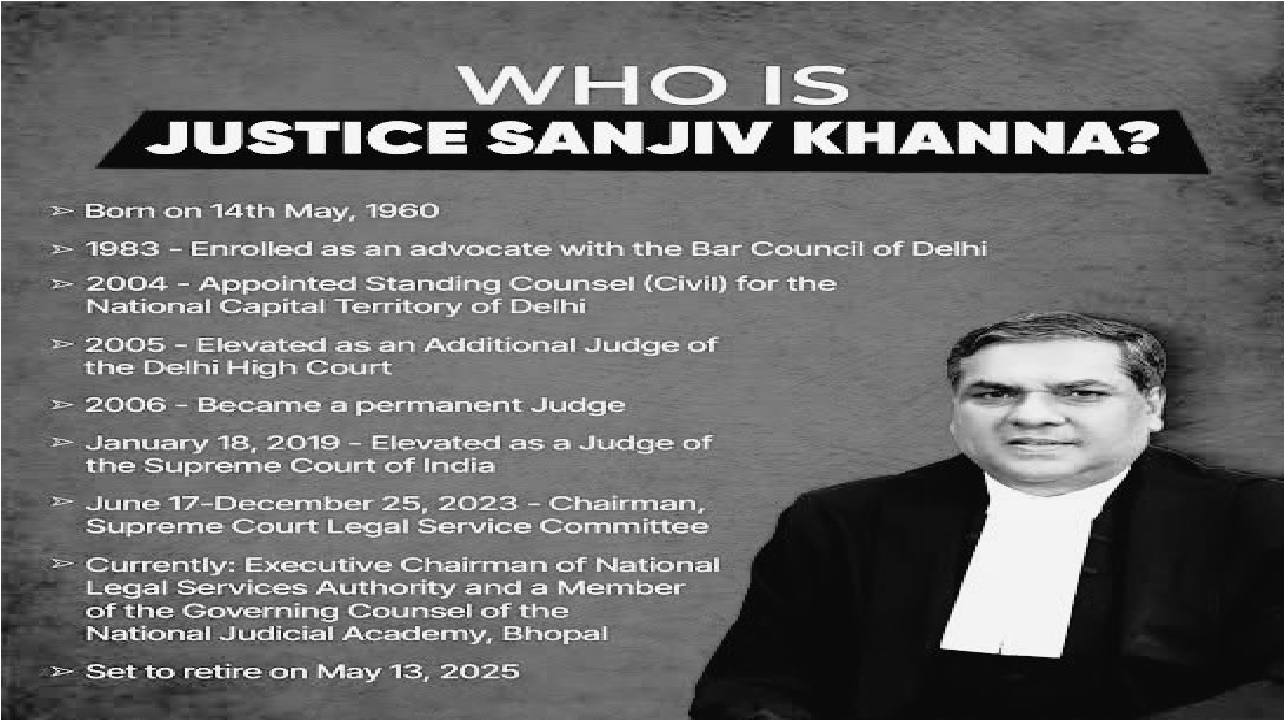
Justice Sanjiv Khanna is set to assume the role of the 51st Chief Justice of India on November 11, 2023. His tenure, though brief lasting until May 2025 comes after the retirement of Dr. D.Y. Chandrachud, who served nearly two years in the prestigious position. Known for his judicial acumen and dedication to upholding the Constitution, Justice Khanna’s appointment adds another notable chapter to his family’s distinguished legal legacy.
A Legal Lineage: A Legacy of Justice
Justice Sanjiv Khanna hails from an illustrious family of legal professionals. As a third-generation lawyer, he follows the path set by his father, Justice D.K. Khanna, who served on the bench of the Delhi High Court. His family legacy also includes his uncle, Justice H.R. Khanna, a figure celebrated for his courage during the 1976 Emergency period. In the landmark case of ADM Jabalpur v. Shivkant Shukla, while other judges upheld the suspension of fundamental rights, Justice H.R. Khanna famously defended citizens’ rights to challenge preventive detention. This stance cost him the position of Chief Justice, as the government at the time bypassed him, appointing Justice M.H. Beg instead.
Education and Early Career of Justice Khanna
Justice Sanjiv Khanna’s educational journey began at St. Stephen’s College, Delhi, where he graduated in 1979. Following this, he studied law at Delhi University’s Campus Law Centre, earning admission to the Delhi Bar Council in 1983. Justice Khanna’s early practice began humbly in the Tis Hazari District Court before advancing to the Delhi High Court. There, he served for seven years as Senior Standing Counsel for the Income Tax Department and also represented the National Capital Territory of Delhi.
In 2005, he was appointed an Additional Judge of the Delhi High Court, gaining permanent status in 2006. Justice Khanna’s promotion to the Supreme Court in January 2019 marked a significant moment in his career, though not without controversy.
The Controversy of His Supreme Court Elevation
Justice Khanna’s elevation to the Supreme Court was met with some debate. At the time, he was ranked 33rd on the seniority list of High Court judges, meaning he superseded several senior judges, including three at his parent court—the Delhi High Court. This decision by the Supreme Court collegium, then headed by Chief Justice Ranjan Gogoi, led to significant discussion and some criticism. However, the collegium later clarified that Justice Khanna and Justice Dinesh Maheshwari were chosen based on their suitability and merit.
Key Judicial Contributions of Justice Khanna
Since joining the Supreme Court, Justice Khanna has participated in various high-profile cases and significant rulings, earning him recognition for his legal insight and steadfast commitment to justice. In 2019, he was part of a special bench that convened to hear allegations of sexual harassment against then-Chief Justice Ranjan Gogoi. Justice Khanna was also on a bench that cautioned the media against reporting “wild and scandalous allegations” related to the case.
Justice Khanna has continued to handle sensitive cases involving political and social dynamics. For instance, he was on a bench that declined to halt the promotion of Justice Victoria Gowri, a Madras High Court judge, despite concerns about her political affiliations. More recently, he granted interim bail to former Delhi Chief Minister Arvind Kejriwal in a case related to the Delhi excise policy, affirming the protection of his rights to life and liberty.
Notable Judgments and Stances
Justice Khanna has been instrumental in cases that extend the transparency of judicial processes and accountability. Early in his Supreme Court tenure, he authored a critical judgment that brought the office of the Chief Justice of India under the scope of the Right to Information Act. He has also made notable contributions in cases involving the abrogation of Article 370, which removed the special status of Jammu and Kashmir, as well as the electoral bonds scheme, which he declared unconstitutional.
Challenges Ahead for the New Chief Justice
As the 51st Chief Justice of India, Justice Khanna will inherit a range of complex and consequential cases. Among these is the Constitutional challenge to the exception of marital rape, a significant issue regarding gender justice and personal autonomy. Justice Khanna is also expected to address cases on the criminalization of triple talaq, the constitutionality of the Bihar caste census, and the validity of the restitution of conjugal rights under the Hindu Marriage Act.
In his role as head of the collegium, Justice Khanna will also be responsible for recommending new appointments to the Supreme Court, filling vacancies created by the retirements of several senior judges. Additionally, as India grapples with increased arrests and detentions under stringent laws like the Unlawful Activities Prevention Act (UAPA) and the Prevention of Money Laundering Act, Justice Khanna’s stance on issues of personal liberty and individual rights will be closely watched.
Upholding Liberty and Justice
Justice Khanna’s career reflects a commitment to the principles of justice and constitutional rights. From upholding citizens’ rights to transparency and accountability, his record has consistently shown a deep respect for the law. With a docket full of pivotal cases, Justice Khanna’s leadership as Chief Justice is expected to leave a lasting impact on India’s judiciary. His upcoming tenure will be observed with interest, as he navigates complex cases and continues the judicial legacy of integrity associated with his name.


![Chandrika Dixit, popularly known as the "Vada Pav Girl," has captivated the online world by disclosing her remarkable earnings from selling the iconic Maharashtrian street food, vada pav. Her daily income of ₹40,000 has left many in awe, showcasing her entrepreneurial spirit and dedication. Chandrika Dixit Joins Bigg Boss OTT 3 The highly anticipated reality show, Bigg Boss OTT 3, recently premiered with Chandrika Dixit as one of its star contestants. Chandrika's claim to fame is her incredible success in the street food business, where she earns a substantial income every day. This revelation has added an interesting dimension to her presence on the show. A Viral Sensation: Chandrika Dixit's Journey In a viral video shared on Instagram, Chandrika can be seen discussing her daily earnings with her fellow Bigg Boss housemates. The video features Chandrika talking about her viral street fight in Delhi and her impressive income from selling vada pav. Her candid disclosure left everyone in the house, and subsequently the viewers, stunned. Hard Work and Dedication: The Secret Behind Her Success During the conversation, actress Sana Makbul acknowledged Chandrika's business acumen by stating, “She is running her business…” To this, Chandrika proudly responded, “Haan, din ka chalis [forty thousand] kama rahi hain na. [Yes, earning ₹40,000 per day]”. Her revelation prompted a surprised reaction from co-contestant Shivani Kumari, who asked, “Din ka Rs 40 hazaar? [Rs 40,000 per day]?” Chandrika's response highlighted her relentless hard work and determination. She said, “Arre yaar toh main mehnat kar rahi hoon na yaar. Main kama rahi hu. Tum bhi karo, mat mobile chalao, mat Netflix chalao, mat raho phone par, utho bahar niklo ghumo. Apne dum par karo. [I am working very hard. I am earning. You also earn. Don't use your smartphones, don't use Netflix. Get up and go outside and do it yourself].” Overcoming Criticism: Chandrika's Perspective Before entering the Bigg Boss OTT 3 house, Chandrika addressed accusations of creating drama to gain attention. In an interview with IANS, she clarified her stance, saying, “I am just keeping my point of view; there is nothing like that. I was running my cart two years ago too and could have done things to gain attention back then when I started and needed money...” Embracing Opportunities: Chandrika's Future Goals Chandrika sees her participation in Bigg Boss OTT 3 as a significant opportunity. She expressed her gratitude and determination to make the most of it, stating, “The opportunity I have got is big; I will do it well, and the reason for doing it is because of the hard work we are doing for our family... It is for a great future for my son. I think I will get help from this.” Conclusion Chandrika Dixit's journey from a street food vendor to a reality show star is a testament to her hard work and entrepreneurial spirit. Her impressive daily earnings from selling vada pav have not only made her a viral sensation but also inspired many to pursue their dreams with dedication and perseverance. As she navigates her journey on Bigg Boss OTT 3, viewers are eager to see how her story unfolds and what new heights she will achieve.](https://www.tgnns.com/wp-content/uploads/2024/06/Chandrika-Dixit-The-Vada-Pav-Girl-Impressive-Daily-Earnings-768x429.jpg)