
Introduction
Explore Asaduddin Owaisi Criticizes CAA Report, Alleges Injustice to Muslims, Asaduddin Owaisi’s criticism of the Citizenship (Amendment) Act (CAA) and the potential rule notification before the 2024 Lok Sabha elections. Understand the controversies, official responses, and the law’s implications on India’s political landscape.
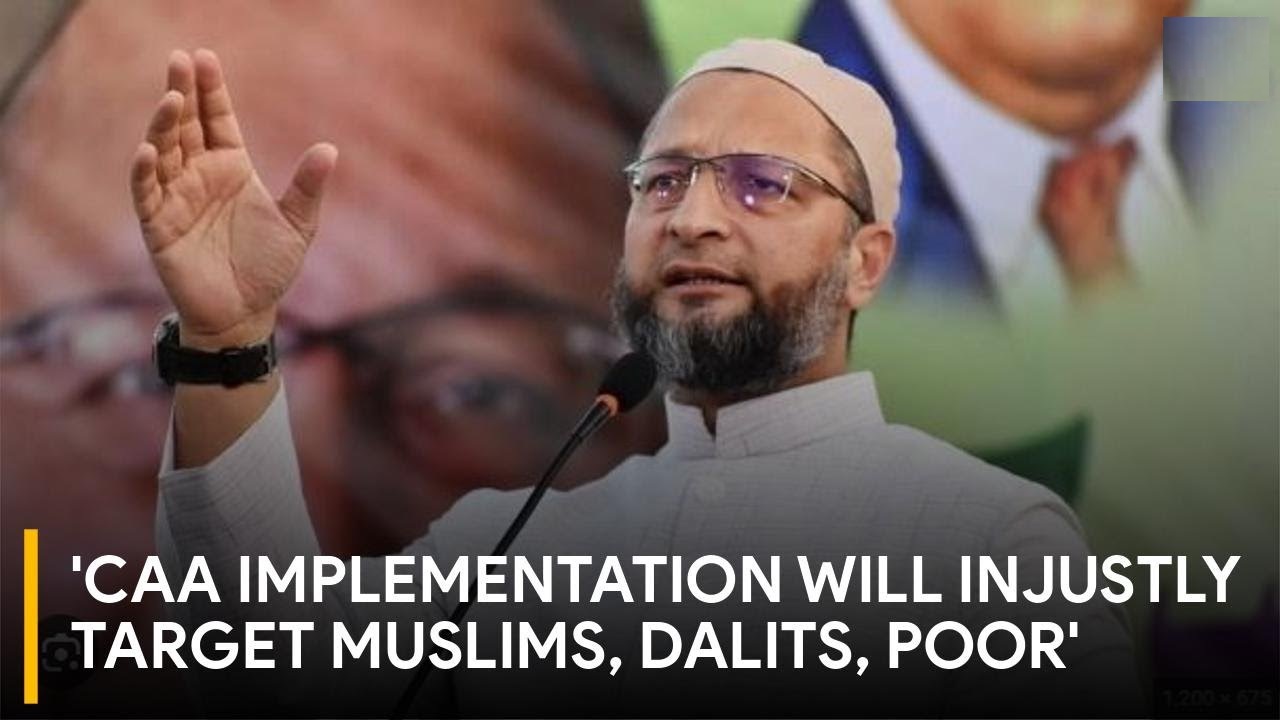
In a recent development, Asaduddin Owaisi, the chief of All India Majlis-e-Ittehad-ul-Muslimeen (AIMIM), reacted strongly to a report suggesting the notification of rules related to the Citizenship (Amendment) Act (CAA) before the 2024 Lok Sabha elections. Owaisi expressed concern, particularly for marginalized communities, asserting that it would result in grave injustice, especially to Muslims. This article delves into Owaisi’s statements, the background of CAA, and the potential implications of the reported rule notification.
Background: CAA and Controversies
CAA Overview
The Citizenship (Amendment) Act, enacted in 2019, facilitates Indian citizenship for non-Muslims – including Hindus, Sikhs, Jains, Buddhists, Parsis, and Christians – from Bangladesh, Pakistan, and Afghanistan, who migrated to India before December 31, 2014.
Owaisi’s Stance
Owaisi categorically termed CAA as “anti-constitutional,” alleging that the law was formulated based on religion. He emphasized the interconnectedness of CAA with the National Population Register (NPR) and National Register of Citizens (NRC), expressing concerns about potential injustices to Muslims, Dalits, and the poor, regardless of their caste or religion.
Centre’s Response and Criticisms
Yechury’s Allegations
Sitaram Yechury, the general secretary of the Communist Party of India (Marxist) [CPI(M)], accused the central government of attempting to fuel communal polarization ahead of the Lok Sabha elections. He suggested that the delayed notification of CAA rules indicated a political strategy to leverage communal sentiments for electoral gains.
Official Statements
While an anonymous official reportedly stated that the CAA rules would be notified before the upcoming elections, the government, represented by Union Minister Amit Shah, remains resolute in implementing CAA. Shah accused West Bengal Chief Minister Mamata Banerjee of misleading the public on the law.
Future Implications and Criticisms
Rule Notification Timing
The timing of the potential rule notification, just before the elections, has stirred controversy. Critics argue that such timing could be a deliberate strategy to exploit religious sentiments for political advantages.
Protest History
The passage of CAA in 2019 triggered massive protests, notably the prolonged demonstration in Delhi’s Shaheen Bagh. The protests raised concerns about the law’s impact on India’s secular fabric.
BJP’s Defense
The Bharatiya Janata Party (BJP) defended its focus on CAA, claiming it as a necessary step despite opposition allegations. However, critics, including Samajwadi Party spokesperson Fakhrul Hasan, argued that such emphasis was a diversion from the government’s unfulfilled promises on issues like employment and farmer income.
Frequently Asked Questions
Q1: What is the Citizenship (Amendment) Act (CAA)?
A1: The Citizenship (Amendment) Act, passed in 2019, aims to grant Indian citizenship to non-Muslims from Bangladesh, Pakistan, and Afghanistan who migrated to India before December 31, 2014.
Q2: Why is Asaduddin Owaisi critical of CAA?
A2: Asaduddin Owaisi deems CAA as “anti-constitutional,” asserting that it discriminates based on religion. He expresses concerns about potential injustices, especially to Muslims, in conjunction with the National Population Register (NPR) and National Register of Citizens (NRC).
Q3: What is the controversy surrounding the timing of CAA rule notification?
A3: Critics argue that the potential notification of CAA rules just before the Lok Sabha elections is a political strategy to capitalize on communal sentiments for electoral gains.
Conclusion
As the debate surrounding the Citizenship (Amendment) Act continues, the reported plan to notify its rules before the upcoming Lok Sabha elections has intensified political discourse. Asaduddin Owaisi’s strong stance reflects broader concerns about the potential impact of CAA on marginalized communities. The political landscape awaits further developments, with implications that extend beyond legal frameworks into the heart of India’s socio-political fabric.