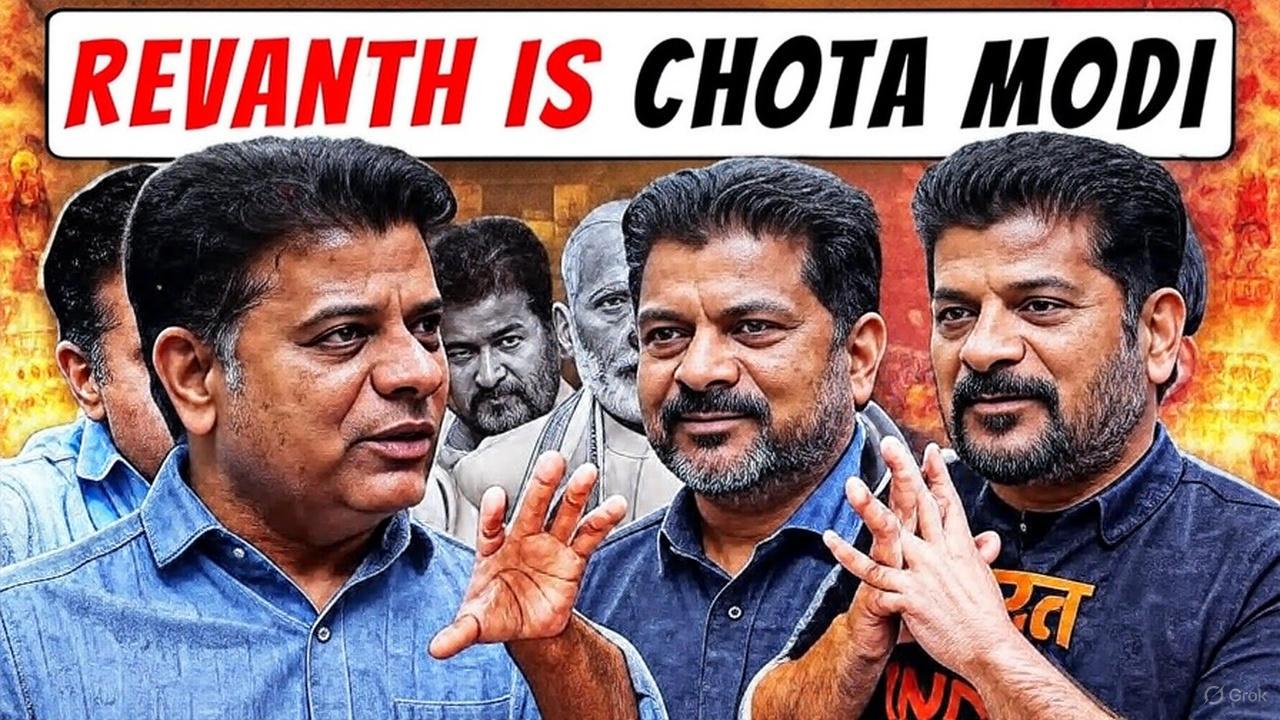
India’s political landscape is a vibrant tapestry of diverse voices, ideologies, and regional aspirations. As the nation approaches the 2029 general elections, a significant shift is emerging: the resurgence of regional parties. These parties, rooted in local issues and identities, are poised to redefine India’s political narrative, challenging the dominance of national giants like the Bharatiya Janata Party (BJP) and the Indian National Congress (Congress). This article explores the factors driving the rise of regional parties, their potential to shape coalition governments, and the critical issues fueling their relevance, such as the North-South divide, delimitation concerns, and linguistic imposition. Drawing insights from a candid conversation with K.T. Rama Rao (KTR), Working President of the Bharat Rashtra Samithi (BRS), we delve into why regional parties could hold the key to India’s political future.
The Decline of National Parties and the Rise of Regional Forces
India’s political history has oscillated between periods of single-party dominance and coalition governments. The 1990s and early 2000s saw coalition governments thrive, with regional parties playing pivotal roles. However, the last decade has witnessed the BJP’s rise to near-hegemonic status, bolstered by a strong nationalist agenda and effective social media strategies. Meanwhile, the Congress, once a formidable national force, has struggled to maintain its relevance, often perceived as a “big-sized regional party” rather than a national contender.
KTR, in a recent discussion, predicted that neither the BJP nor the Congress will cross 150 seats in the 2029 Lok Sabha elections. This bold forecast underscores a growing sentiment: national parties are losing ground due to their inability to address India’s diverse regional needs. Regional parties, with their deep-rooted connections to local issues, are stepping into this vacuum. From the Trinamool Congress (TMC) in West Bengal to the Dravida Munnetra Kazhagam (DMK) in Tamil Nadu and the BRS in Telangana, these parties are proving their mettle by focusing on state-specific concerns like agriculture, infrastructure, and cultural identity.
Why National Parties Are Faltering
The BJP’s dominance has relied heavily on polarizing narratives, leveraging religious and communal issues to consolidate votes. However, KTR argues that this “us vs. them” strategy, while effective in the short term, is a passing phase. India’s electorate, he believes, is mature enough to see through divisive tactics and demand substantive governance. The Congress, on the other hand, suffers from internal fractures and a lack of cohesive leadership. KTR’s critique of Rahul Gandhi, whom he describes as better suited to running an NGO than a political party, reflects a broader perception of the Congress as out of touch with modern political realities.
Regional parties, by contrast, thrive on their ability to connect with voters on issues that matter most to them—jobs, infrastructure, and cultural pride. For instance, the BRS’s Rythu Bandhu scheme, which provided direct financial support to farmers, revolutionized agriculture in Telangana and inspired similar schemes across India. Such targeted policies resonate deeply with local populations, giving regional parties an edge over national players.
The North-South Divide: A Growing Political Fault Line
One of the most pressing issues fueling the rise of regional parties is the perceived North-South divide. This divide, rooted in economic, cultural, and political disparities, has been exacerbated by policies like delimitation and linguistic imposition. Southern states, including Telangana, Tamil Nadu, and Kerala, have long felt marginalized by the central government’s focus on northern states, particularly in resource allocation and political representation.
Delimitation: A Threat to Federal Balance
Delimitation, the process of redrawing parliamentary constituencies based on population, is a contentious issue. The last delimitation exercise, frozen since 1971, ensured proportional representation without penalizing states that successfully implemented family planning. Southern states like Telangana, Tamil Nadu, and Kerala, which adopted robust population control measures, saw their population growth stabilize—Telangana at 113%, Tamil Nadu at 89%, and Kerala at 69% between 1971 and 2011. In contrast, northern states like Bihar (239%) and Rajasthan (200%) saw exponential growth.
If delimitation is conducted purely on population basis, southern states risk losing parliamentary seats to northern states, despite their contributions to India’s economic growth and demographic discipline. KTR argues that this would be an injustice, rewarding states that ignored family planning while punishing those that complied. He advocates for increasing state assembly seats (MLAs) to ensure local representation while maintaining the current proportion of parliamentary seats (MPs) to preserve federal balance.
Linguistic Imposition: Fueling Regional Resentments
Another flashpoint is the perceived imposition of Hindi on non-Hindi-speaking states. Southern and eastern states, with their rich linguistic diversity, view this as an attempt to erode their cultural identities. KTR emphasizes that India, with over 22 official languages and 300 unofficial ones, thrives on its diversity. Forcing Hindi on states like Tamil Nadu or Telangana, where Telugu and Tamil hold deep cultural significance, risks alienating large swathes of the population.
In Telangana, a linguistic melting pot where Hindi is widely understood, the issue is less about opposition to Hindi and more about resisting imposition. KTR cites the example of former Prime Minister P.V. Narasimha Rao, a Telugu native who mastered 16 languages out of personal choice, not coercion. He questions whether the central government would mandate teaching Tamil, Telugu, or Kannada in northern states like Uttar Pradesh or Rajasthan, highlighting the one-sided nature of the Hindi imposition debate.
The Role of Regional Parties in Coalition Politics
KTR’s prediction of a coalition government in 2029 hinges on the strength of regional parties. Historically, regional parties have been kingmakers in coalition governments, as seen with leaders like Chandrababu Naidu (TDP) and Nitish Kumar (JD(U)), who leverage their parliamentary seats to extract significant concessions. The BRS, formerly the Telangana Rashtra Samithi (TRS), rebranded itself to expand its national ambitions, but its core focus remains Telangana.
Success Stories of Regional Parties
Regional parties have consistently challenged the BJP’s growth. The Aam Aadmi Party (AAP) in Delhi, the DMK in Tamil Nadu, and the TMC in West Bengal have held their ground by addressing local aspirations. In Telangana, the BRS’s focus on agricultural reforms and infrastructure development made it a formidable force, even after losing power in 2023 by a narrow 1.8% vote margin. These parties demonstrate that localized governance, coupled with strong leadership, can counter national narratives.
Challenges Facing Regional Parties
Despite their potential, regional parties face significant hurdles. Leadership issues, limited financial resources, and the inability to scale beyond state boundaries hamper their growth. KTR acknowledges that the BRS’s transition from a regional to a national entity has been challenging, particularly after its 2023 electoral loss. The party’s focus on farmers’ welfare, exemplified by its Rythu Bandhu scheme, failed to translate into votes outside Telangana, highlighting the difficulty of projecting a regional agenda nationally.
Moreover, regional parties often face targeted attacks from central investigative agencies like the Enforcement Directorate (ED). KTR points to a pattern where opposition leaders face scrutiny, only to have cases dropped upon joining the BJP. This “washing machine” tactic, as he calls it, undermines democratic accountability and discourages regional voices from challenging the status quo.
The Opposition’s Failure: A Fractured Front
The opposition’s inability to present a united front is a significant barrier to countering the BJP’s dominance. The INDIA bloc, formed to consolidate opposition forces, has struggled with infighting and competing egos. KTR criticizes the Congress for its arrogance, believing it remains a major national party despite its diminished stature. In states like Uttar Pradesh and Bihar, the Congress’s insistence on contesting more seats than its influence warrants has weakened the opposition’s collective strength.
In Telangana, the Congress’s governance under Chief Minister Revanth Reddy has been marred by allegations of intolerance and hypocrisy. KTR cites instances where critics of the state government faced arrests for minor social media posts, drawing parallels to the BJP’s authoritarian tactics. This convergence of tactics between the Congress and BJP in Telangana underscores the need for a credible alternative, which regional parties like the BRS aim to provide.
Social Media and the Battle for Narrative Control
The BJP’s mastery of social media has been a game-changer, allowing it to shape narratives and mobilize voters effectively. KTR acknowledges that no opposition party, including the Congress, matches the BJP’s digital prowess. The BJP’s ability to provoke and polarize—whether through communal narratives or nationalist rhetoric—has kept it ahead in the information war.
However, independent media and social media platforms offer hope for regional parties. KTR praises platforms like Deshbhakt for amplifying alternative voices, but laments the mainstream media’s subservience to the ruling establishment. He urges opposition leaders to engage more with independent media to counter misinformation and connect with younger voters.
Telangana’s Unique Position: A Bridge Between North and South
Telangana, geographically and culturally, serves as a melting pot where North meets South. Hyderabad, its cosmopolitan capital, embodies this fusion, attracting businesses and talent from across India. KTR emphasizes that Telangana’s inclusive environment, where diverse languages and cultures coexist, is a model for the nation. However, he warns against divisive policies that could disrupt this harmony, such as linguistic imposition or biased resource allocation.
The BRS’s focus on Hyderabad as a global IT hub and its agricultural reforms have positioned Telangana as a leader in both urban and rural development. KTR refutes allegations that the BRS neglected rural areas, citing its transformative impact on paddy production, which elevated Telangana to the top spot nationally. These achievements underscore the potential of regional parties to drive progress when given the opportunity.
The Path Forward: A Vision for 2029
As India approaches 2029, the political landscape is at a crossroads. The BJP’s nationalist agenda, while potent, is showing signs of fatigue, particularly after setbacks like the stalled Operation Sindhu and the Pahalgam attack. KTR argues that the government’s failure to deliver on promises like the bullet train, housing for all, and a $5 trillion economy by 2022 has exposed its limitations. Meanwhile, the Congress’s inability to inspire confidence leaves a void that regional parties can fill.
To capitalize on this opportunity, regional parties must address several challenges:
- Unity and Collaboration: Regional parties must overcome their fragmented nature to form strategic alliances, particularly on issues like delimitation and fiscal decentralization.
- Strong Leadership: Charismatic leaders like Mamata Banerjee, M.K. Stalin, and K. Chandrashekar Rao must inspire confidence and project a national vision while retaining regional roots.
- Effective Communication: Leveraging social media and independent platforms to counter the BJP’s narrative dominance is crucial.
- Policy Focus: Prioritizing issues like job creation, infrastructure, and cultural preservation will resonate with voters disillusioned by national parties.
KTR remains optimistic about India’s democratic future, rejecting fears of a one-party state. He believes that India’s diversity and federal structure will prevent any single entity from dominating indefinitely. By empowering regional voices, India can achieve a balanced, inclusive democracy that reflects its multifaceted identity.
Conclusion: A New Era for Regional Parties
The resurgence of regional parties is not just a political trend but a reflection of India’s evolving democratic ethos. As national parties grapple with their limitations, regional players like the BRS, TMC, and DMK are stepping up to champion local aspirations and challenge centralized power. The North-South divide, delimitation concerns, and linguistic imposition are galvanizing these parties to assert their relevance, setting the stage for a coalition-driven future in 2029.
KTR’s vision of a coalition government, where regional parties hold the aces, is a call to action for voters to support leaders who prioritize their needs. By focusing on governance, inclusivity, and economic progress, regional parties can redefine India’s political narrative, ensuring that every voice—whether from Telangana, Tamil Nadu, or Bengal—is heard in the corridors of power. As India stands at this pivotal moment, the choice is clear: empower regional voices to build a stronger, more united nation.