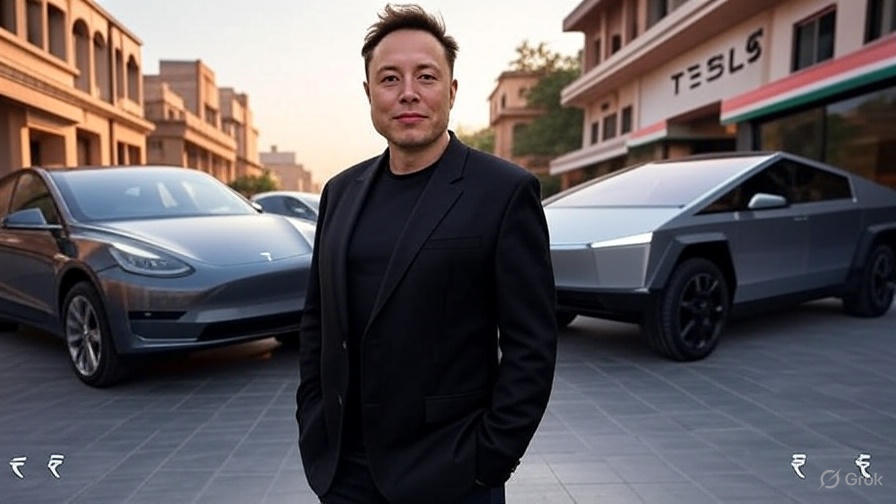
On July 15, 2025, Tesla officially entered the Indian market with the grand opening of its first Experience Center in Mumbai, inaugurated by the Chief Minister of Maharashtra. This milestone marks a significant moment for India’s electric vehicle (EV) landscape, sparking excitement, debates, and questions about Tesla’s pricing, competition, and long-term strategy in the country. With its premium electric cars, cutting-edge technology, and a bold vision for sustainable mobility, Tesla is poised to disrupt the Indian automotive industry. However, high import duties, fierce competition from local and global players, and the absence of tax concessions create a challenging environment for Elon Musk’s brainchild. This article explores Tesla’s entry into India, its pricing conundrum, competitive landscape, and what it means for Indian consumers and the EV market.
Tesla’s Grand Arrival in India
Tesla’s launch in India has been a long-awaited event, with anticipation building since 2016 when early bookings for the Model Y poured in from enthusiastic Indian consumers. The Mumbai Experience Center is a testament to Tesla’s commitment to tapping into one of the world’s fastest-growing automotive markets. The sleek, futuristic showroom allows potential buyers to experience Tesla’s vehicles firsthand, showcasing their advanced features, from autonomous driving capabilities to industry-leading safety systems.
The launch event was a spectacle, with social media buzzing with images of Tesla’s sleek Model Y and Model 3 displayed in Mumbai. However, the excitement comes with a hefty price tag, as Tesla’s vehicles in India are priced significantly higher than in other markets due to import duties. This raises the question: who is Tesla’s target audience in India, and can it compete in a market dominated by established luxury brands and local EV giants?
Why Are Tesla Cars So Expensive in India?
One of the most talked-about aspects of Tesla’s India entry is its pricing. A Tesla Model Y, which retails for approximately $37,490 (around ₹31 lakh) in the United States, costs nearly ₹60 lakh in India. This staggering price difference is primarily due to India’s import duties on Completely Built Units (CBUs). Cars with a Cost, Insurance, and Freight (CIF) value exceeding $40,000 face a 100% import duty, effectively doubling the vehicle’s cost. For cars below this threshold, the duty is 70%, still a significant markup.
Import Duties and Their Impact
India’s import duty structure is designed to protect domestic manufacturers and encourage local production. Tesla’s vehicles, currently manufactured in its Giga Shanghai factory in China, are imported as CBUs, attracting the full brunt of these duties. For instance, a Model Y with a CIF value of $40,000 incurs an additional $40,000 in taxes, pushing the final price to Indian consumers sky-high. This has led to widespread debate about whether India missed an opportunity to offer Tesla tax concessions, especially given Elon Musk’s negotiations with the government.
No Tax Breaks for Tesla
Speculation was rife that Prime Minister Narendra Modi and Elon Musk might strike a deal to reduce import duties, especially after Musk’s close ties with former U.S. President Donald Trump. However, India has stood firm on its tariff policies, earning it the nickname “Tariff King” in some circles. Commerce Minister Piyush Goyal clarified that India’s policies are designed for the entire EV sector, not individual companies. Granting Tesla special concessions would open the floodgates for other global manufacturers, including Chinese EV giant BYD, which could disrupt India’s domestic market.
Comparing Prices Globally
To understand the pricing disparity, consider Tesla’s global pricing for the Model Y:
- United States: $37,490 (₹31 lakh at ₹85/$ exchange rate)
- China: Approximately ₹31 lakh (with tax benefits)
- India: ₹60 lakh (including 100% import duty)
In China, Tesla benefits from significant tax incentives and economies of scale from its Shanghai factory, making its vehicles competitively priced. In contrast, India’s high tariffs make Tesla a premium offering, positioning it alongside luxury brands like Mercedes-Benz and BMW rather than mainstream EVs.
Tesla’s Strategy: Testing the Indian Market
Tesla’s entry strategy in India is cautious yet strategic. Rather than investing in a local manufacturing plant immediately, Tesla is testing demand by importing CBUs. This approach allows the company to gauge consumer interest without committing to the ₹4,150 crore (approximately $5 billion) investment required under India’s EV policy for reduced import duties. The policy also mandates 50% domestic value addition within three years, a condition Tesla has chosen to sidestep for now.
Why China-Made Teslas?
Tesla’s decision to import vehicles from its Shanghai factory is driven by cost efficiency. Since establishing its Giga Shanghai plant in 2019, Tesla has scaled production significantly, making China its largest market after the United States. In 2021, Tesla sold 473,000 vehicles in China, and by 2023, it was the world’s best-selling electric vehicle. By leveraging this facility, Tesla can produce vehicles at a lower cost, even if import duties inflate the final price in India.
Pre-Booking and Market Response
Tesla opened pre-bookings in India at ₹2 lakh, with deliveries expected to begin in October 2025. The response has been enthusiastic, with thousands of bookings reflecting strong consumer interest. However, the high price point limits Tesla’s appeal to affluent buyers who can afford vehicles in the ₹60 lakh+ range, a segment already dominated by German luxury brands and emerging Indian EV players like Tata and Mahindra.
The Competitive Landscape: Can Tesla Stand Out?
India’s EV market is vibrant and competitive, with domestic giants like Tata Motors and Mahindra & Mahindra leading the charge. Tata holds a commanding 62% market share in the Indian EV segment, thanks to affordable models like the Nexon EV and Tiago EV. Mahindra’s BE6 and XEV9E models are also gaining traction, offering premium features at competitive prices. Global players like Hyundai (Ioniq 5) and Kia (EV6) further intensify the competition.
Local Giants: Tata and Mahindra
Tata Motors has solidified its position as India’s EV leader with a focus on affordability and safety. Its Nexon EV, priced between ₹15-20 lakh, offers a range of over 300 km and a five-star safety rating. Mahindra, on the other hand, is betting on innovation with its BE6, which competes directly with Tesla’s Model Y in terms of features but at a lower price point. Anand Mahindra’s viral tweet welcoming Tesla while emphasizing competition highlights the confidence of Indian manufacturers. “Competition drives innovation, and there’s plenty of road ahead,” he tweeted, signaling a readiness to take on Tesla.
Global Rivals: Hyundai, Kia, and BYD
Hyundai’s Ioniq 5 and Kia’s EV6, priced around ₹45-65 lakh, offer advanced features like adaptive cruise control and high safety ratings, making them direct competitors to Tesla. Chinese EV giant BYD, already present in India with models like the Atto 3, poses a significant threat. If India were to relax import duties for Tesla, it could inadvertently benefit BYD, which dominates the global EV market.
Tesla’s Unique Selling Proposition
Tesla’s appeal lies in its brand prestige and cutting-edge technology. The Model Y boasts a range of 622 km, advanced safety features, and semi-autonomous driving capabilities. Key features include:
- Adaptive Cruise Control: Adjusts speed based on surrounding traffic.
- Automatic Emergency Braking: Stops the vehicle to prevent collisions.
- Lane-Keeping Assist: Keeps the car within lane markings, even on curves.
- Traffic Sign Recognition: Displays road signs like speed limits and school zones on the dashboard.
These features, while increasingly common in premium EVs, were pioneered by Tesla, giving it a first-mover advantage in brand perception. However, at ₹60 lakh, Tesla must convince Indian buyers that its technology justifies the premium over competitors.
The Role of Import Duties in Shaping Tesla’s Future
India’s EV policy is designed to boost domestic manufacturing while allowing limited imports at reduced duties for companies that commit to local production. Tesla’s decision to import CBUs means it misses out on these benefits, resulting in prices that deter mass-market adoption. The government’s stance is clear: invest in India to enjoy tax breaks. This policy protects local players like Tata and Mahindra while encouraging foreign companies to set up manufacturing facilities.
Could Tesla Build a Factory in India?
Elon Musk has expressed interest in establishing a Tesla factory in India, but the company is likely waiting to assess market demand before making such a significant investment. A local plant would reduce costs, enable tax benefits, and allow Tesla to compete more effectively with Indian and global rivals. States like Maharashtra, Gujarat, and Tamil Nadu, known for their automotive hubs, are potential locations for a Tesla Gigafactory.
The China Factor
Tesla’s reliance on its Shanghai factory has sparked debates about India’s trade policies with China. While Tesla is an American company, its vehicles are “Made in China,” attracting the same import duties as Chinese products. This has led to accusations that India is indirectly supporting Chinese manufacturing. However, the government’s focus on protecting domestic industries outweighs these concerns, at least for now.
Tesla’s Safety and Technology: A Game-Changer?
Tesla’s vehicles are renowned for their safety and technology, setting benchmarks in the global EV industry. The Model Y, for instance, has received top safety ratings from organizations like the NHTSA and Euro NCAP. Its features, such as automatic emergency braking and lane-keeping assist, make it a pioneer in autonomous driving technology.
Safety Features That Stand Out
- Collision Avoidance: Alerts the driver and applies brakes if a collision is imminent.
- Adaptive Headlights: Automatically switch between high and low beams based on traffic conditions.
- 360-Degree Sensors: Provide real-time feedback on surrounding obstacles.
These features resonate with Indian buyers, who prioritize safety in a country with challenging driving conditions. However, competitors like Hyundai and Kia have introduced similar technologies, narrowing Tesla’s edge.
The Autonomous Driving Debate
Tesla’s vision of fully autonomous vehicles has generated excitement and skepticism. While its Full Self-Driving (FSD) suite is not yet available in India, the prospect of driverless cars is intriguing. However, India’s complex road infrastructure, with its mix of pedestrians, animals, and unpredictable traffic, poses challenges for autonomous systems. Tesla will need to adapt its technology to local conditions to gain traction.
The Indian Consumer: Who Will Buy Tesla?
Tesla’s high prices position it as a luxury brand in India, targeting affluent buyers who might otherwise purchase a Mercedes-Benz, BMW, or Audi. These consumers value brand prestige, cutting-edge technology, and environmental consciousness. However, the ₹60 lakh price tag limits Tesla’s appeal to a niche segment, unlike in China or the U.S., where it competes in the mass premium market.
The Affluent Indian Buyer
India’s growing affluent class, particularly in metropolitan cities like Mumbai, Delhi, and Bangalore, is Tesla’s primary target. These buyers are drawn to Tesla’s futuristic appeal and eco-friendly credentials. However, they must weigh the cost against established luxury brands and emerging Indian EVs that offer similar features at lower prices.
The Role of Charging Infrastructure
One of Tesla’s challenges in India is the lack of widespread charging infrastructure. While the company plans to build Supercharger stations in major cities, the current network is limited compared to markets like the U.S. and China. For Tesla to succeed, it must invest heavily in charging stations to ensure convenience for long-distance travel, a critical factor for Indian consumers.
The Broader Impact on India’s EV Market
Tesla’s entry is a catalyst for India’s EV ecosystem. It signals to global manufacturers that India is a viable market, potentially attracting more investment. However, it also intensifies competition for domestic players, pushing them to innovate and improve their offerings.
Boosting Innovation
As Anand Mahindra noted, competition drives innovation. Tesla’s presence could spur Indian manufacturers to enhance their EV technologies, focusing on range, safety, and affordability. This benefits consumers, who will have access to better vehicles at competitive prices.
Policy Implications
India’s EV policy, with its emphasis on local manufacturing, is a double-edged sword. While it protects domestic industries, it may deter foreign players like Tesla from making significant investments. The government must balance these interests to foster a thriving EV ecosystem.
Financial Literacy: A Side Note for Indian Consumers
In addition to exploring Tesla’s entry, it’s worth addressing the financial implications of such high-value purchases. Investing in a Tesla or any luxury vehicle requires careful financial planning. For those interested in wealth creation, understanding the stock market and mutual funds is crucial.
Stock Market Fundamentals
The stock market offers opportunities for wealth creation, but it requires knowledge and discipline. Key concepts include:
- Demat Account: Essential for trading shares on exchanges like the BSE or NSE.
- Futures and Options: Derivatives that allow investors to speculate on price movements.
- Technical Analysis: Using candlestick charts and indicators to predict market trends.
- Fundamental Analysis: Evaluating a company’s financial health to make informed investments.
Courses on stock market fundamentals can help individuals navigate these complexities, minimizing risks and maximizing returns.
Mutual Funds for Passive Income
For those with limited time, mutual funds offer a passive investment option. They allow your money to grow through diversified portfolios, suitable for goals like retirement, education, or major purchases. Understanding which mutual funds align with your financial goals is key to building wealth over time.
Tesla’s Global Success: Lessons for India
Tesla’s global success provides insights into its potential in India. In 2023, the Model Y became the world’s best-selling vehicle, a first for an EV. Its growth in China, from zero sales in 2019 to over 555,000 in 2023, highlights the power of strategic pricing and local production. India could follow a similar trajectory if Tesla invests in local manufacturing and adapts to market needs.
The Dubai Example: Tesla as a Taxi
Interestingly, Tesla’s Model Y is used as a taxi in Dubai, competing with Toyota’s Camry. While this showcases the vehicle’s versatility, it also underscores the price sensitivity of different markets. In India, Tesla is unlikely to serve as a taxi due to its high cost, but the Dubai example highlights its durability and appeal in diverse use cases.
The Road Ahead for Tesla in India
Tesla’s journey in India is just beginning, but it faces significant hurdles. High import duties, competition from local and global players, and the need for robust charging infrastructure are challenges that require strategic solutions. However, Tesla’s brand strength and technological prowess give it a unique edge.
Potential Expansion Plans
Following the Mumbai launch, Tesla is rumored to be eyeing Delhi for its next Experience Center. Expanding to other metro cities and investing in Supercharger networks will be critical for capturing market share. If Tesla establishes a local factory, it could significantly reduce prices and compete more effectively.
Consumer Sentiment and Brand Perception
Indian consumers are excited about Tesla’s arrival, but the high price point has sparked mixed reactions. Social media platforms like X are abuzz with discussions about Tesla’s pricing and features, with some praising its technology and others questioning its affordability. Building a positive brand perception will be key to Tesla’s success.
Conclusion
Tesla’s entry into India is a landmark moment for the country’s EV industry, signaling a shift toward sustainable mobility. However, high import duties and fierce competition pose significant challenges. By leveraging its technological superiority and potentially investing in local manufacturing, Tesla can carve out a niche in India’s premium EV segment. For consumers, the choice to buy a Tesla will depend on their willingness to pay a premium for innovation and brand prestige. As India’s EV market evolves, Tesla’s presence will undoubtedly drive innovation, benefiting both consumers and the industry at large.
For those looking to make informed financial decisions, whether investing in a Tesla or the stock market, education is key. Explore resources on stock market fundamentals and mutual funds to build a secure financial future. As Tesla navigates India’s complex market, the road ahead promises to be both challenging and exciting.