
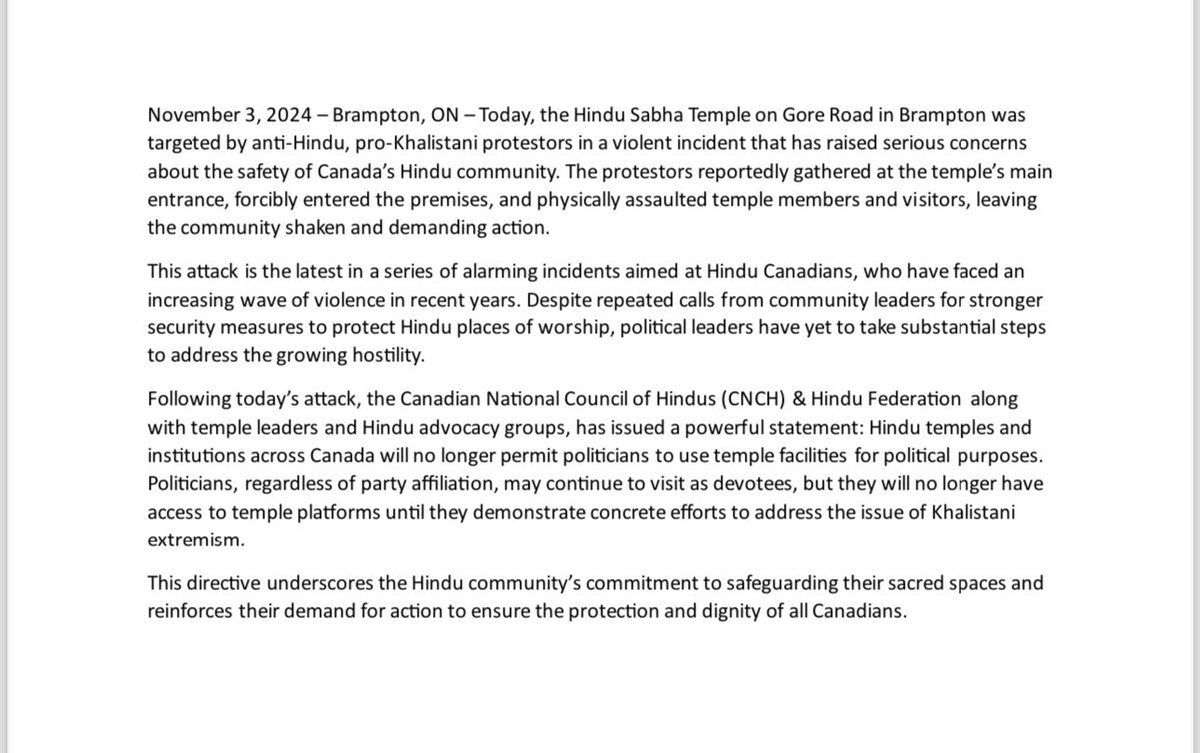
In a bold move to protect their sacred spaces, the Canadian National Council of Hindus (CNCH) and the Hindu Federation have issued a directive that bans all politicians from using Hindu temples for political purposes unless they take a firm stand against Khalistani extremism. This announcement follows a recent violent incident at the Hindu Sabha Temple in Brampton, Ontario, which has heightened concerns over the safety of Canada’s Hindu community.
Anti-Hindu Protest Sparks Outrage in Brampton
On November 3, 2024, a group of anti-Hindu, pro-Khalistani protestors targeted the Hindu Sabha Temple, located on Gore Road in Brampton. According to reports, the protestors gathered at the temple’s entrance, forcibly entered the premises, and physically assaulted both temple members and visitors. This violent attack left the community shaken, raising alarms about the escalating wave of hostility directed at Hindu Canadians in recent years.
This incident is part of a troubling trend, with Hindu temples and institutions across Canada facing similar threats. Despite repeated calls from the community for stronger security measures, little has been done to address these growing concerns.
A Call for Political Accountability
In response to the Brampton attack, the CNCH, the Hindu Federation, and other Hindu advocacy groups have made it clear that they will no longer tolerate political indifference. The joint statement issued by these organizations emphasizes that Hindu temples will remain places of worship but will no longer serve as platforms for political activities.
Under this new directive, politicians from all parties are welcome to visit Hindu temples, but only as devotees. If they wish to speak or campaign in temple settings, they must first show meaningful commitment to addressing the ongoing issue of Khalistani extremism. This move aims to hold political leaders accountable for their inaction and urges them to take a stand in safeguarding the Hindu community.
Escalating Tensions and the Role of Khalistani Extremism
The decision to restrict political access to temples comes amid rising tensions surrounding Khalistani extremism in Canada. The Khalistani movement, which advocates for the creation of a separate Sikh state, has been associated with acts of violence and extremism in various parts of the world, including Canada. For years, Hindu Canadians have voiced concerns about the increasing influence of pro-Khalistani groups, which they believe threatens their safety and the peaceful coexistence of diverse communities.
In recent years, incidents like the attack on the Hindu Sabha Temple have only amplified those fears. The Hindu community has repeatedly urged political leaders to take stronger action against Khalistani extremism and provide adequate security for temples. However, these calls have largely gone unanswered, leaving Hindu Canadians feeling vulnerable and unprotected.
Hindu Community’s Stand for Safety and Dignity
The decision by the CNCH and the Hindu Federation is a powerful statement of solidarity and resolve. It underscores the Hindu community’s determination to safeguard their sacred spaces and ensure the safety of their members. By barring politicians from temple platforms, Hindu leaders are sending a clear message: temples are not venues for political grandstanding, especially when politicians fail to address critical issues like Khalistani extremism.
This move also highlights the community’s broader demand for action from Canada’s political leadership. Hindu advocacy groups are calling for concrete steps to combat extremism and ensure that all Canadians, regardless of their faith, can live in peace and dignity.
Next Steps: What Does This Mean for Politicians?
For politicians across Canada, this new directive is a wake-up call. Hindu Canadians, who form an important and growing part of the country’s multicultural fabric, are no longer content with lip service. To regain access to temple platforms, political leaders must demonstrate genuine efforts to address the concerns raised by the Hindu community, particularly around security and extremism.
While politicians can continue to visit temples as devotees, the community’s leaders have made it clear that those who wish to use temples for public addresses or campaign events must first prove their commitment to protecting the Hindu population from the threats posed by extremism.
Conclusion: Standing Together Against Hate
The recent attack at the Hindu Sabha Temple has drawn attention to a serious and growing problem in Canada. The Hindu community, through the CNCH and Hindu Federation, has taken a firm stand to protect its sacred spaces and demand political accountability. By restricting access to politicians who fail to address the issue of Khalistani extremism, these organizations are making it clear that the safety and dignity of their members are non-negotiable.
As tensions continue to rise, it remains to be seen how political leaders will respond to this call for action. One thing, however, is certain: the Hindu community will not back down in its fight to protect its members from violence and ensure that their voices are heard in the halls of power.