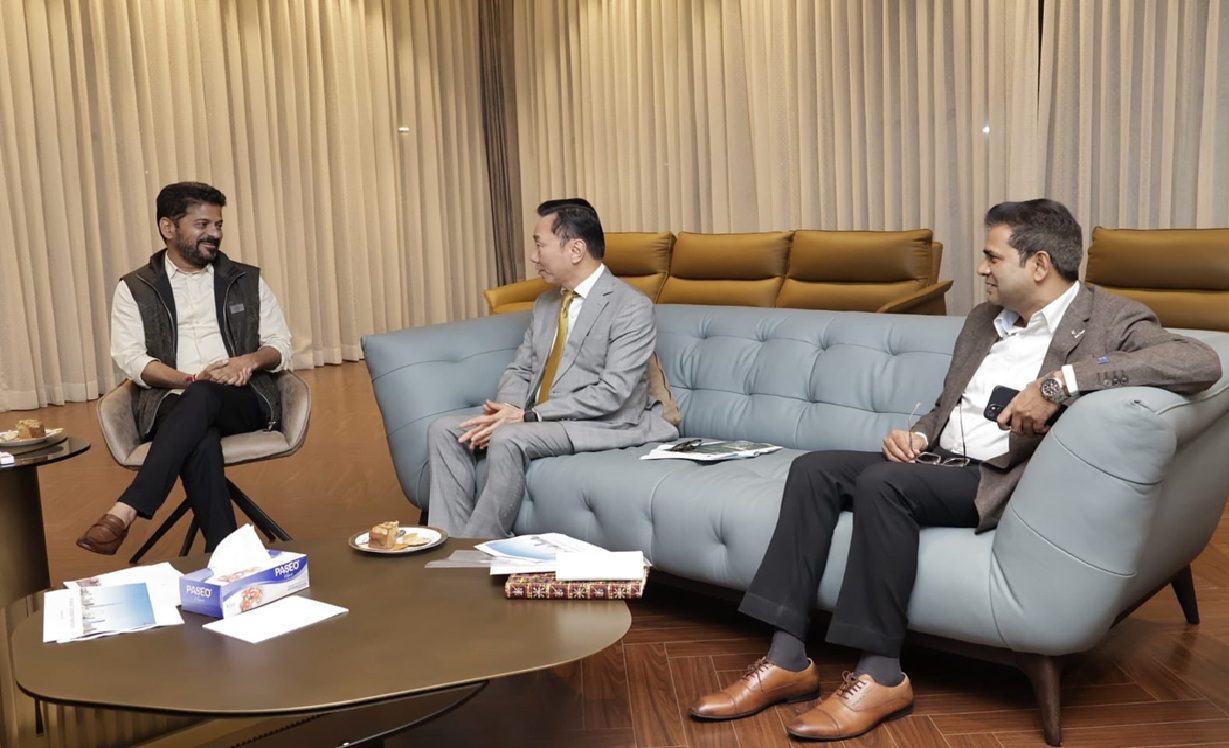
VinGroup Asia’s CEO, Pham Sanh Chau, engaged in high-stakes discussions with Telangana Chief Minister A. Revanth Reddy in New Delhi on November 15, 2025. This encounter signals VinGroup’s aggressive push into Telangana’s investment landscape, focusing on electric vehicle (EV) manufacturing, advanced battery storage solutions, and expansive renewable energy initiatives.
The talks also spotlighted the ambitious Bharat Future City project, positioning Telangana as a magnet for global innovation. As the state gears up for the Telangana Rising Global Summit 2025 on December 8-9, this partnership could catalyze billions in investments, create thousands of jobs, and accelerate India’s transition to a net-zero future.
Chief Minister Reddy’s warm invitation to Chau and VinGroup Chairman Pham Nhat Vuong underscores Telangana’s open-door policy for forward-thinking conglomerates like VinGroup, whose VinFast brand already disrupts the global EV arena.
This development arrives at a critical juncture. India’s EV market surges toward a projected $206 billion by 2030, driven by government incentives and rising consumer demand for sustainable mobility. Telangana, with its robust industrial ecosystem in Hyderabad and surrounding areas, emerges as a prime contender.
VinGroup’s interest not only validates the state’s strategic reforms but also aligns seamlessly with national goals under the India@2047 vision. Senior officials, including Special Chief Secretary Sanjay Kumar from the Industries & Commerce Department, Special Secretary B. Ajith Reddy, and Dr. Gaurav Uppal from the Secretary Coordination for GOI Projects & CSS, witnessed the dialogue, ensuring swift follow-up actions.
As we delve deeper, this article explores the multifaceted implications of this collaboration. From VinGroup’s proven track record in Asia’s EV revolution to Telangana’s blueprint for eco-friendly urban growth, these initiatives promise to reshape the region’s economic trajectory.
Expect detailed insights into EV manufacturing opportunities in Telangana, renewable energy expansions, and the transformative potential of Bharat Future City—all optimized for stakeholders eyeing high-ROI ventures in India’s southern powerhouse.
VinGroup’s Global Dominance in EV Manufacturing: Why Telangana Beckons
VinGroup, Vietnam’s largest private conglomerate, commands a formidable presence in the EV sector through its subsidiary VinFast. Founded in 2017, VinFast catapulted into the spotlight by delivering Vietnam’s first fully electric cars, amassing over 100,000 units sold domestically by 2025. The company’s aggressive expansion across Asia, including a $500 million assembly plant in Tamil Nadu, India, earlier this year, demonstrates its commitment to localized production and supply chain resilience. Now, with eyes set on Telangana, VinGroup aims to replicate this success on a grander scale.
Pham Sanh Chau’s overtures during the New Delhi meeting reveal a strategic calculus. Telangana offers unmatched advantages: a skilled workforce from institutions like IIT Hyderabad, seamless connectivity via the Hyderabad Airport, and proactive policies like the Telangana EV Policy 2020-25, which provides up to 100% capital subsidies for battery manufacturing.
Chau emphasized VinGroup’s intent to establish full-fledged EV assembly lines and gigafactory-scale battery storage facilities, potentially injecting $1-2 billion in the first phase. This move addresses India’s critical bottleneck—domestic battery production, which currently meets only 10% of demand.
Imagine sprawling manufacturing hubs in the Hyderabad Industrial Corridor, churning out affordable EVs like the VinFast VF e34, tailored for Indian roads. VinGroup’s expertise shines here; their Ha Tinh plant in Vietnam, inaugurated in June 2025, boasts an annual capacity of 300,000 units with 80% local sourcing.
In Telangana, similar localization could slash import duties, boost exports to Southeast Asia, and create 10,000 direct jobs in assembly, R&D, and logistics. Chief Minister Reddy hailed this alignment, noting how it dovetails with Telangana’s goal to host 20% of India’s EV output by 2030.
Critics might question the timing—India’s EV policy notifications lagged behind VinFast’s Tamil Nadu rollout, rendering some incentives inaccessible. Yet, Telangana’s agility shines through customized MOUs and land banks in areas like Maheshwaram, ready for plug-and-play setups. This isn’t mere opportunism; it’s a symbiotic bond. VinGroup gains a foothold in India’s 1.4 billion-strong market, while Telangana leapfrogs into the global EV supply chain, rivaling Gujarat and Maharashtra.
Telangana’s EV Manufacturing Revolution: Incentives and Infrastructure Fueling Growth
Telangana doesn’t just invite investors—it equips them for triumph. The state has transformed into an EV manufacturing powerhouse, attracting giants like Tata and Mahindra with its 200-acre dedicated zones and zero-emission mandates for new industrial parks. Under Revanth Reddy’s leadership since late 2023, the government streamlined approvals, slashing clearance times from 180 to 45 days. This efficiency drew VinGroup’s gaze, as Chau praised the “resonance” with Telangana’s visionary projects during their tête-à-tête.
Key to this allure? The Telangana Mobility Valley initiative, a 1,000 sq km corridor blending auto, aero, and EV sectors. Here, VinGroup could anchor a battery ecosystem, partnering with local firms like Megha Engineering for lithium-ion production. Government data reveals Telangana already hosts 15% of India’s EV startups, with charging infrastructure expanding at 50% annually. Subsidies cover 20% of project costs for green tech, and the state pledges renewable power at Rs 3.5 per unit—cheaper than coal-dependent rivals.
Envision the ripple effects: Farmers in rural Telangana transition to EV tractors, reducing diesel dependency by 30%. Urban commuters in Hyderabad zip through traffic in VinFast scooters, cutting emissions by 40% in pilot zones. Economists project a $5 billion GDP uplift from EV alone by 2028, with women-led cooperatives assembling components, fostering inclusive growth. Reddy’s administration smartly leverages this, tying investments to skill programs at TSIC (Telangana State Innovation Cell), training 50,000 youth yearly in EV tech.
Challenges persist—raw material sourcing and grid stability demand innovation. VinGroup’s Vietnam playbook offers solutions: vertical integration from mining to recycling, as seen in their July 2025 pact with BatX Energies for high-voltage battery repurposing. Telangana counters with solar-powered microgrids, ensuring 24/7 operations. This fusion of Vietnamese precision and Telugu dynamism positions the state as Asia’s EV vanguard.
Harnessing Solar and Wind Power: VinGroup’s Renewable Energy Push in Telangana
Beyond batteries, the horizon gleams with renewables. Chau’s interest in solar and wind projects mirrors VinGroup’s V-Green arm, which pledged $300 million for 60,000 EV charging ports in Indonesia last May. In Telangana, this translates to gigawatt-scale farms, capitalizing on the state’s 300 sunny days and Deccan winds averaging 6-8 m/s.
Telangana leads India’s renewable charge, targeting 20 GW by 2026—up from 5 GW today. The state auctions wind sites in Adilabad and solar parcels in Anantapur, offering 25-year PPAs at competitive tariffs. VinGroup eyes hybrid parks, blending solar panels with wind turbines for 24-hour output, integrated with EV grids. This synergy could power 1 million homes carbon-free, slashing CO2 by 2 million tons annually.
Reddy’s green agenda amplifies the appeal. The Telangana Green Climate Fund, seeded with Rs 10,000 crore, subsidizes 40% of capex for foreign investors. Community models empower locals: In Mahabubnagar, wind co-ops share 10% revenues, uplifting 5,000 families. VinGroup’s entry accelerates this; their Vietnamese solar farms boast 25% efficiency via AI-optimized trackers, adaptable to Telangana’s terrain.
Skeptics highlight intermittency risks, but smart storage—tied to VinGroup’s batteries—mitigates them. Projections show renewables comprising 60% of Telangana’s energy mix by 2030, exporting surplus to neighbors. This isn’t greenwashing; it’s economic alchemy, turning sun and wind into $3 billion in FDI and 15,000 green jobs.
Bharat Future City: Telangana’s Net-Zero Urban Beacon Draws VinGroup’s Visionary Stake
At the meeting’s core loomed Bharat Future City (BFC), Telangana’s audacious 30,000-acre net-zero smart city near Hyderabad. Unveiled in September 2025 by Reddy, BFC envisions a $3 trillion economy driver by 2047, spanning nine zones for AI, biotech, sports, and green pharma. Chau’s enthusiasm was palpable; he lauded its “visionary potential” and pledged VinGroup’s involvement in infrastructure and mobility layers.
Designed by U.S. firm Sasaki, BFC prioritizes sustainability: 100% renewable energy, vertical farms yielding 50% of food needs, and EV-only transport via hyperloops. Spanning Shadnagar to Maheshwaram, it allocates 5,000 acres for industrial parks, where VinGroup could embed EV showrooms and R&D labs. The city’s digital backbone—5G, blockchain governance—aligns with VinGroup’s smart city ventures in Vietnam, like Vinhomes Ocean Park.
Reddy’s Telangana Resolution 2047 frames BFC as a Fortune 500 hub, luring 100 global HQs in a decade. VinGroup’s role? Pioneering autonomous shuttles and solar canopies, reducing urban heat by 4°C. Socially, it promises 200,000 jobs, with 40% for women in tech roles, and affordable housing via modular builds.
Detractors cite land acquisition hurdles, but the government’s 70% voluntary buy-in and eco-restoration pledges assuage concerns. BFC isn’t a distant dream; Phase 1 breaks ground in 2026, with VinGroup’s infusion fast-tracking utilities. This collaboration elevates BFC from blueprint to beacon, redefining urban India.
Telangana Rising Global Summit 2025: Catalyzing VinGroup’s Mega Commitments
The summit, slated for December 8-9 in Hyderabad, serves as the perfect crescendo. Reddy’s personal invite to Chau and Vuong spotlights its prestige, building on last year’s $20 billion pledges. Expect 5,000 delegates, including Google and Microsoft execs, unveiling Telangana’s 2047 vision: a $3 trillion GDP via innovation corridors.
VinGroup’s participation could seal EV and renewable MOUs, with sessions on “Green Mobility Asia” featuring Chau as keynote. The event’s hybrid format amplifies reach, live-streaming to 100 countries. Reddy’s flair—proposing “Google Road” namings—infuses charisma, drawing parallels to Dubai’s investor wooing.
Logistics dazzle: A 10,000-sq-m expo hall showcases BFC models, while cultural nights blend Telugu heritage with global fusion. Security and sustainability underscore ethos—zero-waste venues, EV shuttles. For VinGroup, it’s a launchpad; announcements here could ripple to ASEAN markets.
Economic Ripple Effects: Jobs, GDP Surge, and Inclusive Growth in Telangana
This alliance supercharges Telangana’s economy. EV investments alone forecast 25,000 jobs, from welders to AI engineers, with spillover to SMEs in auto ancillaries. Renewables add 20,000 roles in O&M, prioritizing SC/ST youth via quotas. BFC amplifies: 100,000 construction gigs evolving into high-skill tech positions.
GDP projections soar—$10 billion infusion by 2027, per state estimates, lifting per capita income 15%. Inclusive models shine: Women SHGs manage charging stations, earning Rs 50,000 monthly. Rural electrification via wind mini-grids bridges urban-rural divides, curbing migration.
Nationally, it bolsters India’s $500 billion EV export ambition. Challenges like skill gaps? Addressed via VinGroup-TSIC tie-ups, upskilling 100,000 annually. This isn’t zero-sum; it’s multiplicative prosperity.
VinGroup’s Legacy: From Vietnamese Roots to Asian EV Titan
VinGroup’s journey inspires. Born in 1993 as Technocom, it evolved under Pham Nhat Vuong into a $20 billion behemoth, spanning realty, health, and tech. VinFast’s 2025 milestones—Hà Tĩnh plant, Indonesian chargers—cement its green pivot. Asia expansions, like Tamil Nadu’s 50,000-unit output, prove scalability.
In India, Vingroup eyes hospitality and smart cities too, per Chau’s September remarks. Telangana fits perfectly, offering regulatory ease absent in denser states.
Revanth Reddy’s Investment Magnetism: Driving Telangana’s Global Ascendancy
Revanth Reddy, Telangana’s dynamic CM, masterminds this surge. Elected in 2023, he flipped investment inflows from $5 billion to $15 billion annually via single-window clearances and farm-to-factory pipelines. His New Delhi schmoozes, like with USISPF, netted summit invites.
Reddy’s ethos: “Telangana First.” He champions green bonds for BFC funding and EV rebates for farmers. This VinGroup meet exemplifies his hustle—blending diplomacy with data-driven pitches.
Collaborative Horizons: EVs, Renewables, and Smart Cities Intersect
Future synergies abound. VinGroup’s batteries power BFC’s grid; wind farms charge EV fleets. Joint ventures in AI-driven predictive maintenance could cut costs 20%. Cross-border learnings—Vietnam’s 60% localization—elevate Telangana’s benchmarks.
Sustainability metrics? Net-zero by 2035, per aligned goals. Community buy-in via town halls ensures equity.
Forging a Greener Tomorrow: Telangana and VinGroup’s Shared Destiny
As curtains close on this landmark meet, optimism reigns. VinGroup’s Telangana foray heralds a greener, gigafried era—EVs zipping silently, winds whispering power, cities breathing easy. Reddy’s vision, fused with Chau’s ambition, propels India forward. Stake your claim at the Telangana Rising Global Summit 2025; the future accelerates here.