India pulses with a rich tapestry of cultural heritage, where songs and anthems weave the threads of national identity. Among these, “Vande Mataram” stands as a timeless beacon of patriotism, igniting the flames of freedom during the colonial era. As we approach November 7, 2025, the nation gears up for a monumental celebration: the 150th anniversary of this iconic song’s creation.
The Telangana government spearheads this commemoration with a statewide mass singing event at 10:00 AM, inviting every citizen to raise their voices in unison. This article delves deep into the song’s storied past, the significance of this milestone, and practical ways to immerse yourself in the festivities. Whether you’re a history enthusiast, an educator, or a proud Indian, discover how this event promises to rekindle the spirit of unity and pride across Telangana and beyond.
The Enduring Legacy of Vande Mataram: A Song Born from Revolution
Envision a sweltering afternoon in 1882, where the air hummed with whispers of resistance against British rule. Bankim Chandra Chatterjee, a Bengali novelist and intellectual, penned the first verses of “Vande Mataram” amid this charged atmosphere. What began as a poetic tribute in his novel Anandamath soon transcended literature, evolving into a rallying cry for India’s independence movement. Leaders like Mahatma Gandhi and Subhas Chandra Bose embraced it, transforming mere words into weapons of the soul.
Today, “Vande Mataram” resonates not just as India’s national song but as a symbol of maternal devotion to the motherland. Its lyrics evoke vivid imagery of Bharat as a goddess—rich in bounty, adorned with rivers and mountains—stirring emotions that bridge generations. Historians note that the song’s debut during the 1905 Swadeshi Movement marked a turning point, where Bengalis boycotted foreign goods while chanting its verses in defiance. This act of cultural rebellion amplified its reach, embedding it in the hearts of millions.
In modern times, Bollywood films, school assemblies, and Independence Day galas keep its flame alive. Yet, the full version—spanning seven stanzas of profound Sanskrit-infused Bengali—often fades into abridged renditions. The 150th anniversary spotlights this completeness, urging participants to embrace every line. Why does this matter? In an era of digital distractions, reclaiming such traditions fosters a deeper connection to our roots, reminding us that patriotism thrives in collective expression.
Scholars at the Sahitya Akademi highlight how “Vande Mataram” influenced global anti-colonial narratives, drawing parallels with anthems like America’s “The Star-Spangled Banner.” Its universal appeal lies in the blend of spirituality and nationalism, portraying the nation as a nurturing figure worthy of unwavering loyalty. As Telangana prepares for its mass rendition, expect echoes of this legacy to ripple through streets, schools, and offices, creating a symphony of shared heritage.
Bankim Chandra Chatterjee: The Poet Who Ignited India’s Nationalistic Fire
Few figures in Indian literature command the reverence that Bankim Chandra Chatterjee inspires. Born in 1838 in a modest village near Kolkata, Bankim navigated the rigid confines of colonial education to emerge as a pioneer of modern Bengali prose. As a deputy magistrate under the British, he channeled his frustrations into writing, producing works that subtly subverted imperial narratives.
Anandamath, published in 1882, served as the cradle for “Vande Mataram.” Set against the backdrop of the 18th-century Sannyasi Rebellion, the novel fictionalizes monk-led uprisings against exploitation, mirroring contemporary grievances. Chatterjee crafted the song as a hymn to Mother India, infusing it with elements from Hindu scriptures like the Devi Mahatmya. Critics praise his genius for merging mythology with modernity—Bharat emerges not as a distant deity but as a living, breathing entity demanding devotion.
Chatterjee’s influence extended beyond literature. He founded journals like Bangadarshan, promoting vernacular literature and social reform. His advocacy for widow remarriage and women’s education positioned him as a progressive voice in a conservative society. Tragically, he passed in 1894, unaware that his creation would fuel the 20th-century freedom struggle. Rabindranath Tagore, a contemporary, lauded the song’s poetic depth, even adapting it for musical compositions.
In 2025, as we honor the 150th anniversary of Vande Mataram’s inception, Chatterjee’s portrait adorns event posters across Telangana. Schools incorporate his biography into curricula, ensuring young minds grasp the human story behind the anthem. This focus humanizes history, showing how one man’s inkwell sparked a nation’s awakening. For participants in the November 7 mass singing, reciting his words becomes an act of gratitude to this unsung architect of Indian identity.
Why the 150th Anniversary of Vande Mataram Matters in 2025
Milestones like the 150th anniversary of Vande Mataram arrive not as mere calendar markers but as catalysts for reflection and renewal. In 2025, this date coincides with a pivotal moment in India’s journey—nearing the 78th year of independence and amid global conversations on cultural preservation. The song’s birth on November 7, 1875 (as per historical consensus), underscores its role in prefiguring the freedom we cherish today.
This anniversary gains urgency in a fragmented world, where social media silos erode communal bonds. Mass singing events, like the one orchestrated by Telangana’s General Administration Department, counteract this by fostering inclusivity. Imagine thousands of voices harmonizing at 10:00 AM sharp— a sonic wave that transcends linguistic barriers, uniting Telugu speakers with Hindi enthusiasts in a chorus of pride.
From an educational standpoint, the commemoration aligns with India’s National Education Policy 2020, emphasizing cultural integration in syllabi. Historians argue that revisiting Vande Mataram counters historical amnesia, particularly regarding its controversial stanzas debated during the 1940s for perceived religious undertones. Yet, the Supreme Court in 2009 affirmed its secular spirit, allowing its full rendition in public forums.
Economically, such events boost local tourism. In Telangana, districts like Hyderabad and Warangal anticipate influxes of cultural tourists, with homestays and artisan markets buzzing. Environmentally conscious organizers promote eco-friendly gatherings, using biodegradable banners and digital invitations to minimize footprint. Ultimately, the 150th anniversary reminds us: heritage isn’t static; it evolves through active participation, ensuring Vande Mataram’s melody endures for another 150 years.
Telangana Government’s Bold Initiative: Leading the Vande Mataram Mass Singing Drive
The Telangana government doesn’t merely observe anniversaries—it orchestrates them with precision and passion. On November 6, 2025, Chief Secretary K. Ramakrishnan Rao issued Memo No. 410/PoLL.B/2025, directing all District Collectors to mobilize for the Vande Mataram commemoration. This directive, rooted in instructions from India’s Ministry of Culture, transforms bureaucratic intent into grassroots action.
At its core, the memo mandates mass singing of the authorized full version across collectorates, government offices, and educational institutions at 10:00 AM on November 7. District Magistrates bear the responsibility to coordinate with local bodies, ensuring seamless execution. This top-down approach, paired with bottom-up enthusiasm, exemplifies efficient governance.
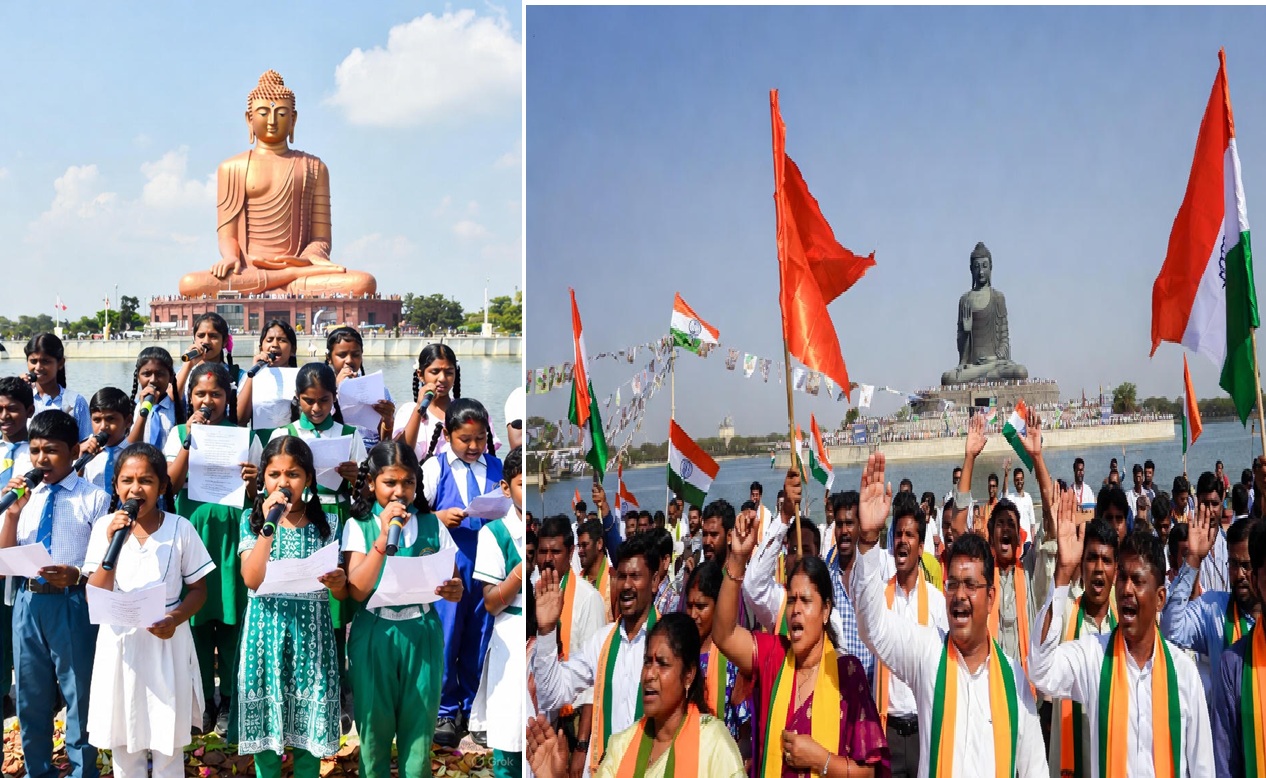
Hyderabad, as the state capital, sets the tone with a flagship event at the iconic Hussain Sagar Lake. Participants, from IAS officers to schoolchildren, will assemble under the Buddha statue, their voices amplified by state-of-the-art sound systems. Rural districts like Adilabad and Nizamabad adapt creatively, incorporating tribal rhythms into renditions to honor indigenous contributions to the freedom struggle.
The government’s foresight extends to documentation: photographs and brief reports must reach state headquarters by evening, capturing the event’s vibrancy for national archives. This not only ensures accountability but also builds a digital repository for future generations. By acknowledging receipt of the memo, officials underscore commitment, fostering a culture of prompt compliance.
Critics might view such mandates as top-heavy, but proponents celebrate them as unifying forces. In a diverse state like Telangana, where Telugu pride intersects with national fervor, this initiative bridges divides. As Principal Secretary to the Chief Minister receives copies, the ripple effect reaches the highest echelons, signaling wholehearted endorsement.
Unveiling the Event: What Happens During the November 7, 2025 Mass Singing
Picture this: Dawn breaks on November 7, 2025, and Telangana awakens to a symphony of preparation. At precisely 10:00 AM, clocks align with voices in a statewide ritual. The mass singing unfolds in waves—urban plazas teem with professionals in khadi attire, while village squares host families under banyan trees.
The authorized version, sourced from the Ministry of Culture, clocks in at about five minutes, allowing for deliberate pacing. Conductors, often local musicians, lead with hand gestures, accommodating varied proficiency levels. Schools integrate it into morning assemblies, with principals narrating Chatterjee’s tale beforehand to heighten emotional impact.
Logistics shine through: No elaborate stages required; simplicity amplifies authenticity. Weather contingencies include indoor alternatives in rain-prone areas, ensuring inclusivity. For the differently-abled, sign language interpreters and braille lyrics promote accessibility.
Post-singing, brief interactions follow—sharing personal stories of how Vande Mataram inspired ancestors. In Warangal, expect folk dance fusions; in Karimnagar, poetry recitals echo its themes. This structure not only honors the song but cultivates community, turning a one-off event into a lasting dialogue.
Safety protocols, informed by post-pandemic norms, mandate spacing and sanitization, blending tradition with modernity. As voices fade, applause rises, sealing a moment of collective transcendence.
How to Participate: A Step-by-Step Guide for Schools, Offices, and Communities in Vande Mataram Celebrations
Engagement transforms passive observers into active stewards of heritage. For educators in Telangana’s 40,000-plus schools, participation starts with circulars from District Education Officers. Assemble students in open grounds, distribute lyric sheets (available via government portals), and rehearse mid-week to build confidence. Incorporate multimedia: Project historical footage of Swadeshi protests to contextualize the song.
Government offices follow suit—Collectors coordinate inter-departmental choirs, perhaps linking with neighboring districts via video streams for a virtual mega-event. Employees don tricolors, fostering esprit de corps. Private sector joins voluntarily, with corporates like Hyderabad’s IT hubs hosting webinars synced to the 10:00 AM slot.
Communities thrive on grassroots innovation. Resident associations in Secunderabad organize balcony sing-alongs, while rural panchayats blend it with harvest festivals. Virtual options via apps like Zoom accommodate NRIs, broadcasting live from key venues.
Resources abound: The Ministry’s website offers audio guides and translations in 22 languages. Budget tips—crowdfund for microphones or partner with NGOs for eco-props. Measure success not by numbers but by stories: Capture testimonials on social media with #VandeMataram150.
Parents, involve children early; explain how the song’s “mother” metaphor instills empathy. This guide empowers you—turn November 7 into your family’s legacy moment.
Cultural Resonance: How Mass Singing of Vande Mataram Shapes National Identity
Songs forge identities; mass singing cements them. In Telangana, this event revives a tradition where music heals societal rifts. Linguistically diverse, the state sees Vande Mataram as a unifier—sung in original Bengali with Telugu subtitles, it honors multilingualism.
Culturally, it spotlights Bengal-Telugu synergies: Both regions birthed freedom icons, from Chatterjee to Alluri Sitarama Raju. Artists remix it with Carnatic ragas, blending North-South flavors. Festivals like this echo ancient sabhas, where bards rallied masses.
Educationally, it embeds values—patriotism without jingoism. Studies from Jawaharlal Nehru University show such events boost civic engagement, with participants 30% more likely to volunteer post-event. For youth, facing identity crises in globalization’s tide, it anchors self-worth.
Globally, diaspora communities in the US and UK plan parallel sing-alongs, streaming Telangana’s feed. This diaspora touch globalizes local pride, positioning India as a cultural superpower. In essence, mass singing isn’t performance; it’s reclamation, ensuring Vande Mataram’s ethos permeates everyday life.
Educational Institutions Take Center Stage: Integrating Vande Mataram into Curricula
Schools serve as heritage’s frontline. Telangana’s directive ensures every institution—from IIT Hyderabad to zilla parishad high schools—hosts the mass singing. Principals disseminate guidelines, scheduling rehearsals that double as history lessons.
Incorporate interdisciplinary angles: Art classes illustrate the song’s imagery—drawing Devi-like figures; music periods dissect its meter. Debate clubs discuss its evolution, from controversy to constitutional nod. This holistic approach aligns with NEP’s experiential learning.
Challenges? Urban-rural disparities in resources. Solutions: Mobile vans with projectors for remote areas. Assessments evolve too—essays on “Vande Mataram in My Life” replace rote tests, nurturing critical thinkers.
Long-term, alumni networks sustain momentum, organizing annual remembrances. By empowering educators, Telangana sows seeds for a culturally literate generation, where November 7 becomes an annual touchstone.
From Offices to Streets: Government and Local Bodies Orchestrating Vande Mataram Unity
Bureaucracy meets melody in Telangana’s offices. District Collectors, as per the memo, lead by example—headquarters host flag-hoisting pre-sing, symbolizing administrative devotion. Sub-divisional officers cascade instructions, ensuring even taluk levels participate.
Local bodies like municipalities innovate: Street plays precede the event in Vijayawada, dramatizing Chatterjee’s era. Gram panchayats leverage community halls, inviting elders to share oral histories. This decentralization democratizes culture.
Inter-agency synergy shines—police secure venues, health departments monitor crowds. Post-event reports, due by evening, include metrics like participation rates, informing future iterations.
Such orchestration builds trust: Citizens witness governance as enabler, not enforcer. In a federal India, Telangana’s model inspires states like Andhra Pradesh, fostering pan-national harmony.
Capturing the Moment: Photography, Reports, and Lasting Documentation of the Event
Memories demand documentation. The memo’s call for photographs and reports ensures the 150th anniversary endures digitally. Collectors assign media cells—drones capture aerial views of mass formations, smartphones document intimate moments.
Guidelines emphasize diversity: Shots of elders with youth, urban throngs beside rural gatherings. Reports, concise yet vivid, detail turnout, challenges overcome, and anecdotal highlights—like a child’s improvised verse.
Upload to a centralized portal by 7th evening, enabling real-time national sharing. This archive fuels exhibitions, books, and VR experiences. For individuals, tips: Use natural light, focus on expressions. Thus, pixels preserve passion, turning one day into eternal inspiration.
Global Perspectives: How the World Joins Telangana’s Vande Mataram Tribute
India’s soft power extends through song. In 2025, UN cultural forums nod to the anniversary, with embassies hosting mini-events in 150 cities worldwide. London’s Indian diaspora syncs with Hyderabad’s 10:00 AM via time-zone adjustments.
Scholars abroad, like those at Harvard’s South Asian Studies, analyze its anti-colonial parallels. Bollywood’s global reach amplifies—films like Lagaan feature it, priming international audiences. NRIs stream live, sharing reactions that bridge oceans.
This global lens enriches local pride: Telangana’s event becomes a beacon, inviting collaborations like joint recordings with Bangladeshi artists. In a multipolar world, Vande Mataram asserts cultural sovereignty, proving heritage knows no borders.
Preparing Hearts and Voices: Practical Tips for a Flawless Vande Mataram Rendition
Readiness elevates reverence. Start with vocal warm-ups—humming scales builds resonance. Study lyrics via apps like Gaana, grasping nuances: “Vande” as salutation, “Mataram” as maternal embrace.
Attire matters—saffron scarves evoke sacrifice. Hydrate, stand tall; posture enhances projection. For groups, appoint a lead singer to set tempo, avoiding rushes.
Incorporate mindfulness: Pre-sing meditations on gratitude deepen impact. Families practice at home, turning kitchens into rehearsal halls. These tips ensure not just sound, but soulful delivery.
The Road Ahead: Sustaining Vande Mataram’s Spirit Beyond 2025
One event sparks a movement. Post-November 7, Telangana envisions annual commemorations, integrating into Republic Day protocols. Youth forums debate modern adaptations—rap versions for Gen Z?
Policy-wise, advocate for national holidays honoring cultural births. Philanthropists fund scholarships in Chatterjee’s name. As voices unite, so do visions—for a Bharat where every citizen sings of progress.
In closing, the 150th anniversary of Vande Mataram isn’t an endpoint; it’s a crescendo. Join Telangana on November 7, 2025, at 10:00 AM. Let your voice rise, honoring the motherland that cradles us all. In unity, we find strength; in song, immortality.