Introduction: Ushering in a New Transportation Era for Hyderabad
The Outer Ring Train project heralds a transformative chapter in India’s transportation sector, poised to revolutionize connectivity around Hyderabad. Stretching an impressive 392 kilometers, this pioneering initiative by South Central Railway (SCR) has finalized its alignment, linking eight districts and 14 mandals. With a projected cost of ₹12,070 crores and the addition of 26 new railway stations, this marks India’s first ring rail network. Designed to drive regional development and integrate with existing infrastructure, the Outer Ring Train promises to enhance travel efficiency, spur economic growth, and champion sustainable living.
Project Overview: Unveiling the Ambitious Scope of the Outer Ring Train
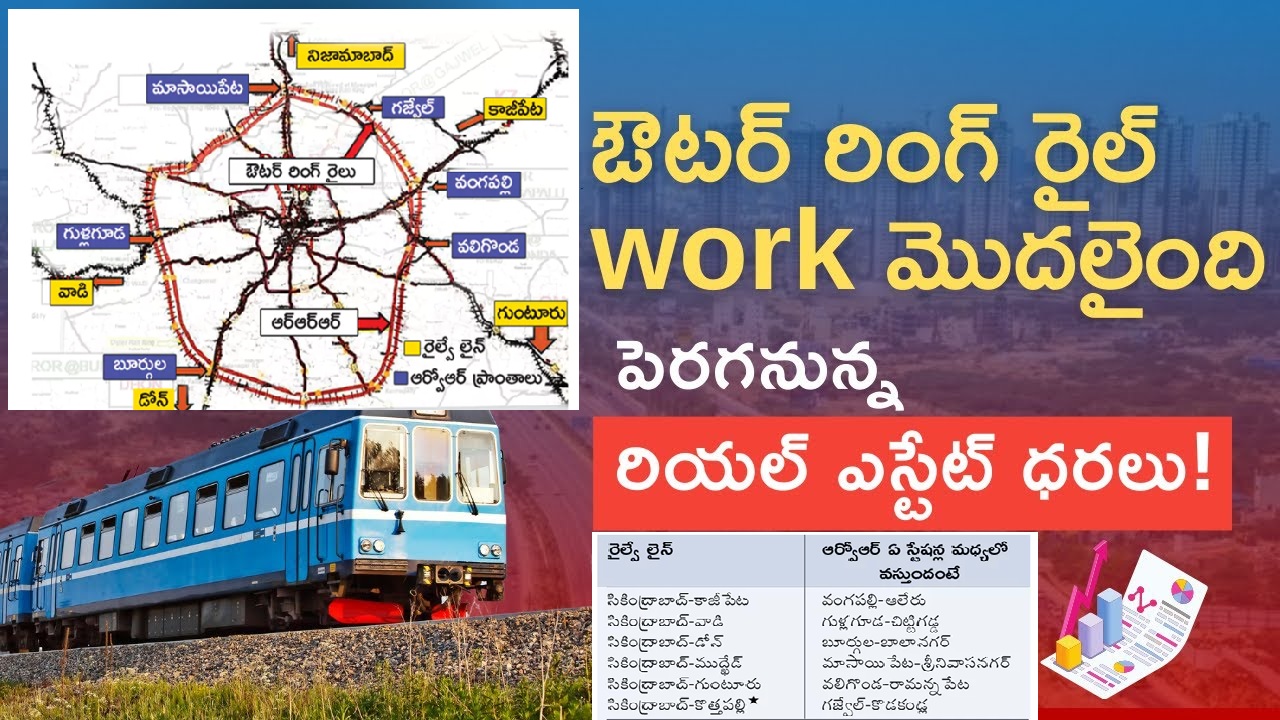
The Outer Ring Train spans eight vital districts—Medak, Sangareddy, Vikarabad, Ranga Reddy, Mahbubnagar, Nalgonda, Yadadri-Bhuvanagiri, and Siddipet—encompassing 14 mandals. This expansive network will introduce 26 new railway stations, strategically placed to serve both urban and rural communities. SCR authorities have refined the route from an initial 508 kilometers to a streamlined 392 kilometers, optimizing travel distances while ensuring proximity to the Regional Ring Road (RRR), typically 3-5 kilometers away, with some sections reaching up to 11 kilometers.
The project incorporates six ‘Rail Over Rail’ (ROR) overpasses at key locations including Masayipet, Gullaguda, Burgula, Valigonda, Vangapalli, and Gajwel. These elevated flyovers will enable the new line to cross existing tracks seamlessly, reducing operational conflicts. As SCR prepares to submit the Detailed Project Report (DPR) to the Railway Board, this project moves closer to realization.
Strategic Alignment: Enhancing Accessibility and Growth
Originally proposed at 508.45 kilometers, the Outer Ring Train’s alignment underwent a rigorous evaluation by SCR, which presented three options: 508.45 km, 511.51 km, and the selected 392.02 km. After deliberation, Union Railway Minister Ashwini Vaishnaw and Union Minister of Coal Kishan Reddy approved the 392-km route. This choice reflects a deliberate strategy to align the rail network closely with the RRR, boosting accessibility to burgeoning regions while shortening the overall distance.
Compared to the initial 508-km plan, the finalized 392-km alignment brings the railway nearer to high-potential development zones, unlocking vast opportunities for economic and infrastructural progress. This optimized route not only reduces travel time but also positions the Outer Ring Train as a catalyst for widespread regional advancement.
Infrastructure Innovations: Cutting-Edge Design and Links
The Outer Ring Train project showcases advanced infrastructure to support its vast network. The six ROR overpasses at Masayipet, Gullaguda, Burgula, Valigonda, Vangapalli, and Gajwel exemplify innovative engineering, allowing the new line to rise above existing tracks for uninterrupted service. These elevated structures enhance efficiency and safety across the network.
Additionally, the project aligns with the 361-km RRR, maintaining a consistent 3-5 km proximity in most areas. This strategic placement fosters multimodal connectivity, integrating railway stations with bus services and the Hyderabad Metro. Travelers will enjoy seamless transitions between transport modes, creating a cohesive travel ecosystem tailored to diverse needs.
Economic Boost: Driving Prosperity Across Regions
The Outer Ring Train is set to accelerate economic development in adjacent areas by improving transportation links. By aligning closely with the RRR, the project facilitates robust road and rail-based growth. Businesses will experience reduced logistics costs, while new industrial and commercial zones can flourish along the route. This enhanced connectivity is poised to attract investments, create jobs, and invigorate local economies.
The railway’s proximity to Hyderabad’s outskirts will also spur the growth of new townships and residential areas. As urban expansion continues, the Outer Ring Train will act as a vital lifeline, connecting rural regions to the city’s economic hub. This balanced growth approach ensures development extends beyond Hyderabad to neighboring districts.
Environmental Advantages: Leading Sustainable Travel
In today’s sustainability-focused world, the Outer Ring Train emerges as an eco-conscious transportation solution. By encouraging public transport usage, the project aims to decrease dependence on private vehicles. This shift will lower fuel consumption and significantly reduce pollution, contributing to cleaner air and a healthier environment.
The initiative supports national objectives to promote environmentally friendly transport systems. As more people choose the Outer Ring Train, reduced vehicular emissions will aid Hyderabad’s transition to a greener city. This dedication to sustainability sets a precedent for future infrastructure projects across India.
Regional Upliftment: Empowering Rural and Suburban Zones
A key benefit of the Outer Ring Train is its ability to uplift rural and suburban areas. By improving rail connectivity between Hyderabad and its neighboring districts, the project decentralizes development. Growth will no longer concentrate solely in the city but will extend to regions like Medak, Sangareddy, and Mahbubnagar.
This enhanced access will drive the development of new townships, residential complexes, and commercial hubs. Rural farmers, artisans, and small entrepreneurs will gain easier market access, enhancing their livelihoods. The Outer Ring Train thus serves as a driver of inclusive growth, spreading prosperity across the region.
Multimodal Integration: Unifying Transport Systems
The Outer Ring Train introduces a unified multimodal connectivity framework, transforming travel experiences. Railway stations along the 392-km network will connect effortlessly with bus services and the Hyderabad Metro, offering passengers multiple transport choices. This integration eliminates the inconvenience of mode switches, delivering a smooth and efficient journey.
For commuters, this means faster trips to workplaces, schools, or recreational spots. For businesses, it ensures improved supply chain efficiency. This multimodal strategy positions Hyderabad as a progressive city, equipped to handle the needs of a growing population with a top-tier transportation network.
Challenges and Resolutions: Navigating Obstacles
The Outer Ring Train project, while promising, faces certain challenges. Constructing six ROR overpasses and establishing 26 new stations demands precise planning and significant funding. Land acquisition and environmental approvals may also present hurdles.
SCR addresses these challenges proactively. The 392-km alignment minimizes land needs, while the DPR will feature thorough environmental impact assessments. Partnerships with local authorities and stakeholders ensure issues are resolved, smoothing the path for successful implementation.
Map for Outer Ring Train
- Background: Use a light gray base map of Hyderabad and its surrounding districts (Medak, Sangareddy, Vikarabad, Ranga Reddy, Mahbubnagar, Nalgonda, Yadadri-Bhuvanagiri, Siddipet).
- Outer Ring Rail Line: Draw a bold red line forming a 392-km circular route around Hyderabad, labeled “Outer Ring Rail” in red text.
- Key Stations: Mark 26 stations with black dots and label them in black text: Aleeru, Valigonda, Gullaguda, Masayipet, Gajwel, etc., evenly spaced along the red line.
- District Boundaries: Outline district boundaries with thin black lines and label each in blue text.
- Regional Ring Road (RRR): Draw a dashed orange line inside the red rail line, representing the 361-km RRR, maintaining a 3-5 km distance, with some stretches up to 11 km.
Future Outlook: Envisioning a Connected Tomorrow
The Outer Ring Train project lays the foundation for a transformative future. As the DPR gains approval and construction commences, the network will become a lifeline for millions. Its success could inspire similar ring rail systems in other cities, setting a new benchmark for urban and regional connectivity.
With its emphasis on economic growth, environmental stewardship, and inclusive development, the Outer Ring Train embodies a comprehensive vision. It promises to reshape Hyderabad’s transportation landscape, establishing a model for innovation and progress in India’s infrastructure domain.
Conclusion: Embracing the Outer Ring Train Transformation
The Outer Ring Train project transcends a mere rail network—it embodies a commitment to progress, sustainability, and regional cohesion. Spanning 392 kilometers across eight districts, this ambitious SCR initiative is poised to redefine connectivity and fuel economic prosperity. Featuring 26 new stations, six ROR overpasses, and seamless multimodal integration, it offers a vision of a future where travel is efficient, eco-friendly, and all-encompassing.
As Hyderabad prepares for this transportation revolution, the Outer Ring Train stands ready to unite communities, empower economies, and safeguard the environment. This pioneering effort is not just a journey—it’s a destination toward a brighter, more connected future.