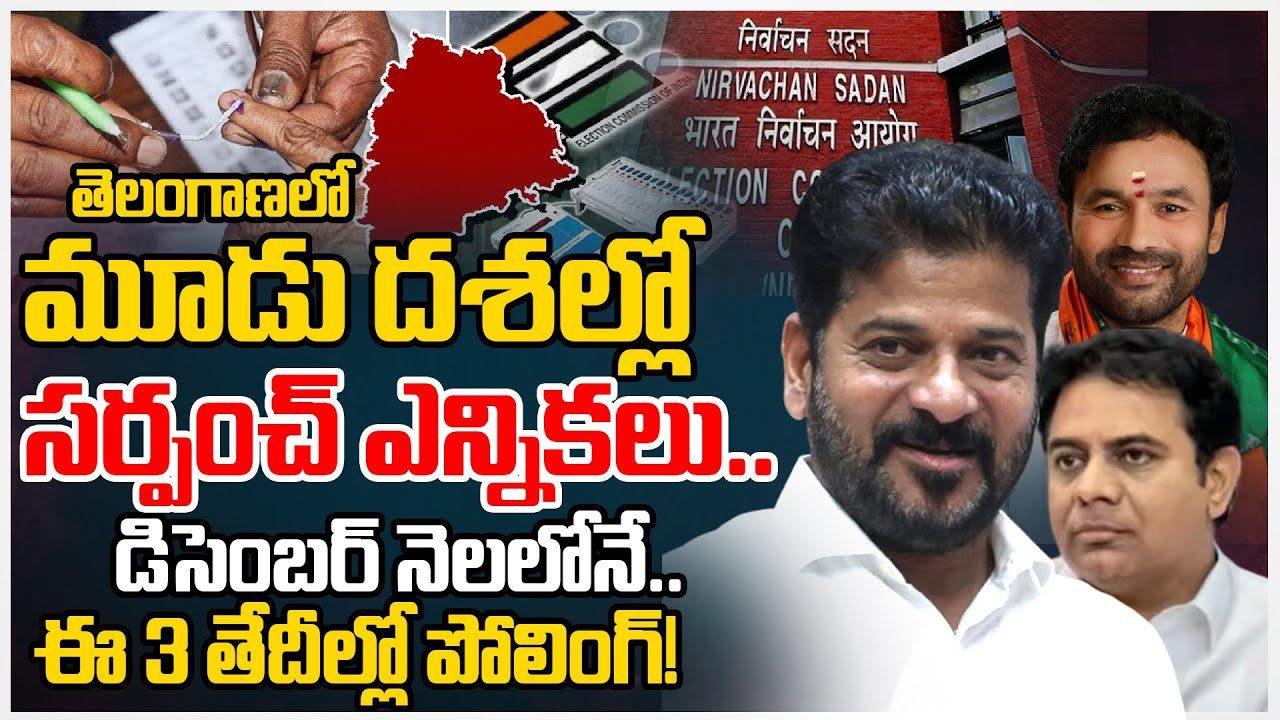
Telangana’s rural heartlands buzz with anticipation as the State Election Commission unleashes the much-awaited schedule for the 2025 Gram Panchayat elections. Spanning three dynamic phases on December 11, 14, and 17, these polls promise to reshape local governance across 12,735 Gram Panchayats. With over 1.66 crore voters poised to cast their ballots, this electoral showdown isn’t just about sarpanch seats—it’s a battleground for political prestige, reservation rights, and rural revival.
From the bustling villages of Siddipet to the resilient communities of Jogulamba Gadwal, candidates gear up amid legal tussles over Backward Classes (BC) quotas. Dive into this comprehensive guide: uncover the phase-by-phase timeline, district-wise breakdowns, party strategies, and why these elections could redefine Telangana’s grassroots democracy.
Unpacking the Telangana Gram Panchayat Elections 2025: A Long-Awaited Rural Revolution
Communities across Telangana have hungered for fresh leadership in their Gram Panchayats for nearly 20 months. Since the last polls wrapped up, special administrators have steered village affairs, often leading to stalled projects and frayed services. Streetlights flicker unrepaired, water schemes gather dust, and essential amenities languish in limbo. Now, the State Election Commission steps in with vigor, announcing elections that ignite a statewide frenzy. Officials release the notification under Rule 5 of the Telangana Panchayat Raj (Conduct of Election) Rules, 2018, kicking off a meticulously planned process.
This isn’t mere routine—it’s a revival. The elections target 12,735 Gram Panchayats, empowering locals to elect sarpanches who drive real change. Voters, numbering around 1.66 crore, hold the key to unlocking development funds and restoring order. Yet, delays stemmed from heated debates over reservations, particularly the push for 42% allocation to BCs. Courts intervened, capping quotas at 50% per Supreme Court precedents, forcing the government to pivot. As a result, the commission greenlights polls under existing norms, ensuring no further postponements that could jeopardize central funding—estimated at ₹4,000 crore—vital for village infrastructure.
Chief Minister A. Revanth Reddy’s administration views these elections as a litmus test. After triumphs in urban arenas like Jubilee Hills, Congress eyes rural strongholds to cement its grip. Opposition parties, including Bharat Rashtra Samithi (BRS) and Bharatiya Janata Party (BJP), counter with their own narratives of past glories and future promises. In villages from Adilabad’s tribal belts to Nagarkurnool’s arid expanses, aspirants rally supporters, turning quiet hamlets into hubs of hoopla. This electoral wave doesn’t just fill seats; it signals a shift toward accountable, community-led progress.
Detailed Election Schedule: Navigating Phases One, Two, and Three for Aspiring Candidates
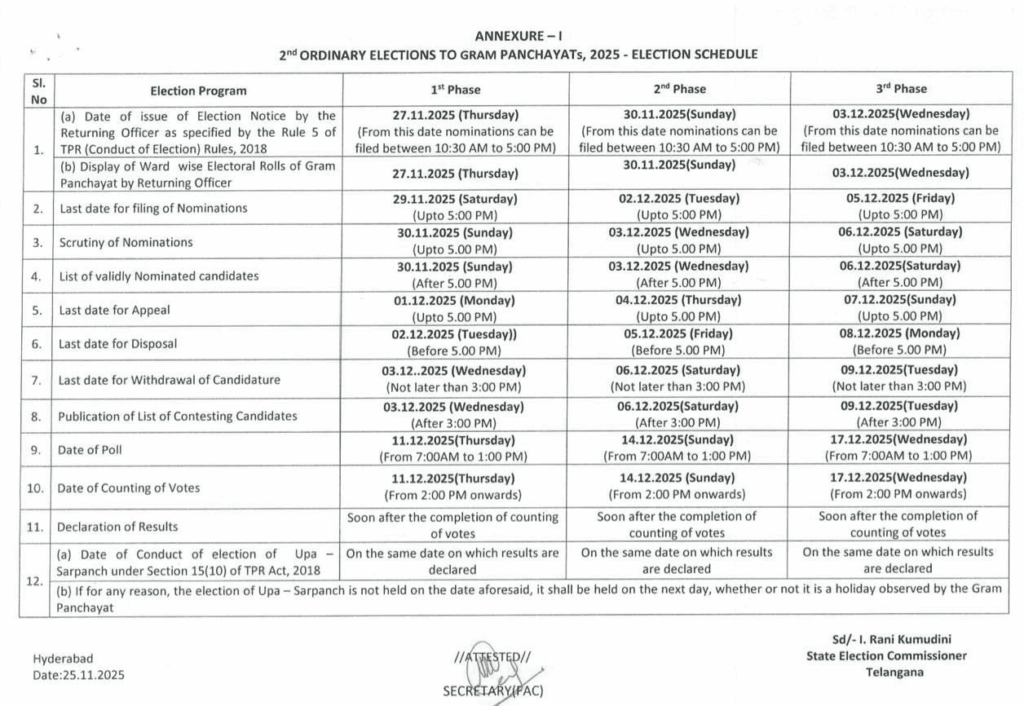
The Telangana Gram Panchayat elections unfold in three staggered phases, a strategic move to manage logistics across the state’s diverse terrain. Phase one fires the starting gun on November 27, 2025, with notifications issued between 10:30 AM and 5:00 PM. Returning officers then display ward-wise electoral rolls on November 29, setting the stage for nominations. Aspiring candidates file papers up to 5:00 PM that day, followed by scrutiny on November 30 until 5:00 PM. Validly nominated contenders emerge by 5:00 PM, with appeals wrapping up by December 1 and disposals by December 2, all before 5:00 PM.
Withdrawals conclude by 3:00 PM on December 3, paving the way for the contesting candidates’ list publication at 3:00 PM that Wednesday. Polling day arrives on December 11, from 7:00 AM to 1:00 PM, with vote counting kicking off at 2:00 PM on December 12. Results declare soon after, adhering to Section 15(10) of the Telangana Panchayat Raj Act, 2018. If unforeseen hiccups delay polling, it shifts to the next day, holiday or not, underscoring the commission’s commitment to unbroken momentum.
Phase two mirrors this rhythm, starting notifications on November 30 between the same hours. Electoral rolls go public on December 2, nominations close at 5:00 PM, and scrutiny happens on December 3. Appeals end December 4, disposals December 5, and withdrawals by 3:00 PM on December 6. The contesting list drops at 3:00 PM that Saturday, leading to polls on December 14 from 7:00 AM to 1:00 PM. Counting follows on December 15 at 2:00 PM onward, with declarations trailing swiftly.
Phase three caps the trilogy: notifications on December 3, rolls on December 5, nominations by 5:00 PM, scrutiny December 6, appeals and disposals December 7 and 8. Withdrawals cease at 3:00 PM on December 9, the list publishes at 3:00 PM, and polling unfolds December 17 from 7:00 AM to 1:00 PM. Final counts begin December 18 at 2:00 PM. This phased approach ensures fair play, allowing officials to deploy resources efficiently—EVMs, security, and observers—across Telangana’s 33 districts.
For candidates, timing is everything. Early birds in phase one, like those in Adilabad or Bhadradri Kothagudem, gain a head start on campaigning. Later phases, hitting urban-rural fringes in Warangal or Yadadri Bhuvanagiri, build on initial buzz. Voters, prepare your IDs and mark your calendars; your voice shapes the sarpanches who’ll champion your needs.
District-Wise Gram Panchayat Insights: Spotlight on High-Stakes Areas Like Siddipet and Jogulamba Gadwal
Telangana’s electoral map reveals stark contrasts across its 33 districts, with 12,735 Gram Panchayats in play. Adilabad leads with 473 total panchayats, 23 allocated to BCs at 4.86%. Bhadradri Kothagudem follows with 471, but zero BC allocations—a glaring zero percent that sparks outrage among Backward Classes leaders. Hanamkonda boasts 210 panchayats, 45 for BCs (21.43%), while Jogulamba Gadwal surges ahead with 255 total and 70 BC seats (27.45%)—the highest percentage, fueling fierce contests.
Jagitial’s 385 panchayats include 98 BC allocations (25.45%), and Jayashankar Bhupalpally’s 248 see 46 (18.55%). Kamareddy’s 532 panchayats allocate 123 to BCs (23.12%), a robust share reflecting demographic heft. Karimnagar’s 318 get 84 (26.42%), and Khammam’s 571 claim 54 (9.46%). Mahabubabad’s 482 have 19 (3.94%), drawing criticism for underrepresentation.
Mahabubnagar’s 423 panchayats assign 86 to BCs (20.33%), Mancherial’s 306 get 23 (7.52%), and Medak’s 492 secure 108 (21.95%). Mulugu’s modest 146 include just 5 (3.42%). On the flip side, Nagarkurnool’s 460 panchayats allocate 61 (13.26%), Nalgonda’s 869 boast 139 (15.99%), and Narayanpet’s 272 claim 72 (26.47%)—another hotspot.
Nirmal’s 400 panchayats have 72 BC seats (18.00%), Nizamabad’s 545 get 125 (22.94%), and Peddapalli’s 263 include 69 (26.24%). Rajanna Sircilla’s 260 allocate 56 (21.54%), Rangareddy’s 526 get 92 (17.49%), Sangareddy’s 613 have 117 (19.09%), and Siddipet’s 508 secure 136 (26.77%)—the raw highest number, positioning it as a BC powerhouse.
Statewide, 2,176 of 12,735 panchayats go to BCs (17.08%), a figure that irks activists demanding more. Districts like Bhadradri Kothagudem face boycotts, with leaders like Srinivas Goud and R. Krishnaiah decrying the “betrayal.” Jogulamba Gadwal and Siddipet, conversely, emerge as success stories, where BC candidates sharpen strategies for victory. These allocations don’t just divide seats—they ignite debates on equity, urging the government to refine future quotas.
Reservation Controversies in Telangana Panchayat Polls: The 42% BC Quota Saga and Courtroom Dramas
At the epicenter of the 2025 Gram Panchayat elections lies a thorny issue: reservations for Backward Classes. The Revanth Reddy government pledged 42% for BCs, a bold move to uplift marginalized groups. Lawmakers introduced a bill post-caste census, forwarding it to the center. An ordinance followed, pending gubernatorial nod. Yet, petitioners challenged it in the Telangana High Court, which stayed the Government Order (GO) No. 9, citing breaches of the 50% cap enshrined in Supreme Court rulings like Indra Sawhney.
The saga escalated. The High Court quashed prior attempts, pushing the state toward the apex court. Justices like Ishwarayya and Chandrakumar, alongside IAS stalwarts, weighed in on constitutional limits. Exceeding 50% risked invalidation, as precedents demand. The government, undeterred, fights on—legally battling for enhanced quotas while proceeding with old norms to avoid total collapse.
This compromise irks BC federations. Protests erupt, with demands for the promised 42% before polls. “The government hoodwinked us,” thunders a BC leader from Siddipet, where 136 seats tantalize yet feel insufficient. In Bhadradri Kothagudem, zero allocations ignite fury: “Not even a single seat? This mocks our census data.” Seven districts cap BC shares below 10%, amplifying cries of injustice. Narayanpet’s 26.47% and Jogulamba Gadwal’s 27.45% stand as beacons, but overall, the 17.08% statewide average falls short.
Politically, this fuels division. Congress treads carefully, balancing welfare schemes like saree distributions to women with electoral urgency. BRS accuses delays of sabotaging rural progress, while BJP positions as the equitable alternative. As polls near, BC outfits vow scrutiny—boycotts loom if grievances fester. The government must navigate this minefield, perhaps via dialogues or interim tweaks, to harness BC votes without derailing the democratic train.
Rural Development at Stake: How Delays Cost Telangana Villages ₹4,000 Crore and Stalled Progress
Twenty months of administrative limbo have exacted a heavy toll on Telangana’s villages. Central funds totaling ₹4,000 crore, earmarked for Gram Panchayats under schemes like MGNREGA and PMAY, evaporate unused. Roads crumble, schools shutter early, and sanitation drives halt. In Sangareddy, a half-built community hall symbolizes neglect; in Vikarabad, irrigation channels dry up, parching farmlands.
Elections promise resuscitation. Elected sarpanches access these funds directly, channeling them into tangible wins: solar streetlights in Jagitial, women’s self-help groups in Khammam, youth skill centers in Warangal. The three-phase rollout ensures no village waits indefinitely—phase one’s December 11 polls revive Adilabad’s 473 panchayats first, injecting vitality.
Yet, reservation rows exacerbate delays. BC underrepresentation in districts like Mahabubabad (3.94%) risks alienating key demographics, slowing consensus. Political parties exploit this: BRS harks back to KCR-era booms, claiming Congress’s “urban bias” starves villages. Congress counters with Revanth Reddy’s six guarantees, from free bus rides to farm loan waivers, positioning polls as validation.
Voters sense the urgency. In Nalgonda’s 869 panchayats, elders reminisce about pre-delay efficiencies; youth demand digital governance. Post-poll, expect a surge: sarpanches prioritizing eco-friendly projects in Medak, health camps in Nirmal. This election isn’t abstract—it’s the lifeline for rural Telangana, where 60% of the population resides, ensuring funds flow and dreams take root.
Political Battlegrounds: Congress, BRS, and BJP Gear Up for Panchayat Power Plays
The 2025 Gram Panchayat elections morph into a high-octane tripartite clash, with sarpanch races as proxies for broader ambitions. Though officially non-partisan—no party symbols on ballots—alliances simmer beneath. Congress, buoyed by Jubilee Hills’ bypoll win, storms rural turf. Revanth Reddy’s team eyes 40% seat shares, leveraging schemes like Indiramma houses and Rythu Bharosa. “We’ve proven urban mettle; now, villages will affirm our vision,” declares a party strategist from Rangareddy.
BRS, stinging from urban setbacks, rebounds in heartlands. KCR’s legacy—mission bhagiratha water, Harithaharam greenery—resonates. “Villages thrived under us; Congress’s delays wrecked that,” they argue, banking on anti-incumbency over unfulfilled promises. In Peddapalli and Rajanna Sircilla, BRS strongholds, they predict 35% hauls, turning voter ire into seats.
BJP, the dark horse, expands from urban enclaves. “Telangana seeks change; we’re the credible alternative,” they proclaim, targeting 25% via Ram Navami fervor and Ayushman Bharat tie-ins. In urban-rural hybrids like Hyderabad fringes, BJP woos with infrastructure vows. Alliances whisper: BRS-BJP pacts in select panchayats to blunt Congress.
Post-sarpanch, ZPTC and MPTC polls intensify partisanship, with parties openly backing proxies. BC quotas add spice—federations may tilt toward Congress if concessions flow, or BRS if history binds. Youth and women, empowered by 50% women’s reservation, emerge as kingmakers. This panchayat frenzy foreshadows 2028 assembly battles, where rural math decides Hyderabad’s throne.
Voter Empowerment in Telangana 2025 Polls: 1.66 Crore Voices and What They Demand
Over 1.66 crore voters—men, women, youth—stand ready to redefine their villages. Electoral rolls, displayed phase-wise, ensure inclusivity; appeals and scrutineys weed out discrepancies. Women, holding 50% seats, demand safe streets and creches; farmers seek crop insurance; tribals in Adilabad push eco-conservation.
Turnout could hit 75%, up from past polls, fueled by EVM simplicity and awareness drives. The code of conduct, active from November 25, curbs muscle-flexing— no lavish rallies, no cash inducements. Voters prioritize: 60% cite development, 25% reservations, 15% party loyalty.
In Siddipet, 508 panchayats draw tech-savvy youth eyeing digital services. Jogulamba Gadwal’s 255 see women-led cooperatives bloom. Challenges persist: migrant laborers in Khammam risk missing polls; illiteracy in Mulugu hampers choices. Yet, commissions’ SVEEP campaigns—street plays, apps—bridge gaps.
Your vote? It elects watchdogs against corruption, architects of progress. As December dawns, Telangana’s electorate awakens, demanding transparency and equity in every booth.
Beyond the Ballot: Long-Term Impacts on Telangana’s Grassroots Governance
These elections ripple far. Elected bodies unlock 15th Finance Commission grants, spurring roads, schools, sanitation. BC empowerment, despite rows, fosters diversity—imagine sarpanches from marginalized castes championing inclusion in Nizamabad’s 545 panchayats.
Politically, winners build assembly war chests; losers recalibrate. Environmentally, green mandates could transform Warangal’s 317 panchayats into model villages. Economically, skilled leadership attracts investments, curbing urban migration.
Challenges loom: post-poll violence, fund misuse. Yet, with vigilant voters and robust oversight, Telangana charts a democratic ascent. As phases unfold, watch villages evolve—from passive hamlets to empowered hubs.
In wrapping up, the 2025 Gram Panchayat elections embody hope. From November 27’s notifications to December 17’s finale, 12,735 panchayats await renewal. Congress, BRS, BJP vie fiercely, but voters hold sway. Tune in for results; Telangana’s rural renaissance begins now.