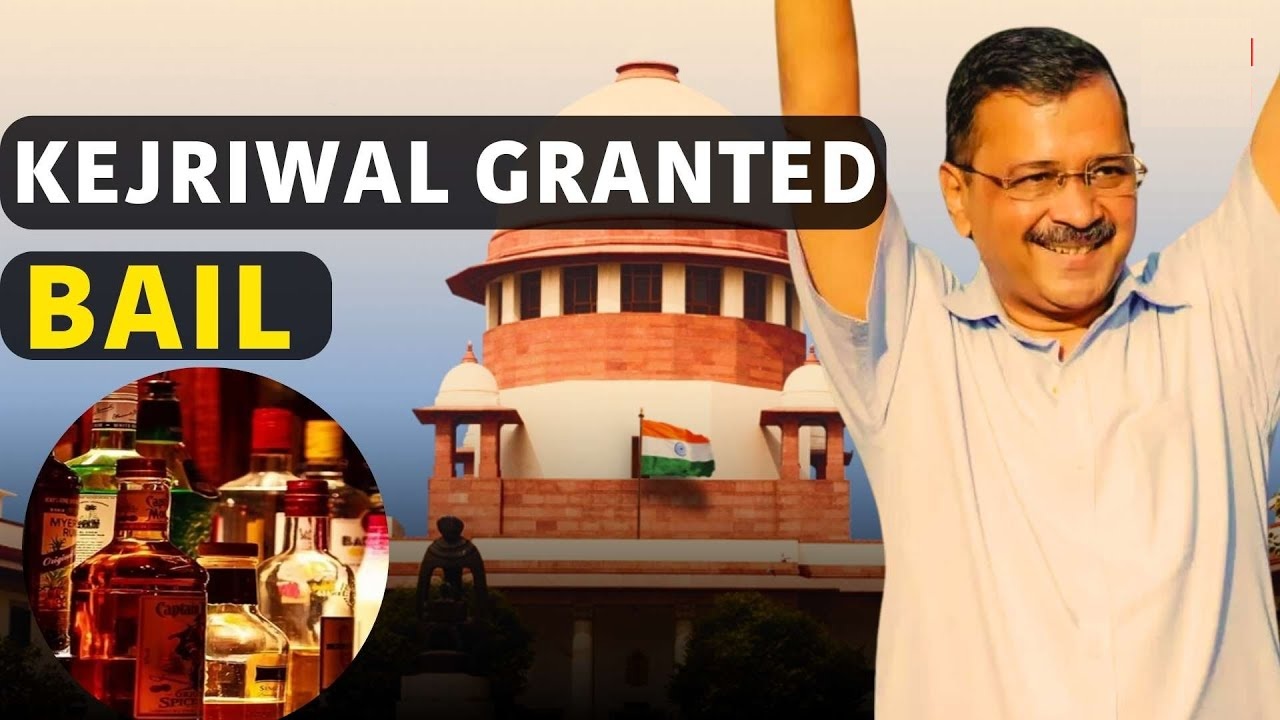
In a significant ruling, the Supreme Court granted bail to Delhi Chief Minister Arvind Kejriwal in the ongoing CBI investigation concerning the Delhi liquor policy case. The Central Bureau of Investigation (CBI) had filed a First Information Report (FIR) against Kejriwal, accusing him of involvement in a liquor policy scam. The Chief Minister’s arrest and subsequent legal proceedings have garnered substantial media attention due to the high-profile nature of the case.
Arvind Kejriwal’s Arrest and Legal Battle
Arvind Kejriwal, leader of the Aam Aadmi Party (AAP) and Delhi’s Chief Minister, was arrested by the CBI as part of an investigation into alleged irregularities in the capital’s liquor policy. The arrest was challenged by Kejriwal’s legal team, which filed petitions seeking his release on bail. The Supreme Court’s verdict comes after the bench of Justices Surya Kant and Ujjal Bhuyan heard arguments from both sides and reserved judgment earlier in September.
Legal Grounds for Bail
Justice Surya Kant, who delivered one of the key judgments, found that the arrest of Kejriwal followed legal procedures and did not violate any provisions of the Code of Criminal Procedure (CrPC). He noted that there was no merit to the argument that the CBI had failed to adhere to Section 41 of the CrPC while arresting Kejriwal.
However, despite validating the arrest, both Justice Kant and Justice Bhuyan agreed that Kejriwal should be granted bail. The rationale behind their decision was the fact that the chargesheet had already been filed, and the trial was unlikely to conclude in the near future. Additionally, the court found that further detention would be unwarranted given the lack of immediate progress in the trial.
Bail Conditions for Arvind Kejriwal
The court placed restrictions on Kejriwal’s activities while on bail. These conditions are similar to those imposed when he was granted interim bail in the Enforcement Directorate (ED) case. For instance, Kejriwal is prohibited from visiting his office as Chief Minister or the Delhi Secretariat. He is also not permitted to sign official files unless it is deemed necessary for seeking approval from the Lieutenant Governor of Delhi.
Diverging Opinions on Kejriwal’s Arrest
While Justice Kant upheld the legality of Kejriwal’s arrest, Justice Bhuyan raised concerns over the necessity of the arrest. According to Justice Bhuyan, the timing of Kejriwal’s arrest by the CBI appeared suspect, as it took place shortly after the special judge granted him regular bail in the ED case related to money laundering. Justice Bhuyan highlighted that the CBI did not take any action against Kejriwal for 22 months, but arrested him only after he was about to be released in the ED case.
Justice Bhuyan’s comments imply that the arrest might have been an attempt to delay Kejriwal’s release. He suggested that the CBI’s actions raised doubts about the fairness of the investigation, questioning whether the arrest was genuinely warranted at that specific time.
CBI’s Role and Public Perception
In his ruling, Justice Bhuyan also emphasized the importance of the CBI maintaining a perception of impartiality in its investigations. He reminded the investigating agency that its duty is to conduct fair and transparent investigations, free from any political bias or influence. Justice Bhuyan referenced a past Supreme Court observation that likened the CBI to a “caged parrot,” controlled by external forces. He stressed that in a functional democracy, investigative agencies must strive to appear and act independently.
Public trust in the CBI is essential, as any perception of bias could harm the credibility of its investigations. Justice Bhuyan’s remarks underscore the need for the CBI to avoid even the appearance of partiality, ensuring that its work remains above reproach.
Kejriwal’s Challenge to the High Court’s Decision
Kejriwal’s legal challenges did not end with the CBI’s investigation. He had previously contested a Delhi High Court decision from August 5, which dismissed his plea challenging his arrest. The High Court gave Kejriwal the option to approach the trial court for bail, but this was met with further legal objections from his team.
Additionally, Kejriwal filed another special leave petition against the High Court’s refusal to hear his bail application. His arrest by the CBI came on the heels of his custody by the ED in the related money laundering case.
Supreme Court’s Interim Bail Decision
Earlier, on July 12, 2024, the Supreme Court had granted interim bail to Kejriwal in the money laundering case. This allowed him to secure temporary freedom from ED custody. However, his release was delayed due to the subsequent arrest by the CBI in connection with the liquor policy case. Kejriwal’s legal troubles date back to March 21, 2024, when he was first taken into custody by the ED.
Co-Accused in the Liquor Policy Case
Kejriwal is not the only prominent figure implicated in the liquor policy scam. Several other political leaders and business figures were also arrested and charged. Among the co-accused are Manish Sisodia, a senior leader of AAP, and K Kavitha, a political leader from Telangana. Both were granted bail by the Supreme Court earlier this year.
In addition, the Delhi High Court recently granted bail to several other individuals involved in the case, including Sameer Mahendru, Chanpreet Singh, and Arun Pillai.
Conclusion
The Supreme Court’s decision to grant bail to Arvind Kejriwal marks a critical development in the ongoing investigations surrounding the Delhi liquor policy. While the court affirmed that Kejriwal’s arrest followed due legal process, concerns over the timing and necessity of the arrest persist. The bail conditions placed on Kejriwal highlight the complex legal and political challenges that remain. As the trial proceeds, the outcome will likely have significant implications for both Kejriwal’s political future and the broader issue of transparency in government policies.