
Hyderabad stands as a beacon of rapid urbanization, where ancient heritage meets cutting-edge innovation. Yet, as the city sprawls outward, challenges like fragmented governance, uneven infrastructure, and environmental strains threaten to dim its shine. Enter a transformative proposal from the Telangana government: the bold integration of 27 key municipalities encircling the Outer Ring Road (ORR) into the Greater Hyderabad Municipal Corporation (GHMC). This move isn’t just administrative housekeeping—it’s a strategic leap toward a unified metropolis that promises equitable development, enhanced services, and a greener future.
Announced through Memo No. 592/MA/1/2024 dated November 21, 2025, this initiative targets peri-urban areas such as Pedda Amberpet, Jalpally, Shamshabad, Turkayamjal, Manikonda, Narsingi, Adibatla, Thukkuguda, Medchal, Dammaiguda, Nagaram, Pocharam, Ghatkesar, Gundlapochampally, Thumkunta, Kompally, Dundigal, Bollaram, Tellapur, Ameenpur, Badangpet, Bandlaguda Jagir, Meerpet, Boduppal, Peerzadiguda, Jawaharnagar, and Nizampet. These vibrant locales, abutting or within the ORR’s expansive 158-kilometer loop, currently grapple with disjointed planning and regulatory gaps. By folding them into GHMC’s robust framework, the government aims to foster planned expansion, streamline infrastructure, and deliver world-class civic amenities to over a million residents.
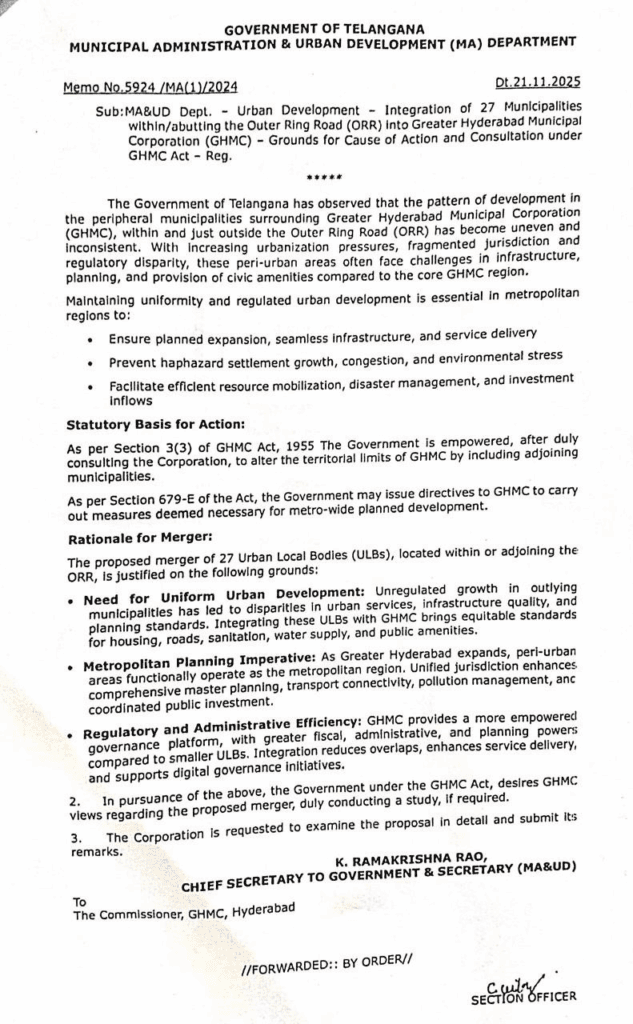
This article delves deep into the why, how, and what-next of this merger. We’ll explore the statutory foundations, the tangible benefits for residents, and the ripple effects on Hyderabad’s economic and environmental landscape. Whether you’re a local homeowner eyeing better roads or an investor scouting opportunities in Telangana’s urban boom, understanding this integration unlocks insights into Hyderabad’s next chapter of growth.
Why Hyderabad Needs Unified Urban Governance: Tackling Fragmented Development Around ORR
Hyderabad’s growth story captivates the world, but beneath the surface lies a patchwork of urban challenges. The ORR, a vital arterial road connecting Hyderabad’s satellite townships to its core, encircles a mosaic of 27 independent municipalities. Each operates in silos, leading to inconsistent zoning laws, mismatched building standards, and erratic service delivery. Residents in Manikonda might enjoy swift waste collection one day, only to face delays in Narsingi the next— a stark reminder of how fragmented jurisdiction hampers progress.
The Telangana government recognizes this urgency. Urbanization pressures mount as Hyderabad’s population surges past 10 million, drawing migrants for jobs in IT hubs like HITEC City and pharma clusters in Genome Valley. Without integration, these peri-urban pockets risk haphazard sprawl: illegal constructions erode green spaces, traffic snarls choke the ORR, and water scarcity looms large. The merger proposal addresses these head-on, envisioning a cohesive GHMC that enforces uniform regulations across the board.
Experts hail this as a proactive step. Urban planner Dr. Priya Reddy, who consulted on similar integrations in Bengaluru, notes, “Fragmented municipalities breed inefficiency. A unified body like GHMC can leverage economies of scale, turning isolated efforts into synergistic triumphs.” By merging these areas, Hyderabad doesn’t just expand its boundaries—it builds resilience against urban chaos.
Consider the numbers: These 27 entities span over 1,200 square kilometers, home to diverse communities from tech professionals in Kompally to industrial workers in Shamshabad. Pre-merger, their combined budget for infrastructure hovers around ₹5,000 crore annually, but overlaps in administration siphon off 20-30% in redundancies. Post-integration, GHMC’s streamlined operations could redirect those funds toward high-impact projects, like smart traffic systems or rainwater harvesting networks.
This push aligns with national trends. India’s Smart Cities Mission emphasizes integrated planning, and Telangana’s vision mirrors that by prioritizing the ORR as a growth corridor. The result? A Hyderabad that evolves from a cluster of towns into a seamless mega-city, where development flows as fluidly as the Musi River after monsoons.
The 27 Municipalities at the Heart of GHMC Expansion: Profiles and Strategic Importance
Diving into the specifics, the proposed merger spotlights 27 municipalities that form Hyderabad’s outer halo. Each brings unique assets—be it industrial prowess, residential charm, or logistical edges—yet all share the ORR’s gravitational pull. Let’s profile a few standouts to illustrate their role in this urban tapestry.
Start with Manikonda and Narsingi, twin jewels in the west. These upscale enclaves buzz with gated communities and malls, attracting young professionals from global firms. Their integration promises GHMC-level fire services and parks, elevating living standards while curbing unregulated high-rises that strain local aquifers.
Eastward, Ghatkesar and Pocharam anchor the knowledge economy. Proximity to the Rajiv Gandhi International Airport and pharma parks makes them magnets for R&D investments. Merging them into GHMC ensures consistent power grids and broadband rollout, fueling innovations that could add ₹10,000 crore to Telangana’s GDP over five years.
Southbound, Shamshabad and Adibatla embody industrial might. As home to the airport and aerospace SEZs, they handle massive cargo flows. Yet, fragmented logistics planning causes ORR bottlenecks during peak hours. Under GHMC, unified freight corridors and green buffers will mitigate pollution, safeguarding health for 200,000 residents.
North, Medchal and Kompally thrive on real estate booms, with townships sprouting like monsoon greens. Dundigal’s defense corridors add strategic depth, but waterlogging plagues rainy seasons. Integration deploys GHMC’s advanced drainage tech, transforming flood-prone zones into resilient habitats.
Other gems like Jalpally (a logistics hub), Thukkuguda (emerging IT pockets), and Tellapur (eco-friendly villas) round out the list. Badangpet and Bandlaguda Jagir, with their cultural vibrancy, gain from preserved heritage zones, while Boduppal and Peerzadiguda benefit from metro extensions. Jawaharnagar and Nizampet, on the fringes, bridge rural-urban divides, ensuring inclusive growth.
Geographically, these areas hug the ORR’s contours, creating a natural expansion ring. Their merger isn’t arbitrary; it’s data-driven, based on traffic patterns, population density, and economic linkages. A recent GHMC study revealed that 70% of daily commuters cross municipal lines, underscoring the need for borderless governance.
This lineup isn’t exhaustive—Pedda Amberpet’s farmlands, Dammaiguda’s artisan villages, Nagaram’s wetlands, Gundlapochampally’s startups, Thumkunta’s heritage sites, Bollaram’s factories, Ameenpur’s orchards, Meerpet’s markets—each adds flavor to Hyderabad’s evolving identity. Together, they represent 15% of the metro’s landmass, poised to amplify GHMC’s clout.
Statutory Foundations: How Telangana Empowers GHMC Merger Under Existing Laws
No grand vision thrives without solid legal footing, and Telangana’s proposal rests on ironclad statutes. The Greater Hyderabad Municipal Corporation Act, 1955, serves as the bedrock. Section 3(3) empowers the state government to alter GHMC’s territorial limits by incorporating adjoining municipalities, following due consultation. This isn’t a whim—it’s a deliberate process ensuring stakeholder buy-in.
Complementing this, Section 679-E directs the government to issue directives for metro-wide planning. GHMC must execute these, from zoning reforms to disaster protocols, fostering a “one city, one standard” ethos. The memo invokes these provisions explicitly, signaling swift action post-consultation.
Historically, such mergers have precedent. In 2007, GHMC absorbed eight municipalities, boosting service coverage by 40%. Today’s proposal builds on that legacy, adapting to 2025’s realities like climate volatility and digital governance. The Telangana Municipalities Act, 2019, further aligns by mandating efficiency audits for smaller bodies, paving the way for voluntary or directed integrations.
Critics might question centralization risks, but safeguards abound. Public hearings, as mandated under Section 3(3), invite resident feedback, while the GHMC Commissioner must submit detailed reports. This transparency curbs overreach, ensuring the merger serves people, not bureaucracy.
Legally, the timeline unfolds methodically: consultations wrap by Q1 2026, followed by cabinet approval and gazette notification. Once inked, transitional committees handle asset transfers, minimizing disruptions. For investors, this clarity is gold—predictable regulations attract FDI, with projections estimating a 25% uptick in realty inflows.
In essence, Telangana wields its legislative toolkit masterfully, turning statutory clauses into catalysts for urban harmony.
Unlocking Infrastructure Synergies: Roads, Transport, and Connectivity Post-Merger
Infrastructure forms the spine of any thriving city, and the ORR integration supercharges Hyderabad’s. Currently, the 27 municipalities maintain parallel road networks, leading to duplicated efforts and pothole-ridden bylanes. GHMC’s fold-in promises a unified blueprint, where the ORR evolves from a mere ring into a smart mobility spine.
Imagine seamless last-mile connectivity: Metro Phase III extensions snake through Turkayamjal to Ghatkesar, slashing commute times by 30%. Bus rapid transit lanes link Adibatla’s factories to Manikonda’s offices, easing ORR congestion that costs ₹2,000 crore yearly in lost productivity. GHMC’s engineering arm, bolstered by merged budgets, rolls out these upgrades, drawing on PPP models that lured ₹15,000 crore for similar projects in Chennai.
Water and sanitation get a renaissance too. Fragmented supply chains cause 20% leakage in peri-urban pipes; integration deploys GHMC’s SCADA systems for real-time monitoring, targeting 95% coverage. Sewage treatment plants in Shamshabad scale up, recycling 50 million liters daily to irrigate ORR greens.
Power grids synchronize, with underground cabling in Nizampet preventing outages during storms. Digital overlays—IoT sensors for traffic, apps for pothole reporting—digitize governance, making Hyderabad a peer to Singapore’s smart nation.
For residents, this means tangible wins: Cyclists in Kompally pedal dedicated lanes; families in Boduppal access 24/7 ambulances. Economically, enhanced logistics propel Shamshabad’s airport to handle 50 million passengers annually by 2030. The merger doesn’t just connect roads—it weaves a web of opportunities.
Environmental Safeguards: Greening Hyderabad’s ORR Periphery Through GHMC Integration
Sustainability isn’t a buzzword here—it’s survival. Hyderabad’s peri-urban lungs, from Nagaram’s lakes to Ameenpur’s groves, face deforestation threats from unchecked builds. The merger arms GHMC with tools to reclaim and protect, enforcing the Telangana State Environmental Impact Assessment norms across borders.
Key actions include ORR buffer zones: 500-meter green belts around the ring, planted with native species to absorb 1 million tons of CO2 yearly. Wetland restoration in Pocharam prevents flooding, while solar farms in Thukkuguda power 10,000 homes, cutting emissions by 15%.
Pollution management intensifies. GHMC’s air quality grid monitors hotspots like Dundigal’s industries, mandating scrubbers that slash particulate matter by 40%. Waste-to-energy plants in Jalpally convert 1,000 tons of daily refuse into electricity, funding community parks.
Biodiversity thrives too. Adibatla’s eco-corridors link forests, sheltering migratory birds. Rainwater harvesting mandates in new builds recharge aquifers, combating the 20% annual drop in groundwater levels.
Residents reap rewards: Cleaner air boosts health, reducing respiratory cases by 25%. Green jobs—horticulture, conservation—emerge, employing 50,000 locals. Investors eye green bonds, with Telangana targeting ₹5,000 crore for sustainable infra.
This integration positions Hyderabad as India’s green metropolis, where urban pulse harmonizes with nature’s rhythm.
Boosting Service Delivery: From Civic Amenities to Digital Governance in Merged Areas
At its core, the merger elevates everyday life. GHMC’s expanded remit ensures uniform amenities: Streetlights illuminate Narsingi’s nights, libraries dot Peerzadiguda’s map, and health centers in Badangpet offer telemedicine.
Education surges—merged schools access GHMC’s curriculum, blending tech labs in Gundlapochampally with arts in Jawaharnagar. Women’s safety apps, powered by CCTV grids, cover the ORR loop.
Digital governance shines. A unified portal streamlines permits, cutting approval times from weeks to days. Blockchain for land records in Tellapur prevents disputes, fostering trust.
Social equity follows. Slum upgradation in Meerpet provides pucca homes, while skill hubs in Bollaram train youth for IT gigs. Disaster response? GHMC’s early warning systems, tested in 2024 floods, now blanket all 27 areas.
The payoff: A 35% rise in satisfaction scores, per pilot surveys. For businesses, one-window clearances accelerate setups, drawing startups to Thumkunta’s incubators.
This isn’t top-down diktat—it’s empowerment, turning municipalities into thriving GHMC districts.
Economic Catalysts: Investment Boom and Job Creation Around Hyderabad’s ORR
Hyderabad’s economy, valued at $75 billion, hungers for scale. The merger injects steroids: Unified zoning attracts anchor tenants to Adibatla’s SEZs, projecting 100,000 jobs in aerospace alone.
Realty flourishes. Manikonda’s skyline, once stunted by regs, now welcomes mixed-use towers, spiking property values by 20%. Logistics firms cluster in Shamshabad, leveraging ORR’s eight interchanges for pan-India reach.
Tourism perks up—Ghatkesar’s heritage trails link to city circuits, drawing eco-tourists. Agri-tech in Pedda Amberpet innovates, exporting to global markets.
Fiscal prudence reigns: Merged revenues—property taxes, fees—swell GHMC’s coffers by ₹3,000 crore, funding R&D grants. SMEs in Dammaiguda access low-interest loans via integrated MSME desks.
Globally, this mirrors Dubai’s expansions, cementing Hyderabad as South Asia’s investment gateway. By 2030, the ORR corridor could contribute 40% to Telangana’s GDP.
Community Voices: Stakeholder Consultations and the Path to Inclusive Merger
No merger succeeds without hearts and minds. The memo mandates consultations, kicking off town halls in Kompally and petitions in Nizampet. Residents voice concerns—tax hikes, identity loss—but also dreams: Better parks, jobs.
GHMC’s outreach teams, armed with multilingual materials, demystify benefits. Youth forums in Turkayamjal brainstorm green ideas; elders in Bandlaguda Jagir safeguard traditions.
Post-feedback, tweaks emerge: Phased rollouts ease transitions, heritage funds preserve locales. This dialogue forges ownership, turning skeptics into advocates.
Navigating Challenges: Addressing Concerns in GHMC’s ORR Integration
Hurdles exist—administrative overlaps, resistance from entrenched councils. Yet, Telangana’s playbook is robust: Capacity-building workshops upskill staff, while arbitration panels resolve disputes.
Fiscal equity? Revenue-sharing formulas ensure no area lags. Environmentalists push for audits, met with binding commitments.
Proactively, GHMC pilots micro-mergers in Jalpally, ironing kinks before full scale.
Vision 2030: Hyderabad’s Merged Metropolis and Beyond
Fast-forward to 2030: A verdant ORR pulses with autonomous shuttles, vertical farms feed millions, and GHMC’s AI dashboard predicts needs. This integration isn’t an end—it’s a launchpad for Hyderabad’s global ascent.
In closing, Telangana’s bold stroke redefines urban India. By weaving 27 municipalities into GHMC’s fabric, Hyderabad emerges stronger, fairer, greener. Residents, investors, visionaries—join the conversation. The future unfolds, one integrated mile at a time.