In the heart of Telangana, where monsoon rains often transform lush landscapes into zones of peril, a high-level official recently took decisive action to evaluate the havoc wrought by excessive downpours. Arvind Kumar, the Principal Secretary for Disaster Management, spearheaded a comprehensive inspection tour across Mahabubnagar and Nagarkurnool districts. This visit underscores the state’s proactive stance against natural calamities, especially as Mahabubnagar grapples with an astonishing 83% surplus rainfall this season. As communities rebuild and authorities mobilize, this article delves into the inspection details, the broader implications of heavy rainfall in Telangana, and the strategies shaping effective disaster response. From overflowing rivers to volunteer heroism, we explore how Telangana navigates these turbulent waters to safeguard its people.
Understanding the Monsoon Fury: Heavy Rainfall Patterns in Telangana
Telangana’s monsoon season, typically spanning June to September, brings vital water for agriculture but also poses severe risks when rains exceed norms. This year, the state has witnessed unprecedented precipitation levels, with Mahabubnagar district emerging as a hotspot for excess rainfall. Meteorologists attribute this surge to shifting climate patterns, including intensified low-pressure systems over the Bay of Bengal and the influence of global warming on regional weather dynamics.
Experts from the India Meteorological Department (IMD) report that Telangana’s average annual rainfall hovers around 900 mm, but deviations like this season’s 83% excess in Mahabubnagar highlight vulnerabilities. Such anomalies disrupt daily life, inundate farmlands, and erode infrastructure. Farmers, who rely on timely rains for crops like paddy, cotton, and pulses, now face submerged fields and delayed harvests. Urban areas contend with waterlogged streets, leading to traffic chaos and health hazards from stagnant water breeding mosquitoes.
The Principal Secretary’s inspection arrives at a critical juncture, emphasizing the need for real-time assessments. By visiting affected sites, officials gain firsthand insights into the scale of damage, enabling targeted interventions. This approach not only accelerates relief but also informs long-term policies to mitigate future risks. In a region where monsoons dictate economic rhythms, understanding these patterns becomes essential for resilience-building.
Principal Secretary’s On-Ground Assessment in Mahabubnagar District
Arvind Kumar, a seasoned IAS officer known for his expertise in urban development and disaster management, personally led the evaluation in Mahabubnagar. His visit focused on areas hardest hit by the relentless rains, where swollen streams and breached tanks have displaced families and damaged properties. Kumar interacted directly with local residents, listening to their stories of loss and survival, which humanizes the bureaucratic response.
During the tour, the Principal Secretary commended the efforts of the Telangana State Disaster Response Force (TGSDRF), National Cadet Corps (NCC) volunteers, and Aapda Mitra teams. These groups have worked tirelessly, evacuating stranded individuals, distributing essential supplies, and restoring access to isolated villages. TGSDRF, equipped with specialized rescue gear, has conducted over 50 operations in the district alone, showcasing their preparedness honed through rigorous training programs.
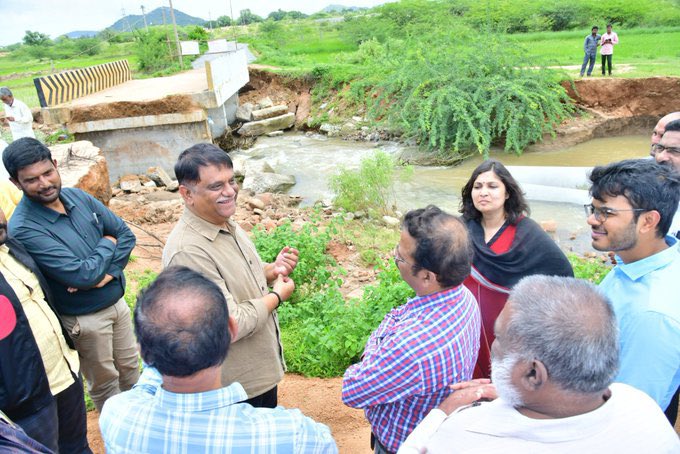
District administration officials accompanied Kumar, providing detailed briefings on the extent of damages. Reports indicate that roads, bridges, and irrigation canals suffered extensive erosion, with repair costs estimated in crores. In one poignant moment, Kumar inspected a collapsed culvert that had cut off a remote hamlet, directing immediate temporary fixes to reconnect the community. His presence boosted morale among frontline workers, reinforcing the government’s commitment to swift action.
Mahabubnagar’s geography, characterized by undulating terrain and numerous water bodies, exacerbates flood risks. The district’s Krishna River basin often overflows during heavy monsoons, affecting low-lying areas. This inspection highlights the importance of integrating local knowledge with state-level strategies, ensuring that relief efforts align with community needs.
Inspecting Flood Devastation in Nagarkurnool: Focus on Dundubhi River Overflow
Shifting focus to Nagarkurnool district, the Principal Secretary extended his inspection to villages like C Tirumalapur and Sirsawada, where the Dundubhi River’s overflow caused widespread flooding. Homes submerged under murky waters, livestock swept away, and agricultural lands rendered barren—these scenes painted a grim picture of nature’s wrath. Kumar, alongside the District Collector and Superintendent of Police, reviewed the situation on-site, assessing structural damages and coordinating rescue operations.
The Dundubhi River, a tributary feeding into larger waterways, typically sustains local ecosystems but turns destructive during monsoons. This year’s excess rainfall overwhelmed its banks, leading to flash floods that caught villagers off guard. Eyewitness accounts describe water levels rising rapidly overnight, forcing evacuations in the dark. The inspection team documented breaches in embankments, proposing reinforcements as a priority measure.
Collaboration marked the visit, with the District Collector from Nagarkurnool sharing data on affected households—over 500 families displaced—and the Superintendent of Police outlining security measures to prevent looting in evacuated areas. Kumar emphasized inter-departmental synergy, praising how police forces integrated with disaster teams for efficient crowd management and aid distribution.
Nagarkurnool’s rural economy, heavily dependent on rain-fed agriculture, faces long-term setbacks from such events. Soil erosion depletes fertility, while contaminated water sources raise health concerns. The Principal Secretary’s directives included deploying mobile health units and sanitation drives, addressing immediate humanitarian needs while planning for rehabilitation.
The Vital Role of Disaster Response Forces in Telangana’s Flood Management
At the forefront of Telangana’s battle against floods stand dedicated forces like TGSDRF, NCC, and Aapda Mitra. These entities form the backbone of emergency operations, embodying the state’s motto of preparedness and rapid response. TGSDRF, established to handle natural disasters, trains personnel in search-and-rescue techniques, using boats, drones, and communication tools to navigate challenging terrains.
NCC cadets, drawn from educational institutions, bring youthful energy to relief efforts. Their involvement fosters a culture of volunteerism, teaching young minds the value of community service. Aapda Mitra, a community-based initiative, empowers locals with basic disaster management skills, turning residents into first responders. During Kumar’s interactions, he highlighted how these groups’ synergy minimized casualties, with zero reported fatalities in the inspected areas despite severe flooding.
Training programs, often conducted in collaboration with national bodies like the National Disaster Response Force (NDRF), equip these teams for diverse scenarios. Simulations of flood rescues and medical aid drills ensure readiness. In Mahabubnagar and Nagarkurnool, their proactive patrols prevented escalations, such as alerting villagers to rising water levels via loudspeakers.
The Disaster Management Department’s integration of technology amplifies these efforts. Real-time weather apps, satellite imagery, and GIS mapping allow precise predictions and deployments. Kumar’s visit reinforced the need for expanding these resources, advocating for more funding to enhance equipment and training.
Government’s Commitment to Quick Relief and Long-Term Resilience
The Telangana government, through its Disaster Management Department, pledges unwavering support to rain-affected communities. Kumar reiterated this during his reviews, stressing coordinated actions with agencies like the Revenue Department, Irrigation, and Health Ministries. Quick relief measures include distributing food packets, temporary shelters, and financial aid to rebuild homes.
In Mahabubnagar, where excess rainfall damaged over 10,000 acres of crops, compensation schemes activate swiftly. Farmers receive subsidies for seeds and fertilizers, aiding recovery. Nagarkurnool’s focus shifts to infrastructure repairs, with teams assessing bridges and roads for permanent fixes.
Long-term strategies involve watershed management, afforestation, and early warning systems. The department collaborates with environmental experts to promote sustainable practices, reducing vulnerability to climate change. Community education campaigns teach flood safety, empowering locals to participate in mitigation.
Kumar’s leadership exemplifies proactive governance, inspiring confidence amid adversity. By minimizing impacts through efficient coordination, the state sets a benchmark for disaster management in India.
Economic and Social Impacts of Excess Rainfall in Southern Telangana
Beyond immediate damages, excess rainfall ripples through Telangana’s economy and society. In Mahabubnagar and Nagarkurnool, agriculture employs over 70% of the population, making crop losses devastating. This season’s floods destroyed paddy fields worth millions, pushing families into debt and food insecurity.
Socially, displacements disrupt education and healthcare. Children miss school due to flooded paths, while elderly residents face isolation. Women, often managing households, bear additional burdens in relief camps. Mental health strains emerge from trauma, necessitating counseling services.
Economically, disrupted supply chains inflate prices, affecting urban centers like Hyderabad. Tourism in scenic areas halts, and small businesses suffer from power outages. However, silver linings appear in community solidarity, where neighbors share resources and volunteers organize drives.
Government interventions aim to cushion these blows. Crop insurance schemes, linked to national programs like PMFBY, provide payouts. Skill development initiatives retrain affected workers for non-agricultural jobs, fostering diversification.
Historical Context: Learning from Past Floods in Telangana
Telangana’s flood history offers valuable lessons. The 2009 Krishna River floods displaced thousands, prompting infrastructure upgrades. Recent events, like the 2020 Hyderabad deluge, accelerated urban drainage projects. Mahabubnagar’s recurrent issues stem from inadequate river desilting, addressed in current plans.
Comparative analysis with neighboring states reveals best practices. Andhra Pradesh’s coastal defenses inspire Telangana’s riverbank reinforcements. National policies, such as the Disaster Management Act of 2005, guide state actions, ensuring standardized responses.
Kumar’s inspection builds on this legacy, incorporating past insights into present strategies. By documenting current damages, officials refine predictive models, enhancing future preparedness.
Community Involvement and Volunteerism in Disaster Response
Communities play pivotal roles in disaster resilience. In Mahabubnagar and Nagarkurnool, locals formed watch groups to monitor river levels, alerting authorities promptly. Aapda Mitra volunteers, trained in first aid, saved lives during evacuations.
Encouraging participation through awareness programs strengthens bonds. Schools integrate disaster education, teaching evacuation drills. NGOs partner with government, providing hygiene kits and psychological support.
Kumar praised these efforts, urging more citizens to join. Volunteerism not only aids immediate relief but cultivates a resilient society, ready for climate uncertainties.
Technological Innovations Enhancing Flood Mitigation in Telangana
Technology revolutionizes disaster management. Drones survey inaccessible areas, delivering aid packages. AI-powered forecasting models predict rainfall with 90% accuracy, allowing preemptive evacuations.
In the inspected districts, mobile apps disseminate alerts, while IoT sensors monitor water levels. Satellite data from ISRO maps flood zones, guiding resource allocation. Kumar advocated scaling these tools, integrating them with national networks for seamless operations.
Challenges like rural connectivity persist, but initiatives like BharatNet bridge gaps. These innovations minimize human error, saving lives and resources.
Environmental Considerations: Balancing Development and Nature
Excess rainfall underscores environmental imbalances. Deforestation and urbanization exacerbate flooding by reducing natural absorption. In Telangana, rapid industrial growth in Mahabubnagar strains ecosystems.
Sustainable practices, like rainwater harvesting and green corridors, counter these. The government promotes eco-friendly farming, reducing chemical runoff. River restoration projects desilt channels, improving flow.
Kumar’s visit highlighted conservation, directing assessments of ecological damages. Protecting biodiversity ensures long-term stability, harmonizing development with nature.
Health and Sanitation Challenges Post-Floods
Floods breed health risks, from waterborne diseases to vector-borne illnesses. In affected villages, contaminated sources spread cholera and dengue. Mobile clinics deploy vaccines and treatments, while sanitation teams disinfect areas.
Nutrition programs combat malnutrition in camps. Mental health support addresses anxiety and PTSD. Kumar reviewed these, ensuring comprehensive care.
Preventive measures, like chlorination and mosquito nets, curb outbreaks. Collaboration with WHO enhances protocols, safeguarding public health.
Infrastructure Rebuilding: Pathways to Recovery
Rebuilding demands strategic planning. Damaged roads receive priority, with engineers designing flood-resistant structures. Bridges incorporate elevated designs, while canals get reinforced linings.
Funding from central schemes like CRF supports efforts. Public-private partnerships accelerate projects, bringing expertise. Kumar’s directives emphasize quality, preventing future vulnerabilities.
Policy Recommendations for Future Disaster Preparedness
Forward-thinking policies shape resilience. Enhancing early warning systems, investing in training, and community mapping reduce risks. Insurance expansion covers more assets, while research on climate adaptation informs decisions.
Kumar’s inspection informs these, advocating integrated approaches. By learning from current events, Telangana fortifies against tomorrow’s challenges.
Conclusion: Towards a Resilient Telangana
Arvind Kumar’s inspection in Mahabubnagar and Nagarkurnool exemplifies dedicated leadership amid crisis. As rains subside, the focus shifts to recovery and prevention. Through collaborative efforts, Telangana emerges stronger, ready to face nature’s tests. This commitment ensures safer futures for its people, blending immediate action with visionary planning.