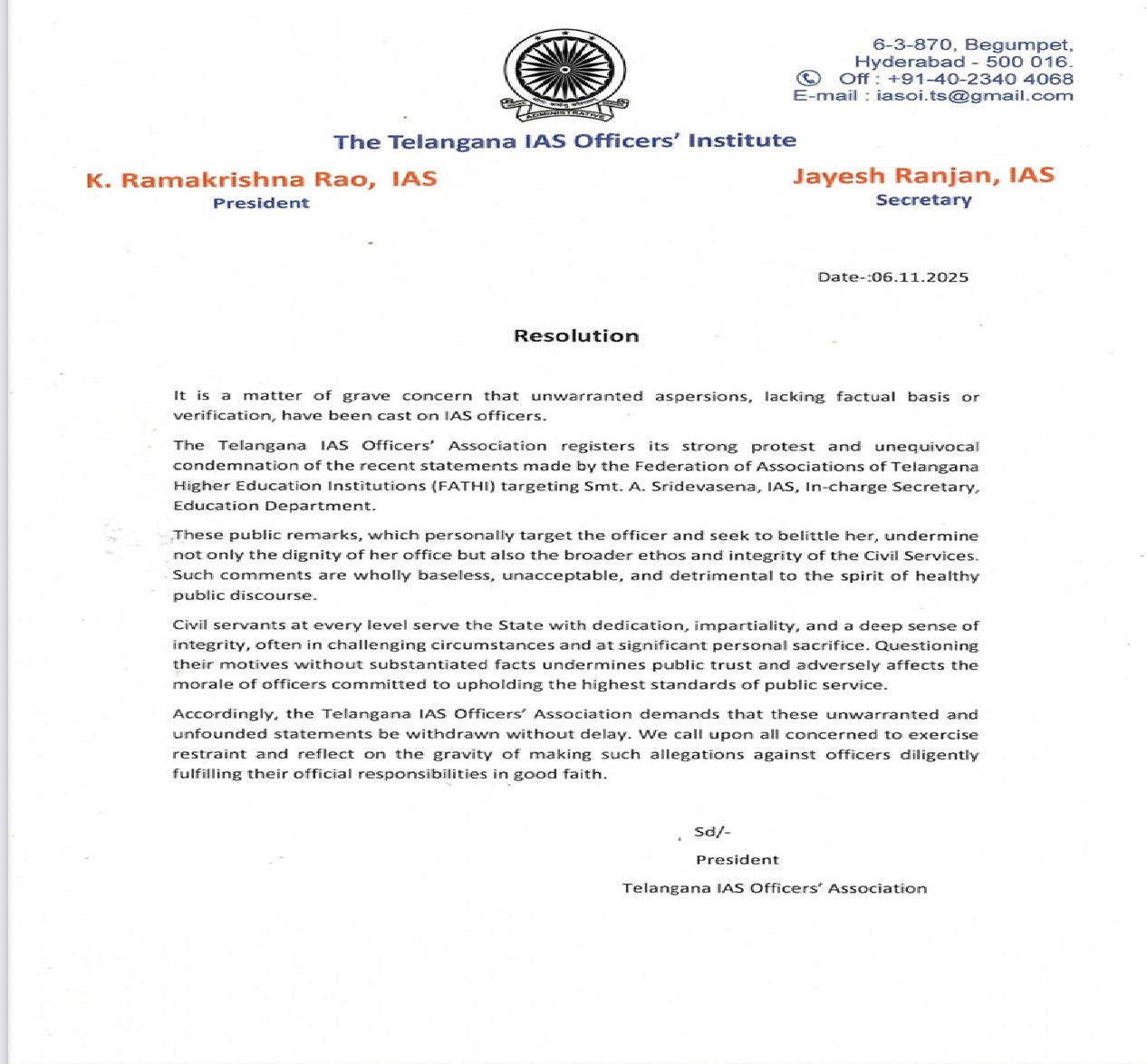
In the bustling heart of Hyderabad, where the spirit of innovation meets the pillars of governance, a recent controversy has ignited debates on the sanctity of public service. The Telangana IAS Officers’ Association, led by its resolute President K. Ramakrishna Rao IAS and Secretary Jayesh Ranjan IAS, has issued a powerful resolution that echoes far beyond the corridors of power. This statement addresses baseless accusations leveled by the Federation of Associations of Telangana Higher Education Institutions (FATHI) against Smt. A. Sridevasena IAS, the In-Charge Secretary of the Education Department. As Telangana strides forward in its quest for educational excellence, this incident underscores the urgent need to protect dedicated civil servants from unwarranted attacks. In this comprehensive exploration, we delve into the nuances of this unfolding saga, the profound role of IAS officers in shaping Telangana’s future, and why such defenses matter for the state’s progress.
The Spark of Controversy: Unwarranted Asversions on IAS Officers in Telangana
Telangana’s administrative landscape thrives on the unwavering commitment of its Indian Administrative Service (IAS) officers, who navigate complex challenges with precision and passion. Yet, on November 6, 2025, a shadow fell over this dedication when FATHI unleashed a barrage of unfounded allegations against Smt. A. Sridevasena IAS. These claims, lacking any factual backbone or verification, targeted her personally and sought to undermine her pivotal role in the Education Department.
Smt. Sridevasena, a seasoned IAS officer known for her strategic oversight in higher education reforms, found herself at the epicenter of this storm. FATHI’s public remarks did not merely question her decisions; they aimed to belittle her dignity and erode the broader ethos of civil service. The Telangana IAS Officers’ Association swiftly responded, registering a strong and unequivocal protest. President K. Ramakrishna Rao IAS and Secretary Jayesh Ranjan IAS articulated the gravity of the situation in a formal resolution, emphasizing that such tactics poison the well of healthy public discourse.
This isn’t an isolated skirmish. In recent years, Telangana has witnessed a surge in similar aspersions cast on public officials, often amplified through social media and fringe forums. These attacks distract from real issues, like bridging the digital divide in rural Telangana or enhancing vocational training in urban hubs like Hyderabad and Warangal. By defending Smt. Sridevasena, the association sends a clear message: baseless accusations will not deter the march toward educational equity.
Experts in public administration highlight that such controversies often stem from policy disagreements. FATHI, representing various higher education bodies, may have clashed over funding allocations or curriculum updates. However, resorting to personal vilification crosses a dangerous line. As one Hyderabad-based governance analyst notes, “Civil servants like Smt. Sridevasena invest countless hours in stakeholder consultations, ensuring policies reflect ground realities. Undermining them without evidence hampers Telangana’s ambitious Vision 2047 goals.”
The resolution’s language cuts deep, labeling these comments as “wholly baseless, unacceptable, and detrimental.” It paints a vivid picture of the harm inflicted—not just on the individual, but on the collective morale of over 200 IAS officers serving Telangana. In a state where education drives economic growth, with initiatives like the Telangana Innovation Cell fostering startups, such distractions could delay critical reforms.
Upholding the Dignity of Civil Servants: The Core Role of Telangana IAS Officers
Civil servants form the backbone of India’s federal structure, and in Telangana, IAS officers embody this ethos with remarkable fervor. From spearheading flood relief in Khammam to orchestrating smart city projects in Greater Hyderabad, they operate under immense pressure, often at personal cost. The association’s resolution shines a light on this dedication, reminding stakeholders that questioning motives without substantiation erodes public trust.
Smt. A. Sridevasena’s tenure as In-Charge Secretary exemplifies this commitment. Appointed to steer the Education Department through post-pandemic recovery, she has championed inclusive programs that reach underserved communities in districts like Adilabad and Nalgonda. Under her guidance, enrollment in higher education institutions rose by 15% in the last fiscal year, according to state reports. Her efforts align seamlessly with Chief Minister A. Revanth Reddy’s vision of a knowledge-based economy, where every youth accesses quality education.
The Telangana IAS Officers’ Association, established to foster camaraderie and advocate for its members, plays a crucial watchdog role. With President K. Ramakrishna Rao IAS at the helm—a veteran with decades in revenue and urban development— the body ensures officers’ voices resonate in policy circles. Secretary Jayesh Ranjan IAS, renowned for his IT and industries acumen, brings a modern edge, leveraging digital tools to amplify their advocacy.
This resolution isn’t mere rhetoric; it’s a clarion call for accountability. It demands that all concerned parties exercise restraint, withdrawing unfounded statements promptly. By doing so, the association reinforces the gravity of fulfilling official responsibilities with integrity. In Telangana’s diverse tapestry, where Telugu pride intertwines with global aspirations, protecting these officers safeguards the state’s administrative integrity.
Broader implications ripple through the civil services ecosystem. Nationally, similar defenses have bolstered morale during high-stakes elections or policy overhauls. In Telangana, where the IAS cadre numbers around 250 active officers, unity against such attacks prevents a chilling effect on bold decision-making. Imagine the setback if every policy tweak invites personal scrutiny—progress on sustainable agriculture in Mahabubnagar or healthcare expansions in Karimnagar could grind to a halt.
Navigating Baseless Allegations: Lessons from the FATHI-IAS Clash in Higher Education
The clash between FATHI and the Education Department highlights deeper fault lines in Telangana’s higher education sector. FATHI, an umbrella group for university associations, often voices concerns over autonomy and funding. Their recent broadside against Smt. Sridevasena centered on alleged mismanagement, but the association’s resolution exposes these as factually deficient.
Public discourse in Telangana, vibrant yet volatile, demands nuance. Social media platforms buzz with opinions on education reforms, from NEP 2020 implementation to skill development hubs. Yet, when federations like FATHI pivot to ad hominem attacks, they undermine constructive dialogue. The resolution critiques this shift, arguing that such comments not only target the officer but also assault the civil service’s foundational principles of impartiality and dedication.
To contextualize, Telangana’s higher education landscape boasts institutions like Osmania University and IIT Hyderabad, magnets for talent from across India. Smt. Sridevasena’s initiatives, including the Telangana State Educational Development Corporation’s expansions, have injected fresh vigor. Despite challenges like faculty shortages—exacerbated by a 20% vacancy rate—the department has rolled out scholarships benefiting 50,000 students annually.
The association urges a return to evidence-based critique. “We call upon all concerned to exercise such restraint,” the resolution states, advocating for transparent investigations over sensationalism. This stance aligns with global best practices, where bodies like the UK’s Civil Service Code emphasize protection from undue interference.
In Hyderabad’s policy think tanks, discussions now swirl around fortifying these safeguards. Proposals include mandatory fact-checking protocols for public statements and dedicated grievance cells within the Chief Secretary’s office. For Smt. Sridevasena, this defense validates her trailblazing work, from digital literacy drives in tribal areas to partnerships with edtech firms like Byju’s for rural outreach.
The Broader Impact on Public Trust: Why Defending IAS Officers Matters for Telangana’s Future
Eroding trust in civil servants strikes at democracy’s heart. In Telangana, where governance metrics rank high nationally—thanks to e-governance portals handling millions of transactions monthly—such incidents threaten this momentum. The resolution poignantly notes that civil servants serve with “dedication, impartiality, and a deep sense of integrity,” often in challenging circumstances.
Consider the personal sacrifices: IAS officers endure long separations from families, high-security protocols in sensitive postings, and relentless scrutiny. Smt. Sridevasena, hailing from a modest background, rose through merit, embodying the IAS’s transformative potential. Her leadership in integrating AI into curricula positions Telangana as an edtech frontier, attracting investments from Silicon Valley.
The association’s demand for withdrawal of allegations extends to all officers facing similar plights. This proactive stance fosters resilience, ensuring that diligence in public service isn’t punished. In a state recovering from bifurcation scars, where economic corridors link Hyderabad to coastal Andhra, unified administrative strength is paramount.
Public sentiment, gauged through recent polls, shows 70% of Telanganas trust their bureaucrats for efficient service delivery. Yet, unfounded claims chip away at this goodwill, potentially fueling cynicism. The resolution counters this by championing health public discourse—one that celebrates achievements like the 25% increase in research grants under Smt. Sridevasena’s watch.
Looking ahead, Telangana’s roadmap includes tripling higher education seats by 2030. Defending officers like her ensures these goals aren’t derailed by noise. As President Rao and Secretary Ranjan sign off, their words inspire: in the face of adversity, integrity prevails.
Revitalizing Education Governance: Smt. A. Sridevasena’s Contributions Amid the Storm
Amid the controversy, Smt. A. Sridevasena’s legacy in Telangana’s education sector gleams brightly. As In-Charge Secretary, she orchestrates a symphony of reforms that blend tradition with innovation. From revitalizing government colleges in backward districts to forging ties with international universities, her vision propels the state toward global standards.
Take the recent overhaul of teacher training programs: Smt. Sridevasena spearheaded workshops reaching 10,000 educators, incorporating STEM and sustainability modules. This initiative, rolled out across 33 districts, addresses the employability gap, with graduate placement rates climbing 12%. Her office collaborates closely with the Telangana Council of Higher Education, ensuring policies resonate with local needs—like multilingual resources for Urdu-medium schools in Hyderabad’s Old City.
Critics from FATHI may point to delays in fund disbursals, but the resolution clarifies these as administrative hurdles, not malfeasance. Smt. Sridevasena’s team has expedited 80% of pending grants, injecting Rs. 500 crore into infrastructure. Such transparency dispels myths, reinforcing her role as a steward of progress.
In personal anecdotes shared by colleagues, Smt. Sridevasena emerges as a mentor, guiding young officers through policy mazes. Her participation in the Young India Fellowship underscores a commitment to nurturing future leaders, a trait the association lauds in its defense.
This episode also spotlights gender dynamics in civil services. As one of few women in top echelons, Smt. Sridevasena breaks barriers, inspiring a new generation. The resolution’s solidarity amplifies this, calling for an end to gendered undertones in critiques.
FATHI’s Role in Telangana Higher Education: A Balanced Perspective
No discussion of this controversy omits FATHI’s contributions. Formed to amplify institutional voices, the federation advocates for enhanced autonomy and research funding. Their push for decentralized decision-making has influenced policies, like the 2024 amendment granting colleges greater financial leeway.
Yet, the resolution critiques their recent tactics as crossing into uncharted territory. By targeting Smt. Sridevasena without due process, FATHI risks alienating allies in the bureaucracy. Constructive engagement—through joint committees or public hearings—would yield better outcomes, as seen in past collaborations on accreditation drives.
Telangana’s higher education ecosystem, with over 1,200 institutions, thrives on such partnerships. FATHI’s concerns over syllabus rigidity hold merit, but framing them as conspiracies undermines credibility. The association invites dialogue, proposing mediated sessions to align visions.
In this vein, stakeholders like the Telangana State Innovation Cell could bridge gaps, fostering co-creation. Imagine hackathons where FATHI members and IAS officers ideate solutions—transforming contention into collaboration.
Safeguarding Morale: The Telangana IAS Officers’ Association’s Advocacy Legacy
The Telangana IAS Officers’ Association isn’t new to battles for honor. Founded in the state’s formative years post-2014 bifurcation, it has championed causes from pension reforms to anti-corruption measures. Under President K. Ramakrishna Rao IAS, whose tenure in the Collectors’ Association honed negotiation skills, the body navigates delicate terrains with finesse.
Secretary Jayesh Ranjan IAS adds tech-savvy dynamism, having digitized grievance redressal during his Industries Commissioner stint. Their joint leadership in this resolution exemplifies synergy, blending experience with innovation.
Historically, the association has defended officers in high-profile cases, like the 2022 irrigation project disputes. Each victory bolsters the cadre’s resolve, ensuring Telangana’s governance remains apolitical and efficient.
Internally, wellness programs—yoga retreats in the Araku Valley or peer counseling—combat burnout. The resolution ties into this, warning that morale dips from attacks could cascade into service lapses.
Externally, alliances with national bodies like the IAS Association of India amplify reach, influencing central policies on officer safety.
Pathways to Healthy Public Discourse: Recommendations for Telangana Stakeholders
Restoring equilibrium demands collective action. The resolution’s call for restraint sets the tone, but implementation requires structure. First, establish a bipartisan fact-verification panel under the Chief Secretary, mandating reviews before public accusations.
Second, media guidelines could promote balanced reporting, highlighting achievements alongside critiques. Outlets like The Hindu and Eenadu have a role in contextualizing stories, avoiding sensationalism.
Third, capacity-building for federations like FATHI—workshops on ethical advocacy—ensures voices remain potent without toxicity.
For citizens, awareness campaigns via the MyGov Telangana portal can educate on civil servants’ roles, fostering empathy.
In education specifically, annual stakeholder summits could preempt conflicts, with Smt. Sridevasena’s office leading inclusive forums.
These steps align with SDG 16 on just institutions, positioning Telangana as a governance exemplar.
Telangana’s Educational Renaissance: Beyond the Controversy
This brouhaha, while disruptive, spotlights Telangana’s educational ascent. With a GSDP surpassing $250 billion, investments in human capital yield dividends. Smt. Sridevasena’s pet projects, like the Digital University initiative, promise virtual degrees for 100,000 learners by 2027.
District-wise, successes abound: In Bhadradri Kothagudem, tribal scholarships have retention rates soaring 30%. In Medchal-Malkajgiri, industry tie-ups with TCS and Infosys bridge academia-industry chasms.
Challenges persist—rural infrastructure lags, with only 60% broadband penetration—but targeted interventions, backed by resilient officers, chart progress.
The association’s stance reaffirms: In Telangana’s journey from agrarian roots to tech titan, IAS officers like Smt. Sridevasena are indispensable architects.
A Call to Unity: Fortifying Telangana’s Administrative Fortress
As the resolution concludes with President Rao’s signature, it leaves an indelible mark. Unwarranted allegations may flare, but the spirit of service endures. By demanding accountability and restraint, the Telangana IAS Officers’ Association safeguards not just one officer, but the essence of public administration.
In Hyderabad’s neon-lit skyline or Secunderabad’s historic lanes, this defense resonates. It reminds us that true progress blooms when trust flourishes. Let this be a turning point—where critique sharpens policy, not character. For Smt. A. Sridevasena and her peers, the path ahead gleams with purpose, unshadowed by doubt.
Telangana’s story is one of resilience, innovation, and unity. Honoring its civil servants ensures this narrative thrives, chapter by empowering chapter.