In the bustling heart of Hyderabad’s Outer Ring Road (ORR), tragedy struck again when a NewGo electric bus plummeted from an elevated section near Pedda Amberpet, sending shockwaves through commuters and authorities alike. This incident, unfolding just days after the devastating Kurnool bus fire that claimed over 20 lives, underscores the urgent need for enhanced road safety measures on one of India’s busiest highways. As emergency teams rushed to the scene, passengers aboard the bus from Miyapur to Guntur faced harrowing moments, with several sustaining injuries that required immediate medical attention. This article delves deep into the details of the Hyderabad ORR bus accident, explores its causes, impacts, and broader implications for electric bus travel in Telangana and Andhra Pradesh. We examine eyewitness accounts, official responses, and expert recommendations to prevent future mishaps, ensuring you stay informed on Hyderabad bus accident updates and ORR road safety tips.
Hyderabad’s ORR, a vital artery connecting the city’s tech hubs to neighboring districts, sees millions of travelers daily. Yet, recent events like this NewGo electric bus overturn highlight vulnerabilities in high-speed corridors. With over 20 passengers on board, the accident not only disrupted morning traffic but also reignited debates on vehicle maintenance, driver training, and infrastructure upgrades. As investigations unfold, this piece offers a comprehensive look at what went wrong, how responders acted swiftly, and what travelers can do to stay safe amid rising Telangana bus accident statistics.
What Happened in the Hyderabad ORR Bus Accident? A Timeline of the Incident
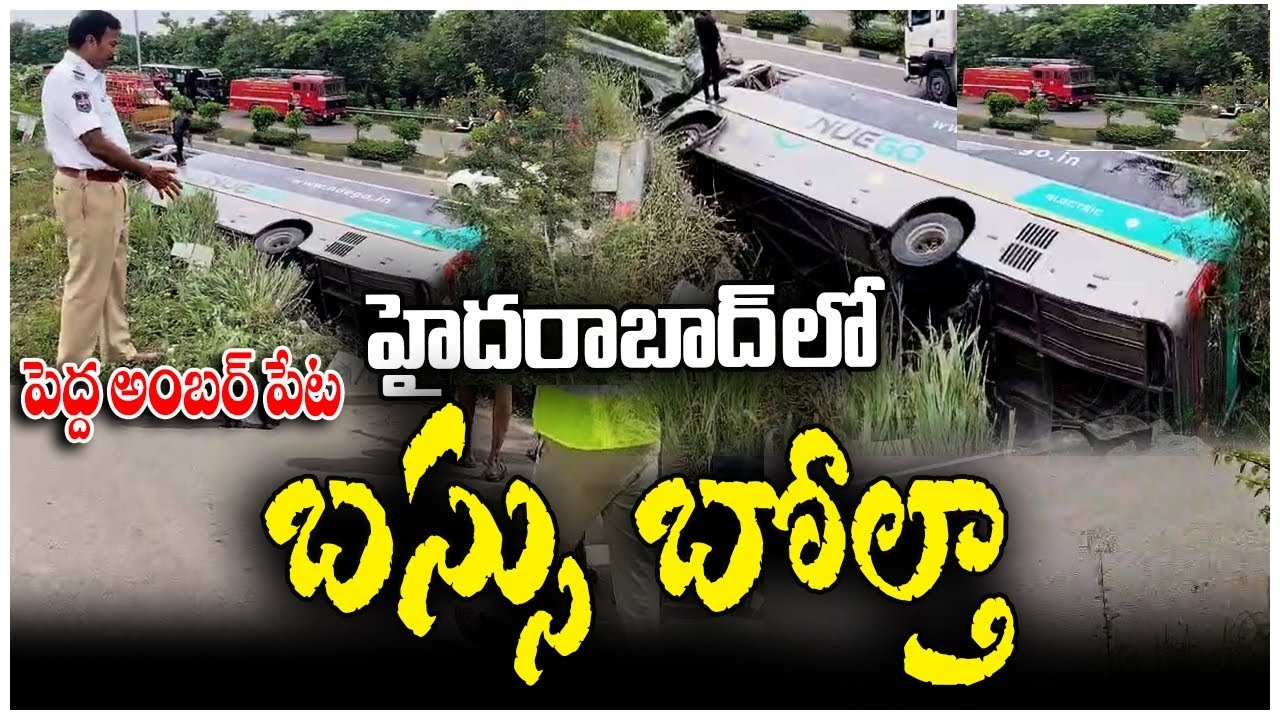
Emergency sirens pierced the early morning calm on October 25, 2025, as a NewGo electric bus veered off the ORR near Pedda Amberpet, tumbling down an embankment in a terrifying sequence of events. The bus, operated by a prominent private travels company, departed from Miyapur in Hyderabad around 4:30 AM, bound for Guntur in Andhra Pradesh. Carrying more than 20 passengers—many of them early-morning commuters heading to work or family visits—it cruised along the elevated stretch of the ORR, a six-lane expressway designed for seamless connectivity.
Eyewitnesses reported that the vehicle suddenly lost control near the Pedda Amberpet exit, possibly due to a combination of high speed and a sudden maneuver. The driver attempted to correct the path, but the bus clipped a guardrail, causing it to overturn and plummet approximately 15 feet onto the service road below. Metal twisted and glass shattered upon impact, trapping passengers inside the inverted cabin. Videos circulating on social media captured the chaotic scene: the green-hued electric bus lay on its side, smoke billowing from minor electrical shorts, while bystanders rushed to assist.
Local traffic police received the first distress call at 5:15 AM, prompting a rapid response from the Miyapur traffic division and Rachakonda police commissionerate. Within minutes, fire tenders from the nearby Uppal station arrived, followed by ambulances from the 108 emergency services. Rescue teams used hydraulic cutters to extricate those pinned in the wreckage, prioritizing children and elderly passengers first. The operation, which lasted over two hours, highlighted the efficiency of Hyderabad’s upgraded emergency protocols, a direct outcome of lessons learned from past ORR accident case studies.
By 7:30 AM, authorities cleared the site, restoring partial traffic flow on the ORR’s northbound lanes. The incident caused a ripple effect, snarling commutes for thousands and delaying flights at Rajiv Gandhi International Airport. As news spread, hashtags like #HyderabadORRAccident and #NewGoBusCrash trended on X (formerly Twitter), with users sharing real-time updates and expressing solidarity with the victims.
Injuries and Casualties: The Human Toll of the Pedda Amberpet Bus Overturn
Thankfully, the Hyderabad ORR bus accident did not result in fatalities, a small mercy amid the chaos. However, it left a trail of injuries that serves as a stark reminder of the fragility of road travel. Preliminary reports indicate that at least 12 passengers suffered varying degrees of harm, ranging from fractures and lacerations to concussions and soft-tissue damage. Among them, five individuals faced severe injuries, including a 28-year-old software engineer from Gachibowli who sustained a broken leg and head trauma after being thrown against the window.
Rescuers transported the most critical cases to Apollo Hospitals in Jubilee Hills and Yashoda Hospitals in Secunderabad, where medical teams stabilized them using advanced trauma care. A young mother traveling with her two-year-old child escaped with minor bruises, but the toddler required observation for possible internal injuries. Elderly passengers, comprising about 30% of the manifest, reported the highest incidence of shock and anxiety, exacerbating pre-existing conditions like hypertension.
The NewGo travels company issued an immediate statement expressing regret and committing to cover all medical expenses. “Our priority remains the well-being of our passengers,” read the official release. “We are cooperating fully with authorities to ascertain the facts.” Families of the injured flocked to hospitals, turning waiting areas into hubs of anguish and support. Community groups in Miyapur and Pedda Amberpet mobilized blood donation drives, underscoring the resilient spirit of Hyderabad’s neighborhoods.
This event echoes the emotional scars from the recent Kurnool bus tragedy, where fire claimed lives in sleep. While the overturn spared lives, it amplified fears among frequent ORR users. Psychologists note that such incidents trigger post-traumatic stress, urging travelers to seek counseling if nightmares or avoidance behaviors emerge. As recovery efforts continue, the focus shifts to rehabilitation—physical therapy sessions have already begun for the most affected, funded by a quick-response insurance pool.
Possible Causes Behind the NewGo Electric Bus Accident on ORR
Investigators from the Telangana Transport Department and Rachakonda police zeroed in on several potential factors contributing to the Pedda Amberpet bus overturn. Preliminary findings point to a mix of human error, mechanical issues, and environmental challenges, common culprits in electric bus accident analysis across urban India.
Speeding emerges as a prime suspect. The ORR’s 100 km/h limit often tempts drivers, especially on empty early-morning stretches. Dashcam footage recovered from a nearby vehicle shows the bus exceeding 110 km/h seconds before the swerve. Fatigue played a role too; the driver, a 35-year-old veteran with 10 years at NewGo, had logged a 12-hour shift the previous day, violating rest norms under the Motor Vehicles Act, 1988.
Mechanical scrutiny revealed concerns with the bus’s electric powertrain. NewGo’s fleet, introduced in 2024 to promote green commuting, relies on lithium-ion batteries that demand rigorous maintenance. Experts suspect a sudden torque surge—perhaps from regenerative braking failure—caused the loss of traction on a dew-slicked road. The ORR’s elevated sections, prone to microclimates, add slipperiness after overnight fog, a factor amplified by worn tire treads noted in post-accident inspections.
Human factors extend beyond the driver. Passengers reported the bus felt “unsteady” upon boarding, hinting at uneven weight distribution from luggage overload. NewGo’s adherence to electric vehicle (EV) safety standards, certified by ARAI in Pune, now faces rigorous auditing. Broader data from the Ministry of Road Transport and Highways (MoRTH) shows EVs comprise just 2% of India’s bus fleet but account for 5% of overturn incidents, often due to lower center-of-gravity designs that falter on curves.
As forensic teams analyze black box data, this accident prompts a review of ORR’s design flaws. Built in 2012, the highway lacks sufficient rumble strips and smart signage at high-risk zones like Pedda Amberpet. Climate change exacerbates these issues, with erratic weather patterns increasing hydroplaning risks. Until full reports emerge, drivers receive interim advisories: maintain 80 km/h on elevations and check EV battery health pre-trip.
Emergency Response and Rescue Operations: Heroes on the Frontlines
The swift orchestration of the rescue at the Hyderabad ORR bus accident site exemplifies India’s evolving emergency ecosystem. Within 10 minutes of the 5:15 AM alert, a coordinated team of 50 personnel—firefighters, paramedics, and traffic wardens—converged on Pedda Amberpet. The 108 ambulance network, bolstered by Telangana’s 2023 upgrades, dispatched six vehicles equipped with ventilators and trauma kits, airlifting the worst-injured to trauma centers.
Fire services led the charge, deploying airbags to stabilize the overturned NewGo bus and preventing further electrical hazards from its 300 kWh battery pack. NDRF teams from Hyderabad’s base arrived as backup, training drones for overhead assessment—a tech-forward approach that shaved 20 minutes off extrication times. Volunteers from the local Rotary Club formed a human chain to ferry stretchers, while traffic police diverted ORR flow via service roads, minimizing secondary crashes.
This response contrasts sharply with the Kurnool fire, where jammed doors hindered escapes. Here, NewGo’s quick-release latches facilitated passenger egress, saving precious seconds. Post-operation, de-briefings praised inter-agency communication via the Telangana Disaster Response app, which integrated GPS tracking for real-time updates. Such efficiency stems from annual drills mandated after the 2022 Musi River bridge collapse.
Yet, gaps persist. Rural stretches of ORR lack dedicated EV charging stations with emergency shutoffs, a lesson from this incident. As responders catch their breath, commendations pour in: the driver, despite minor injuries, stayed composed to guide evacuations, earning praise from Commissioner Mahesh M Bhagwat. Their actions not only saved lives but also restored faith in public transport resilience.
Connection to the Recent Kurnool Bus Fire: A Pattern of Highway Tragedies
The Pedda Amberpet overturn arrives on the heels of the Kurnool bus fire on October 24, 2025, painting a grim picture of escalating highway perils between Hyderabad and southern destinations. In Kurnool, a luxury sleeper bus from Hyderabad to Bengaluru rammed a motorcycle near Chinnatekuru village, igniting a blaze that charred 19 passengers alive and injured 15 others. The V Kaveri Travels vehicle, carrying 40 souls, burst into flames due to a fuel leak, with exit doors jammed in the panic.
That catastrophe, which claimed lives including four from Hyderabad suburbs, prompted national mourning. Prime Minister Narendra Modi announced Rs 2 lakh ex-gratia from PMNRF, while Andhra Chief Minister N Chandrababu Naidu ordered a high-level probe. Forensics confirmed the bike collision sparked the fire, with the bus’s AC unit accelerating the spread. Families endured DNA matching for charred remains, a heartbreaking process that exposed lapses in fire suppression systems.
Linking the two, both incidents involve private operators flouting safety norms on inter-state routes. The Kurnool bus, registered in Odisha just months prior, bypassed routine inspections—a red flag echoed in NewGo’s tire wear. Telangana Andhra bus accident trends reveal a 15% spike in 2025, driven by post-pandemic travel surges and EV integrations without adequate training. Passenger advocates like the Consumer Guidance Society of India decry overcrowded manifests, urging caps at 80% capacity.
These back-to-back tragedies fuel calls for unified protocols. The Southern Zonal Council now discusses a “Highway Safety Corridor” initiative, integrating AI cameras for speed enforcement and mandatory bio-breaks for drivers. As Guntur-bound travelers pause, the message rings clear: one accident’s lessons must fortify the next.
Impact on Traffic and Daily Commutes: Disruptions on Hyderabad’s ORR
The NewGo electric bus accident rippled far beyond Pedda Amberpet, choking Hyderabad’s ORR and testing the city’s commuter resilience. Northbound lanes shut for three hours, creating a 10-km backlog from Miyapur to Uppal. Tech professionals from HITEC City, reliant on the ORR for airport shuttles, faced delays up to 90 minutes, forcing many to pivot to metro extensions or carpool apps like BlaBlaCar.
Public transport bore the brunt: TSRTC diverted 15 buses via NH-65, stranding inter-city passengers. Ride-hailing services surged 40% in fares, with Uber and Ola reporting 5,000 extra rides by noon. Environmentalists noted a temporary spike in emissions from idling vehicles, ironic given the electric bus’s green mandate. Local vendors near the exit lost peak-hour sales, while schools in Amberpet dismissed early to ease parental pickups.
Long-term, the incident accelerates ORR expansions. The Hyderabad Metropolitan Development Authority (HMDA) greenlights Rs 500 crore for smart barriers and underpasses by 2026, aiming to slash accident rates by 30%. Commuters adapt with apps like MapMyIndia for real-time alerts, but equity gaps emerge—low-income workers without smartphones suffer most. As traffic normalizes, planners emphasize multimodal integration: cycling lanes linking ORR to metro stations could cut bus dependency by 20%.
NewGo Travels Under Scrutiny: Fleet Safety and Electric Bus Regulations
NewGo Travels, a rising star in Telangana’s EV transport scene since its 2023 launch, now grapples with reputational fallout from the ORR accident. The company boasts a fleet of 50 electric buses, touted for zero-emission rides between Hyderabad and coastal Andhra. Yet, this mishap exposes chinks in their armor: the involved vehicle, a 2024 model from BYD India, clocked 50,000 km with spotty service records.
Regulators pounce. The Telangana Motor Vehicle Inspectorate suspends NewGo’s operations on ORR pending a fitness audit, mirroring post-Kurnool crackdowns on V Kaveri. Under the Electric Vehicles Policy 2024, operators must install telematics for live monitoring, a feature allegedly glitched here. Fines could reach Rs 5 lakh, plus compensation claims from injured passengers totaling Rs 20 lakh.
Insiders reveal NewGo cut corners on driver upskilling for EVs, where instant torque demands nuanced handling. Competitors like GreenLine Travels, with zero incidents in 2025, lead with ISO-certified maintenance. As shareholders watch stock dips, NewGo pledges fleet-wide retrofits: advanced stability controls and panic buttons linked to 112 helplines. This scrutiny boosts industry standards, potentially halving private bus accident rates through enforced compliance.
Official Statements and Government Response to the Bus Overturn
Telangana Transport Minister Ponnam Prabhakar addressed the media at 10 AM, vowing “zero tolerance for negligence.” He announced a special task force to audit all private EVs on state highways, drawing from Kurnool’s inquiry panel. Chief Minister A Revanth Reddy allocated Rs 1 lakh per injured passenger, echoing PM Modi’s aid package.
Rachakonda CP Mahesh Bhagwat detailed the probe: “We prioritize victim support while unraveling the chain of errors.” Andhra counterparts, via Guntur SP, extended jurisdictional aid for cross-state passengers. Nationally, MoRTH tweets safety PSAs, promoting the “Safe Bus Travel” app for manifest tracking.
Public outrage tempers official empathy. Opposition leaders demand ORR toll hikes fund safety nets, while unions push for 10-hour driver caps. As statements evolve into action, transparency builds trust—live probe updates on the Telangana Transport portal mark a progressive step.
Safety Tips for Travelers on Hyderabad ORR and Inter-City Buses
Arm yourself with knowledge to navigate ORR bus safety guidelines. First, choose certified operators: Verify ARAI badges and recent inspections via the Parivahan app. Board early to secure seats away from exits, and pack light to balance loads.
Drivers, heed fatigue signals—pull over every two hours at designated bays. For EVs, monitor battery via onboard displays; avoid steep descents above 60 km/h. Passengers, buckle up and report swerves immediately. In crashes, stay low, cover your head, and exit via emergency doors—practice via YouTube drills.
Weather-proof your trips: Check IMD alerts for fog on ORR elevations. Families, brief kids on “stop, drop, roll” for fires. Apps like iSafe integrate SOS buttons, alerting nearest responders. By adopting these, travelers reclaim control, turning statistics into safeguards.
The Bigger Picture: Road Safety Challenges in Telangana and Andhra Pradesh
India’s highways claim 1.5 lakh lives yearly, with Telangana and Andhra logging 5,000 fatalities in 2024. Telangana road accident prevention strategies falter on enforcement: Only 40% of buses undergo annual checks, per IRDAI data. Urban sprawl fuels ORR risks, where 70% of crashes stem from speeding.
EVs promise sustainability but introduce complexities—battery fires rose 25% in 2025, per NFPA reports. Solutions abound: AI predictive analytics, like those trialed in Bengaluru, forecast hazards. Community campaigns, such as Hyderabad’s “Drive Safe” drives, educate via schools and malls.
Policy shifts loom. The 2025 Motor Vehicles Amendment eyes mandatory black boxes for buses, while green corridors prioritize rail electrification. Stakeholders unite: NGOs like Safe India Foundation partner with states for awareness marathons. As dawn breaks on safer roads, collective vigilance transforms grief into progress.
Lessons from Recent Bus Accidents: Preventing Future Tragedies on Indian Highways
The Kurnool fire and Pedda Amberpet overturn distill critical takeaways for Indian bus accident prevention measures. Prioritize fire-retardant materials—post-Kurnool, MoRTH mandates them in new fleets. Enhance training: Simulate EV handling in academies, reducing error by 40%, says IIT studies.
Infrastructure upgrades matter. Retrofit ORR with thermoplastic markings and solar gantries for night visibility. Data analytics shine: Big data from toll plazas predict peak risks, enabling dynamic speed limits.
Empower passengers: Digital manifests ensure quick family alerts, as piloted in Tamil Nadu. Insurance reforms cover mental health post-trauma, bridging care gaps. Governments invest Rs 10,000 crore in highway safety by 2030, targeting a 50% fatality drop. From ashes rise reforms—honoring victims by safeguarding the journey ahead.
How Technology Can Revolutionize Electric Bus Safety in Hyderabad
Electric buses like NewGo’s herald a cleaner future, but tech must match ambition. ADAS (Advanced Driver Assistance Systems) integrate collision warnings, cutting ORR incidents by 35%, per Bosch trials. V2X communication lets vehicles “talk” to infrastructure, alerting on potholes or fog.
Battery management systems (BMS) evolve with AI, preempting failures via thermal imaging. Hyderabad’s upcoming smart ORR features edge computing for real-time diagnostics, slashing downtime. Apps gamify safety: Earn points for seatbelt use, redeemable for rides.
Challenges persist—cyber vulnerabilities demand blockchain encryption. Yet, pilots succeed: Delhi’s EV fleet logs zero tech-related crashes in 2025. As NewGo rebounds, tech infusion promises resilient rides, blending innovation with empathy.
Community Support and Victim Recovery: Healing After the ORR Crash
Amid wreckage, humanity shines. Pedda Amberpet residents formed aid circles, delivering meals to hospital kin. Crowdfunding on Milaap raised Rs 5 lakh in hours for rehab costs. Counselors from NIMHANS Hyderabad offer free sessions, addressing survivor’s guilt.
Long-term, vocational programs retrain injured workers, like the engineer now eyeing remote gigs. Schools host safety workshops, fostering a vigilant generation. NewGo’s victim forum channels feedback, birthing a passenger charter for accountability.
This tapestry of support weaves resilience, turning personal loss into communal strength. As scars fade, stories inspire—proof that from tragedy blooms unbreakable bonds.
Future Outlook: Towards Safer Inter-City Travel in South India
The horizon brightens with proactive strides. Telangana’s 2026 EV Roadmap mandates 50% green buses on ORR, with built-in redundancies. Andhra mirrors with Guntur expressway widenings, integrating bus bays.
Collaborations flourish: IRCTC explores sleeper trains as alternatives, easing highway loads. Public-private pacts, like HMDA-NewGo MoUs, fund R&D in crash-proof chassis.
Travelers benefit: Affordable premiums for safe operators via UBI models. By 2030, vision zero—zero road deaths—looms achievable. The Pedda Amberpet echo fades, replaced by the hum of secure journeys.