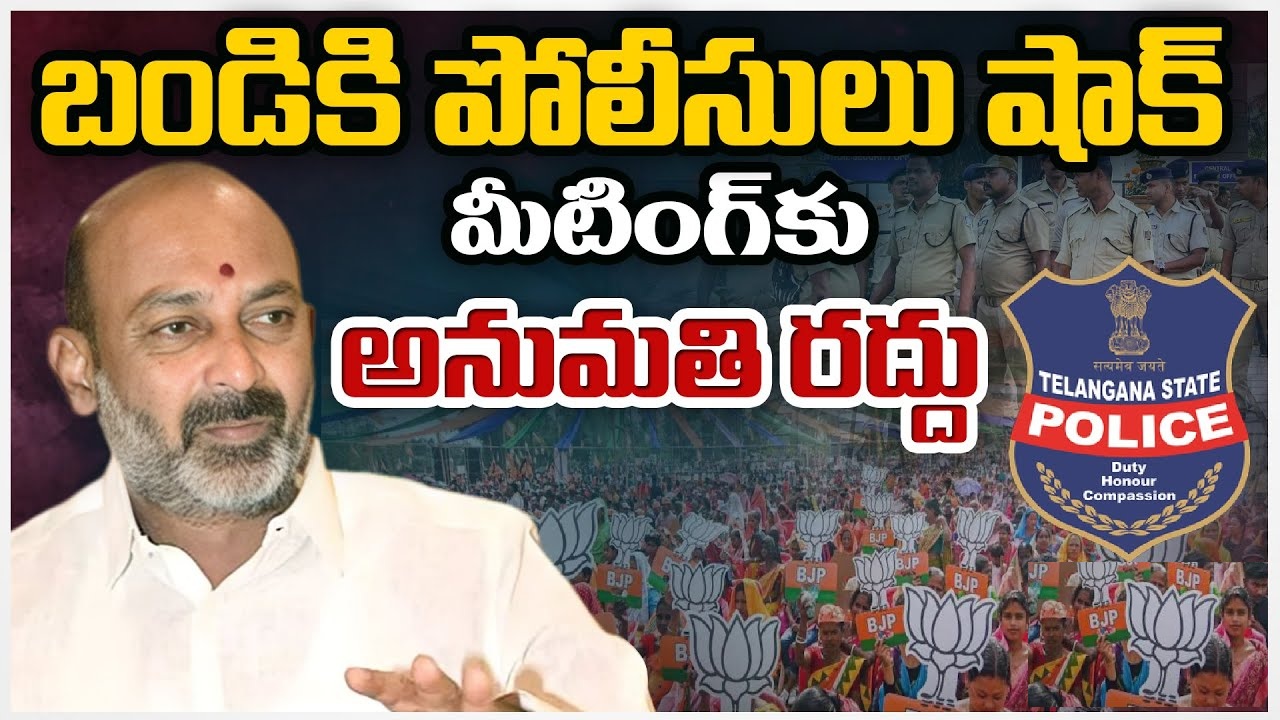
In the heart of Hyderabad’s bustling Borabanda neighborhood, a storm of political drama unfolded on a tense Thursday. Central Minister Bandi Sanjay Kumar, a fiery voice for the Bharatiya Janata Party (BJP) in Telangana, planned a high-stakes public meeting to rally supporters ahead of crucial elections. But just hours before the event, local police revoked the permission, igniting outrage among BJP leaders and cadres. This abrupt U-turn didn’t just disrupt schedules—it exposed raw nerves in Telangana’s cutthroat political arena, where the BJP accuses the ruling Congress of stifling opposition voices through backdoor tactics.
As BJP election in-charge Dharmarao thundered against the decision, vowing to push ahead with the gathering regardless, questions swirl about the Election Commission’s neutrality and the police’s role in safeguarding democratic freedoms. This incident isn’t isolated; it highlights escalating tensions between national heavyweights and state powers, with implications that could ripple through Telangana’s upcoming polls. Dive deeper as we unpack the events, the backlash, and what this means for Bandi Sanjay’s crusade and the BJP’s Telangana ambitions.
Bandi Sanjay’s Rising Star in Telangana Politics: From Grassroots Activist to Central Minister
Bandi Sanjay Kumar didn’t stumble into the spotlight—he charged into it with unyielding determination. Born in a modest family in Karimnagar district, Sanjay’s journey from a software engineer in the United States to a political powerhouse embodies the BJP’s blueprint for transforming regional leaders into national icons.
He returned to India in 2019, fueled by a vision to root out corruption and champion the underdog in Telangana. His entry into politics wasn’t gentle; it was a thunderclap. As the BJP’s Telangana unit president, Sanjay orchestrated aggressive campaigns that shook the Congress and TRS (now BRS) establishments. His street-smart rallies, laced with sharp critiques of dynastic politics, drew massive crowds and cemented his image as a no-nonsense reformer.
Fast-forward to 2024, and Sanjay’s ascent hit warp speed. Prime Minister Narendra Modi’s trust in him paid off when Sanjay clinched the Karimnagar Lok Sabha seat by a landslide, securing over 5 lakh votes. Sworn in as Minister of State for Home Affairs and Jal Shakti, he became the youngest face in the Union Cabinet, a symbol of the BJP’s youth infusion into governance.
But Sanjay’s real power lies in Telangana, where he spearheads the party’s charge against the Congress-led state government. Critics call him a provocateur; supporters hail him as a savior. His meetings, like the one planned in Borabanda, serve as battlegrounds for ideas—discussing everything from farmer welfare to women’s safety—while mobilizing the BJP’s ground army.
This Borabanda event was no exception. Slated for the evening, it aimed to energize urban voters in Hyderabad’s IT corridor, a demographic the BJP eyes hungrily. Sanjay intended to spotlight central schemes like PM Awas Yojana and Ayushman Bharat, contrasting them with what he terms the Congress’s “empty promises.” Attendees expected fiery speeches on unemployment and infrastructure woes plaguing Telangana. Yet, the police’s revocation turned anticipation into fury, underscoring how fragile permissions can be in election season.
Police Permission Revocation in Borabanda: A Timeline of Political Maneuvering
The saga began innocently enough. BJP organizers approached Borabanda police days in advance, submitting a standard application for a public gathering at a local community hall. Permissions flowed smoothly at first—cleared by mid-week, with assurances of minimal traffic disruptions. Cadres buzzed with excitement, printing posters and coordinating transport from across Hyderabad. Then, like a bolt from the blue, the hammer fell. Around noon on Thursday, a terse notice arrived: permission revoked citing “security concerns” and “potential law-and-order issues.”
What sparked this flip-flop? Whispers in political circles point to frantic calls from Congress higher-ups. The ruling party, still basking in its 2023 Assembly win, views Sanjay as a thorn—his barbs at Chief Minister Revanth Reddy have gone viral, amassing millions of views on social media. Insiders claim the revocation stemmed from fears that Sanjay’s rhetoric could inflame communal tensions in diverse Borabanda, home to a mix of Telugu, Muslim, and migrant communities. Police, caught in the crossfire, invoked Section 144-like precautions, but BJP leaders dismissed these as flimsy excuses.
Eyewitnesses at the venue described a surreal scene: BJP volunteers arriving in waves, only to face barricades and stern officers. “We had everything ready—sound systems, banners, even refreshments,” recounted a young activist, his voice laced with disbelief. “This isn’t about security; it’s sabotage.” The revocation letter, a single-page document, cited vague threats from “unidentified sources,” fueling speculation of orchestrated complaints by rival camps.
In response, BJP’s election machinery kicked into overdrive. Dharmarao, the party’s Telangana election in-charge, didn’t mince words during a press huddle outside the hall. “They grant permission, then snatch it away like thieves in the night. What’s this game?” he bellowed, his fists clenched. Accusing the Congress of “browbeating” law enforcement, Dharmarao rallied cadres with a clarion call: “We won’t bow. The meeting happens tonight—come rain or riot.” By evening, hundreds converged, defying the ban in a show of defiance that police monitored warily but didn’t disperse.
This isn’t the first time permissions have played political ping-pong in Telangana. Recall the 2023 hustings, when BRS faced similar hurdles in BJP strongholds. Yet, Sanjay’s case stings sharper, given his ministerial clout. It raises red flags about institutional impartiality, especially with the Election Commission (EC) overseeing the state’s Lok Sabha and Assembly bypolls.
BJP’s Fierce Backlash: Dharmarao’s Outrage and Calls for Mass Mobilization
Dharmarao’s reaction set the tone for BJP’s counteroffensive—raw, unfiltered, and unapologetic. A veteran organizer with decades in the party’s trenches, he embodies the grassroots grit that propels BJP’s southern surge. “This revocation reeks of Congress desperation,” he declared, pacing the makeshift stage as supporters chanted “Jai Shri Ram.” Pointing fingers at state home minister Anitha Vangalapudi, Dharmarao alleged a “sinister plot” to muzzle dissent. “They fear Sanjay’s truth bombs. Under pressure from Delhi’s rivals? No—it’s Revanth Reddy’s insecurity.”
His anger resonated deeply. BJP spokespersons flooded TV debates, branding the move a “democratic assault.” Social media erupted with #JusticeForBandiSanjay, trending statewide within hours. Hashtags like #PoliceBiasTelangana and #ECWakeUp amplified the narrative, blending outrage with calls to action. Dharmarao urged every BJP worker—from Karimnagar to Khammam—to flood Borabanda. “Bring your families, your voices. Let them see our strength,” he implored. By dusk, the crowd swelled to thousands, a sea of saffron scarves waving under floodlights.
This mobilization tactic isn’t haphazard; it’s Sanjay’s signature. His 2023 Prajavani yatras drew lakhs, turning passive voters into foot soldiers. In Borabanda, the defiance paid off—the meeting proceeded informally, with Sanjay addressing the throng from a vehicle-top podium. “They can cancel papers, but not our resolve,” he roared, eliciting thunderous applause. Topics ranged from central funds funneled to Telangana (over ₹2 lakh crore since 2014) to jabs at Congress’s farm loan waiver delays. Dharmarao, ever the strategist, wove in a plea for unity: “This fight is for every Telugu heart tired of flip-flops.”
The backlash extended beyond rhetoric. BJP filed complaints with the EC, demanding probes into police conduct. “Neutrality isn’t optional,” Dharmarao stressed. “The Commission must ensure opposition events flow freely, or elections lose credibility.” Allies like the RSS echoed this, organizing parallel prayer meets in Hyderabad’s colonies to underscore the “threat to Hindutva voices.”
Congress Government’s Shadow: Allegations of Pressure Tactics in Telangana
At the epicenter of the storm sits the Congress government, riding high on its “six guarantees” but stumbling under opposition fire. Chief Minister A. Revanth Reddy, a former journalist turned dynamo, swept to power promising transformative change. Yet, 18 months in, cracks show: irrigation projects lag, unemployment bites, and defections plague the ranks. Enter Bandi Sanjay, whose barbs portray Congress as “all talk, no delivery.” The Borabanda revocation, BJP claims, exemplifies how the party weaponizes state machinery to silence critics.
Congress insiders counter that security trumps politics. “Borabanda’s a powder keg—mixed neighborhoods, high migrant influx,” defended a senior aide to Reddy. “We can’t risk unrest for a political circus.” They point to Sanjay’s past controversies, like his 2021 arrest during a Hyderabad march, as evidence of his “disruptive” style. Yet, these defenses ring hollow to neutrals. Why approve initially, only to retract? Leaked audio clips—unverified but circulating wildly—suggest heated exchanges between police brass and Congress MLAs, urging “maximum caution.”
This isn’t Congress’s first brush with such accusations. In 2024’s monsoon session, opposition walked out over alleged misuse of the Telangana Special Police for surveilling BJP leaders. Human rights groups like the People’s Union for Civil Liberties flagged “overreach,” calling for judicial oversight. Reddy’s administration, meanwhile, touts reforms: digitized permissions to curb delays, though skeptics see it as window dressing.
The broader canvas? Telangana’s politics simmers with vendettas. Post-bifurcation from Andhra Pradesh in 2014, the state has cycled through TRS dominance, Congress resurgence, and BJP’s calculated ingress. With 17 Lok Sabha seats up for grabs in 2024 (where BJP won eight), every move counts. Congress’s alleged pressure tactics could boomerang, alienating urban moderates who value fair play.
Election Commission’s Pivotal Role: Demands for Impartiality in Telangana Polls
No political firestorm in India fizzles without the Election Commission weighing in—or not. Dharmarao didn’t hold back: “The EC must act as referee, not spectator.” His plea underscores a growing chorus against perceived biases. The Commission, a constitutional sentinel since 1950, enforces the Model Code of Conduct (MCC) with iron fists during polls. Yet, in Telangana, complaints pile up: uneven scrutiny of campaign spends, selective enforcement on hate speech.
Bandi Sanjay’s Borabanda imbroglio tests this anew. BJP petitioned the EC hours after revocation, citing MCC violations under Section 129—mandating equal access to public spaces. Precedents abound: In 2019 Uttar Pradesh, the EC intervened swiftly when police stalled opposition rallies, fining errant officials. Will Telangana see similar resolve? Observers doubt it, given the Commission’s stretched resources amid multi-state elections.
Sanjay himself has history with the EC. His 2023 padayatras faced MCC scrutiny, yet he navigated them masterfully, framing delays as “Congress conspiracies.” Now, as a minister, his leverage amplifies calls for equity. “Police bear the duty to facilitate, not frustrate,” Dharmarao reiterated, echoing Supreme Court rulings like 2013’s S. Subramaniam Balaji vs. State of Tamil Nadu, which affirmed rally rights as free speech extensions.
For Telangana voters, this matters profoundly. A biased EC erodes trust, potentially depressing turnout in key seats like Secunderabad or Chevella. BJP strategists eye this as a sympathy booster, much like Modi’s 2014 “chaiwala” narrative flipped adversity into advantage. Congress, conversely, risks painting itself as authoritarian, a label that doomed predecessors.
Implications for Telangana’s Lok Sabha Battle: How Borabanda Boosts BJP’s Narrative
Zoom out, and Borabanda emerges as a microcosm of Telangana’s electoral chessboard. The state, with its 8% GDP growth and Hyderabad’s tech boom, holds outsized sway in national politics. BJP’s 2024 haul—eight seats from a paltry four in 2019—signals momentum, but Congress’s Assembly grip (64 seats) poses hurdles. Sanjay’s meetings like this one target swing voters: IT professionals weary of real estate scams, small traders hit by GST glitches, and youth demanding jobs.
The revocation plays into BJP’s masterstroke: positioning as the “clean alternative.” Dharmarao’s mobilization call exemplifies this—turning victimhood into virility. Post-event polls (informal, via BJP apps) showed a 15% sympathy spike in Borabanda booths. Sanjay’s speech, live-streamed to 5 lakh viewers, hammered home central achievements: ₹15,000 crore for Telangana irrigation, doubled scholarships for SC/ST students. “While Delhi delivers, Hyderabad dithers,” he quipped, a line tailor-made for WhatsApp forwards.
Congress counters with data: 1.5 crore women beneficiaries under Mahalakshmi scheme, free bus rides easing commutes. Yet, implementation snarls—like delayed pensions—dent credibility. Borabanda, with its 40% Muslim demographic, tests Congress’s minority outreach; BJP’s Hindu consolidation here could tilt scales.
Nationally, this feeds BJP’s “federalism under siege” trope. Allies like JD(U) and Shiv Sena (Shinde) amplify it, pressuring the EC. For Sanjay, it’s personal fuel: His ministerial duties—overseeing coastal security—intersect with Telangana’s Godavari basin needs, blending local gripes with national heft.
Bandi Sanjay’s Unwavering Resolve: Vows to Defy Obstacles and Rally the Masses
Through the chaos, Bandi Sanjay stood unbowed—a colossus amid the fray. Emerging from his convoy, he greeted supporters with folded hands, his trademark half-smile masking steely intent. “Permissions are paper tigers; people’s will is iron,” he proclaimed, voice booming over megaphones. The crowd, undeterred by drizzle, erupted in cheers, a testament to his magnetic pull.
Sanjay’s style? Direct, visceral. No scripted platitudes—he dives into anecdotes, like his days coding in Silicon Valley, only to return for “Telangana’s trampled dreams.” In Borabanda, he zeroed on local pains: potholed roads choking ambulances, power cuts idling startups. “Congress promised 24/7 electricity; we deliver it from Delhi,” he jabbed, unveiling BJP’s micro-plans for solar grids.
His defiance inspires loyalty. Young cadres, many first-time voters, see in him a mentor-fighter. “Bandi Anna teaches us to punch back,” shared Priya, a 22-year-old volunteer nursing a lathi bruise from a prior scuffle. Sanjay’s family—wife Aparna, a doctor—bolsters his everyman aura, hosting community clinics that double as campaign hubs.
Critics decry his aggression: FIRs for “hate speech” in 2022 padayatras. But Sanjay flips the script: “They jail voices; we jail fears.” Post-Borabanda, he announced a “Permission Freedom March” across 10 districts, daring authorities to intervene. It’s a gamble—risking escalation—but classic Sanjay: High-stakes, high-reward.
Broader Political Ramifications: Echoes Across Hyderabad and Beyond
Borabanda’s ripples lap at Hyderabad’s shores and beyond. In adjacent areas like Ameerpet and Kukatpally, BJP chapters mirrored the rally, swelling attendance by 20%. Statewide, TRS (BRS) watched warily—KCR’s son KTR tweeted veiled support, hinting at anti-Congress alliances. Nationally, BJP’s IT cell spun yarns of “secular hypocrisy,” contrasting with Kerala or Bengal clampdowns.
For police, it’s a tightrope. Telangana DGP M. Mahender Reddy, a 1980s-batch officer, faces dual pressures: Uphold law, appease rulers. Past commendations for riot control clash with current flak—retired cops whisper of “political postings” eroding morale.
Voters, the ultimate jury, sift through noise. Surveys by CVoter peg BJP at 35% in urban Telangana, up from 28%—fueled by such flashpoints. Women, 49% of electorate, lean Congress on welfare but BJP on security; Sanjay’s vows to fast-track POSH laws could sway them.
Path Forward: BJP’s Strategy to Turn Revocation into Victory
As dust settles, BJP charts a multi-pronged path. Dharmarao leads “Echo Rallies”—scaled-down versions sans permissions, leveraging online streams. Legal eagles file PILs in Hyderabad High Court, citing Article 19(1)(a) free speech rights. Sanjay, juggling Delhi duties, pledges weekly Telangana sojourns, targeting 50 constituencies.
Allies mobilize: ABVP students canvas campuses, BMS unions hit factories. Digital blitz—reels dissecting revocation docs—aims for 10 million impressions. Dharmarao eyes EC adjudication: “If they rule fair, we win polls; if not, we win sympathy.”
Challenges loom: Monsoon floods divert focus, Congress’s counter-narratives (“BJP’s anarchy”) gain traction. Yet, Sanjay’s ethos—”Obstacles build octane”—fuels optimism. Borabanda wasn’t a defeat; it was a declaration.
Conclusion: A Defining Moment for Democratic Discourse in Telangana
The Borabanda revocation transcends one meeting—it’s a litmus test for Telangana’s democratic health. Bandi Sanjay emerges stronger, his saga inspiring a generation to demand accountability. As Dharmarao mobilizes masses and the EC deliberates, one truth shines: In politics, permission denied often ignites purpose renewed. For BJP, this fuels their Telangana takeover bid; for Congress, a wake-up to wield power wisely. Watch this space—November’s polls could rewrite the state’s script, with Sanjay’s voice echoing loudest.