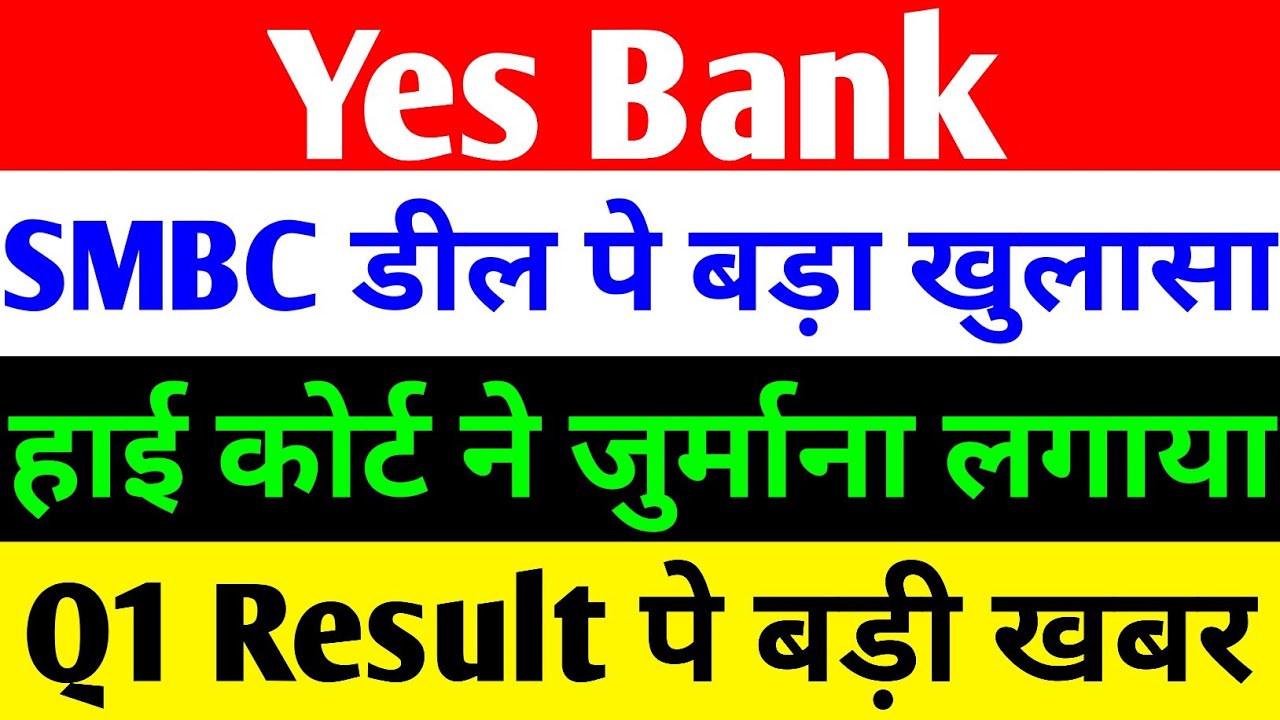
Yes Bank, a prominent private-sector bank in India, has been making significant strides in 2025, capturing the attention of investors and stakeholders alike. From securing major foreign investments to implementing robust governance changes and achieving remarkable financial recovery, the bank is poised for a transformative year. This article delves into the latest Yes Bank updates, including Japan’s SMBC deal, boardroom reshuffles, financial performance, and a recent legal setback. By exploring these developments, we aim to provide a clear, actionable understanding of Yes Bank’s trajectory and its implications for investors and the banking sector.
SMBC’s Strategic Investment in Yes Bank: A Game-Changing Deal
Japan’s SMBC Seeks CCI Approval for 20% Stake
One of the most significant developments for Yes Bank in 2025 is the strategic investment from Japan’s Sumitomo Mitsui Banking Corporation (SMBC). SMBC has sought approval from the Competition Commission of India (CCI) to acquire a 20% stake in Yes Bank, marking a pivotal moment for the bank’s growth strategy. This move aligns with India’s Foreign Direct Investment (FDI) policies, necessitating regulatory clearance to ensure compliance with fair trade regulations. The deal, valued at ₹13,483 crore, represents one of the largest cross-border transactions in India’s banking sector.
SMBC, a wholly-owned subsidiary of Sumitomo Mitsui Financial Group (SMFG), is Japan’s second-largest banking group, boasting total assets of approximately $2 trillion as of December 2024. With a strong global presence and a diversified portfolio spanning lending, digital payments, deposits, forex services, investment banking, and cash management, SMBC’s entry into Yes Bank is set to bolster the latter’s operational capabilities. Upon completion, SMBC will emerge as Yes Bank’s single largest shareholder, holding 20% of the bank’s share capital and voting rights.
Breakdown of the SMBC Deal
The acquisition involves a consortium of lenders, including the State Bank of India (SBI) and seven other banks—Axis Bank, Bandhan Bank, Federal Bank, HDFC Bank, ICICI Bank, IDFC First Bank, and Kotak Mahindra Bank—divesting their stakes. SBI will transfer 13.19% of its holding for ₹8,889 crore, while the remaining 6.81% will come from the other lenders for ₹4,594 crore. This transaction follows Yes Bank’s reconstruction efforts initiated under the Reserve Bank of India’s (RBI) guidance, where these lenders had previously acquired stakes at ₹10 per share.
The deal underscores SMBC’s confidence in Yes Bank’s potential, especially as the bank’s stock is trading at a discount compared to the ₹12.5 price point at which earlier deals were struck. As of July 2025, Yes Bank’s stock closed at ₹20.43, reflecting a 4.44% surge, signaling positive market sentiment toward these developments.
Implications for Yes Bank’s Future
SMBC’s investment is more than a financial transaction; it’s a strategic partnership that enhances Yes Bank’s credibility and operational strength. By leveraging SMBC’s global expertise and resources, Yes Bank aims to expand its footprint in digital banking, investment services, and corporate lending. This deal also signals to investors that Yes Bank is on a robust growth path, making it an attractive opportunity for those seeking exposure to India’s banking sector.
Governance Overhaul: Boardroom Changes at Yes Bank
Appointment of D. Shiva Kumar as Non-Executive Director
In a significant governance update, Yes Bank has revamped its boardroom with the appointment of D. Shiva Kumar as a non-executive director, nominated by Advent International’s subsidiary, Vventa Holdings Limited. This move follows the resignation of Shweta Jalan, who stepped down on June 26, 2025, citing personal and professional commitments. The board accepted her resignation during its June 27 meeting and approved Shiva Kumar’s appointment, pending shareholder approval.
D. Shiva Kumar brings a wealth of experience to Yes Bank. As an operating partner at Advent International, he has previously served as CEO for major brands like Aditya Birla Group, PepsiCo India, Nokia, and Philips. His extensive boardroom experience includes roles at Burger King, Godrej Consumer, IIM Ahmedabad, IIM Udaipur, XLRI, and SBJIMR. Shiva Kumar’s appointment is expected to strengthen Yes Bank’s governance framework, particularly in areas like fraud monitoring, corporate social responsibility (CSR), environmental, social, and governance (ESG) initiatives, and capital raising.
Impact of Governance Changes
Shweta Jalan’s resignation also saw her exit from several key committees, including fraud monitoring, CSR, ESG, capital raising, and nomination and remuneration. Yes Bank promptly notified the National Stock Exchange (NSE) and Bombay Stock Exchange (BSE) of these changes, ensuring transparency. Shiva Kumar’s appointment, coupled with his unblemished record with regulatory bodies like the Securities and Exchange Board of India (SEBI), positions him as a credible leader to guide Yes Bank through its next phase of growth.
These governance changes reflect Yes Bank’s commitment to aligning with global best practices, enhancing investor confidence, and ensuring robust oversight. As the bank navigates a competitive landscape, such leadership transitions are critical to sustaining momentum.
Yes Bank’s Financial Performance: A Remarkable Turnaround
Record Profits and Improved Metrics
Yes Bank’s financial performance in the first quarter of 2025 has been nothing short of impressive. The bank reported a profit of approximately ₹246 crore, marking its strongest performance in the last five years. Key financial metrics highlight the bank’s recovery:
- Net Interest Margin (NIM): Stable at 2.4% in Q1 2025, down slightly from 2.5% in Q4 2024. Yes Bank aims to elevate NIM to 3.5% in the medium term.
- Return on Assets (ROA): Currently at 0.6%, with a peak of 0.7% in Q4 2024. The bank targets an ROA of 1% by 2027 and 1.15% by 2030.
- Operating Profit: Recorded at ₹4,254 crore, with a 26% year-on-year increase in pre-provision operating profit (PPOP). The PPOP-to-assets ratio stands at 1%, reflecting improved operational efficiency.
- Asset Quality: Gross non-performing assets (NPA) dropped to 1.6%, and net NPA fell to 0.3%, the best figures since FY2020. The bank recovered ₹5,923 crore, surpassing its own estimates.
- Restructured Loan Book: Reduced from ₹1,900 crore to ₹400 crore, indicating near-complete resolution of legacy stressed loans.
- Loan Book Growth: Expanded to ₹2.46 lakh crore, with a projected growth rate of 12–15% annually.
- CASA Ratio: Improved to 34.3% from 30.9% last year, signaling stronger customer deposits.
- Credit-Deposit (CD) Ratio: Stands at 86.5%, with a liquidity coverage ratio (LCR) of 125%, underscoring robust liquidity.
Strategic Focus Areas
Yes Bank’s leadership has outlined three key priorities for sustained growth:
- Enhancing Margins: By optimizing interest income and reducing funding costs.
- Quality Growth: Expanding the loan book while maintaining stringent asset quality standards.
- Operational Efficiency: Streamlining processes to boost profitability and customer satisfaction.
These metrics and strategic goals demonstrate that Yes Bank has successfully navigated past challenges and is now positioned for sustainable growth. The absence of sectoral stress further bolsters its outlook, making it a compelling choice for investors seeking stability and growth in the banking sector.
Legal Setback: Bombay High Court’s Fine on Yes Bank
The Aadhaar Controversy
Despite its positive developments, Yes Bank faced a legal setback in 2025 when the Bombay High Court imposed a ₹1 crore fine. The penalty stems from a case involving the bank’s refusal to open accounts for clients without Aadhaar cards, despite a Supreme Court ruling that Aadhaar is not mandatory for account opening. The clients, unable to lease their property due to the lack of a bank account, suffered financial losses and sought compensation.
The bench, comprising Justices M.S. Sonak and Jitendra Jain, ruled that Yes Bank’s insistence on Aadhaar violated the Supreme Court’s directive. The court ordered the bank to pay ₹1 crore as compensation to the affected clients. While this fine is relatively minor in the context of Yes Bank’s financials, it highlights the importance of adhering to regulatory and judicial guidelines.
Lessons for Yes Bank
This incident serves as a reminder for Yes Bank and other financial institutions to align their policies with legal frameworks. While the fine won’t significantly impact the bank’s financials, it underscores the need for robust compliance mechanisms to avoid similar issues in the future. Investors should view this as a minor hiccup rather than a systemic issue, given Yes Bank’s overall positive trajectory.
Why Yes Bank Is a Compelling Investment Opportunity
Market Performance and Investor Sentiment
Yes Bank’s stock performance reflects growing investor confidence. Closing at ₹20.43 with a 4.44% gain, the stock remains attractively priced compared to its historical deal benchmarks. The SMBC investment, coupled with strong financial metrics and governance improvements, positions Yes Bank as a top contender in India’s banking sector.
Competitive Edge in the Banking Sector
Yes Bank’s focus on digital banking, diversified services, and strategic partnerships like SMBC gives it a competitive edge. The bank’s ability to resolve legacy NPAs, improve asset quality, and grow its loan book demonstrates resilience and adaptability. As India’s economy continues to grow, Yes Bank is well-positioned to capitalize on opportunities in retail and corporate banking.
Risks to Consider
While Yes Bank’s outlook is promising, investors should remain mindful of potential risks:
- Regulatory Hurdles: Delays in CCI approval for the SMBC deal could impact timelines.
- Market Volatility: Fluctuations in the banking sector or broader market could affect stock performance.
- Operational Challenges: Scaling operations while maintaining asset quality requires careful execution.
Investors are advised to consult financial advisors and conduct thorough research before making investment decisions.
Conclusion: Yes Bank’s Bright Future in 2025
Yes Bank’s journey in 2025 is a testament to its resilience and strategic vision. The SMBC investment, governance overhaul, and stellar financial performance signal a robust recovery and a promising future. While the Bombay High Court fine serves as a minor setback, it does not overshadow the bank’s achievements. With a clear focus on margins, quality growth, and operational efficiency, Yes Bank is well on its way to reclaiming its position as a leading player in India’s banking sector.
For investors, Yes Bank offers a compelling blend of value and growth potential. As the bank continues to execute its strategic plans and leverage global partnerships, it is poised to deliver strong returns in the coming years. Stay informed, consult with financial experts, and consider Yes Bank as a key player in your investment portfolio.