
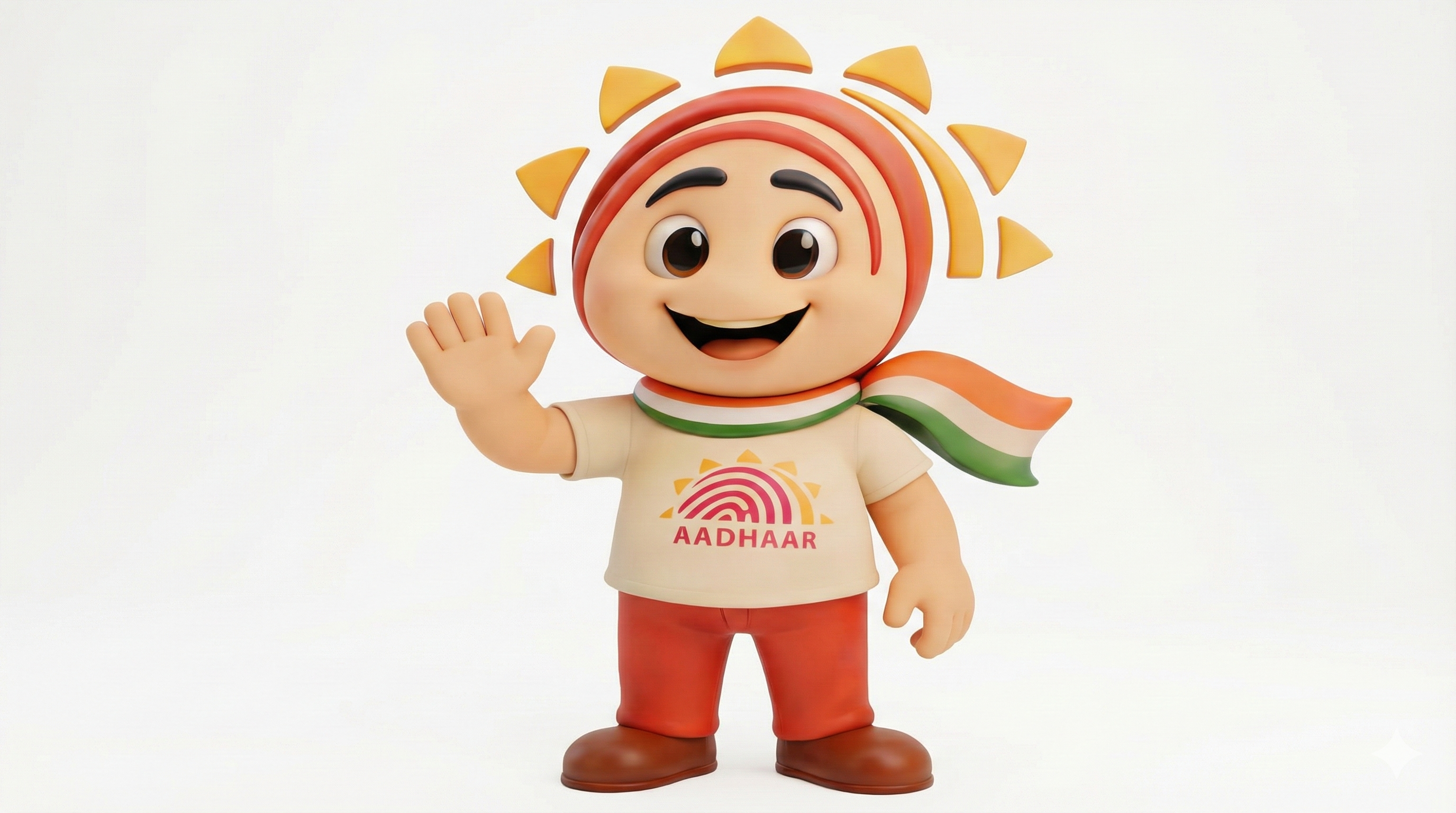
In a groundbreaking move that blends creativity with public engagement, the Unique Identification Authority of India (UIDAI) introduces Udai, the official Aadhaar mascot. This friendly figure aims to demystify Aadhaar services for millions across the nation, making complex processes like updates, authentication, and data sharing feel approachable and user-friendly. As India pushes forward with its digital transformation, Udai stands as a symbol of inclusivity, trust, and innovation in identity management. This launch not only highlights UIDAI’s commitment to resident-centric communication but also underscores Aadhaar’s role in empowering over 1.4 billion Indians with secure, accessible identification.
The Genesis of Udai: A Nationwide Creative Spark for Aadhaar Awareness
UIDAI sparks nationwide excitement by launching Udai through an open competition on the MyGov platform. Designers, students, and professionals from every corner of India pour in their ideas, resulting in 875 unique entries. This inclusive approach ensures that Udai truly reflects the diverse spirit of the country. Officials at UIDAI carefully evaluate each submission through a multi-stage process, prioritizing creativity, relevance, and simplicity.
Arun Gokul from Thrissur, Kerala, emerges as the top winner in the mascot design category. His vision captures Aadhaar’s essence as a reliable companion for everyday Indians. Idris Dawaiwala from Pune, Maharashtra, and Krishna Sharma from Ghazipur, Uttar Pradesh, secure second and third places, respectively, adding layers of regional flair to the final concept.
In the naming contest, Riya Jain from Bhopal claims first prize with “Udai,” a name that evokes dawn and new beginnings—perfectly aligning with Aadhaar’s promise of empowerment. Idris Dawaiwala again shines in second place, while Maharaj Saran Chellapilla from Hyderabad takes third. These winners receive recognition at a special event in Thiruvananthapuram, where UIDAI Chairman Neelkanth Mishra unveils Udai to the world.
Mishra emphasizes how this mascot advances UIDAI’s mission to create simpler, more inclusive communication channels. He notes that Udai will guide residents through Aadhaar’s vast ecosystem, from basic enrollments to advanced features like offline verification and responsible data usage. This initiative builds on Aadhaar’s foundation as a public good, fostering trust through active participation.
Udai’s Role in Simplifying Aadhaar Services: A Resident-Friendly Guide
Udai steps into the spotlight as a communication powerhouse, transforming how Indians interact with Aadhaar. This mascot acts as a narrator and companion, breaking down barriers in understanding services that touch every aspect of daily life. Whether you need to update your address, authenticate for benefits, or explore new tech integrations, Udai makes it relatable.
UIDAI CEO Bhuvnesh Kumar highlights the competition’s success in reinforcing Aadhaar’s core value: participation breeds trust. The massive response shows how deeply Aadhaar resonates as an essential tool for empowerment. Deputy Director General Vivek C. Verma adds that Udai will ease connections to Aadhaar information, turning technical jargon into everyday conversations.
This launch aligns with UIDAI’s broader strategy to boost awareness and responsible adoption. In a country as vast as India, where digital literacy varies, Udai bridges gaps by appearing in campaigns, videos, and educational materials. Imagine Udai explaining selective data sharing—where users control what information they reveal—or promoting secure authentication methods. This approach not only educates but also builds confidence in Aadhaar’s privacy safeguards.
Aadhaar’s Evolution: From Identity Void to National Empowerment Tool
Aadhaar transforms lives by filling a critical gap in identification. Before its inception, nearly 250 million Indians lacked any form of official ID, hindering access to services and benefits. UIDAI launches Aadhaar to provide a unique 12-digit number, backed by biometrics, to every resident. This initiative empowers the marginalized, enabling direct government reach through schemes like Direct Benefit Transfer (DBT).
Kumar, in his address at a state-level workshop in Chhattisgarh, shares insights into Aadhaar’s impact. He recounts his first visit to Raipur, marveling at the state’s progressive use of technology. From innovative district administration efforts to data centers and startup ecosystems, Chhattisgarh exemplifies how Aadhaar integrates with local development. Kumar praises the government’s orientation toward public welfare, noting how Aadhaar accelerates progress in education, infrastructure, and healthcare.
Aadhaar costs about ₹100 per enrollment, yet it generates massive savings. Through DBT, governments save around ₹4,000 for every ₹100 invested, curbing corruption and ensuring funds reach intended beneficiaries. This efficiency funds roads, bridges, electricity, and housing, driving national growth. Kumar stresses that Aadhaar’s dynamic regulations adapt to challenges, preventing misuse while maintaining accessibility.
Strengthening Aadhaar Enrollment: Tackling Fraud and Ensuring Eligibility
UIDAI tightens enrollment processes to safeguard Aadhaar’s integrity. New applicants over 18 must verify citizenship and residency through state portals, reducing risks from ineligible individuals like illegal immigrants. Centers focus on child enrollments and updates, limiting adult enrollments to select locations.
Kumar addresses common fraud attempts, such as multiple enrollments or biometric tampering. UIDAI deploys AI and machine learning models to detect anomalies in fingerprints and iris scans, rejecting suspicious applications. Date of birth changes limit to once, with name changes capped at twice before requiring in-person verification at regional offices.
To combat fake documents, UIDAI shifts toward online verification. States receive requests to digitize documents and add QR codes for automatic authentication. Integrations with databases like CBSE marksheets, birth certificates (now linked in 35 states), PAN, passports, MGNREGA, and PDS enhance reliability. For children under 18, birth certificates become mandatory for enrollment and name changes.
UIDAI introduces a new universal client software, tested on 2,000 machines and set for full deployment by October 31. This online tool verifies documents in real-time via QR codes, minimizing manual errors and fraud. These measures ensure Aadhaar remains a trusted identity foundation, despite occasional rejections that prioritize credibility.
Aadhaar Updates: Streamlining Changes for a Mobile Population
Residents frequently update Aadhaar details, with address changes topping the list due to migration. UIDAI processes about 7.5 lakh update requests daily, totaling 230 million annually. Mobile number updates follow, crucial for digital payments and authentications. Date of birth, name, and gender changes occur less often but require strict verification.
For major name alterations, gazette notifications become mandatory. Gender updates, though rare, accommodate corrections or transitions. Online options allow address and document updates from home, but sensitive changes like mobile numbers demand in-person biometric verification to prevent hacking.
Kumar announces upcoming enhancements: Integrating face authentication will enable home-based mobile updates, making the process seamless. This innovation, alongside simplified audit checklists for agencies, eases onboarding and maximizes Aadhaar’s utility.
Mastering Aadhaar Authentication: Secure Access to Benefits and Services
Authentication forms Aadhaar’s backbone for institutions, verifying identities for schemes funded by consolidated funds. Section 7 of the Aadhaar Act mandates verification for government benefits, with Chhattisgarh running 75 such schemes ripe for integration. Adding Aadhaar curbs irregularities, ensuring transparent DBT.
Section 4(4)(b)(ii) extends authentication to non-financial uses like attendance or welfare innovations. Departments apply via a new portal, gaining approval from the Ministry of Electronics and IT and UIDAI. Kumar urges increasing Authentication User Agencies (AUAs) and KYC User Agencies (KUAs) in states like Chhattisgarh to amplify impact.
UIDAI handles 90 million authentications daily, over 2,800 crore annually, and 15,000 crore cumulatively. Responses include yes/no for basic verification or eKYC, sharing name, photo, address, date of birth, and gender. Methods encompass mobile OTP, biometrics, and face authentication.
To counter fraud, UIDAI upgrades devices from L0 to L1, with 25 lakh of 40 lakh converted. Face authentication, via apps like NIC’s Beneficiary Jeevan Pramaan, simplifies processes for pensioners, allowing home-based life certificates. Kumar recommends shifting to face auth for its security and convenience, reducing reliance on fingerprint devices.
Aadhaar’s Broader Impact: Driving Inclusion and Innovation Across India
Aadhaar extends eligibility to residents, including NRIs, OCIs, and legal foreigners, with immigration database checks. This inclusivity supports India’s diverse population, from urban professionals to rural farmers. In Chhattisgarh, Aadhaar fuels schemes benefiting children and vulnerable groups, as seen in district innovations.
Kumar notes daily new enrollments: 75,000 applications, mostly for children (98%), aligning with India’s population growth of about 20 million annually. This sustains Aadhaar’s coverage at 1.4 billion numbers.
Challenges persist, like negative media on fake Aadhaars, but collective responsibility—among registrars, operators, and states—strengthens the system. UIDAI monitors operators dynamically, flagging errors and enforcing limits (25 mistakes monthly) to protect residents. Training, certification, and testing ensure only qualified individuals operate.
Future-Proofing Aadhaar: Technology and Collaboration for Maximum Reach
UIDAI commits to ongoing innovations, collaborating with states like Chhattisgarh for seamless integrations. Kumar assures full support, emphasizing joint efforts to maximize Aadhaar’s benefits. Workshops like the one in Raipur drive this synergy, honoring top performers and fostering best practices.
As Udai embarks on its journey, it symbolizes Aadhaar’s evolution—from a simple ID to a digital lifeline. This mascot, born from public creativity, promises to make Aadhaar more accessible, secure, and integral to India’s growth story.
Aadhaar in Action: Real-World Benefits for Indian Citizens
Aadhaar revolutionizes access to subsidies, pensions, and scholarships. Farmers in rural Haryana link Aadhaar to bank accounts for direct fertilizer subsidies, eliminating middlemen. Urban dwellers in Delhi use it for instant eKYC in banking, opening accounts in minutes.
In healthcare, Aadhaar integrates with Ayushman Bharat, verifying eligibility for free treatments. Education sees streamlined admissions and scholarships, reducing paperwork. During pandemics, Aadhaar enables contactless vaccinations and aid distribution.
Small businesses leverage Aadhaar for GST registrations and loans, boosting economic inclusion. Women, often without traditional IDs, gain empowerment through Aadhaar-linked schemes like Ujjwala for LPG connections.
Overcoming Aadhaar Challenges: Privacy, Security, and Public Trust
Critics raise privacy concerns, but UIDAI counters with robust measures. Data stores in encrypted servers, with no sharing without consent. Virtual IDs and masked Aadhaars allow selective disclosure.
Legal frameworks, including Supreme Court rulings, limit Aadhaar’s mandatory use to welfare schemes. UIDAI’s grievance portals address issues swiftly, maintaining transparency.
Kumar acknowledges exceptions in a 1.4 billion-strong system but stresses adaptive regulations. By curbing fraud, UIDAI preserves trust, ensuring Aadhaar serves as a force for good.
Udai and Beyond: UIDAI’s Vision for Digital India
Udai represents UIDAI’s forward-thinking approach, engaging youth through social media and animations. Future campaigns may feature Udai in regional languages, tailoring messages for states like Kerala or Uttar Pradesh.
Integrations with emerging tech—like blockchain for enhanced security—loom on the horizon. UIDAI explores AI-driven chatbots, with Udai as the face, for instant queries.
This launch coincides with India’s digital push, from UPI to DigiLocker. Aadhaar anchors these, creating a unified ecosystem for seamless services.
Conclusion: Embracing Udai for a Brighter Aadhaar Future
UIDAI launches Udai to humanize Aadhaar, making it a trusted ally for all Indians. From enrollment rigor to authentication ease, Aadhaar drives empowerment and efficiency. As residents embrace Udai’s guidance, India’s digital identity landscape shines brighter, inclusive, and secure.