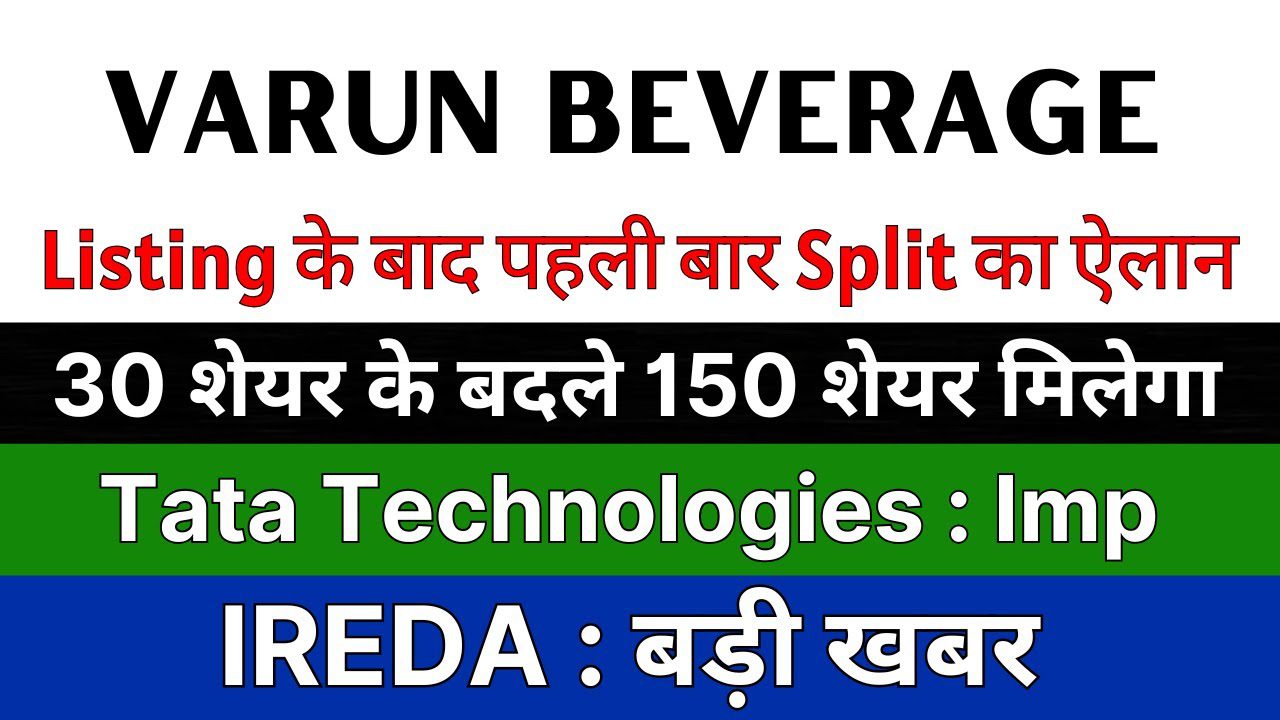
Tata Technologies emerges as a powerhouse in engineering and digital services, delivering breakthroughs that propel automotive and aerospace giants forward. Meanwhile, IREDA champions renewable energy financing, fueling India’s green revolution with ambitious growth trajectories.
Varun Beverages (VBL) refreshes its strategy amid market dips, while Cams (Computer Age Management Services) shakes up its equity structure with a landmark split. This comprehensive analysis dives deep into these developments, offering actionable insights for savvy shareholders and traders. From Tata Technologies’ Volvo partnership to IREDA’s potential ₹3,000 crore QIP, explore how these moves reshape portfolios in 2025’s dynamic landscape.
Tata Technologies Leadership Transition: Welcoming Uttam Gujarati as New CFO
Tata Technologies continues to solidify its position as a global leader in product engineering and digital transformation services. Investors closely watch every boardroom shuffle, and the recent appointment of Uttam Gujarati as Chief Financial Officer (CFO) and Member of the Management Committee marks a pivotal shift. Effective from December 31, 2025, this change replaces Savita Balachandran, who previously steered the company’s financial helm with precision.
Why does this matter for Tata Technologies shareholders? Management transitions often signal strategic pivots, especially in a sector where innovation demands robust fiscal oversight. Gujarati brings a wealth of experience from his prior roles within the Tata ecosystem, ensuring seamless continuity.
Analysts predict this move strengthens Tata Technologies’ financial reporting and investor relations, potentially boosting confidence amid volatile markets. As Tata Technologies navigates complex supply chains and R&D investments, Gujarati’s dual role as CFO and management member positions the company to accelerate growth initiatives without missing a beat.
This isn’t just an internal reshuffle; it reflects Tata Technologies’ commitment to agile leadership. In an era where electric vehicles (EVs) and autonomous driving redefine automotive engineering, sharp financial acumen becomes non-negotiable. Shareholders should monitor quarterly filings post-appointment to gauge impacts on earnings per share (EPS) and capital allocation. For those tracking Tata Technologies stock trends, this update underscores the company’s proactive stance, potentially stabilizing share prices in the short term.
Tata Technologies Strikes Gold with Volvo Cars: A Strategic Supplier Partnership
Excitement brews in the engineering services arena as Tata Technologies secures a game-changing nod from Volvo Cars. The Swedish automaker, renowned for its safety innovations and luxury EVs, selects Tata Technologies as a strategic supplier. This partnership amplifies Tata Technologies’ footprint in premium automotive design and digital solutions, promising mutual benefits in a fiercely competitive market.
Volvo’s choice highlights Tata Technologies’ prowess in end-to-end product lifecycle management. From concept sketching to production-ready prototypes, Tata Technologies delivers tailored engineering that aligns with Volvo’s sustainability goals. This collaboration extends beyond mere contracts; it fosters co-innovation in areas like connected vehicles and advanced driver-assistance systems (ADAS). For Tata Technologies, tapping into Volvo’s global network opens doors to European and North American markets, diversifying revenue streams away from traditional Indian OEMs.
Market watchers hail this as a win-win scenario. Volvo gains access to cost-effective, high-quality engineering talent, while Tata Technologies bolsters its order book with high-margin projects. Recent data shows Tata Technologies’ automotive segment already contributes over 70% to its revenue, and this tie-up could push that figure higher. Investors eyeing Tata Technologies share price forecasts should note the potential for accelerated top-line growth, especially as EV adoption surges globally. In 2025, with regulations favoring green tech, such alliances position Tata Technologies at the forefront of the $500 billion automotive engineering market.
This development also spotlights Tata Technologies’ broader ecosystem synergies within the Tata Group. Leveraging shared resources like Jaguar Land Rover’s tech stack, Tata Technologies enhances its value proposition. For shareholders, this means enhanced resilience against supply chain disruptions, a lesson hard-learned from pandemic-era challenges. As Volvo ramps up its EV lineup, expect Tata Technologies to announce milestone deliveries soon, injecting fresh momentum into its stock performance.
Tata Technologies Completes Early Acquisition of STC: Unlocking 7-8% Revenue Uplift
Tata Technologies doesn’t rest on laurels; it charges ahead with bold acquisitions that redefine its competitive edge. The swift completion of its €75 million buyout of STC (Société de Traitement de Capteurs), ahead of schedule, exemplifies this aggressive strategy. This French firm specializes in sensor processing and validation, a niche critical for automotive and aerospace applications.
By fast-tracking the deal, Tata Technologies integrates STC’s expertise into its portfolio, enhancing capabilities in real-time data analytics and embedded systems. STC’s annual revenue hovers between €32-35 million, injecting an immediate 7-8% boost to Tata Technologies’ consolidated topline in the upcoming fiscal year. This isn’t mere arithmetic; it’s a strategic infusion that fortifies Tata Technologies’ offerings in smart manufacturing and IoT-enabled vehicles.
Delve deeper: STC’s client base includes European tier-1 suppliers, providing Tata Technologies with instant market access and cross-selling opportunities. The acquisition aligns perfectly with industry shifts toward sensor fusion for Level 4 autonomy. Financially, the €75 million price tag appears accretive, with synergies expected to yield cost savings and innovation pipelines. Tata Technologies’ management projects this move to drive profit margins upward by leveraging STC’s proprietary tools alongside its own AI-driven platforms.
For investors dissecting Tata Technologies financials, this acquisition signals robust M&A appetite. Post-deal, watch for updated guidance on EBITDA margins, which could climb from current 12-14% levels. In a landscape where peers like Capgemini and Accenture dominate digital engineering, Tata Technologies’ nimble execution sets it apart. This coup not only diversifies geographic risks but also cements its role as an indispensable partner for global OEMs chasing net-zero ambitions.
IREDA’s Ambitious Fund Raise: ₹3,000 Crore QIP to Fuel Renewable Energy Boom
Shifting gears to the green frontier, Indian Renewable Energy Development Agency (IREDA) plots a monumental leap. Reports from CNBC-TV18 reveal plans for a Qualified Institutional Placement (QIP) to raise up to ₹3,000 crore, earmarked for expanding its lending arsenal in renewables. Though unofficial, such disclosures from credible sources often precede formal announcements, making this a must-note for IREDA stakeholders.
IREDA thrives as India’s premier non-banking financial company (NBFC) dedicated to renewable projects. Over the past 3-5 years, it delivered consistent revenue growth, underscoring its pivotal role in the nation’s 500 GW non-fossil fuel target by 2030. However, last year’s profit growth lagged revenue due to asset quality hiccups from Gensol Engineering’s bankruptcy—a one-off dent now healing through prudent underwriting.
This fund raise arrives at a propitious moment. India’s renewable financing market, valued at $24 billion in 2024, eyes $52 billion by 2030, growing at a robust 8.1% CAGR. IREDA’s strategy? Bolster its loan book to capture a larger slice of this pie, outpacing rivals like banks and emerging NBFCs. With reserves exceeding ₹10,000 crore, cash equivalents at ₹972 crore, and loans & advances at ₹82,623 crore, IREDA boasts a fortress balance sheet primed for scaling.
Why bet on IREDA now? Unlike monopolistic utilities like CDSL or NSE, IREDA operates in a fragmented yet exploding sector. Banks like HDFC and ICICI dominate traditional lending, but IREDA’s specialized focus on solar, wind, and hydro projects gives it an edge. More capital means more project financings, healthier disbursements, and fortified market share—mirroring how loan books propel banking giants. As global funds pour into ESG assets, IREDA’s QIP could attract marquee investors, potentially lifting its share price toward 52-week highs.
Critics might flag execution risks, but IREDA’s track record rebuts them. It financed over 50 GW of capacity last decade, with non-performing assets (NPAs) trending downward. This infusion promises EPS accretion and dividend hikes, rewarding patient holders. In 2025’s climate-conscious markets, IREDA stands as a beacon for sustainable investing, blending profitability with planetary impact.
Navigating IREDA’s Growth Catalysts: From Loan Book Strength to Market Dominance
IREDA’s ascent isn’t accidental; it stems from laser-focused execution in a sector ripe for disruption. Consider its loan portfolio: meticulously curated to back viable projects, minimizing defaults while maximizing yields. The recent Gensol setback? A blip that prompted tighter due diligence, now yielding cleaner books. With ₹3,000 crore incoming, IREDA eyes doubling disbursements, targeting mid-sized developers underserved by conservative lenders.
Market dynamics favor this play. Government incentives like PLI schemes and green bonds amplify demand for IREDA’s services. Unlike generic financiers, IREDA offers tailored structures—mezzanine debt, viability gap funding—that de-risk projects from ideation to commissioning. This niche mastery positions it to underwrite 20-25% of incremental capacity additions, per industry estimates.
Financially, the math stacks up. Post-QIP, expect debt-to-equity ratios to optimize, funding costs to dip via longer tenors, and ROE to rebound above 15%. Shareholders benefit from amplified scale: larger AUM translates to fee income surges and cross-sell upsides in advisory. Globally, peers like US EXIM or Germany’s KfW inspire IREDA’s model, but its India-centric agility trumps them.
Challenges persist—regulatory flux and interest rate volatility—but IREDA’s buffers mitigate them. Its 8+ years of NPA trends show resilience, even amid COVID. For portfolio diversifiers, IREDA offers uncorrelated returns: renewables’ tailwinds outpace cyclical sectors. As 2030 looms, this fund raise catapults IREDA from enabler to ecosystem leader, promising multi-bagger potential for early adherents.
VBL Shares Face Headwinds: Analyzing the 27% Dip from 52-Week Highs
Varun Beverages (VBL), the PepsiCo bottling behemoth, grapples with a stark reality: shares trade 27.1% below their 52-week peak. This correction prompts scrutiny of valuation metrics, where PEG ratios suggest neither egregious overpricing nor screaming bargains. Over the past five years, VBL’s price-to-earnings multiples hover near historic lows, hinting at a potential floor—unless earnings disappoint.
Last quarter’s single-digit revenue growth, following a flat predecessor, underscores domestic softness. India’s beverage market, VBL’s core, contends with inflation-weary consumers and seasonal vagaries. Profitability suffers as input costs bite, eroding EPS and pressuring multiples. Yet, VBL counters with diversification, eyeing a rebound through operational tweaks and volume drivers.
Valuation context matters. At current levels, VBL trades at discounts to peers like Hindustan Coca-Cola, reflecting temporary gloom. If management sustains these multiples, normalization seems plausible; a breakdown below would signal deeper woes, likely triggered by subpar quarterly prints. Investors must weigh this against VBL’s entrenched distribution network, spanning 27 plants and serving 3 million+ outlets.
This dip, while painful, echoes broader FMCG headwinds—rural slowdowns and urban premiumization lags. VBL’s response? Aggressive cost controls and portfolio refreshes, including healthier SKUs. For long-term holders, this presents a tactical entry, betting on festive season catalysts to reignite momentum.
VBL’s Expansion Blueprint: Cashback Tie-Up and Kenyan Subsidiary Launch
VBL refuses to yield ground. A landmark partnership with Cashback—a fintech disruptor—targets untapped bear market segments, blending beverages with digital rewards. This alliance, post-announcement, sparked a share rally, validating its potency. By integrating loyalty programs, VBL enhances consumer stickiness, driving repeat buys in price-sensitive demographics.
Globally, VBL amplifies its footprint with a Kenyan subsidiary, anchoring African ambitions. This move counters flat Indian growth—where VBL derives 80%+ revenue—by chasing double-digit international targets. Kenya’s burgeoning middle class and urbanization trends align with VBL’s scalable model, promising export synergies and local production ramps.
Strategically, this diversification buffers domestic risks. India’s beverage volumes stagnate amid health trends, but exports to South Asia and Africa offer counterbalance. The Kenyan venture, backed by $50 million+ investments, eyes 20% CAGR in regional sales. Paired with Cashback’s tech infusion, VBL modernizes go-to-market, leveraging data analytics for personalized promotions.
Financially, these initiatives could lift consolidated revenue 10-15% YoY, per analyst models. EPS recovery hinges on margin expansion from scale, offsetting ad spends. For VBL shareholders, this blueprint signals resilience: from distress to dominance, transforming headwinds into tailwinds.
IREDA vs. VBL: Comparative Insights for Portfolio Builders in 2025
Juxtaposing IREDA and VBL reveals divergent paths. IREDA rides secular green waves, with fund raises fueling loan growth in a $52 billion market. VBL, conversely, battles cyclical FMCG tides but counters via global forays. Valuation-wise, IREDA’s forward P/E at 12x undervalues its 20%+ ROE potential; VBL’s 25x reflects recovery bets.
Risk profiles differ: IREDA’s NPAs pose credit risks, mitigated by policy tailwinds. VBL faces volume volatility, cushioned by brand moats. Both boast strong balance sheets—IREDA’s ₹82,000 crore loans vs. VBL’s ₹5,000 crore cash pile—enabling aggressive plays. For diversified portfolios, blending IREDA’s growth with VBL’s stability yields balanced exposure.
In 2025, macroeconomic vectors favor IREDA’s renewables surge amid net-zero mandates. VBL benefits from easing inflation, unlocking rural demand. Investors blending these could target 15-20% blended returns, hedging sector bets astutely.
Cams Stock Split Announcement: 1:5 Ratio Unlocks Shareholder Value
Cams (Computer Age Management Services) delivers cheer to its investor base with its inaugural post-listing stock split: a 1:5 ratio that democratizes ownership. Existing shares transform into five, enhancing liquidity and broadening appeal to retail participants.
This move, the first since Cams’ 2020 debut, responds to a 300%+ appreciation, making shares less intimidating for new entrants. Splits rarely alter fundamentals but often catalyze trading volumes, as seen with peers like Infosys. For Cams holders, it signals confidence in sustained mutual fund registry leadership, where AUM under management exceeds ₹50 lakh crore.
Operationally, Cams thrives on digitization tailwinds, processing 80%+ of India’s SIP flows. The split coincides with robust Q2 growth—revenue up 25% YoY—driven by platform migrations and API integrations. Post-split, expect tighter bid-ask spreads, potentially lifting multiples from current 40x.
Non-shareholders may overlook this, but for the faithful, it’s a liquidity boon without dilution. Cams’ moaty business—high switching costs, regulatory barriers—ensures enduring cash flows. As demat accounts proliferate to 150 million, Cams cements its registrar throne, promising EPS compounding.
Broader Implications: How These Updates Reshape Indian Market Narratives
These vignettes—Tata Technologies’ alliances, IREDA’s capital quest, VBL’s global pivot, Cams’ accessibility—paint a vibrant market tapestry. Tata Technologies exemplifies engineering export, IREDA green finance, VBL consumer resilience, and Cams capital markets efficiency. Collectively, they underscore India’s dual engine: tech-driven innovation and sustainable scaling.
For 2025, themes emerge: M&A acceleration, ESG prioritization, and geographic diversification. Tata Technologies’ STC buy and VBL’s Kenya foray highlight outbound zeal; IREDA’s QIP and Cams’ split emphasize domestic deepening. Risks linger—geopolitics for Tata, monsoons for VBL—but opportunities abound.
Investors, arm yourselves with research. These aren’t mere headlines; they’re harbingers of alpha. As markets evolve, blending these narratives crafts resilient strategies, outpacing benchmarks in an uncertain yet exhilarating era.