
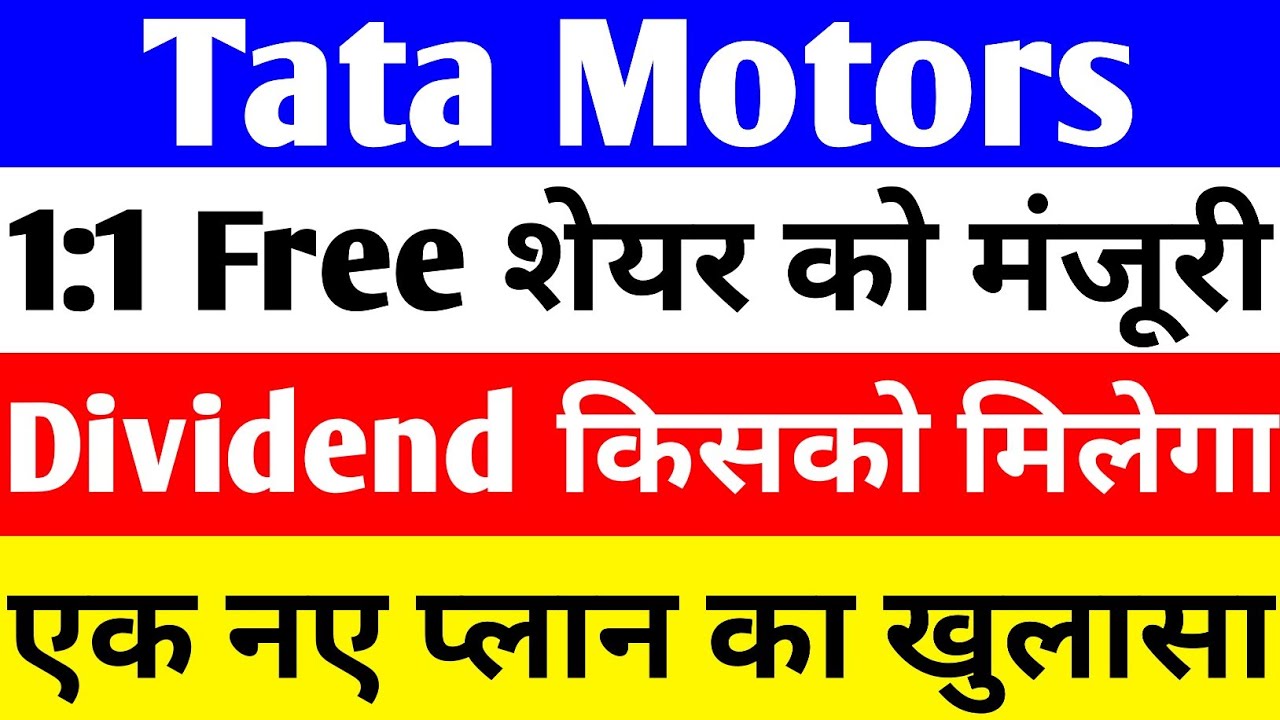
Tata Motors, a leading name in the Indian automotive industry, has been making headlines with its recent financial maneuvers and strategic decisions. From announcing a substantial dividend to securing shareholder approval for a landmark demerger, the company is taking bold steps to navigate market challenges and enhance its growth trajectory. Despite a recent dip in sales and share price, Tata Motors is rolling out aggressive strategies, including significant discounts on popular models like the Tata Altroz, to recapture market share and attract customers. This article delves into the latest Tata Motors share news, the implications of its share split, the separation of its commercial and passenger vehicle businesses, and the company’s plans to drive future growth.
Tata Motors Share Price: Navigating Market Volatility
Tata Motors’ share price has experienced fluctuations recently, reflecting broader market trends and specific company developments. On June 3, 2025, the stock traded around ₹675, marking a decline of approximately 0.91% intraday, with a low of ₹718. This dip aligns with a broader market correction, as the BSE Sensex dropped 545 points to 88,287, a 0.67% decline. Despite an early intraday gain of 300 points, profit booking at higher levels has kept the market and Tata Motors’ stock under pressure. The Nifty Auto index also saw a marginal decline of 0.032%, settling at 23,339.
The stock’s volatility stems from multiple factors, including foreign institutional investor (FII) selling and a cautious market sentiment. On June 2, 2025, FIIs offloaded shares, contributing to the downward pressure. However, Tata Motors remains a focal point for investors due to its strategic initiatives and strong fundamentals, such as its leadership in safety ratings and a robust portfolio of vehicles.
Dividend Announcement: Rewarding Shareholders
Tata Motors has announced a final dividend of ₹6 per share for FY25, a significant increase from the ₹3 final dividend and ₹3 special dividend declared in FY24. This payout, totaling ₹228 crore, underscores the company’s commitment to rewarding shareholders despite recent financial challenges. The record date for the dividend is set for June 4, 2025, meaning shareholders who hold Tata Motors shares in their demat accounts by the end of trading on June 3, 2025, will be eligible. Dividend payments will commence on or after June 24, 2025.
Retail investors, who hold a 20.05% stake in the company, stand to benefit significantly, with an estimated ₹44.2 crore in dividends allocated to them. This move not only boosts investor confidence but also highlights Tata Motors’ financial stability, as the company reported a net cash balance of approximately ₹1,000 crore. For investors, this dividend provides a compelling reason to hold or acquire shares ahead of the record date.
Tata Motors Demerger: A Strategic Split for Focused Growth
One of the most significant developments for Tata Motors is the shareholder approval for its demerger plan, announced on May 6, 2025. With an overwhelming 99.9995% of votes in favor, the company will split into two separate listed entities: one for its Commercial Vehicle (CV) business, including trucks and buses, and another for its Passenger Vehicle (PV) business, encompassing cars, electric vehicles (EVs), and the luxury brand Jaguar Land Rover (JLR). This restructuring, initially proposed in March 2024, aims to unlock value by allowing each entity to pursue independent growth strategies.
Share Entitlement Ratio: 1:1 Split
The demerger will follow a 1:1 share entitlement ratio, meaning shareholders will receive one share of the new Commercial Vehicle entity (TML Commercial Vehicles Limited, or TMLCV) for every share they hold in the existing Tata Motors Limited (TML). The Passenger Vehicle business, including EVs and JLR, will remain under TML, which will be renamed post-demerger. The process is expected to be completed by Q3 FY26, providing ample time for a seamless transition.
This split is designed to enhance operational efficiency, attract focused investor interest, and enable each business to capitalize on market-specific opportunities. The CV division, a leader in trucks and buses, will cater to industrial and fleet transport needs, while the PV division, bolstered by JLR and a growing EV portfolio, will target the premium and sustainable mobility segments.
Why the Demerger Matters
The demerger positions Tata Motors to align with global automotive trends, where companies often separate core business verticals to streamline operations. Analysts view this as a long-term value-creation strategy, with the potential to enhance shareholder returns. The move also addresses challenges like declining sales by allowing each entity to focus on tailored growth plans, such as expanding export markets for CVs or accelerating EV adoption for PVs.
Sales Performance: Addressing the Decline
Tata Motors reported a double-digit sales decline in May 2025, with total sales of 41,557 units compared to 46,697 units in May 2024, marking an 11% year-on-year drop. This downturn affected both the CV and PV segments, with domestic CV sales falling 10% and PV sales dropping 6% in April 2025. The company’s Q4 FY25 results further highlighted challenges, with a 51.3% year-on-year decline in net profit to ₹8,470 crore, though this exceeded analyst expectations of ₹7,662 crore.
Segment-wise, Jaguar Land Rover saw a 1.7% revenue drop to £7.7 billion, the PV segment declined 13.1% to ₹1,500 crore, and the CV segment fell 5% to ₹21,500 crore. These figures reflect global headwinds, including U.S. tariffs on auto imports and increased competition in the Indian EV market. Despite these challenges, Tata Motors remains a leader in safety, with models like the Punch, Nexon, Safari, and Harrier earning top safety ratings.
Export Growth: A Silver Lining
While domestic sales faced headwinds, Tata Motors reported a 28% year-on-year increase in passenger vehicle exports, shipping 483 units in May 2025 compared to 378 units the previous year. This growth, particularly in markets like Nepal, Bhutan, Sri Lanka, and Mauritius, underscores the company’s focus on expanding its global footprint. Models like the Tata Punch, Nexon, and Curvv (ICE vehicles) and Tiago.ev, Punch.ev, and Nexon.ev (EVs) are driving this export surge.
Strategic Initiatives: Boosting Sales with Discounts and New Launches
To counter declining sales and regain market share, Tata Motors is implementing aggressive strategies, including substantial discounts and the launch of updated models. The company’s focus on customer-centric initiatives aims to capitalize on its strong SUV portfolio and growing EV segment.
Tata Altroz MY 2024: Bumper Discounts
Tata Motors has rolled out attractive offers on its popular hatchback, the Tata Altroz MY 2024, with discounts of up to ₹1,35,000 in June 2025. This includes cash discounts and exchange bonuses, making the car, priced at ₹6.89 lakh (ex-showroom) for the base model and ₹10.49 lakh for the top variant, an appealing choice for buyers. Customers can contact their nearest dealership for detailed offer information.
The updated Altroz features a refreshed cabin with a 10.25-inch digital instrument cluster, auto AC controls, an electric sunroof, cruise control, rear AC vents, ambient lighting, and a 360° camera. With a five-star safety rating, the Altroz competes strongly in the premium hatchback segment, where Tata Motors holds an 11.5% market share. This discount strategy aims to boost sales in a segment that accounts for 6-7% of India’s passenger vehicle market.
Electric Vehicle Segment: Modest Growth
Tata Motors continues to dominate the Indian EV market, with models like the Tiago EV, Tigor EV, Punch EV, Nexon EV, and Curvv EV. In May 2025, the company sold 5,685 electric cars, a 2% increase from 5,558 units in May 2024. However, rising competition from other automakers has slightly eroded Tata’s market share. To counter this, the company is focusing on innovation and expanding its EV portfolio to maintain its leadership in sustainable mobility.
Financial Performance: Mixed Results with Optimism
Tata Motors’ Q4 FY25 results revealed a mixed performance. While net profit fell significantly, the company outperformed analyst expectations, signaling resilience. The net cash position of ₹1,000 crore reflects prudent financial management, and the company’s deleveraging plan aims to make its India business net debt-free in 2024, with JLR on track to achieve the same by FY25.
Despite sales challenges, analysts remain cautiously optimistic. Among 34 analysts covering Tata Motors, 19 recommend “Buy,” nine suggest “Hold,” and six advise “Sell.” CLSA maintains an “Outperform” rating with a price target of ₹805, indicating a potential 14% upside from recent levels. However, global challenges, such as U.S. tariffs on auto imports, could impact JLR’s volumes by 14% in FY26, according to CLSA.
Market Outlook: Opportunities and Challenges
Tata Motors operates in a dynamic automotive landscape, with opportunities in the growing SUV and EV markets but challenges from global tariffs and domestic competition. The India-UK Free Trade Agreement, signed in May 2025, could reduce automotive tariffs from over 100% to 10% under a quota system, potentially boosting JLR’s sales in India. However, U.S. tariffs, effective from April 3, 2025, pose a risk, as JLR derives 22% of its sales from the U.S. market.
The company’s focus on intellectual property rights (IPR) also signals long-term innovation. In FY25, Tata Motors secured 68 patent grants and filed 81 copyright applications, covering technologies like connectivity, electrification, sustainability, and safety. These efforts align with automotive megatrends and position Tata Motors as a forward-thinking player.
Why Invest in Tata Motors?
Tata Motors presents a compelling investment case despite recent stock price volatility. The demerger offers shareholders exposure to two focused entities with distinct growth strategies. The CV business will capitalize on industrial demand, while the PV business, with JLR and EVs, targets premium and sustainable markets. The ₹6 dividend, robust safety ratings, and aggressive discounts further enhance the stock’s appeal.
However, investors should exercise caution and conduct thorough research or consult a financial advisor before investing. The automotive sector faces macroeconomic challenges, and Tata Motors’ sales recovery will depend on the success of its strategic initiatives.
Conclusion: A Transformative Phase for Tata Motors
Tata Motors is at a pivotal juncture, balancing short-term challenges with long-term growth strategies. The demerger, approved with near-unanimous shareholder support, sets the stage for enhanced operational focus and value creation. Meanwhile, attractive discounts on models like the Tata Altroz and a growing presence in the EV and export markets signal the company’s commitment to regaining momentum. For investors, the combination of dividends, a 1:1 share split, and strategic restructuring makes Tata Motors a stock to watch in 2025.
Disclaimer: This article is for educational purposes only. Always consult a financial advisor and conduct your own research before making investment decisions.