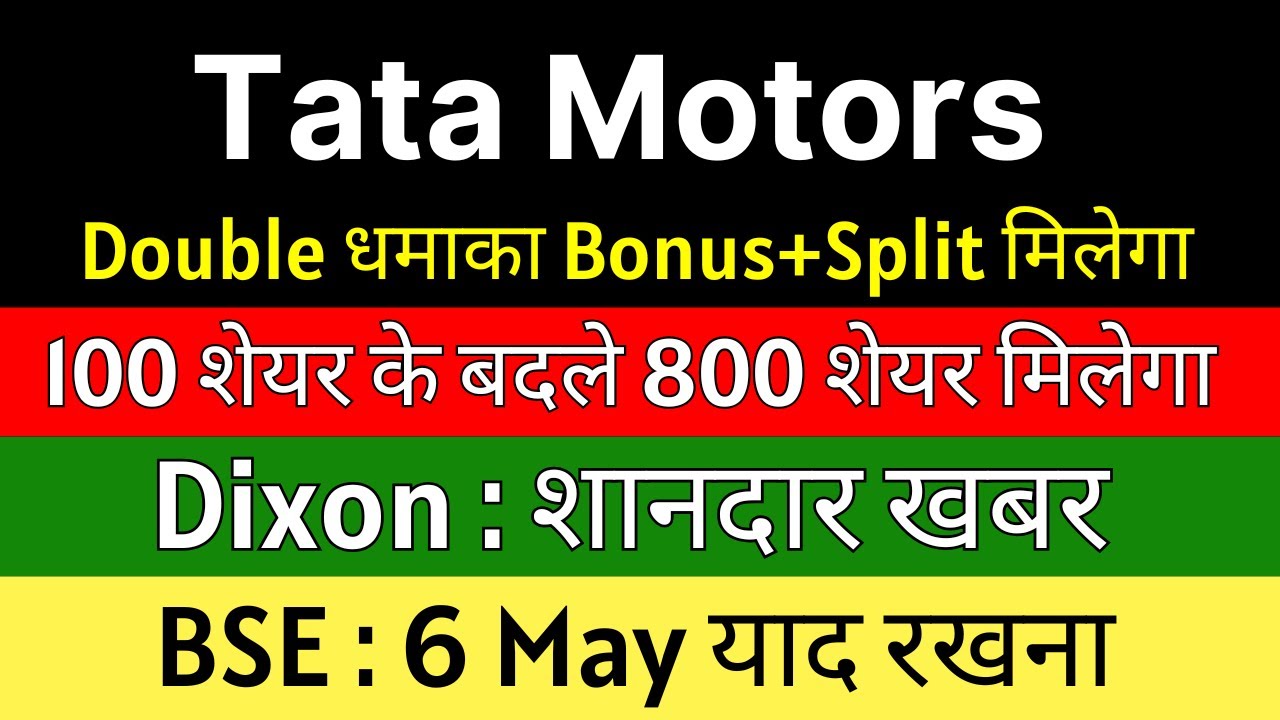
TATA Motors and Dixon Technologies: Bonus, Split Announcements, and BSE Share Updates for 2025
The Indian stock market is buzzing with significant updates from leading companies like TATA Motors, Dixon Technologies, and BSE. These firms have recently announced critical developments, including bonus issues, stock splits, and substantial investments, sparking interest among investors. This comprehensive guide dives into the latest news, financial performance, and growth prospects of these companies, offering valuable insights for investors aiming to capitalize on market opportunities in 2025. With a focus on electronic manufacturing, automotive sectors, and stock exchange dynamics, this article explores how these updates could shape investment decisions.
Dixon Technologies: Pioneering Electronic Manufacturing Growth
Dixon Technologies has emerged as a powerhouse in India’s electronic manufacturing services (EMS) sector, capitalizing on government incentives and strategic investments. The company’s recent performance and expansion plans position it as a top contender in the market.
Capitalizing on PLI Schemes for Exponential Growth
Dixon Technologies has leveraged India’s Production-Linked Incentive (PLI) schemes to fuel its growth. Participating in five to six PLI schemes, Dixon enjoys a competitive edge over other EMS players. The government’s recent announcement of a ₹23,000 crore PLI scheme for electronic components presents a golden opportunity for Dixon to expand its manufacturing capabilities. This initiative aligns with India’s push for self-reliance in electronics, and Dixon’s early-mover advantage strengthens its market position.
The company’s financials reflect its robust growth trajectory. Over the past year, Dixon reported a staggering 106% increase in revenue and an 81% surge in profits. These figures underscore Dixon’s ability to translate government incentives into tangible financial gains. Investors eyeing long-term growth in the EMS sector should closely monitor Dixon’s progress in this space.
Strategic Investments in Fixed Assets
Dixon’s commitment to expansion is evident in its substantial investments in fixed assets. In 2019, the company’s fixed assets totaled ₹241 crore. By the first half of the 2025 financial year, this figure soared to ₹2,465 crore—a tenfold increase in just five years. This aggressive capital expenditure (CapEx) strategy signals Dixon’s intent to scale operations and capture a larger share of the electronic components market.
The company’s cash flow statements further highlight its financial discipline. Over the past two years, Dixon generated approximately ₹1,200–1,300 crore in cash from operations. In the last financial year alone, it generated ₹584 crore, of which ₹531 crore was reinvested into the business. By prioritizing reinvestment over dividend payouts—spending only ₹18 crore on dividends—Dixon ensures sustained growth, benefiting both the company and its investors.
TATA Electronics’ Potential Collaboration
Rumors of TATA Electronics investing ₹2,000 crore in electronic component manufacturing services (ECMS) have sparked speculation about a potential collaboration with Dixon Technologies. While TATA Electronics has not officially confirmed these reports, industry sources suggest that the conglomerate is eyeing the EMS sector to diversify its portfolio. If materialized, this investment could create synergies with Dixon’s expertise, further boosting the EMS ecosystem in India.
However, TATA Electronics has downplayed these speculations, stating no immediate plans for such investments. Investors should approach this news cautiously, awaiting official confirmation before factoring it into their strategies.
TATA Motors: Navigating Challenges with Strategic Moves
TATA Motors, a stalwart in India’s automotive industry, has faced a challenging year marked by subdued performance. Despite these hurdles, the company’s upcoming announcements and strategic initiatives offer hope for a turnaround.
Q4 Earnings and Dividend Expectations
TATA Motors is set to announce its Q4 earnings on May 13, 2025, during its board meeting. Investors are keenly awaiting these results, which could shed light on the company’s ability to navigate global and domestic headwinds. While revenue growth remains a concern—particularly due to stagnant domestic sales and tariff-related shipment halts in the U.S.—analysts expect TATA Motors to report double-digit profit growth on a quarter-on-quarter (Q-o-Q) basis.
The company may also declare a dividend, providing a potential boost for shareholders. Based on historical dividend yields, investors can estimate the payout, though exact figures will depend on the board’s decision. Additionally, TATA Motors is reportedly considering raising ₹500 crore to fund expansions or repay debt, a move that could strengthen its financial position.
Addressing Revenue and Profit Challenges
TATA Motors’ lackluster performance over the past year stems from multiple factors. Globally, the company reported double-digit revenue and volume growth in the U.S., but tariff issues disrupted shipments, impacting its stock performance. Domestically, TATA Motors has struggled to grow revenue, with year-on-year (Y-o-Y) profit declines in recent quarters. For instance, Q4 2024 saw a profit of ₹17,500 crore, while Q3 2024 reported ₹5,500 crore—a significant drop.
Analysts predict that Q4 2025 profits may not match last year’s figures, but improved margins could drive Q-o-Q growth. Investors should temper expectations, as revenue growth remains elusive. However, TATA Motors’ focus on cost control and operational efficiency could pave the way for a recovery in the coming quarters.
Strategic Fundraise for Future Growth
The potential ₹500 crore fundraise signals TATA Motors’ commitment to long-term growth. Whether allocated to debt repayment or expansion projects, this capital infusion could enhance the company’s resilience. Investors should monitor how TATA Motors deploys these funds, as strategic investments in electric vehicles (EVs) or new market segments could unlock significant value.
BSE: Riding High with Bonus Issue and Strong Financials
The Bombay Stock Exchange (BSE) continues to dominate India’s financial markets, trading near its 52-week high. Recent announcements, including a bonus issue, have further fueled investor enthusiasm.
Bonus Issue and Earnings Outlook
On May 6, 2025, BSE will announce its Q4 earnings, a critical event for investors given the stock’s premium valuations. Trading at a price-to-earnings growth (PEG) ratio above 5.5, BSE is considered expensive, making its upcoming numbers pivotal for sustaining investor confidence.
The company recently declared a 2:1 bonus issue, rewarding shareholders with two additional shares for every share held. The record date for this bonus is expected to be announced soon, adding to the stock’s appeal. In the previous quarter, BSE reported record-breaking revenue, marking one of its best performances. However, profits fell short of expectations, raising the stakes for Q4.
Investors expect BSE to deliver both strong revenue and profit figures to justify its high valuations. Failure to meet these expectations could trigger profit-booking, given the stock’s proximity to its all-time high. Conversely, robust numbers could propel BSE to new heights, reinforcing its dominance in India’s financial ecosystem.
Institutional Confidence Boosts Sentiment
BSE’s attractiveness is further underscored by increased stakes from foreign institutional investors (FIIs) and domestic institutional investors (DIIs). This institutional backing signals confidence in BSE’s growth prospects, particularly as India’s capital markets continue to expand. Investors should weigh these positive developments against the stock’s high valuations when making investment decisions.
Bajaj Finance: Rewarding Shareholders with Bonus and Split
Bajaj Finance, a leading non-banking financial company (NBFC), has announced a significant shareholder-friendly move, combining a bonus issue with a stock split. This development has generated buzz among investors.
Understanding the Bonus and Split Mechanics
Bajaj Finance’s announcement includes a 1:4 bonus issue and a 1:2 stock split, resulting in a net 1:10 share increase for investors. Here’s how it works:
- Bonus Issue: For every share held, shareholders receive four additional shares, increasing their holding to five shares.
- Stock Split: Each of these five shares is split into two, resulting in a total of ten shares for every original share.
This move enhances liquidity and makes Bajaj Finance’s stock more accessible to retail investors. While it does not alter the company’s fundamental value, it signals management’s confidence in future growth and rewards loyal shareholders.
Implications for Investors
For existing Bajaj Finance investors, the bonus and split announcement is a positive development, potentially boosting the stock’s market performance. Those not invested in Bajaj Finance can view this as a strategic move to attract new investors, though it does not inherently change the company’s financial outlook. Investors should evaluate Bajaj Finance’s fundamentals, including its loan book growth and asset quality, before making investment decisions.
Investment Opportunities in India’s Dynamic Market
The updates from Dixon Technologies, TATA Motors, BSE, and Bajaj Finance highlight the diverse opportunities within India’s stock market. Each company operates in a distinct sector—electronics, automotive, financial services, and capital markets—offering investors a range of options to diversify their portfolios.
Key Takeaways for Investors
- Dixon Technologies: A high-growth EMS player benefiting from PLI schemes and aggressive CapEx. Ideal for investors seeking exposure to India’s electronics manufacturing boom.
- TATA Motors: Facing short-term challenges but poised for a potential recovery with strategic fundraises and EV focus. Suited for patient investors with a long-term horizon.
- BSE: A premium-valued stock with strong institutional backing. Q4 earnings will be critical to sustaining its upward trajectory.
- Bajaj Finance: A shareholder-friendly NBFC with robust growth prospects. The bonus and split enhance its appeal for retail investors.
Strategies for 2025
Investors should adopt a balanced approach, combining fundamental analysis with market sentiment. For Dixon Technologies, focus on its ability to capitalize on PLI schemes and expand production capacity. For TATA Motors, monitor Q4 earnings and fund allocation for signs of a turnaround. BSE investors should brace for volatility if earnings disappoint, while Bajaj Finance offers stability for those seeking exposure to India’s financial sector.
Conclusion: Seizing Opportunities in a Volatile Market
India’s stock market in 2025 presents a mix of challenges and opportunities, with companies like Dixon Technologies, TATA Motors, BSE, and Bajaj Finance leading the charge. Dixon’s dominance in EMS, TATA Motors’ resilience in automotive, BSE’s stronghold in capital markets, and Bajaj Finance’s shareholder rewards underscore the potential for growth. By staying informed and aligning investments with long-term goals, investors can navigate market volatility and unlock significant value.
For the latest updates, consider joining financial communities or following trusted analysts on platforms like Telegram. As always, conduct thorough research and consult with financial advisors before making investment decisions. The Indian market is ripe with potential—act strategically to make the most of it.