Supreme Court order Maharashtra Over OBC Reservation Breach: Total Quota Cannot Exceed 50% in Local Body Elections 2025
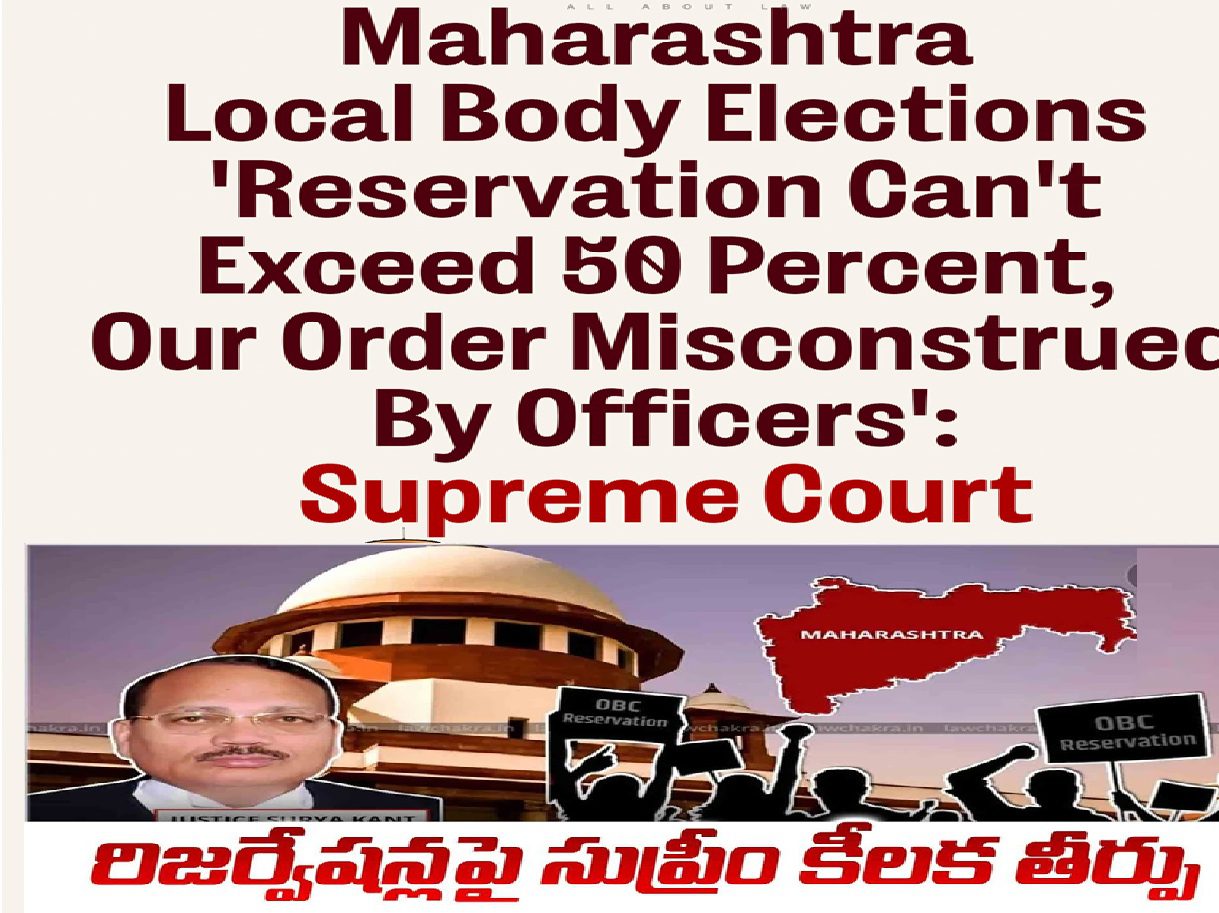
The Supreme Court of India delivered a strong rebuke to Maharashtra authorities on November 17, 2025, asserting that total reservations in upcoming local body elections must strictly adhere to the constitutional 50% ceiling. Justices Surya Kant and Joymalya Bagchi clarified that their previous orders were misinterpreted, emphasizing that no provision allows reservations for SC, ST, and OBC categories combined to surpass this limit. With nominations underway and polls looming, the bench warned that any breach could derail the entire election process.
What Triggered the Supreme Court’s Intervention in Maharashtra Local Body Polls?
The controversy erupted during a hearing on petitions challenging the implementation of OBC reservations in Maharashtra’s municipal councils, zilla parishads, and panchayat samitis elections. Petitioners alleged that state officials misread a May 6, 2025, Supreme Court order, leading to reservation matrices in several local bodies exceeding 50%—in some cases reaching up to 70%.
The bench, visibly frustrated, pointed out that the May order explicitly directed elections to follow the pre-2022 JK Banthia Commission framework. That commission had recommended a 27% OBC quota, but its report remains under judicial scrutiny. Justices stressed that reverting to “pre-Banthia” status does not mean blanket 27% OBC reservation everywhere if it pushes total quotas over the 50% cap.
Justice Surya Kant remarked emphatically, “We never allowed more than 50%!” He accused officials of complicating a straightforward directive, even hinting at potential contempt proceedings.
Understanding the 50% Reservation Cap: A Constitutional Mandate
India’s reservation policy in public employment and education has long been governed by the landmark Indra Sawhney judgment (1992), which capped total reservations at 50% to balance social justice with merit and equality. This “50% rule” extends to local body elections, as reaffirmed in subsequent rulings.
In the context of Maharashtra OBC political reservation, the Supreme Court in Vikas Kishanrao Gawali v. State of Maharashtra (2021) struck down a uniform 27% OBC quota in zilla parishads and panchayat samitis because it violated this ceiling when added to SC/ST reservations. The court introduced the “triple test” for validating OBC quotas in local bodies:
- Set up a dedicated commission for empirical data on backwardness.
- Determine proportionate reservation based on local body-specific data.
- Ensure total SC/ST/OBC reservation does not exceed 50%.
Maharashtra’s Banthia Commission attempted to fulfill this, but its findings are still pending full approval. Until then, any OBC reservation must fit within existing limits without breaching the cap.
Key Exchanges in the November 17 Hearing: Bench Puts State on Notice
The hearing turned intense as Solicitor General Tushar Mehta, representing Maharashtra, highlighted that nominations were set to begin imminently and elections were already in motion. He sought time to file a detailed reply and argued that developments should remain subject to the court’s final decision.
The bench refused to budge:
- Justice Joymalya Bagchi questioned whether “pre-Banthia” meant imposing 27% OBC quota uniformly, noting it would contradict earlier stays on similar notifications.
- Justice Surya Kant warned, “If the process has started is your plea, then we are staying the elections today. We will not allow elections contrary to the Constitution Bench judgment.”
- When informed that reservations hit 70% in some areas, Justice Kant declared, “That can’t be permitted.” Justice Bagchi added, “Not in respect of OBCs. The Constitution Bench is very clear—[reservation] cannot cross 50%.”
Senior Advocate Vikas Singh, for petitioners, cited the Gawali precedent and claimed excesses in about 40% of municipalities. The bench issued notice on the applications and directed the state to report exactly how many local bodies crossed the threshold.
Ultimately, the court postponed nominations’ full implementation pending the next hearing on November 19, 2025, while allowing the process to continue subject to outcome.
Timeline of Maharashtra’s OBC Reservation Saga in Local Bodies
Maharashtra’s battle over OBC political quotas has dragged on for years, delaying local governance and affecting thousands of seats:
- 2021: Supreme Court stays 27% OBC reservation in local polls, ruling it breached the 50% cap without triple test compliance.
- 2022: Banthia Commission submits report recommending data-backed OBC quotas, but court maintains status quo.
- May 2025: Apex court allows elections with pre-Banthia OBC provisions, aiming to end delays.
- September 2025: Deadline set for all polls by January 31, 2026.
- November 17, 2025: Fresh clarifications amid allegations of over-reservation; court warns of staying polls.
This timeline underscores how political pressures often clash with judicial mandates, leaving grassroots democracy in limbo.
Why the 50% Ceiling Matters for Fair Elections in Maharashtra
Exceeding 50% reservation risks inverting the principle of equality enshrined in Articles 14, 15, and 16 of the Constitution. It could disenfranchise general category voters and lead to reverse discrimination. In local bodies—closest to citizens—balanced representation ensures inclusive governance.
For Maharashtra, home to diverse castes and communities, strict adherence prevents vote-bank politics from overriding constitutional safeguards. The court’s insistence on capping quotas protects merit while upholding affirmative action.
Implications for Upcoming Maharashtra Municipal and Panchayat Elections 2025-2026
With over 367 local bodies slated for polls by January 2026, the ruling forces immediate corrections:
- State Election Commission must redraw wards where total quotas exceed 50%.
- OBC candidates may lose reserved seats in high-breached areas, converting them to general.
- Delays in nominations could push timelines, but the court prioritized constitutional compliance over speed.
Political parties, especially those relying on OBC votes, now face recalibration. The Maha Yuti alliance and opposition MVA will watch the November 19 hearing closely.
The Triple Test Explained: How States Must Justify OBC Quotas
Post-Gawali, no state can provide OBC reservation in local bodies without:
- Empirical Data Collection: A commission gathers contemporary data on OBC backwardness in each local body.
- Proportionate Allocation: Quotas reflect actual population proportions, not uniform percentages.
- 50% Aggregate Limit: Combined SC/ST/OBC cannot exceed half the seats.
Maharashtra’s partial reliance on Banthia data without full validation sparked this crisis. Other states like Madhya Pradesh and Telangana have navigated similar hurdles successfully by strictly following these steps.
Supreme Court’s Stand on Reservation Misinterpretation by States
Justices Kant and Bagchi repeatedly expressed anguish over “officers complicating” clear orders. “There is contempt also,” Justice Kant noted, though not pursuing it immediately. This highlights a broader issue: Executive overreach in interpreting judicial directives for political gain.
The bench referenced a prior three-judge ruling staying 27% notifications, warning a two-judge bench cannot override Constitution Bench precedents.
What Happens Next in Maharashtra OBC Reservation Case?
The matter returns on November 19, 2025. The state must submit data on breached local bodies and justify implementations. Possible outcomes:
- Partial stay on elections in violating areas.
- Directions to revert to pure general seats where needed.
- Full validation or rejection of Banthia report later.
Elections will proceed, but strictly within constitutional bounds.
Broader Impact on OBC Political Reservation Across India
This case reinforces that OBC quotas in panchayats and municipalities are not automatic. States like Karnataka, Uttar Pradesh, and Bihar face similar scrutiny. It pushes governments toward data-driven, localized reservations rather than populist blanket policies.
Ultimately, the Supreme Court’s firm stance safeguards democracy’s foundational equity.
Conclusion: Constitutional Limits Trump Electoral Hurry
In upholding the 50% reservation ceiling, the Supreme Court has sent a clear message: Social justice cannot come at the cost of constitutional balance. Maharashtra’s local body elections 2025 must reflect this principle, ensuring fair representation without alienating any group. As nominations pause and corrections loom, citizens await polls that truly embody “of the people, by the people, for the people.”