
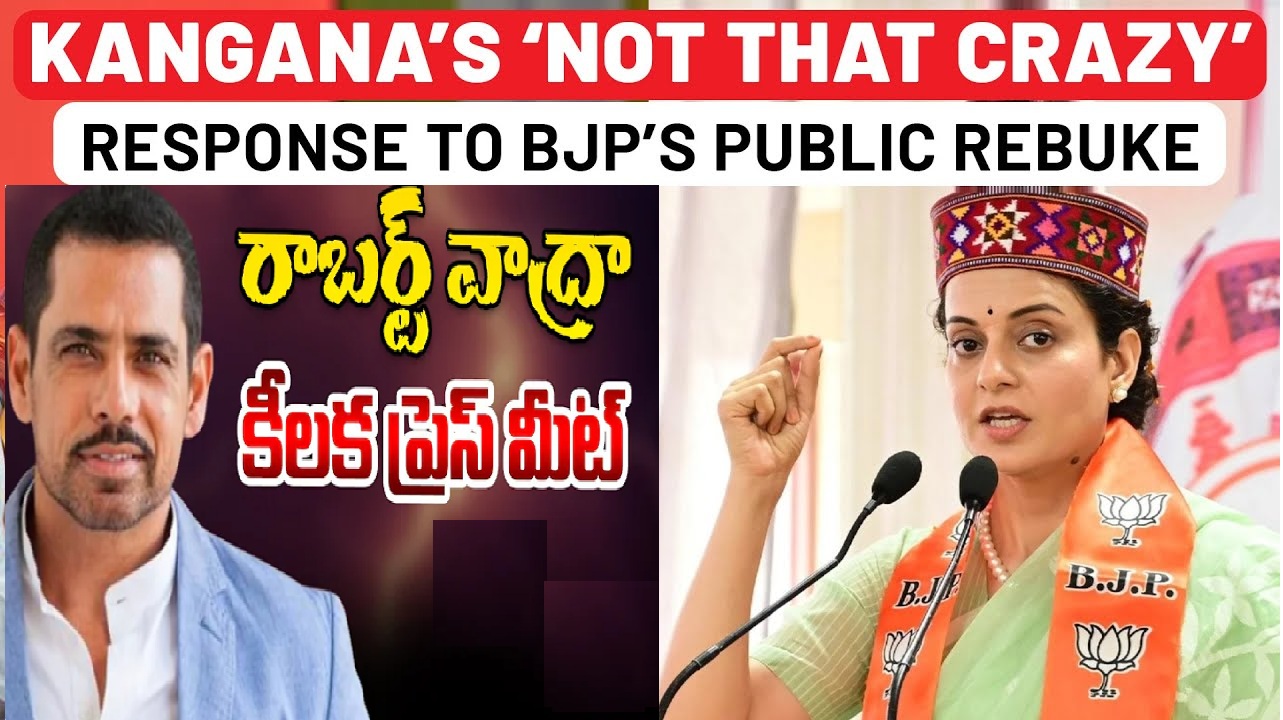
Robert Vadra, a prominent businessman and husband of Congress leader Priyanka Gandhi Vadra, recently made headlines with his strong remarks against BJP MP Kangana Ranaut. Vadra’s comments come at a time when the debate over women’s safety and representation in India is increasingly in the spotlight. His criticism of Ranaut highlights the ongoing concerns about the role of women in politics and society, urging a reevaluation of who represents the people in Parliament.
Robert Vadra Criticizes Kangana Ranaut
Vadra’s criticism of Kangana Ranaut was sparked by her recent controversial statements regarding the farmers’ protest against the now-repealed farm laws. Ranaut, who represents Mandi in Parliament, had claimed that the protest could have led to a “Bangladesh-like situation” in India if not for strong leadership. She also made alarming statements about the violence that purportedly occurred during the protests, including allegations of rapes and hangings.
In response, Vadra openly questioned Ranaut’s suitability for her parliamentary role. He expressed his disapproval by stating, “She is a woman and she doesn’t deserve to be in the Parliament.” Vadra’s comments were not merely a reaction to Ranaut’s statements but also a critique of her qualifications, suggesting that her focus is more on personal interests than on public welfare.
Questioning Ranaut’s Parliamentary Role
Vadra’s remarks were particularly pointed regarding Ranaut’s educational background and her understanding of her responsibilities as a parliamentarian. He implied that Ranaut’s approach and qualifications do not align with the demands of a parliamentary role, stating, “I respect her but I feel that she has no place in the Parliament. She is not educated and there is no reason for her to be in the Parliament.”
This critique raises broader questions about the criteria for holding public office in India. Vadra’s comments suggest that beyond just being a celebrity or having a public profile, a deeper understanding of governance, public welfare, and the challenges facing the nation is essential for anyone aspiring to a parliamentary role.
The Importance of Women’s Safety and Representation
Vadra’s criticism of Ranaut also touched on the critical issue of women’s safety in India. He emphasized that this is a matter of national concern, urging men across the country to take responsibility for ensuring the safety of women. “Nowadays we need to be concerned about women, for their safety and whatever is happening with women is wrong,” Vadra stated, calling for a collective effort to address these issues.
Moreover, Vadra’s comments serve as a reminder that women’s representation in politics should not only be about numbers but also about the quality and commitment of those representing women’s issues. He urged that female politicians, including those from the BJP, should be at the forefront of advocating for women’s safety and rights.
The BJP’s Response to Ranaut’s Remarks
Interestingly, the BJP was quick to distance itself from Ranaut’s statements, expressing strong disagreement with her views. This reaction underscores the sensitivity of the issue and the potential backlash that such statements can provoke, not just from political opponents but also from within one’s own party.
Vadra’s call for a more thoughtful and qualified representation in Parliament is timely, especially in a country where the safety and rights of women remain critical issues. His critique of Ranaut, while controversial, opens up a necessary dialogue about who is best suited to represent the people, particularly in a role as significant as that of a Member of Parliament.
Conclusion
Robert Vadra’s remarks against Kangana Ranaut have brought to the forefront important discussions about the role of women in politics, the criteria for parliamentary representation, and the ongoing issue of women’s safety in India. While his comments may stir debate, they highlight the need for a more qualified and conscientious representation in Parliament, especially when it comes to addressing the needs and rights of women. As the nation continues to grapple with these challenges, Vadra’s call for action serves as a crucial reminder that the safety and well-being of women must remain a top priority in both political discourse and governance.