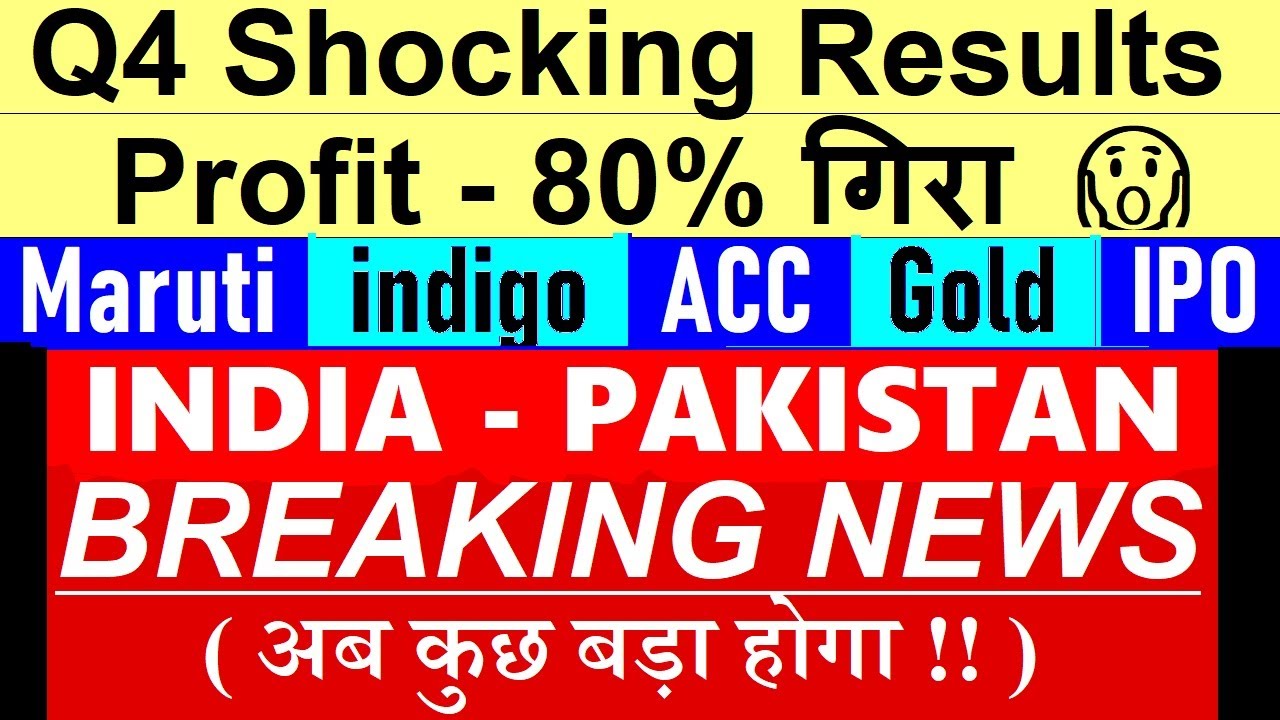
The global financial landscape in early 2025 is a whirlwind of volatility, opportunity, and uncertainty. From shocking Q4 corporate earnings to geopolitical tensions impacting markets, investors face a complex environment. Gold prices are plummeting, IPOs are stirring excitement, and companies like Maruti Suzuki, Indigo, and ACC are navigating challenges. Meanwhile, India-Pakistan tensions and international trade dynamics add layers of complexity. This comprehensive analysis dives into the latest market trends, corporate performances, and investment prospects, offering actionable insights for savvy investors.
US Market Performance: A Mixed Bag of Signals
The US stock market paints a varied picture as of April 2025. The Dow Jones Industrial Average struggles, posting a flat performance with a slight dip into negative territory. This lackluster showing reflects investor caution amid global uncertainties. Conversely, the NASDAQ shines, climbing 1% and outperforming its counterpart. This divergence underscores the tech sector’s resilience, driven by innovation and investor confidence in growth stocks.
Key Takeaways for Investors
- Dow Jones: Monitor for signs of recovery as global trade talks progress.
- NASDAQ: Consider tech-heavy portfolios for short-term gains, but stay vigilant for volatility.
US-China Relations: Trade Talks and Tariff Impacts
Recent developments in US-China relations are shaping global markets. Reports suggest a phone call between US leadership and Chinese President Xi Jinping, signaling potential dialogue. While China has historically dismissed such claims, a notable shift is evident: China plans to accept a 125% tariff rate on certain US imports. This move hints at a softening stance, potentially easing trade tensions.
Market Implications
- Gold Prices: Gold, a safe-haven asset, plummeted from $12,000 to $98,000 as trade optimism reduces demand. Expect further declines if positive news emerges.
- Dollar Index: The US dollar strengthens, surpassing 9950, reflecting improved investor confidence.
- Bond Yields: Yields are trending downward, suggesting a cautious but optimistic market outlook.
Investment Strategy
- Reduce exposure to gold and gold-related ETFs until stability returns.
- Explore dollar-based assets to capitalize on the strengthening currency.
Gold Market Dynamics: A Sharp Decline
Gold’s dramatic fall is a focal point for investors. The metal’s price, once hovering near $12,000, crashed to $98,000, driven by optimism in US-China trade talks. Historically, gold thrives in times of geopolitical or economic distress. As tensions ease, its appeal wanes, leading to significant sell-offs.
Chart Patterns and Predictions
Technical analysis reveals a clear bearish trend in gold. Investors should:
- Watch for support levels around $95,000.
- Avoid long positions until geopolitical risks resurface.
Why Gold is Falling
- Reduced global uncertainty lowers demand for safe-haven assets.
- Strengthened US dollar pressures gold prices.
Hyundai’s Strategic Shift: Navigating Tariffs
Hyundai Motor is making bold moves to counter tariff challenges. The company announced a task force to shift production from Mexico to the US, aiming to mitigate tariff impacts. This strategic pivot could enhance Hyundai’s competitiveness in the US market while reducing costs.
Implications for the Auto Sector
- Cost Efficiency: Localized production may lower expenses.
- Market Share: Hyundai could gain an edge over competitors slow to adapt.
Investment Opportunity
Consider Hyundai stock or auto sector ETFs as the company strengthens its US presence.
Maruti Suzuki Q4 Results: Profit Slips, Dividend Shines
Maruti Suzuki, a leading Indian automaker, reported a 4.3% year-on-year profit decline in Q4, with net profit at ₹3,711 crore. Despite the drop, the company outperformed previous years’ profits in absolute terms. Maruti also declared a ₹135 per share dividend, signaling confidence in its financial health.
Why Profits Fell
- Rising input costs and supply chain disruptions.
- Increased competition in the Indian auto market.
Bright Spots
- Strong brand loyalty and market dominance.
- Dividend payout enhances shareholder value.
Investment Outlook
Maruti remains a solid long-term investment, particularly for dividend-focused portfolios. Monitor cost management strategies for future growth.
ACC Cement: Adani’s Mixed Performance
ACC Cement, under the Adani Group, reported a 2% year-on-year drop in Q4 profit after tax, totaling ₹735 crore. However, revenue surged by 11%, reflecting robust demand in the construction sector. The company declared a ₹7.5 per share dividend, reinforcing its commitment to shareholders.
Key Factors
- Revenue Growth: Driven by infrastructure projects in India.
- Profit Decline: Higher expenses and tax adjustments eroded margins.
Investment Considerations
ACC’s strong revenue growth suggests resilience. Investors should weigh its exposure to rising costs against India’s infrastructure boom.
Indigo Airlines: Geopolitical Turbulence Hits Hard
Indigo Airlines faced a brutal sell-off in its shares, triggered by geopolitical tensions between India and Pakistan. Pakistan’s decision to close its airspace has forced Indigo to reroute flights, increasing fuel costs and operational expenses. This development, coupled with a management shakeup, has dented investor confidence.
Geopolitical Impact
- Airspace Closure: Longer flight routes inflate costs.
- Kashmir Tourism: A 60% cancellation rate for Kashmir trips and 15,000+ flight changes signal reduced demand.
Management Changes
Indigo appointed a former FIA chief as an independent director, aiming to bolster governance. However, this move has yet to reassure investors.
Investment Strategy
- Short-term: Avoid Indigo stock due to ongoing volatility.
- Long-term: Monitor geopolitical developments and cost-control measures.
Samsung’s India Investment: A Boost for Make in India
Samsung is doubling down on India with a ₹1,000 crore investment in its Chennai facility. This move aligns with the Make in India initiative, aiming to expand manufacturing and create jobs. Samsung’s strategy counters Apple’s growing presence in India, positioning it as a key player in the electronics market.
Economic Benefits
- Job Creation: Thousands of new jobs in Chennai.
- Market Expansion: Enhanced production capacity strengthens Samsung’s foothold.
Investment Opportunity
Samsung’s investment signals long-term growth potential. Consider electronics sector ETFs or Indian manufacturing-focused funds.
Canara Bank’s IPO: A New Player in Asset Management
Canara Bank’s asset management arm, Canara Robeco, filed IPO papers with SEBI, signaling its entry into the competitive mutual fund market. This move positions Canara as the fifth major asset management company in India, alongside HDFC AMC, Nippon, UTI, and Aditya Birla.
Market Impact
- Increased competition may drive innovation in mutual funds.
- Investors gain access to a new player with strong banking backing.
Investment Tip
Keep an eye on Canara Robeco’s IPO for potential early investment opportunities.
India-Pakistan Tensions: A Risk to Markets
Geopolitical tensions between India and Pakistan are escalating, with significant market implications. Pakistan’s defense minister, Khawaja Asif, admitted to supporting terrorism with US backing, a statement that could strain diplomatic relations. This revelation 100% unique revelation has heightened uncertainty, impacting sectors like aviation and tourism.
Market Risks
- Aviation: Indigo and other airlines face higher costs.
- Tourism: Kashmir’s tourism industry suffers, with 60% trip cancellations.
Investor Precautions
- Diversify portfolios to mitigate geopolitical risks.
- Focus on defensive sectors like consumer goods and healthcare.
Poonawalla Fincorp: Profit Plummets, Growth Potential Remains
Poonawalla Fincorp reported an 81% drop in Q4 net profit, falling to ₹62 crore. Despite a 27% revenue increase, higher expenses and new business ventures in gold and consumer durable loans weighed on profitability. The company’s diversification efforts could yield future gains.
Growth Prospects
- Expansion into new loan segments diversifies revenue streams.
- Long-term profitability hinges on cost management.
Investment Outlook
Poonawalla is a speculative play. Consider small positions for high-risk, high-reward portfolios.
RBL Bank: Profitability Takes a Hit
RBL Bank’s Q4 net profit plunged 80% to ₹69 crore, driven by higher provisions. Despite declaring a dividend, the bank faces challenges in maintaining profitability. Net interest income also dipped by 2%, signaling operational hurdles.
Why Profits Fell
- Provisions: Increased reserves for potential loan defaults.
- Competitive Pressure: Rival banks with lower provisions outperform.
Investment Strategy
- Avoid RBL Bank until provisioning stabilizes.
- Explore stronger banking stocks like HDFC Bank or ICICI Bank.
Currency and Commodities: Dollar, Rupee, and Crude
The USD-INR exchange rate remains below 85.50, supporting foreign institutional investments in India. However, the rupee’s long-term depreciation trend persists. Crude oil prices hover around $66 (WTI at $62-63), reflecting stable supply dynamics.
Investment Implications
- Rupee: Hedge currency risks for international investments.
- Crude: Monitor oil prices for impacts on inflation and corporate margins.
Conclusion: Navigating a Volatile Market
The global financial landscape in April 2025 demands agility and foresight. From gold’s sharp decline to corporate earnings shocks and geopolitical risks, investors face a dynamic environment. Key strategies include:
- Diversifying across sectors to mitigate risks.
- Capitalizing on opportunities in tech, manufacturing, and asset management.
- Staying informed on US-China trade talks and India-Pakistan developments.
By leveraging these insights, investors can position themselves for success in a challenging yet opportunity-rich market.