
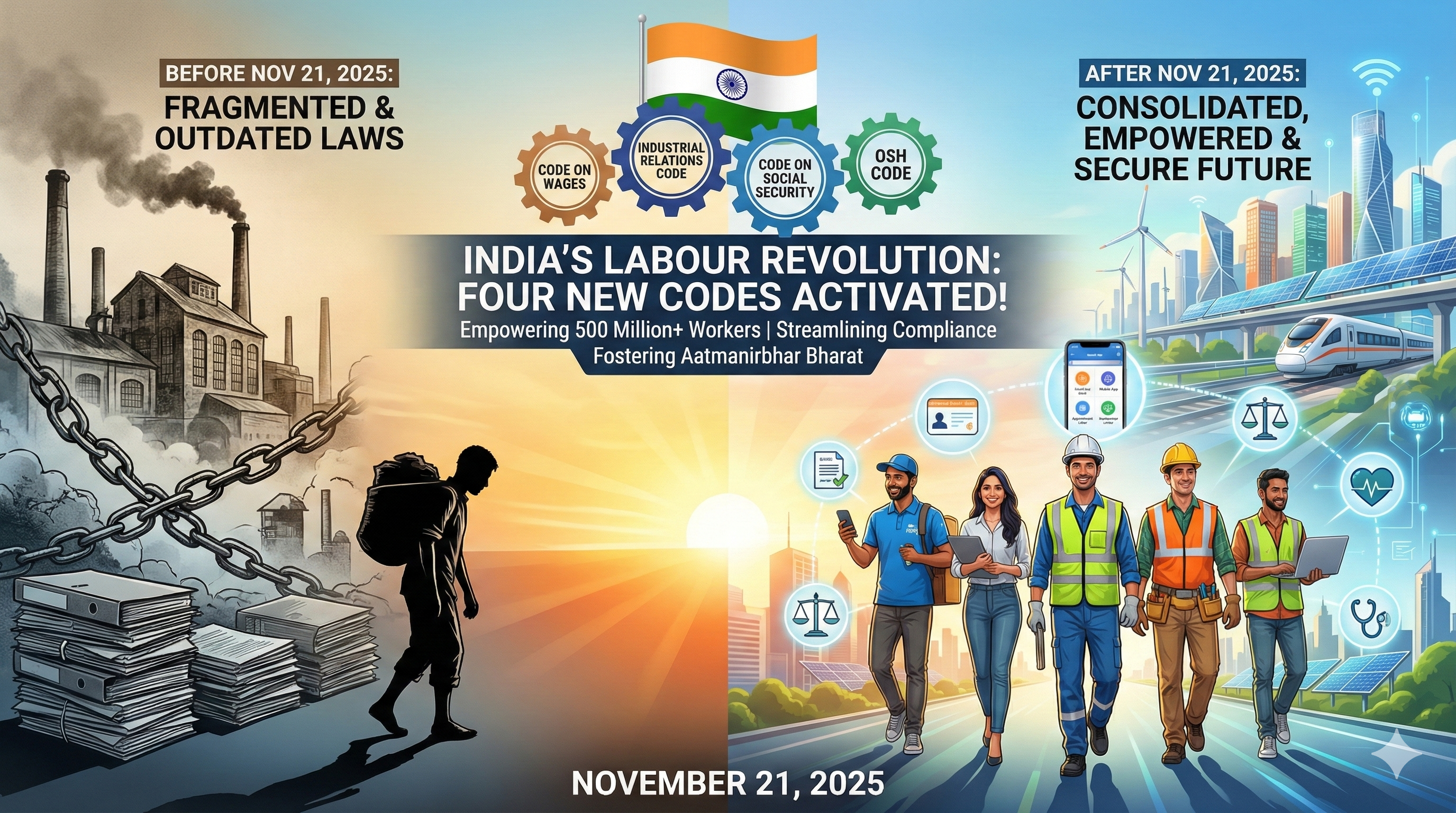
The Government activates four transformative Labour Codes on November 21, 2025. These codes—the Code on Wages 2019, Industrial Relations Code 2020, Code on Social Security 2020, and Occupational Safety, Health and Working Conditions Code 2020—consolidate 29 outdated laws into a modern framework. Workers across sectors gain stronger protections, fairer pay, and comprehensive welfare, while businesses enjoy streamlined compliance. This overhaul aligns India’s workforce with global standards, fosters job creation, and empowers millions in the gig economy, manufacturing, and beyond. As Aatmanirbhar Bharat gains momentum, these reforms promise a resilient economy where every laborer thrives.
Streamlining India’s Labour Ecosystem: From Colonial-Era Hurdles to Modern Empowerment
India’s labor landscape has long grappled with relics from the 1930s and 1950s, when factories hummed under British rule and the post-independence economy focused on basic industrialization. Back then, lawmakers drafted 29 fragmented Central laws to regulate wages, disputes, safety, and security. These rules, though well-intentioned, became tangled webs of bureaucracy. Employers faced endless registrations and returns, while workers navigated unclear rights in a world of informal jobs and gig platforms. Compliance costs soared, stifling small businesses and leaving vast swaths of the workforce—over 90% in the unorganized sector—without basic safeguards.
The government now sweeps away this clutter. By enforcing the four Labour Codes, officials merge these disparate laws into cohesive structures that adapt to today’s digital gigs, remote work, and export booms. Imagine a factory owner in Gujarat no longer juggling multiple licenses; instead, a single pan-India registration suffices. Or a delivery rider in Bengaluru accessing portable provident funds seamlessly. This shift not only cuts red tape by 70% but also injects transparency and trust into employer-employee bonds.
Experts hail this as a game-changer for India’s 500 million-plus workforce. The International Labour Organization (ILO) praises the alignment with Convention 155 on occupational safety, positioning India as a leader in emerging markets. Businesses report potential savings of billions in compliance, freeing capital for hiring and innovation. For workers, the payoff is immediate: mandatory appointment letters end verbal job promises, ensuring documented security from day one.
Key Transformations: Before and After the Labour Codes Implementation
To grasp the seismic shift, consider the stark contrasts in India’s labor framework pre- and post-reforms. Before November 21, 2025, the system favored rigidity over relevance. Post-reforms, flexibility and fairness reign supreme.
Formalizing Employment: Appointment Letters as the New Standard
Previously, employers often skipped written contracts, leaving workers vulnerable to abrupt terminations without proof of service. Verbal agreements dominated, especially in informal sectors like construction and retail, where disputes over back wages dragged on for years.
Now, the Industrial Relations Code mandates appointment letters for every worker, regardless of contract type. This simple document outlines salary, duties, benefits, and termination clauses, fostering accountability. A textile mill operator in Tamil Nadu, for instance, receives a letter detailing his Rs 15,000 monthly wage and eligibility for provident fund contributions. This transparency curbs exploitation and builds a verifiable employment history, crucial for loans or future job hunts.
Expanding Social Security: From Elites to Every Earner
Social security once catered mainly to organized sectors, excluding gig workers, migrants, and small-shop employees. Coverage hovered at a dismal 19% in 2015, leaving millions without pensions or health insurance during crises like the COVID-19 pandemic.
The Code on Social Security flips this script. It blankets all workers—including Uber drivers and freelance coders—with provident funds (PF), Employees’ State Insurance Corporation (ESIC) benefits, and maternity support. Aggregators contribute 1-2% of turnover to a welfare fund, capped at 5% of worker payouts. An Aadhaar-linked Universal Account Number (UAN) ensures portability; a migrant from Bihar working in Delhi carries his benefits nationwide, accessing claims via a mobile app. By 2025, coverage surges to 64%, a testament to decade-long expansions now supercharged by these codes.
Securing Minimum Wages: Universal Floors for Financial Stability
Minimum wages applied sporadically, covering only scheduled industries and leaving agricultural laborers or domestic helps in limbo. Many earned below Rs 200 daily, perpetuating poverty cycles.
Under the Code on Wages, every worker claims a statutory minimum, set by a national floor wage plus state variations. Timely payments become non-negotiable, with penalties for delays. A housekeeping staffer in Mumbai now banks on Rs 18,000 monthly, paid by the 7th, reducing stress and enabling savings. This floor wage, determined centrally, guarantees a dignified living standard, indexed to inflation for sustained relevance.
Prioritizing Preventive Healthcare: Annual Check-Ups for Longevity
Employers rarely offered proactive health measures; workers over 40 toiled without routine screenings, leading to undetected ailments like diabetes in high-stress factories.
Reforms compel free annual health check-ups for those above 40, plus ESIC extensions to hazardous units. Even solo employees in chemical plants qualify. This initiative cultivates a wellness culture, potentially slashing absenteeism by 20% as per health ministry projections. A 45-year-old welder in Punjab catches hypertension early, returning to work fitter and more productive.
Empowering Women: Night Shifts and Equal Opportunities Unleashed
Restrictions barred women from night shifts or hazardous roles, limiting earnings and perpetuating gender gaps. Only 25% of India’s workforce was female, far below global averages.
The codes dismantle these barriers. Women consent to night work in IT firms or mines, backed by safety protocols like transport and CCTV. Equal pay for equal work becomes law, with gratuity after one year. Grievance committees mandate female representation, while family definitions expand to include in-laws. A software engineer in Hyderabad earns overtime premiums during graveyard shifts, boosting her income by 30% and inspiring peers.
Nationwide ESIC Reach: Bridging Urban-Rural Divides
ESIC once confined to urban hubs, exempting shops under 10 workers or rural hazardous sites. Coverage gaps left farmhands exposed during monsoons.
Post-reforms, ESIC spans pan-India, voluntary for tiny units but mandatory for hazardous ones with even one employee. A small pesticide unit in Rajasthan insures its lone operator, providing cashless treatment. This universality expands protection, targeting 10 crore more beneficiaries by 2030.
Easing Compliance: One-Stop Solutions for Businesses
Multiple filings across laws overwhelmed SMEs; a Kolkata garment exporter filed 15 returns yearly.
Now, a unified portal handles single registrations, licenses, and returns. The Inspector-cum-Facilitator role emphasizes guidance over fines, with digital dashboards tracking adherence. This slash in paperwork—down 80%—lets entrepreneurs focus on growth, not audits.
Sector-Specific Wins: Tailored Reforms for Diverse Workforces
The Labour Codes shine brightest when viewed through sector lenses, addressing unique pain points while amplifying shared gains. From mines to media, these updates ignite productivity and equity.
Fixed-Term Employment: Parity and Portability for Temporary Roles
Fixed-term employees (FTEs) once languished with inferior perks, facing renewal uncertainties that discouraged skill-building.
Reforms equate FTEs to permanents: same leave, medicals, and social security. Gratuity kicks in after one year, not five. A seasonal fruit picker in Maharashtra secures PF contributions during his six-month stint, easing transitions to off-season gigs. This parity curbs “contractualization abuse,” promoting direct hires and reducing turnover by 15%, as industry surveys predict.
Gig and Platform Economy: Defining and Defending Digital Drudges
India’s 15 million gig workers—Zomato riders, Swiggy packers—operated in a regulatory void, sans definitions or safety nets.
The codes pioneer terms like “gig work” and “platform work,” mandating aggregator contributions to welfare boards. A Delhi freelancer accesses life insurance via UAN, portable across apps. This framework, inspired by global models like California’s AB5, balances innovation with rights, potentially adding Rs 50,000 crore to worker incomes annually.
Contract Labor: Bridging the Gap Between Principal and Proxy
Contract workers endured wage disparities and benefit blackouts, with principals dodging responsibilities.
Now, principals extend health and social security to contractors’ staff, including free check-ups. A construction site in Odisha provides ESIC to 200 temps, cutting accident costs. Fixed-term options further empower, with gratuity after 12 months, fostering loyalty without permanence fears.
Boosting Women in the Workforce: Consent, Safety, and Equity
Beyond night shifts, codes ban gender bias outright, covering transgender inclusivity. A Mumbai stunt artist in films works heavy roles with gear mandates, earning doubles for overtime.
Representation in committees ensures voices amplify; expanded dependents cover more families. This inclusivity could lift female participation to 35% by 2030, unlocking Rs 5 lakh crore in GDP, per World Bank estimates.
Youth Employment: Safeguards for the Next Generation
Young entrants faced exploitation—delayed wages, no letters—stifling aspirations in a 65% under-35 demographic.
Guaranteed minimums, mandatory letters, and leave pays protect them. A 22-year-old intern in Bengaluru builds a PF nest egg from internship one, deterring moonlighting pitfalls. Anti-exploitation clauses, like floor wages, ensure decent starts, aligning with Skill India for a 500 million-strong employable youth.
MSMEs: Lightening the Load for Small-Scale Saviors
MSMEs, employing 110 million, drowned in regs; canteens or rest areas were luxuries.
Codes cover them under social security based on size, mandating basics like water and overtime doubles. Timely wages stabilize cash flows. A Surat jewelry workshop pays leaves promptly, retaining talent amid competition.
Beedi and Cigar Craftsmen: Reviving Traditional Trades with Modern Rights
These 40 lakh workers toiled endlessly, wages erratic.
Caps at 48 weekly hours, consent-based overtime at double rates, and bonuses after 30 days uplift them. A Bihar roller earns Rs 300 daily minimum, plus PF, preserving crafts while preventing burnout.
Plantations: Greening Labor with Safety and Education
Tea estates, with 13 lakh workers, ignored OSHWC; chemical exposures ravaged health.
Inclusion mandates training, gear, and ESIC for families, plus child education. A Assam picker accesses schools for her kids, breaking poverty chains.
Audio-Visual and Digital Media: Spotlights on Behind-the-Scenes Heroes
Journalists and dubbers lacked entitlements; payments lagged.
Mandatory letters detail perks; overtime consents pay premiums. A Chennai editor gets timely Rs 40,000 monthly, stabilizing creative flows.
Mining Sector: Digging Deeper into Safety Protocols
Commuting mishaps went uninsured; hours unchecked.
Codes deem certain accidents work-related, cap shifts at 48 weekly, and enforce standards. Free check-ups spot silicosis early in Jharkhand pits.
Hazardous Industries: Fortifying Frontlines Against Risks
Free annuals and national standards shield all; women enter with safeguards.
Safety committees in large sites monitor chemicals. A Gujarat dye worker avoids exposures, committees flagging hazards proactively.
Textiles: Weaving Welfare for Migrant Threads
Migrants missed PDS portability; dues unresolved.
Equal wages, three-year claims, and double overtime aid. A Tamil Nadu loom operator ports rations interstate.
IT and ITES: Coding Compliance into Innovation Hubs
Salaries by the 7th, equal pays, and night options for women.
Harassment resolutions speed up; fixed-terms guarantee security. Hyderabad coders thrive, disputes nipped via tribunals.
Dockyards: Anchoring Rights for Port Pulse
Informal dockers lacked recognition.
Letters, PF, and facilities standardize. Mumbai loaders get aid kits, reducing injuries 25%.
Export Sectors: Fueling Global Growth with Worker Wins
Fixed-terms snag gratuity; leaves after 180 days.
No deductions, night consents with transport. A Chennai exporter’s packer earns overtime safely, boosting shipments.
Broader Reforms: Inspectorates, Tribunals, and National Standards
The codes extend beyond sectors, embedding systemic upgrades. A National Floor Wage prevents sub-living pays, dynamically adjusted. Gender-neutral policies eradicate biases, embracing diversity.
Inspectors evolve into facilitators, offering workshops over raids—compliance rates could climb 40%. Two-member tribunals expedite disputes post-conciliation, slashing resolution times from years to months.
Unified filings replace chaos; the National OSH Board harmonizes standards, from factory ergonomics to mine ventilation. Larger factories (500+ workers) form safety committees, while micro-units breathe easier with raised thresholds.
Stakeholder consultations shape rules, ensuring buy-in. Transitional laws persist, smoothing the glide.
A Decade of Progress: From 19% to 64% Coverage and Beyond
India’s social security odyssey—from 19% in 2015 to 64% in 2025—reflects visionary policies like PMJJBY insurance. The codes accelerate this, portabilizing benefits for migrants and giggers.
Women, youth, and unorganized laborers anchor the vision. Reduced burdens spark 2 crore new jobs yearly, per NITI Aayog. This pro-worker ethos—pro-women, pro-youth, pro-employment—redefines labor as a growth engine.
| Pre Labour Reforms | Post Labour Reforms | |
| Formalisation of Employment | No mandatory appointment letters | Mandatory appointment letters to all workers. |
| Written proof will ensure transparency, job security, and fixed employment. | ||
| Social Security Coverage | Limited Social Security Coverage | Under Code on Social Security, 2020 all workers including gig & platform workers to get social security coverage. |
| All workers will get PF, ESIC, insurance, and other social security benefits. | ||
| Minimum Wages | Minimum wages applied only to scheduled industries/employments; large sections of workers remained uncovered | Under the Code on Wages, 2019, all workers to receive a statutory right minimum wage payment. |
| Minimum wages and timely payment will ensure financial security. | ||
| Preventive Healthcare | No legal requirement for employers to provide free annual health check-ups to workers | Employers must provide all workers above the age of 40 years with a free annual health check-up. |
| Promote timely preventive healthcare culture | ||
| Timely Wages | No mandatory compliance for employers payment of wages | Mandatory for employers to provide timely wages, |
| ensuring financial stability, reducing work stress and boosting overall morale of the workers. | ||
| Women workforce participation | Women’s employment in night shifts and certain occupations was restricted | Women are permitted to work at night and in all types of work across all establishments, subject to their consent and required safety measures. |
| Women will get equal opportunities to earn higher incomes – in high paying job roles. | ||
| ESIC coverage | ESIC coverage was limited to notified areas and specific industries; establishments with fewer than 10 employees were generally excluded, and hazardous-process units did not have uniform mandatory ESIC coverage across India | ESIC coverage and benefits are extended Pan-India – voluntary for establishments with fewer than 10 employees, and mandatory for establishments with even one employee engaged in hazardous processes. |
| Social protection coverage will be expanded to all workers. | ||
| Compliance Burden | Multiple registrations, licenses and returns across various labour laws. | Single registration, PAN-India single license and single return. |
| Simplified processes and reduction in Compliance Burden. |
Conclusion: A Future-Ready Workforce for Aatmanirbhar Bharat
As the clock strikes November 21, 2025, India’s four Labour Codes ignite a renaissance. Workers claim empowered lives; industries forge resilient paths. This isn’t mere legislation—it’s a covenant for dignity, equity, and prosperity. By harmonizing rights with realities, India steps onto the global stage, workforce primed for innovation and inclusion. The journey continues, but the foundation stands unbreakable: a nation where labor lifts all.