
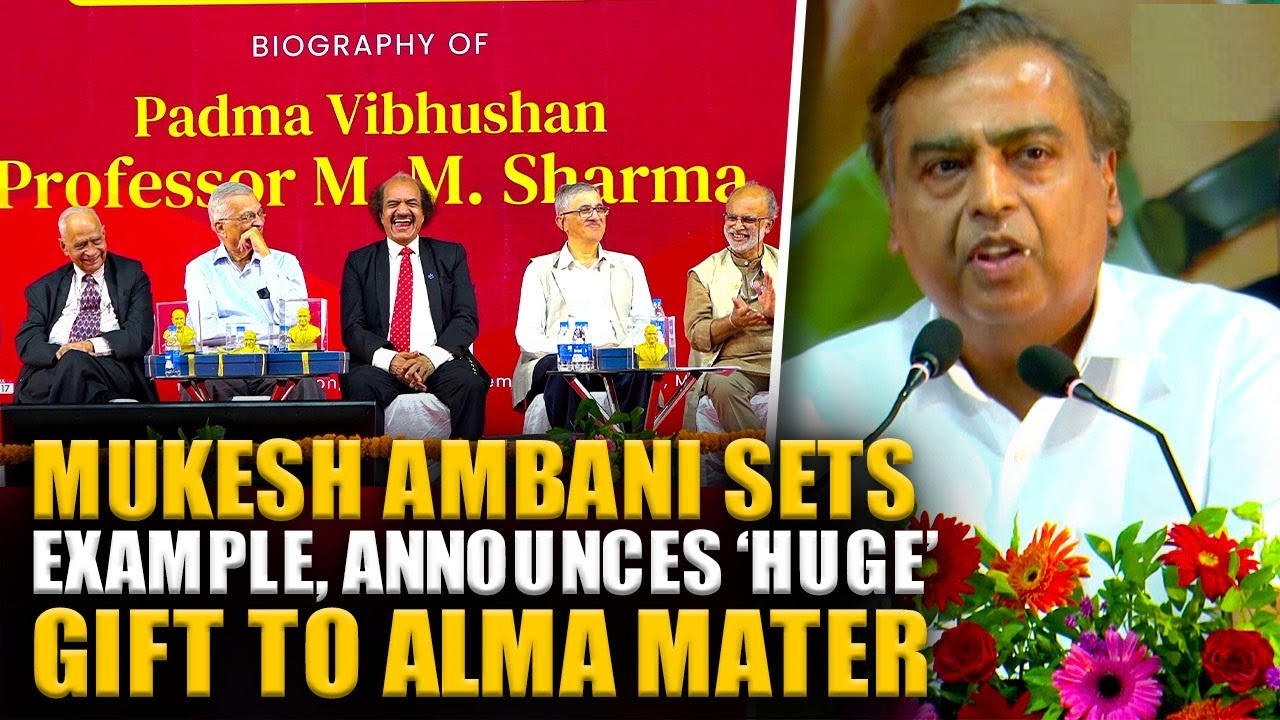
Mukesh Ambani, one of India’s most influential business magnates, has made headlines with his monumental Rs 151 crore donation to his alma mater, the Institute of Chemical Technology (ICT) in Mumbai. This transformative contribution, announced in honor of his revered mentor, Professor M.M. Sharma, underscores Ambani’s commitment to advancing India’s education system and positioning the nation as a global leader in deep tech and advanced manufacturing. In this article, we explore the significance of this donation, the legacy of Professor Sharma, and how this act aligns with Ambani’s broader vision for a technologically advanced and prosperous India.
The Significance of Mukesh Ambani’s Donation to ICT Mumbai
Mukesh Ambani’s Rs 151 crore donation to ICT Mumbai is more than a financial gesture—it’s a bold step toward redefining India’s educational and technological landscape. This unconditional contribution reflects Ambani’s deep-rooted connection to ICT, formerly known as the University Department of Chemical Technology (UDCT), where he studied in the 1970s. By choosing to support his alma mater, Ambani not only honors his academic roots but also sets a precedent for private-sector investment in education.
This donation is poised to strengthen ICT’s infrastructure, foster cutting-edge research, and attract top-tier talent. It aligns with Ambani’s vision of transforming India into a hub for deep tech innovation, leveraging advancements in artificial intelligence (AI), advanced manufacturing, and sustainable technologies. By investing in ICT, Ambani is empowering an institution that has long been a beacon of excellence in chemical engineering and related fields.
Why ICT Mumbai Matters
The Institute of Chemical Technology, Mumbai, is a premier institution renowned for its contributions to chemical engineering, technology, and applied sciences. Established in 1933, ICT has produced some of India’s finest scientists, engineers, and industry leaders. Its legacy of fostering innovation and bridging academia with industry makes it a fitting recipient of Ambani’s generous donation.
ICT’s focus on practical, problem-solving education has earned it a reputation as a cradle of innovation. By supporting ICT, Ambani is ensuring that the institution continues to lead in areas such as biotechnology, materials science, and sustainable manufacturing—fields critical to India’s global competitiveness.
Honoring a Guru: The Legacy of Professor M.M. Sharma
At the heart of Ambani’s donation is his deep respect for Professor M.M. Sharma, a legendary figure in chemical engineering and one of Ambani’s most influential mentors. During the announcement, Ambani paid heartfelt tribute to Professor Sharma, describing him as a “divine scientist” and a “rashtra guru” (national mentor) whose teachings shaped not only his career but also his worldview.
A Mentor Who Transformed Minds
Professor Sharma’s impact on Ambani began in the mid-1970s when Ambani was a student at UDCT. Choosing UDCT over the more popular IIT Bombay, Ambani was captivated by Sharma’s ability to transform curiosity into knowledge and knowledge into societal and commercial value. Sharma’s lectures blended scientific rigor with practical applications, inspiring Ambani to view chemical engineering as a tool for leadership and social good.
Sharma’s philosophy extended beyond the classroom. He emphasized the “economics of chemistry,” teaching students how to create value from molecules while maintaining a balance between profitability and sustainability. This principle became a cornerstone of Ambani’s approach to building Reliance Industries, one of India’s largest conglomerates.
The Principle of Co-Products and Sustainability
One of Sharma’s most enduring lessons was his rejection of the term “byproduct” in favor of “co-product.” He believed that nothing in manufacturing should go to waste, and every output should be transformed into value. This philosophy of sustainability influenced Reliance’s operations, leading to innovations like backward and forward integration in the value chain—from crude oil to PET bottles and consumer products like Campa Cola.
Ambani credits Sharma’s guidance for Reliance’s ability to create harmony between economy and ecology, a model that has made the company a global leader in petrochemicals and refining. Sharma’s selfless approach, offering consultation without expecting royalties, further cemented his status as a guru who prioritized societal impact over personal gain.
A Quiet Architect of India’s Economic Reforms
Beyond his academic contributions, Professor Sharma played a pivotal role in shaping India’s economic policies during the 1970s and 1980s. At a time when India’s economy was constrained by regulatory hurdles and a license-permit regime, Sharma advocated for opening the chemical industry to private players. His authoritative voice influenced policymakers, paving the way for reforms that allowed Indian industries to scale and compete globally.
Ambani recalls meetings between Sharma and his father, Dhirubhai Ambani, where the two visionaries discussed the need for world-class manufacturing facilities. Their shared belief in the power of science, technology, and private entrepreneurship laid the foundation for India’s emergence as a global industrial force. Today, India’s chemical industry stands as a testament to their foresight.
A Vision for India’s Deep Tech Future
Mukesh Ambani’s donation is not just a tribute to his guru but a strategic investment in India’s future. During his speech at ICT, Ambani outlined a bold vision for transforming India into a deep tech nation and a leader in advanced manufacturing. He proposed five key ideas to achieve this goal, each rooted in the principles he learned from Professor Sharma.
1. Building a Deep Tech Nation
Ambani emphasized the need for India to lead in deep tech fields such as AI, biotechnology, and advanced materials. He urged universities and research institutions to focus on developing technologies that address global challenges, such as curing complex diseases, creating sustainable materials, and boosting productivity. ICT, with its strong foundation in chemical engineering, is well-positioned to drive this transformation.
By investing in cutting-edge research, India can attract top talent and establish itself as a global hub for innovation. Ambani’s donation will enable ICT to expand its research capabilities, fostering breakthroughs that could redefine industries and improve lives.
2. Strengthening Industry-Academia Collaboration
The 1990s marked a turning point for India’s economy, with the private sector unlocking unprecedented growth. Ambani believes the private sector must now play a similar role in education. By fostering collaboration between businesses, academia, and government, India can create world-class institutions that rival global universities.
ICT’s problem-solving approach to education serves as a model for this collaboration. Ambani’s donation will support initiatives that bridge the gap between theoretical research and practical applications, ensuring that students are equipped to solve real-world challenges.
3. Promoting Human Values in Education
Drawing from Professor Sharma’s teachings, Ambani highlighted the importance of inculcating human values in education. Integrity, humility, empathy, and honesty—values rooted in India’s cultural heritage—are as critical as technical expertise. These qualities, exemplified by Sharma, ensure that education creates not just skilled professionals but also responsible citizens.
By emphasizing character alongside competence, ICT can produce graduates who contribute to society’s well-being while driving economic progress. Ambani’s vision aligns with the idea of “Viksit Bharat” (Developed India), where success is balanced with cultural values.
4. Inspiring a Generation of Gurus
Ambani described Professor Sharma as an “influencer” long before the term became popular in the age of social media. Sharma’s passion for teaching and his ability to inspire students make him a role model for educators. With India’s large youth population, Ambani called for thousands of gurus like Sharma to guide the next generation.
These educators must teach students to combine success with “sanskar” (values), ensuring that India’s youth are equipped to lead in a rapidly changing world. ICT, with its legacy of transformative teaching, is poised to nurture such educators.
5. A Personal Commitment to ICT
Ambani’s fifth idea was not an idea but an instruction from Professor Sharma himself: to do something significant for ICT. The Rs 151 crore donation fulfills this directive, providing the institution with the resources to pursue ambitious goals. This unconditional contribution reflects Ambani’s trust in ICT’s ability to drive meaningful change.
The Broader Impact of Ambani’s Donation
Mukesh Ambani’s donation is a catalyst for change, not only for ICT but for India’s education and innovation ecosystem. By investing in an institution known for its excellence in chemical engineering, Ambani is signaling the importance of specialized education in driving national progress. The donation will likely fund scholarships, research programs, infrastructure upgrades, and faculty development, ensuring that ICT remains a global leader.
Attracting Global Talent
At a time when many prestigious universities worldwide are facing challenges, India has a unique opportunity to attract top students and faculty. Ambani’s donation positions ICT as a destination for global talent, enhancing its reputation as a hub for cutting-edge research and education.
Advancing Sustainable Technologies
Sustainability is a key focus of Ambani’s vision, inspired by Professor Sharma’s teachings. The donation will support research in areas such as clean energy, biodegradable materials, and waste-to-value technologies. These advancements align with global priorities and position India as a leader in sustainable innovation.
Inspiring Other Philanthropists
Ambani’s act of giving sets a powerful example for other business leaders and philanthropists. By investing in education, private-sector leaders can amplify their impact on society, creating a ripple effect that benefits future generations. This donation may inspire similar contributions to other institutions, strengthening India’s academic landscape.
The Role of ICT in India’s Economic Growth
ICT Mumbai has long been a cornerstone of India’s chemical industry, producing graduates who have driven innovation and growth. Ambani’s donation reinforces the institute’s role in shaping the future of Indian industry. By supporting research in areas like enzymes, proteins, and advanced materials, ICT can contribute to breakthroughs that enhance India’s global competitiveness.
A Legacy of Innovation
From its founding as UDCT to its current status as ICT, the institute has been at the forefront of technological advancements. Its alumni, including Ambani, have applied their education to build world-class businesses and contribute to India’s economic rise. The Rs 151 crore donation will enable ICT to continue this legacy, fostering innovations that address both local and global challenges.
Aligning with National Goals
Ambani’s vision for ICT aligns with India’s broader goals of becoming a $5 trillion economy and a leader in advanced manufacturing. By investing in education and research, India can reduce its dependence on imports, build global brands, and create jobs. ICT’s focus on applied sciences makes it a key player in achieving these objectives.
A Personal Connection to ICT
For Mukesh Ambani, ICT is more than an academic institution—it’s a “sacred temple” where he was shaped as a student, leader, and visionary. His decision to donate Rs 151 crore reflects a deep sense of gratitude and responsibility toward his alma mater. Ambani’s nostalgic recollections of his student days, combined with his admiration for Professor Sharma, highlight the personal significance of this contribution.
A Guru Dakshina
In Indian culture, students are expected to offer “guru dakshina” (a tribute to their teachers) as a mark of respect. Ambani’s donation is a modern-day guru dakshina, honoring not only Professor Sharma but also the countless educators who have shaped generations of students at ICT. This act reinforces the timeless value of giving back to one’s roots.
A Call to Action for Alumni
Ambani’s donation also serves as a call to action for ICT’s alumni and students. By supporting their alma mater, they can contribute to its mission of advancing knowledge and innovation. Whether through financial contributions, mentorship, or collaboration, alumni can play a vital role in ICT’s continued success.
Looking Ahead: India’s Bright Future
As Ambani concluded his speech, he expressed optimism about India’s future, noting that the nation’s star is shining brightly on the global stage. His donation to ICT is a step toward realizing this potential, empowering the institute to lead in education, research, and innovation. By investing in deep tech, fostering industry-academia partnerships, and promoting human values, ICT can help India achieve its dreams of becoming a global leader.
A Message to the Youth
Ambani’s message to ICT’s students and young Indians is clear: dream big, study diligently, and work with dedication. Inspired by Professor Sharma’s teachings, he urged the youth to combine ambition with discipline and a spirit of service. With opportunities greater than ever before, India’s youth have the chance to shape a prosperous and inclusive future.
A Legacy of Impact
Mukesh Ambani’s Rs 151 crore donation to ICT Mumbai is a testament to the power of education, mentorship, and philanthropy. By honoring his guru and investing in his alma mater, Ambani is paving the way for a new era of innovation and progress. As ICT continues to nurture talent and drive breakthroughs, it will play a pivotal role in India’s journey toward global leadership.
Conclusion
Mukesh Ambani’s Rs 151 crore donation to the Institute of Chemical Technology, Mumbai, is a landmark moment for Indian education and industry. Rooted in gratitude for his mentor, Professor M.M. Sharma, this contribution reflects Ambani’s vision for a technologically advanced, sustainable, and values-driven India. By empowering ICT to lead in deep tech and advanced manufacturing, Ambani is not only honoring his alma mater but also shaping the future of a nation. As India stands at the cusp of global leadership, initiatives like this will ensure that the country’s youth are equipped to dream big and achieve greatness.