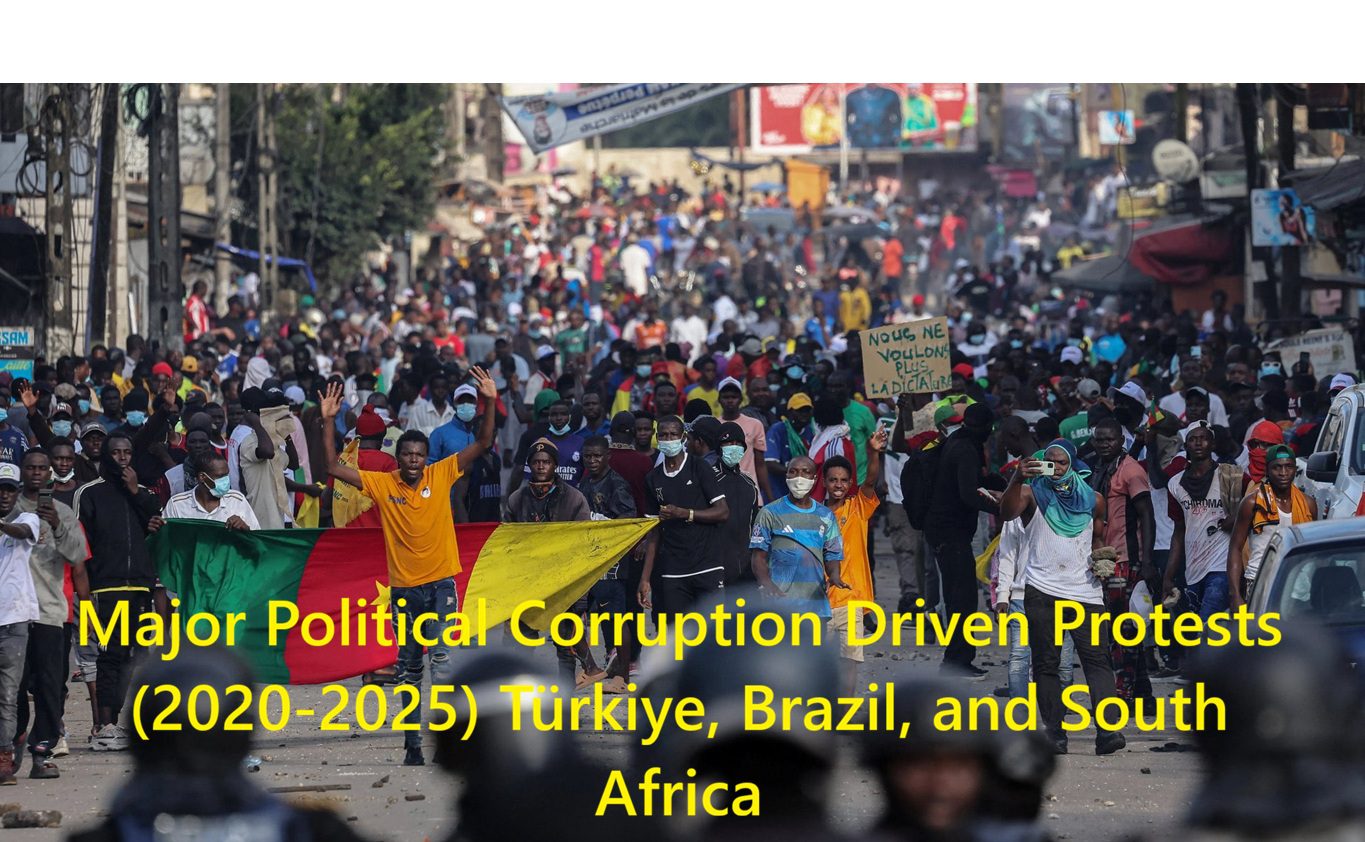
Major Political Corruption Driven Protests 2020-25 Türkiye, Brazil, and South Africa
This comprehensive analysis examines the major waves of corruption-driven political protests that have swept across Türkiye, Brazil, and South Africa between 2020 and 2025, revealing distinct patterns of democratic backsliding, institutional capture, and public mobilization in response to systemic corruption and abuse of state power.
The three countries present instructive case studies of how corruption scandals intersect with democratic deterioration, with varying outcomes ranging from institutional resilience in Brazil to judicial capture in Türkiye and ongoing struggles against state capture in South Africa.
These protests demonstrate that even as authoritarian pressures intensify, citizens continue to mobilize in defense of democracy and accountability, though the success of such movements depends heavily on the resilience of independent institutions, particularly the judiciary and legislatures.s3.amazonaws

Major Corruption-Driven Political Protests: Türkiye, Brazil, and South Africa (2020-2025)
Türkiye: From 2013 Corruption Scandal to 2025 Democratic Crisis
Türkiye’s experience with corruption-driven protests spans a critical period of democratic deterioration, beginning with the December 2013 corruption scandal and culminating in the unprecedented 2025 protests surrounding the arrest of opposition leader Ekrem Imamoglu.
The 2013 corruption scandal marked a turning point in Turkish politics, representing both a moment where corruption allegations briefly threatened Erdogan’s rule and the catalyst for his subsequent consolidation of authoritarian control through systematic judicial capture. On December 17-25, 2013, Turkish prosecutors initiated a large-scale anti-corruption operation targeting businessmen, bankers, and sons of serving cabinet ministers, with allegations focusing on bribery, illicit financial dealings, and money laundering involving Iranian businessman Riza Sarraf who allegedly bribed ministers millions of dollars to launder Iranian money and bypass U.S. sanctions.
The investigation exposed deep-rooted corruption in Erdogan’s inner circle, with leaked audio recordings even revealing Erdogan instructing his son, Bilal Erdogan, to remove millions of dollars from their home before a feared raid.
The government’s response to the 2013 scandal, rather than resulting in accountability and reform, instead precipitated a fundamental transformation of Turkish state institutions in Erdogan’s favor. Three cabinet ministers—Zafer Çağlayan (Economy), Erdoğan Bayraktar (Environment), and Muammer Güler (Interior)—resigned from their positions. However, Erdogan subsequently accused the Gülen movement of orchestrating the corruption investigation as a “judicial coup” and systematically dismantled judicial independence by bringing the judiciary under direct government control.
The government dismissed or reassigned thousands of police officers and hundreds of judges and prosecutors, fundamentally altering the balance of power within the Turkish state. This transformation set the stage for twelve years of progressive democratic backsliding, during which Erdogan consolidated power by eliminating potential rivals and using the judiciary as a tool of political control rather than a check on executive authority.
The March 2025 arrest of Ekrem Imamoglu represents the culmination of this trajectory and demonstrates how corruption allegations have become weaponized within Turkish politics as a mechanism for eliminating political opposition. Imamoglu, Istanbul’s mayor and the main opposition figure expected to challenge Erdogan in the 2028 presidential election, was arrested on March 19, 2025, on corruption charges including bribery, extortion, illegally recording personal data, and bid-rigging.
The timing and nature of the arrest sparked immediate and widespread skepticism about its political motivations, particularly given that Imamoglu’s arrest occurred just one day after his university revoked his diploma—a requirement for presidential eligibility—and mere days before he was to be formally nominated as the Republican People’s Party’s (CHP) presidential candidate. The government denied political motivations, with a judiciary official maintaining that being an elected official does not equate to immunity from prosecution, yet the sequence of events and historical precedent suggested otherwise.
The 2025 Imamoglu arrest sparked Türkiye’s largest anti-government demonstrations in over a decade, with hundreds of thousands of protesters taking to the streets across the country. On March 29, 2025, hundreds of thousands gathered for a mass rally in Istanbul called by the opposition CHP, with large crowds continuing to assemble outside Istanbul city hall for consecutive nights of protests.
Protesters characterized the detention as an attack on democratic processes and institutions, with demonstrators explicitly stating that Imamoglu had “beat Erdoğan four times at the ballot box” through legitimate democratic processes, and warning that the arrest would strengthen public support for him. The government imposed four-day demonstration bans in Istanbul and five-day bans in Ankara and Izmir, yet protests persisted despite restrictions. Turkish police responded to the demonstrations with tear gas, rubber bullets, and water cannons, resulting in numerous injuries and detentions.
The Turkish government’s response to the 2025 protests revealed the extent of institutional capture and authoritarian control. Turkish authorities detained nearly 1,900 people during the protests, including prominent figures such as actor Cem Yigit Uzumoglu, merely for supporting calls for an economic boycott on social media. Turkish prosecutors initiated criminal investigations against boycott organizers, specifically targeting the CHP for identifying and publicly boycotting companies allegedly supporting the government.
The international response was severe—the BBC expelled its correspondent Mark Lowen from the country after he was taken from his hotel and informed he posed a “threat to public order,” raising alarms among human rights organizations regarding press freedoms. The financial markets reacted sharply to the arrest, with the Turkish lira depreciating significantly, prompting the central bank to utilize reserves to stabilize currency markets. This combination of political repression, media censorship, international isolation, and economic instability exemplifies the broader democratic deterioration that has characterized Turkish governance since Erdogan’s consolidation of judicial control following the 2013 corruption scandal.
Brazil: Democratic Institutions Withstand Corruption Challenges
Brazil’s experience with corruption-driven protests from 2020 to 2025 presents a markedly different trajectory than Türkiye, demonstrating both the vulnerabilities of Brazilian democracy to populist exploitation of corruption scandals and the resilience of democratic institutions in resisting authoritarian backsliding. Brazil’s corruption protests have occurred in three major waves:
the June 2013 mass mobilizations that originated from bus fare grievances but expanded to encompass broader anti-corruption sentiments; the March 2015 mega-protests following revelations from the Lava Jato (Operation Car Wash) anti-corruption investigation; and the September 2025 demonstrations against proposed amnesty bills and judicial immunity measures that would have protected former President Bolsonaro and his allies from prosecution.
The June 2013 protests represented a critical moment in Brazilian civil mobilization, during which issues of corruption became central to public discourse and political consciousness. Initial protests began in late May 2013 against bus fare hikes in mid-sized cities such as Natal and Goiânia, led primarily by leftist university student groups organized under the banner Movimento Passe Livre (MPL).
The conflict escalated on June 13, 2013, when police responded to a peaceful march with excessive force, firing tear gas and rubber bullets at demonstrators, wounding journalists and bystanders. This police violence catalyzed rapid mobilization, with large demonstrations expanding from approximately 300,000 people on June 17 to an estimated 1.2 million Brazilians across more than 100 cities by June 20, 2013.
Significantly, a Datafolha poll taken among demonstrators at the June 17 march showed that while 56 percent were protesting bus fare increases, 40 percent were protesting corruption, 35 percent against “politicians,” and 31 percent against police violence—demonstrating how the initial protest grievances had expanded to encompass systemic issues including widespread corruption.
The Lava Jato investigation, which began in March 2014, revealed corruption at a scale that shocked Brazilian society and reinvigorated the corruption protest movement in 2015. Operation Car Wash initially investigated money laundering at a car wash in Brasília but ultimately exposed massive corruption involving Petrobras, Brazil’s state-owned oil company, and thirteen major construction companies engaged in a systematic cartel to defraud the government.
The investigation documented that “recipients of the bribes were high-level government functionaries, including both allies and opponents of the governing coalitions of President Lula da Silva and his successor Dilma Rousseff,” with the task force eventually arresting 292 individuals, of whom 278 either pleaded guilty or were convicted of crimes including fraud, bribery, and money laundering.
In March 2015, with anger over a stagnating economy combined with concrete proof of rampant corruption, more than 1 million Brazilians again poured into the streets demanding Rousseff’s removal from office. This public mobilization directly contributed to Rousseff’s impeachment in August 2016, demonstrating that Brazilian democratic institutions, at least in 2015-2016, maintained sufficient autonomy to respond to popular demand and remove a sitting president.
However, the Lava Jato investigation also revealed the vulnerabilities of Brazilian institutions to corruption and political manipulation. It was later revealed that Judge Sergio Moro, who presided over Lula’s corruption conviction, had collaborated with prosecutors to convict the former president specifically to ensure Bolsonaro’s victory in the 2018 presidential election.
Leaked communications between Moro and prosecutors—the so-called “Vaza Jato” leaks—demonstrated that “their prosecutorial motive was to prevent Lula’s re-election,” suggesting that the anti-corruption investigation itself had become corrupted by political motivations. This scandal exposed how even well-intentioned anti-corruption mechanisms could be weaponized for political purposes, raising fundamental questions about the independence of the Brazilian judiciary and prosecution system.
Bolsonaro’s subsequent presidency (2019-2022) represented a period of democratic backsliding during which the far-right president attacked other branches of government, sought to mobilize his supporters against the judiciary, and pursued policies that undermined democratic norms and institutions.
The September 2025 protests in Brazil, however, demonstrated that despite years of institutional strain and political polarization, Brazilian democratic institutions have maintained sufficient resilience to resist authoritarian capture and protect the rule of law.
Following Bolsonaro’s September 11, 2025 conviction for plotting a coup (with a sentence of 27 years), the conservative-majority Congress fast-tracked two controversial proposals: an amnesty bill that could pardon Bolsonaro and supporters involved in the January 2023 insurrection, and a constitutional amendment (the “Shield Bill” or “Shielding Constitutional Amendment”) that would expand parliamentary immunity and limit the judiciary’s ability to hold lawmakers accountable.
The government explicitly justified these measures as necessary to secure far-right support in a fragmented legislature. This represented precisely the kind of judicial capture and institutional backsliding that has characterized democratic deterioration in other countries.
Yet within days of the Chamber of Deputies’ approval of these bills, large-scale demonstrations erupted across Brazil to defend democracy and judicial independence. On September 21, 2025, protests took place in at least twenty-three state capitals across Brazil, mobilizing hundreds of thousands of citizens.
In São Paulo, the Political Debate Monitor at the University of São Paulo estimated crowds of 42,000, with a similar figure in Rio de Janeiro—”the biggest turnout for the left since President Luiz Inacio Lula da Silva was re-elected in 2022″. Iconic octogenarians of Brazilian music including Caetano Veloso, Gilberto Gil, and Chico Buarque performed resistance songs from Brazil’s dictatorship era, drawing explicit historical parallels between the current threats to democracy and military authoritarianism.
Protesters held signs reading “No amnesty” and “Shameless Congress,” expressing their conviction that the proposed bills represented “shameless” attempts to “camouflage corruption” and “impunity”. The mobilization was coordinated across diverse political constituencies, with participants united by a commitment to democratic principles rather than partisan loyalty.
Critically, the September 2025 protests achieved immediate and tangible results that demonstrated the power of democratic mobilization and the resilience of Brazilian institutions. Within days of the mass demonstrations, the Senate’s Committee on Constitution and Justice unanimously rejected the “Shielding Bill,” effectively burying the proposal for expanded parliamentary immunity.
The unanimous rejection, supported by senators from different political parties, demonstrated “the decisive role of the public in holding political actors accountable” and indicated that senators across the political spectrum recognized the fundamental threat posed by the proposed amendment. As one source noted, “for the first time in many years, it was not the far-right that filled the streets, but Brazilians from across the political spectrum who came together to defend democracy”.
The amnesty bill subsequently faced growing resistance in the National Congress, with its passage becoming increasingly uncertain. This outcome demonstrates that despite decades of corruption scandals, judicial manipulation, and institutional strain, Brazilian democratic institutions have maintained sufficient autonomy and legitimacy to resist authoritarian capture and protect constitutional democracy.
South Africa: State Capture, Personal Corruption, and Institutional Fragmentation
South Africa’s experience with corruption-driven protests from 2020 to 2025 presents a more troubled trajectory, characterized by ongoing struggles against systemic state capture, personal corruption scandals implicating even anti-corruption reformers, and institutions that demonstrate both significant accomplishments in investigating corruption while struggling to enforce accountability.
The country’s protests have centered on three major episodes: the October 2020 workers’ mobilization against systemic corruption; the July 2021 unrest triggered by former President Jacob Zuma’s imprisonment for contempt of court; and the November-December 2022 protests against President Cyril Ramaphosa following revelations about unexplained cash hidden at his farm.
South Africa’s systematic corruption problems emerged from the presidency of Jacob Zuma (2009-2018), during which the Gupta family of Indian-origin businessmen allegedly exercised unprecedented influence over state institutions and state-owned enterprises in what became known as “state capture”—the systematic and deliberate infiltration of government institutions by private interests for economic gain.
The Congress of South African Trade Unions (COSATU) and the South African Federation of Trade Unions (SAFTU) mobilized workers in October 2020 to protest corruption, with COSATU emphasizing that “corruption costs the country’s Gross Domestic Product, GDP, at least 27 billion rand (US$1.63 billion) annually” and characterizing corruption as “like cancer eating at the moral fibre of our society”.
The COVID-19 pandemic had further exacerbated corruption concerns, as massive theft and fraud in the procurement of personal protective equipment added to the massive corruption storm that had already plagued South African institutions.
The appointment of President Cyril Ramaphosa in December 2017 following Zuma’s departure raised hopes that South Africa would undertake genuine anti-corruption reform. Ramaphosa established the Zondo Commission (the Judicial Commission of Inquiry into Allegations of State Capture, Corruption and Fraud in the Public Sector) in 2018 to investigate state capture during the Zuma era.
The Zondo Commission undertook unprecedented investigative work, “sitting for 400 days of hearings during which over 300 witnesses gave evidence” and gathering “an immense amount of evidence” through “teams of investigators”. The Commission issued “3,171 summonses on top of 1,380 requests for information” and implicated “approximately 1,438 people” in its evidence.
The Commission’s investigation documented extensive corruption including the systematic weakening of the South African Revenue Service (SARS), widespread fraud at state-owned enterprises including South African Airways (SAA), Denel, Eskom, and Transnet, and corruption involving the state contractor BOSASA.
However, the implementation of the Zondo Commission’s recommendations has proven disappointing and has paradoxically contributed to new corruption scandals. Chief Justice Raymond Zondo criticized President Ramaphosa for appointing cabinet members who had been implicated by the Commission despite the president accepting its findings.
Furthermore, Ramaphosa himself became embroiled in a major corruption scandal in 2022 when former intelligence chief Arthur Fraser alleged that the president had concealed a theft of millions in cash from his private Phala Phala game farm in February 2020.
According to Fraser’s allegations, Ramaphosa had hidden large sums of money in furniture at his farm and failed to report the theft to authorities, allegedly violating foreign currency control laws and engaging in money laundering. A parliamentary panel’s probe found that Ramaphosa “may be guilty of a serious violation of certain sections of the constitution” and raised questions about the source of the money, which Ramaphosa claimed came from the sale of game animals.
The Ramaphosa farm scandal triggered immediate political consequences that demonstrated the fragmentation of South African politics and the vulnerability of even reform-minded leaders to corruption accusations. In December 2022, a group of demonstrators interrupted Ramaphosa’s address at the ruling African National Congress (ANC) conference, drowning him out with loud chants and songs demanding his resignation.
Opposition parties and Ramaphosa’s detractors within the ANC called for his impeachment or resignation, with the opposition Democratic Alliance stating that “President Ramaphosa most likely did breach a number of constitutional provisions” and demanding that “impeachment proceedings into his conduct must go ahead”.
The scandal invigorated Jacob Zuma’s supporters, who had been politically marginalized following his imprisonment and who subsequently backed a new political party, uMkhonto we Sizwe (MK), that became a major disruptor in South Africa’s 2024 national election.
The July 2021 unrest surrounding Jacob Zuma’s imprisonment represented the most severe civil disorder that South Africa experienced since the end of apartheid and demonstrated how corruption-related institutional crises can escalate into broader social violence.
On June 29, 2021, the Constitutional Court sentenced Zuma to 15 months in prison for contempt of court after he refused to testify before the Zondo Commission, engaging in what judges characterized as a “politically motivated smear campaign” against the country’s judiciary.
Zuma’s imprisonment triggered violent protests by his supporters in KwaZulu-Natal province on July 9, 2021, which quickly escalated into widespread looting across both KwaZulu-Natal and Gauteng provinces. The unrest resulted in 354 deaths, with “more than 2,500 individuals initially detained, primarily for minor offenses”.
The economic damage was catastrophic, with the turmoil inflicting “approximately 50 billion rand ($3.3 billion in economic damage)”. The government deployed 25,000 troops to suppress the violence, yet security forces struggled to prevent widespread destruction.
The July 2021 unrest raised fundamental questions about whether the violence represented genuine grassroots support for Zuma or whether it had been orchestrated by political elites seeking to undermine Ramaphosa’s anti-corruption agenda.
President Ramaphosa stated before the South African Human Rights Commission that “the primary trigger for the unrest was a conscious choice by certain individuals to provoke, organize, and incite extensive property damage, violence, and looting,” suggesting that the violence had been deliberately planned rather than spontaneously emerging from public opposition to Zuma’s imprisonment.
Evidence subsequently emerged linking twenty-six individuals from within the ANC and government to “instigating, organising, and coordinating the unrest following Zuma’s imprisonment,” based on WhatsApp group evidence. Zuma’s daughter, Duduzile Zuma-Sambudla, was charged with inciting violence through social media posts in July 2021.
While corruption and state capture concerns motivated initial protests against Zuma’s refusal to testify before the Zondo Commission, the subsequent violence appeared increasingly detached from the original corruption narratives and instead reflected elite-led factional conflict within the ANC.
Comparative Analysis: Patterns and Divergences in Protest Dynamics and Democratic Outcomes
Examining these three cases together reveals several critical patterns regarding how corruption-driven protests interact with democratic institutions, state capacity, and possibilities for either democratic resilience or authoritarian backsliding.
One fundamental pattern is that the nature of corruption allegations—whether directed against incumbent leaders seeking to consolidate power or against opposition leaders and reform-minded presidents—dramatically shapes protest trajectories and political outcomes.
In Türkiye, the 2013 corruption scandal initially threatened Erdogan but ultimately became the catalyst for his systematic consolidation of judicial capture and authoritarian control, as he weaponized the scandal to blame the Gülen movement and justify the elimination of judicial independence.
By contrast, in Brazil, the 2015 Lava Jato investigation revealed corruption that was sufficiently broad and bipartisan that it could not be easily weaponized by a single faction, though it was subsequently corrupted by Judge Moro’s collaboration with prosecutors, and Brazilian democratic institutions ultimately proved capable of resisting the threat posed by Bolsonaro’s 2025 allies’ amnesty bills.
A second critical pattern concerns the role of institutional autonomy, particularly judicial independence, in determining whether anti-corruption mobilizations translate into accountability or become vehicles for authoritarian consolidation. In Türkiye, the judiciary’s loss of independence following 2013 meant that by 2025, the courts became instruments of political persecution rather than checks on executive authority, with judges obliging Erdogan’s wishes to imprison his main political rival.
In Brazil, despite serious concerns about judicial independence and the Moro scandal, the 2025 Senate’s unanimous rejection of the Shield Bill demonstrated that the legislature maintained sufficient autonomy to resist executive pressure and protect constitutional democracy.
In South Africa, the Zondo Commission accomplished unprecedented investigative work documenting corruption, yet the absence of systematic prosecutions and the appointment of implicated individuals to cabinet positions revealed that investigative capacity alone cannot ensure accountability without independent prosecution mechanisms and political will.
A third pattern involves the scale and composition of protest movements, with larger and more socially diverse mobilizations appearing correlated with more successful resistance to institutional capture. Brazil’s September 2025 protests—which mobilized “Brazilians from across the political spectrum” and achieved “the biggest turnout for the left since President Luiz Inacio Lula da Silva was re-elected in 2022″—successfully pressured the Senate to reject the Shield Bill within days of mass mobilization.
Türkiye’s 2025 Imamoglu protests, while representing “the largest protests in a decade,” nonetheless failed to prevent the mayor’s continued imprisonment and the government’s intensification of repression, partly because the Turkish government’s control of the judiciary meant that popular mobilization could not translate into legal accountability.
South Africa’s July 2021 unrest, despite involving massive numbers of participants, became progressively detached from its original corruption-focused narrative and transformed into factional elite competition as evidence suggested organized coordination by political figures seeking to undermine their rivals.
Conclusion: Democracy Under Pressure and the Role of Institutional Resilience
The major corruption-driven political protests of 2020-2025 across Türkiye, Brazil, and South Africa demonstrate that corruption remains a powerful mobilizing force capable of generating mass popular movements demanding accountability and democratic reform. Yet these cases also reveal the profound vulnerability of democratic institutions to authoritarian capture, the instrumental role that corruption allegations can play in elite power struggles, and the critical importance of institutional autonomy—particularly judicial independence and legislative strength—in translating popular mobilization into genuine accountability and democratic protection.
Türkiye’s trajectory, from the 2013 corruption scandal through the 2025 Imamoglu arrest and unprecedented mass protests, illustrates the danger posed when incumbents respond to corruption allegations by capturing the judiciary rather than submitting to accountability. Twelve years of systematic institutional capture meant that by 2025, despite massive popular mobilization, the Turkish courts became tools of political persecution rather than protectors of democratic rights, and the government’s response to protests involved extensive repression, media censorship, and international isolation rather than democratic dialogue. Brazil’s experience, by contrast, demonstrates that even amid decades of corruption scandals, judicial manipulation, and institutional strain, democratic institutions can maintain sufficient autonomy and legitimacy to resist authoritarian capture. The 2025 Senate rejection of the Shield Bill—occurring within days of mass mobilization and with unanimous support across political parties—suggests that Brazilian legislators recognized that protecting constitutional democracy served their long-term interests better than enabling executive capture of the judiciary.workers+9
South Africa presents a more ambiguous case, where investigative institutions have accomplished unprecedented work in documenting state capture and corruption, yet the absence of systematic enforcement, the appearance of corruption among anti-corruption reformers, and the transformation of corruption protests into factional elite conflict suggest ongoing institutional fragmentation. The challenge facing South Africa’s democratic defenders is not primarily a lack of information about corruption—the Zondo Commission’s massive evidentiary record demonstrates that—but rather the political will to enforce accountability consistently and impartially across all political factions.pinsentmasons+6
Going forward, the effectiveness of corruption-driven protests in defending democracy will depend heavily on whether citizens, opposition parties, and reform-minded officials can preserve the institutional autonomy of courts and legislatures against incumbent pressure to capture them, maintain protest movements’ focus on systemic institutional reform rather than allowing them to become vehicles for factional elite conflict, and build cross-party coalitions capable of resisting the polarization and demonization of opposition that authoritarian leaders use to justify institutional capture. The Brazilian Senate’s 2025 rejection of the Shield Bill offers a model of how democratic institutions can successfully resist such threats, but only if political leaders prioritize democratic principles over short-term factional advantage—a commitment that remains contested and fragile across all three countries.