
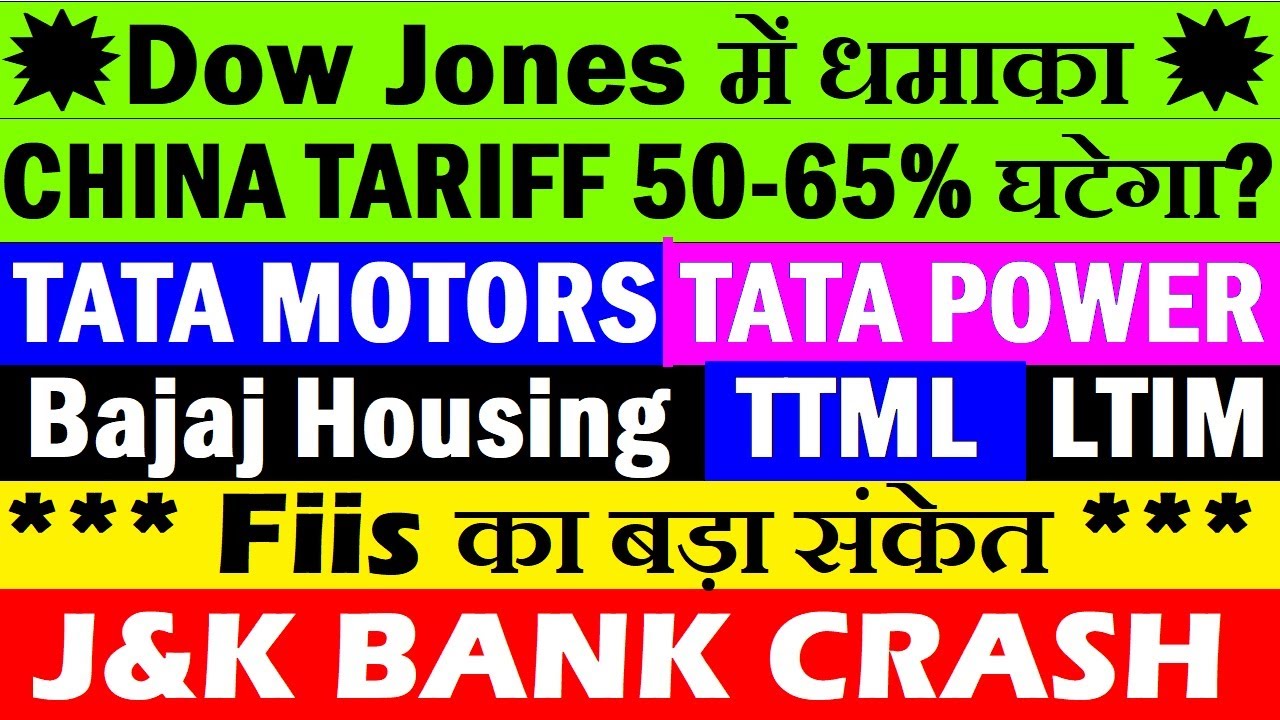
The global financial landscape is buzzing with significant developments, from the J&K Bank crash to a robust Dow Jones rally and potential China tariff reductions. This article dives deep into these events, offering actionable insights into stock market trends, company performances, and macroeconomic factors shaping investments. Whether you’re tracking Bajaj Housing Finance, TTML, LTIM, Tata Motors, or Tata Power, or analyzing FII and DII activities, this comprehensive guide equips you with the knowledge to navigate today’s dynamic markets.
Understanding the J&K Bank Crash: Causes and Implications
The recent 9% plunge in J&K Bank’s stock price has sent ripples through the Indian stock market, particularly due to its ties to regional instability in Jammu and Kashmir. The bank, a key player in the region’s financial ecosystem, faced this sharp decline amid unsettling news of an attack that has sparked widespread concern.
Why Did J&K Bank’s Stock Crash?
The primary trigger for the crash was a tragic incident in Jammu and Kashmir, which disrupted the region’s stability. As the area heavily relies on tourism for economic growth, such events directly impact businesses like J&K Bank, which plays a pivotal role in financing local enterprises. The market’s reaction reflects investor fears of declining economic activity and potential disruptions in the bank’s operations.
Broader Implications for Investors
For investors, the J&K Bank crash underscores the vulnerability of region-specific stocks to geopolitical risks. While the bank has shown resilience in the past, this event highlights the need for diversification to mitigate risks tied to localized instability. Monitoring government responses and potential stabilization measures will be crucial for assessing the stock’s recovery potential.
Strategies to Navigate Regional Stock Volatility
- Diversify Investments: Spread your portfolio across sectors and regions to reduce exposure to localized risks.
- Monitor News Closely: Stay updated on geopolitical developments in sensitive regions like Jammu and Kashmir.
- Assess Long-Term Potential: Evaluate J&K Bank’s fundamentals, such as its loan portfolio and capital adequacy, to determine if the dip presents a buying opportunity.
Dow Jones Surges: A 2% Rally Fueled by Tariff Hopes
The U.S. stock market, particularly the Dow Jones Industrial Average, witnessed a remarkable 2% surge, climbing as much as 1,100 points intra-day. This rally, anticipated by market analysts, stems from optimism surrounding potential tariff reductions on Chinese goods and a softening stance from key policymakers.
What’s Driving the Dow’s Rally?
The primary catalyst is the growing expectation of a significant reduction in U.S. tariffs on Chinese imports, potentially slashing rates by 50-55%. This development signals a thaw in U.S.-China trade tensions, boosting investor confidence. Additionally, comments from Fed Chair Jerome Powell and a perceived shift in policy rhetoric have further fueled market optimism.
The Trump Indicator: A Key Market Mover
The video highlights the “Trump Indicator,” where market movements closely align with policy announcements from former President Donald Trump. Positive policy shifts, such as tariff reductions or conciliatory remarks, trigger bullish sentiment, while negative news leads to sell-offs. This dynamic has dominated market behavior, with futures indicating a 2.25% uptick before the rally materialized.
How Investors Can Capitalize on U.S. Market Trends
- Track Policy Announcements: Stay informed about U.S. trade policies and Fed commentary, as they heavily influence market direction.
- Invest in Sector ETFs: Consider ETFs tracking the Dow or S&P 500 to gain exposure to broad market gains.
- Leverage Futures Data: Use futures as an early indicator of market sentiment to time your trades effectively.
China Tariff Reductions: A Game-Changer for Global Markets
The potential slashing of U.S. tariffs on Chinese goods has emerged as a pivotal factor driving global market sentiment. Reports suggest a reduction of up to 55%, which could reshape trade dynamics and benefit both U.S. and Asian markets.
Why Tariff Cuts Matter
High tariffs have long strained U.S.-China trade relations, increasing costs for businesses and consumers. A substantial cut would lower import costs, boost corporate profitability, and stimulate economic activity. For Indian investors, this could enhance export opportunities to both nations, particularly in sectors like automobiles and technology.
Impact on Indian Stocks
Companies like Tata Motors, which are sensitive to global trade policies, stand to benefit from normalized trade relations. Reduced tariffs could lower input costs and improve margins, making such stocks attractive for long-term investors.
Investment Strategies for Tariff-Driven Markets
- Focus on Export-Oriented Stocks: Identify Indian companies with significant exposure to U.S. and Chinese markets.
- Monitor Currency Movements: Tariff cuts may strengthen the U.S. dollar, impacting Indian exporters. Hedge currency risks where necessary.
- Stay Agile: Be prepared for volatility, as tariff negotiations can be unpredictable.
Bajaj Housing Finance: Stellar Q4 Performance
Bajaj Housing Finance, a recent IPO star, has delivered impressive Q4 results, reinforcing its position as a top performer in the Indian financial sector. The company’s robust loan growth and stable asset quality have caught investors’ attention.
Breaking Down Bajaj Housing’s Numbers
- Net Profit Surge: Q4 net profit soared 54% to ₹587 crore, while the full-year profit grew 25% to ₹2,163 crore.
- Net Interest Income: A 30% jump in net interest income reflects strong lending activity.
- Asset Under Management (AUM): AUM crossed ₹1.14 lakh crore, up 26% year-on-year, with ₹6,365 crore added in Q4 alone.
- Asset Quality: Non-performing assets (NPAs) remained stable, indicating prudent risk management.
Why Bajaj Housing Stands Out
The company’s ability to sustain loan growth while maintaining asset quality sets it apart in a competitive market. Its IPO, which saw significant investor interest, continues to deliver value, with many investors reporting 25-54% returns depending on the timeframe.
Investment Tips for Bajaj Housing Finance
- Long-Term Hold: Given its strong fundamentals, Bajaj Housing is a solid pick for long-term portfolios.
- Understand Metrics: Differentiate between quarterly and annual growth figures to avoid confusion.
- Watch Interest Rates: As a housing finance company, its performance is tied to interest rate trends. Monitor RBI policies closely.
TTML’s Persistent Challenges: Debt Weighs Heavy
Tata Teleservices Maharashtra Limited (TTML) reported its Q4 results, but the numbers reflect ongoing struggles with a familiar issue: excessive debt.
TTML’s Q4 Performance
- Revenue Decline: Revenue fell to ₹308 crore from ₹333 crore year-on-year.
- Operating Profit: A slight increase to ₹153 crore, but still insufficient to offset interest expenses.
- Net Loss: Heavy interest payments on debt continue to convert operating profits into net losses.
The Debt Dilemma
TTML’s core issue is its substantial debt burden, which erodes profitability despite decent operational performance. Past attempts to convert debt into equity, similar to Vodafone Idea’s strategy, briefly boosted the stock but were later abandoned, leading to a 50% crash from its peak.
Should You Invest in TTML?
- High Risk, High Reward: TTML could rebound if it successfully restructures its debt, but the risk remains high.
- Wait for Clarity: Avoid investing until concrete debt resolution plans emerge.
- Track Promoter Actions: Monitor Tata Group’s moves, as their backing could signal a turnaround.
LTIMindtree’s Steady Growth and Dividend Boost
LTIMindtree, a leading IT services provider, posted solid Q4 results, reinforcing its reputation as a reliable performer in the Indian tech sector.
LTIM’s Q4 Highlights
- Profit Growth: Net profit rose 4% quarter-on-quarter to ₹1,128 crore.
- Dividend Announcement: A final dividend of ₹45 per share, signaling confidence in future cash flows.
- Stable Margins: Improved operational efficiency contributed to profitability.
Why LTIMindtree Remains Attractive
The company’s consistent growth, coupled with a shareholder-friendly dividend policy, makes it a favorite among conservative investors. Its focus on digital transformation and global client base ensures steady revenue streams.
Investment Strategies for LTIMindtree
- Accumulate on Dips: Use market corrections to build positions in this fundamentally strong stock.
- Leverage Dividend Income: Reinvest dividends to compound returns over time.
- Monitor IT Sector Trends: Stay updated on global IT spending, as it directly impacts LTIM’s growth.
Tata Motors and Tata Power: A Renewable Energy Partnership
Tata Motors and Tata Power have announced a strategic partnership to develop wind and solar projects, aligning with India’s renewable energy push.
Details of the Partnership
The collaboration focuses on expanding renewable energy capacity, leveraging Tata Power’s expertise in clean energy and Tata Motors’ commitment to sustainability. This move strengthens both companies’ positions in future-oriented sectors.
Market Implications
- Tata Motors: The partnership could reduce energy costs and enhance margins, especially if global trade policies stabilize.
- Tata Power: As a leader in renewables, this deal bolsters its project pipeline and long-term growth prospects.
Investment Opportunities
- Long-Term Growth: Both stocks are well-positioned for gains as India accelerates its renewable energy adoption.
- Watch Tariff Impacts: Tata Motors’ performance remains sensitive to global tariff changes, so monitor trade news.
- Diversify Within Tata Group: Consider other Tata Group stocks to balance sector-specific risks.
FII and DII Activities: Driving Market Momentum
Foreign Institutional Investors (FIIs) and Domestic Institutional Investors (DIIs) play a critical role in shaping Indian market trends. Recent data highlights their contrasting strategies.
FII and DII Trends
- FII Buying: FIIs purchased ₹3,300 crore worth of equities, signaling strong confidence in Indian markets.
- DII Selling: DIIs sold ₹1,200 crore, possibly booking profits after recent market gains.
Why FIIs Are Bullish
The sustained FII buying aligns with the Nifty’s recent uptrend, driven by a weakening U.S. dollar against the Indian rupee. A softer dollar enhances FII returns, encouraging inflows. Additionally, optimism around tariff cuts and global trade normalization has bolstered sentiment.
Investment Strategies Based on FII/DII Data
- Follow FII Flows: Stocks with heavy FII buying often outperform in the short term.
- Balance with DII Moves: DII selling may indicate profit-taking, so focus on fundamentally strong stocks.
- Monitor Currency Trends: A weaker dollar could sustain FII inflows, boosting market sentiment.
Macro Factors Shaping the Market
Several macroeconomic factors are influencing global and Indian markets, from currency movements to policy shifts.
The Dollar Index and Trump’s U-Turns
The U.S. dollar index, currently hovering around 99, plays a pivotal role in market dynamics. A weaker dollar prompts policy U-turns, as seen in recent tariff reduction talks. Conversely, a dollar recovery above 100 could reverse these trends, impacting FII flows and Indian stocks.
Geopolitical Risks in Jammu and Kashmir
The attack in Jammu and Kashmir not only affected J&K Bank but also raised broader concerns about regional stability. Investors must factor in such risks when allocating capital to region-specific stocks.
RBI and Fed Policies
While the Fed’s commentary has softened, RBI’s interest rate decisions will influence sectors like housing finance and banking. A stable or dovish RBI stance could support stocks like Bajaj Housing Finance.
How to Build a Resilient Investment Portfolio
Navigating today’s volatile markets requires a strategic approach. Here are actionable tips to build a resilient portfolio:
Diversify Across Sectors
Invest in a mix of financials (Bajaj Housing, LTIM), automobiles (Tata Motors), and utilities (Tata Power) to balance risk and reward.
Stay Informed
Use real-time tools like stock screeners, news aggregators, and X posts to track market developments. For instance, analyzing X user sentiment can provide early signals of market shifts.
Leverage Fundamental Analysis
Focus on companies with strong fundamentals, such as LTIMindtree’s consistent profitability or Bajaj Housing’s robust AUM growth.
Manage Risk
Use stop-loss orders and position sizing to protect against sudden downturns, as seen in J&K Bank’s crash.
Conclusion: Seizing Opportunities in a Dynamic Market
The stock market is a complex interplay of global and local factors, from the Dow’s tariff-driven rally to J&K Bank’s regional challenges. By understanding key developments—like Bajaj Housing’s stellar results, TTML’s debt struggles, and Tata’s renewable energy push—investors can make informed decisions. Stay vigilant, diversify wisely, and leverage data-driven insights to thrive in today’s fast-paced markets.
For the latest updates, explore financial platforms like grok.com or follow real-time discussions on X. Ready to take control of your investments? Start analyzing these trends today and build a portfolio that withstands volatility while capturing growth.