Telangana Women SHG Bus Ownership Scheme 2025: Empowering 1 Crore Rural Women to Become Millionaires Through Revolutionary Asset Creation
Telangana is leading India in women’s economic empowerment, transforming rural women from self-help group (SHG) members into proud asset owners and entrepreneurs. Under the visionary leadership of Chief Minister A. Revanth Reddy, the state government has pioneered a groundbreaking initiative that puts bus ownership directly into the hands of women’s groups. For the first time in the country, Mandal-level Mahila Samakhyas are purchasing public transport buses and leasing them to the Telangana State Road Transport Corporation (TGSRTC), generating guaranteed monthly income of nearly ₹70,000 per bus.
This bold SHG bus ownership program builds on the massive success of the Maha Lakshmi free bus travel scheme and forms a core pillar of the Indira Mahila Shakti Mission. The ultimate goal? To turn one crore Telangana women into crorepatis (millionaires) by creating sustainable wealth through large-scale loans, revenue-generating assets, and entrepreneurial opportunities. As of 2025, this women-led public transport revolution is already delivering stable livelihoods, boosting rural connectivity, and inspiring similar models nationwide.
From Free Bus Rides to Owning the Fleet: The Journey of Telangana Women Empowerment
The Congress government, led by Chief Minister Revanth Reddy, wasted no time delivering on its promises. Within the first 48 hours of taking office, it rolled out two flagship guarantees: enhanced health coverage under Rajiv Aarogyasri and the Maha Lakshmi Scheme, offering free bus travel for all women and transgender persons across Telangana.
Launched on December 9, 2023, the Maha Lakshmi Scheme quickly became a game-changer. Women no longer had to choose between essential travel and household expenses. By mid-2025, over 200 crore free rides had been issued, saving women more than ₹6,700 crore in fares. Daily female ridership skyrocketed, pushing overall bus occupancy from around 70% to nearly 90%. Rural women gained easier access to markets, hospitals, schools, and jobs, while TGSRTC saw a dramatic revenue surge despite zero-fare tickets (fully reimbursed by the government).
This surge in passenger numbers created the perfect foundation for the next leap: turning women into bus owners. Why rent buses from private operators when empowered SHGs could own them? The government asked this question and delivered an innovative answer that no other state in India has matched.
India’s First-Ever SHG-Owned Public Transport Buses: How the Scheme Works
Through the Society for Elimination of Rural Poverty (SERP) and in partnership with TGSRTC, the Telangana government empowered Mandal Mahila Samakhyas (federations of village-level women’s SHGs) to purchase buses using a smart, low-risk financing model.
Here’s the breakdown:
- Total Buses Targeted: 600 (one bus per selected Mandal Mahila Samakhya)
- Cost Per Bus: Approximately ₹36 lakh
- Funding Structure:
- ₹6 lakh contributed from the Samakhya’s own corpus funds
- ₹30 lakh provided as interest-subsidized loan or Community Investment Fund support from SERP (with government guarantee)
- Lease to TGSRTC: Buses are registered in TGSRTC’s name for operational ease but hypothecated to the women’s group. TGSRTC operates and maintains them.
- Monthly Rental Income: ₹69,648 per bus (some sources cite up to ₹77,220 in early proposals)
- Roughly ₹19,000–20,000 covers operational costs and profit margin
- ₹50,000 directly repays the loan principal and interest
- Contract Duration: 7 years of guaranteed rental, after which the bus becomes a fully paid asset of the women’s group—or they can refinance for a new one.
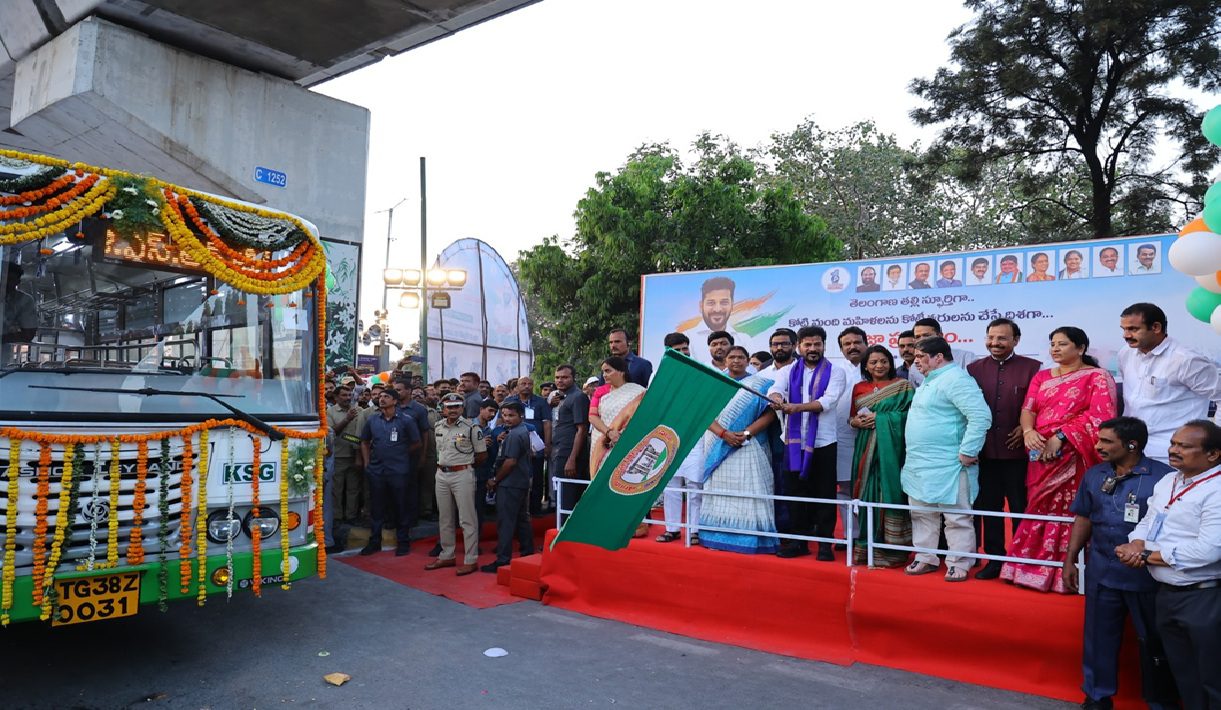
Phase 1 delivered 151 buses across 17 districts, flagged off by Chief Minister Revanth Reddy on International Women’s Day (March 8) in 2025. By November 2025, women’s groups had already received multiple rental installments totaling over ₹5–10 crore collectively. Phase 2, covering the remaining 449 buses, is rapidly underway, with procurement and financing streamlined for faster rollout.
This isn’t charity—it’s smart economics. SHGs, renowned nationwide for their discipline and 99%+ loan repayment rates, now enjoy risk-free, predictable income while contributing to public welfare.
Indira Mahila Shakti Mission 2025: The Blueprint for Making One Crore Women Crorepatis
The bus ownership program is just one jewel in the crown of the Indira Mahila Shakti Mission launched in March 2025. Chief Minister Revanth Reddy declared an audacious yet achievable vision: leverage ₹1 lakh crore in bank linkages over five years to create wealth-generating enterprises for SHGs.
Key pillars expanding alongside bus ownership include:
- Women-Run Petrol Bunks: From the first SHG-managed pump in Narayanpet to rollout across all districts in partnership with BPCL and IOCL.
- Solar Power Plants: 64 MW capacity managed entirely by women’s groups—2 MW per district—delivering clean energy and steady dividends.
- Rice Mills, Godowns, and Food Processing Units: Taking over fraud-hit mills and turning them into profitable SHG enterprises.
- Stitching Centers and School Contracts: SHGs earned crores stitching uniforms for over 10 lakh government school children.
- Interest-Free Loans and Insurance: Zero-interest funding, accident coverage, and marketing support for SHG products.
With current SHG membership at 65–67 lakh and aggressive outreach underway, the government is on track to reach one crore members soon. A mega rally—potentially the world’s largest gathering of empowered women—along Hyderabad’s Outer Ring Road is being planned to celebrate this milestone.
Real Voices from the Ground: How Bus Ownership is Changing Lives
“Nothing compares to the pride of seeing our Samakhya’s name painted on the bus. It’s not just transport—it’s OUR bus, OUR asset, OUR future.” — P. Padma, President, Mandal Mahila Samakhya, Eturunagaram, Mulugu District
Women leaders echo this sentiment across Telangana. One Mandal Samakhya president from Mulugu explained: “Every month, ₹69,000+ flows directly into our group account—no marketing worries, no maintenance headaches. Over seven years, this single bus will help dozens of families send children to college, build homes, and start side businesses.”
In rural areas where jobs are scarce, this steady income is transformative. It funds weddings, medical emergencies, and education while strengthening the entire SHG ecosystem. Women who once borrowed small amounts for daily needs now manage multi-crore asset portfolios.
Why Telangana’s Model is Inspiring the Nation
Telangana’s approach stands out for three reasons:
- Zero Risk, High Reward: Government-backed guarantees and fixed rentals eliminate entrepreneurial risk for rural women.
- Synergy with Free Travel: Higher ridership from Maha Lakshmi ensures buses run full, maximizing revenue for TGSRTC and rental security for SHGs.
- Scalable Wealth Creation: Unlike one-time subsidies, this creates appreciating assets and perpetual income streams.
National leaders and women’s organizations are studying the model closely. From Tamil Nadu to Karnataka, policymakers are exploring adaptations, but Telangana remains the pioneer.
However, the scheme employs a carefully structured financial arrangement that distributes the investment burden across multiple stakeholders:
| Financial Component | Amount | Source |
|---|---|---|
| Group’s Own Contribution | ₹6 lakh | Self-help group members’ accumulated savings |
| Community Investment Fund | ₹30 lakh | SERP funds (Society for Elimination of Rural Poverty) |
| Total Bus Cost | ₹36 lakh | Combined sources |
The TGSRTC monthly rental payment represents the income engine of this model. The corporation pays each group ₹69,648 per month, structured as follows:
- ₹19,648 directed toward operational and maintenance expenses
- ₹50,000 allocated toward loan repayment
This rental structure continues for seven years, providing mathematical certainty and financial predictability that traditional businesses cannot offer. Self-help groups know precisely how much income will arrive monthly for seven consecutive years, enabling them to plan expansion activities, invest in additional assets, or distribute returns to members.
Consider the practical implications for a rural woman SHG member. Over 84 months, the rental payments total approximately ₹5.85 crore, ensuring debt retirement while generating surplus revenue for the organization. Members can reinvest earnings into secondary income sources, create emergency funds, or enhance member benefits including healthcare and education support.
Implementation Progress: From Vision to Reality Across Districts
Phase One: The Foundation Years
The scheme’s rollout followed a phased approach designed to ensure operational viability and institutional learning. During Phase One, initiated in March 2025, the government identified and supported 151 Mandal Mahila Samakhyas (district-level women’s federations) across 17 districts to purchase 151 buses.
This first phase concentration in specific districts served strategic purposes. The government selected mandals with financially stable SHG networks demonstrating consistent loan repayment discipline. Emphasis fell on regions including erstwhile Khammam, Karimnagar, Mahabubnagar, and Warangal districts—areas with substantial rural populations and demonstrated organizational maturity in SHG networks.
By November 2025, the TGSRTC had released approximately ₹5 crore in rental payments to participating women’s groups, validating the scheme’s operational feasibility. This significant capital injection into rural areas demonstrates immediate economic impact.
Phase Two: Scaling the Vision
Building on Phase One’s success, Phase Two targets procurement of an additional 449 buses, bringing the total program to 600 vehicles. This expansion ensures that women’s groups across the entire state can participate in this wealth-creation opportunity.
The scaling strategy reflects the government’s confidence in the model’s sustainability and impact potential. Rather than hesitantly introducing changes, the administration is substantially increasing program scope, suggesting strong performance metrics and community enthusiasm from Phase One participants.
Beyond Buses: The Comprehensive Women Empowerment Ecosystem
Complementary Initiatives Under Indira Mahila Shakti
The bus ownership scheme represents just one component of the comprehensive Indira Mahila Shakti framework. The government recognizes that sustainable economic empowerment requires multifaceted interventions addressing financial access, skill development, market connectivity, and social conditions simultaneously.
Economic Enterprise Expansion: Beyond bus ownership, SHGs are venturing into traditionally male-dominated sectors. Women’s groups now operate petrol pumps, establishing entrepreneurial presence in the fuel retail industry. Solar energy installations represent another frontier, with the government allocating 2MW solar power projects across all 32 districts, positioning women as leaders in renewable energy adoption.
Skill and Market Development: The government invests heavily in skill development programs tailored to individual group preferences and capacities. Simultaneously, branding and packaging support enhances the appeal of SHG-produced goods. The government has allocated premium commercial spaces near Hitech City and other urban centers, enabling rural products direct access to sophisticated consumer markets.
Financial Infrastructure: Banks have extended loans totaling approximately ₹27,000 crore to women’s self-help groups, reflecting unprecedented financial inclusion. Remarkably, these groups demonstrate an outstanding 98% loan repayment rate—substantially exceeding corporate India’s performance—validating women’s financial reliability and institutional discipline.
Infrastructure Investment: The government proposes establishing common processing centers and mini-industrial parks in every assembly constituency of Telangana. This infrastructure development creates ecosystems where multiple women enterprises can operate efficiently, share resources, and achieve economies of scale previously unavailable to individual groups.
The Impact on Rural Connectivity and Women’s Mobility
Addressing Transportation Gaps Through Women-Owned Vehicles
Prior to this initiative, the TGSRTC contracted private bus operators to cover rural routes and sparsely populated areas. These private operators prioritized profitability over comprehensive coverage, creating transportation deserts in economically marginal regions. Women-owned buses are systematically addressing this gap.
The Maha Lakshmi Scheme’s free travel component incentivizes increased bus utilization, justifying expanded fleet deployment. As more women travel freely, passenger revenues from male passengers and non-free categories increase sufficiently to justify route expansion. Women-owned buses, specifically positioned for rural route operations, extend connectivity to previously underserved mandals and villages.
This expanded transportation access generates multiplier effects throughout rural economies. Students can reach educational institutions distant from home villages. Agricultural workers can access larger markets. Healthcare access improves as patients reach district hospitals. Women themselves gain unprecedented mobility, facilitating employment access and social participation.
Psychological Empowerment and Dignity
Beyond financial metrics, women participating in this scheme report profound psychological transformation. As one Mandal Samakhya president expressed, “Seeing the name of our Indira Mahila Shakti Mandal Samakhya on the bus makes us feel proud. It is our bus.” This simple statement encapsulates a fundamental shift from welfare beneficiary status to asset-owning entrepreneur status.
The transition from free bus travelers to bus owners symbolizes broader societal perceptions of women’s economic role and capability. When rural women own and operate businesses generating consistent income, it recalibrates community expectations regarding female economic participation and decision-making authority within households.
Comparative Analysis: How Telangana Leads Women’s Empowerment Initiatives
National Context and Innovation
While various Indian states have implemented women-centric schemes, Telangana’s approach distinguishes itself through ambitious scope and structural innovation. Most states focus on microfinance or subsidized enterprise support. Telangana escalates women to asset ownership in critical infrastructure sectors.
Karnataka’s Shakti Scheme provides free travel for women on non-premium buses, benefiting approximately 38.69 crore journeys annually. However, this initiative remains essentially welfarist in character, providing consumption benefits without wealth creation mechanisms.
By contrast, Telangana’s model integrates welfare benefits (free travel) with wealth creation (bus ownership and consistent rental income). This integration represents innovative policy design that simultaneously addresses immediate accessibility needs and long-term financial security.
Challenges and Sustainability Considerations
Financial Risk Management
While the bus ownership scheme appears well-structured, certain risks merit consideration. The seven-year rental agreement provides income certainty, but operational expenses may fluctuate due to fuel price volatility or maintenance requirements exceeding projections. SHGs require financial literacy support to manage surplus income prudently.
Additionally, the scheme depends on TGSRTC’s financial viability. If the transport corporation faces operational difficulties or political pressure to reduce rental payments, groups’ income expectations could be disrupted. Government guarantees backing these rental commitments become essential for scheme credibility.
Scaling and Institutional Capacity
Expanding from 151 to 600 buses (and potentially beyond) requires robust institutional support. Mandal Samakhyas must develop business management capabilities, financial reporting systems, and leadership pipelines to sustain operations across extended periods. Inadequate capacity-building during expansion phases could undermine scheme effectiveness.
The Broader Vision: Women as Agents of Economic Transformation
Chief Minister Revanth Reddy has articulated a vision extending far beyond individual financial enrichment. By transforming one crore women into crorepatis, the state aims to restructure economic dynamics throughout Telangana. When 10 million women control significant income and assets, household decision-making patterns shift fundamentally.
The long-term implications appear transformative. Children in households with financially independent mothers experience educational benefits. Health outcomes improve as women control household spending allocations. Political participation increases as financially secure women engage in civic processes. Women’s entrepreneurial success inspires younger generations, creating positive feedback loops accelerating social change.
Conclusion: A Model for Inclusive Growth
Telangana’s women-owned bus initiative represents far more than a public transportation solution. It exemplifies how creative policy-making can simultaneously address welfare, economic development, environmental sustainability, and gender justice. By enabling rural women to own substantial capital assets generating consistent income, the state has created a scalable model potentially applicable to other economic sectors and geographic regions.
The scheme’s success hinges on sustained government commitment, institutional support for participating groups, and protection of rental payment guarantees. If properly implemented across Phase Two and beyond, this initiative could genuinely transform one crore women’s lives while addressing Telangana’s development challenges. The women of Telangana, once passengers on their state’s transport systems, are becoming proprietors of public infrastructure—a symbolic and practical transformation deserving recognition as pioneering women’s economic empowerment policy.
The Road Ahead: More Buses, More Power, More Millionaires
As Phase 2 accelerates and new sectors like electric buses and inter-city coaches open up, thousands more women will become bus owners by 2026–27. Combined with solar plants, petrol pumps, and micro-enterprises, the Indira Mahila Shakti ecosystem is poised to generate lakhs of crorepatis in the coming decade.
Chief Minister Revanth Reddy sums it up best: “When women own the wheels of progress, the entire state moves faster.”
Telangana isn’t just empowering women—it’s building an economy where rural women lead from the driver’s seat. This is more than a scheme; it’s a revolution on wheels.