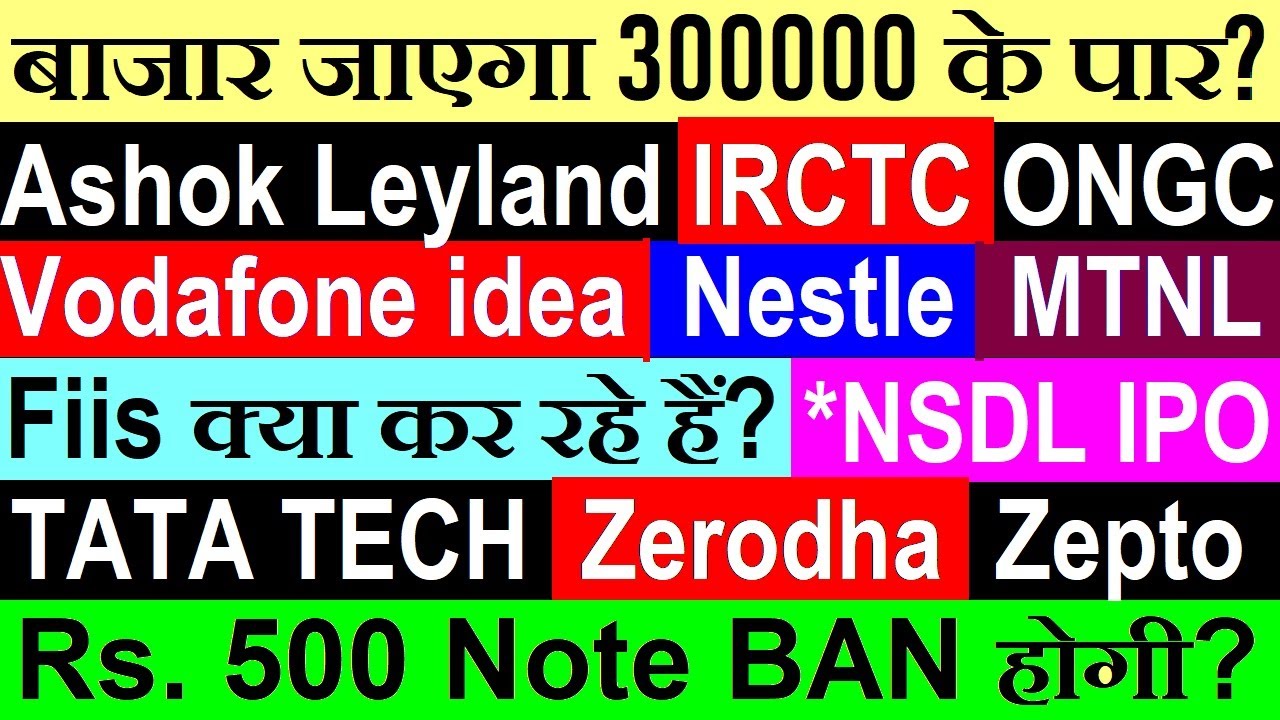
The Indian stock market is a dynamic landscape, buzzing with opportunities and uncertainties. From bold predictions about Sensex reaching unprecedented heights to rumors about the ₹500 note ban, the financial world is never short of excitement. In this comprehensive article, we dive deep into the latest market trends, company updates, and economic developments shaping India’s financial ecosystem. Whether you’re an investor, trader, or simply curious about the market, this guide offers valuable insights into key players like Tata Technologies, Ashok Leyland, IRCTC, Zerodha, and more. Let’s explore the factors driving the market and debunk myths circulating in the financial space.
Understanding the Current Market Sentiment
The Indian stock market, much like its global counterparts, often experiences periods of volatility and stagnation. Recently, the market has been described as “boring,” with no significant momentum driving it upward or downward. This lack of direction mirrors trends in the U.S. market, where indices like the Dow Jones have also been range-bound. Investors are eagerly awaiting catalysts—perhaps a bold statement from global leaders or significant policy changes—to ignite a breakout. But what does this mean for Indian investors? Let’s break it down.
Why Is the Market Stagnant?
Several factors contribute to the current lackluster performance:
- Global Uncertainty: Geopolitical events and policy decisions, such as those influenced by U.S. leadership, impact global markets, including India’s.
- Domestic Volatility: Fluctuations in key sectors and the absence of major economic announcements have kept the market in a tight range.
- Investor Sentiment: Both Foreign Institutional Investors (FIIs) and Domestic Institutional Investors (DIIs) are showing mixed behavior, with FIIs recently buying stocks worth around ₹1,000 crore, while DIIs have been more active with purchases nearing ₹2,500 crore.
Despite this, the market’s resilience suggests underlying strength. Understanding these dynamics helps investors make informed decisions, whether they’re eyeing short-term gains or long-term growth.
Sensex at 300,000? A Bold Prediction
Renowned investor Raamdeo Agrawal of Motilal Oswal recently made a striking prediction: the BSE Sensex could climb to 150,000 by 2030 and a staggering 300,000 by 2035. While these numbers seem ambitious, they reflect confidence in India’s long-term economic growth. Agrawal’s forecast is rooted in India’s robust GDP growth, increasing market participation, and the potential of key sectors like technology, infrastructure, and consumer goods.
Factors That Could Drive Sensex to New Heights
- Economic Growth: India’s GDP is projected to grow steadily, supported by government initiatives like Make in India and Digital India.
- Corporate Earnings: Strong performances by companies in sectors like IT, automotive, and financial services could fuel market gains.
- Retail Investor Participation: The rise of platforms like Zerodha has democratized investing, bringing millions of retail investors into the market.
- Infrastructure Push: Investments in railways, highways, and urban development are boosting companies like IRCTC and Ashok Leyland.
While Agrawal’s prediction is bold, it’s a reminder to focus on the bigger picture. Investors should prioritize companies with strong fundamentals and management to capitalize on this potential growth.
Debunking the ₹500 Note Ban Rumors
Social media has been abuzz with rumors that the Reserve Bank of India (RBI) plans to ban ₹500 notes or stop dispensing them through ATMs. These claims have sparked widespread confusion, but the Press Information Bureau (PIB) has categorically dismissed them as fake news.
Why the ₹500 Note Ban Is a Hoax
- Official Clarification: The PIB has confirmed that no such policy exists, and the RBI will continue to circulate ₹500 notes as legal tender.
- Misinformation on Social Media: False narratives often spread rapidly online, amplified by unverified sources or sensationalist content.
- RBI’s Stance: The central bank has not announced any plans to phase out ₹500 notes, and ATMs will continue to dispense them.
Investors and the public should rely on credible sources like the RBI or PIB for accurate information. Falling for such rumors can lead to unnecessary panic and poor financial decisions.
Ashok Leyland: Driving Growth with New Orders
Ashok Leyland, a flagship company of the Hinduja Group, continues to strengthen its position in the heavy vehicle sector. The company recently secured a significant order from the Tamil Nadu State Transport Corporation for 543 buses, valued at approximately ₹183.8 crore. This follows another major order, signaling strong demand for Ashok Leyland’s products.
Why Ashok Leyland Is a Stock to Watch
- Government Contracts: Orders from state governments highlight the company’s role in India’s public transportation infrastructure.
- Market Leadership: Ashok Leyland’s expertise in manufacturing buses and trucks positions it as a leader in the commercial vehicle space.
- Growth Potential: As India invests heavily in infrastructure and urban mobility, Ashok Leyland is well-placed to benefit.
For investors, Ashok Leyland represents a stable long-term opportunity, particularly in the context of India’s infrastructure boom.
Ola Electric: Navigating Challenges
Ola Electric, a prominent player in India’s electric vehicle (EV) market, is facing a turbulent phase. The company has been grappling with controversies, declining market share, and a significant block deal worth ₹731 crore, reportedly involving an exit by Hyundai Motor. Despite these challenges, Ola Electric’s long-term potential remains intact.
Ola Electric’s Road to Recovery
- Market Challenges: Ola has lost market share to competitors, and recent controversies have dented its reputation.
- Strategic Moves: The company is focusing on innovation and cost optimization to regain its footing.
- EV Market Growth: With India’s push for sustainable transportation, Ola Electric could stage a comeback if it addresses operational issues.
Investors should approach Ola Electric with caution but keep an eye on its ability to navigate these challenges. Strong management and strategic partnerships could pave the way for a recovery.
Nestlé India: A Case Study in Resilience
Nestlé India, known for its iconic Maggi brand, has demonstrated remarkable resilience following the 2015 Maggi crisis. Despite a nationwide ban and product recalls, the company has bounced back, with its turnover increasing 2.5 times over the past decade.
Lessons from Nestlé’s Comeback
- Strong Management: Nestlé’s ability to handle the crisis and rebuild consumer trust underscores the importance of effective leadership.
- Brand Loyalty: Maggi’s enduring popularity proves that strong brands can recover from setbacks.
- Diversified Portfolio: Beyond Maggi, Nestlé’s wide range of products, from chocolates to beverages, drives consistent growth.
Nestlé India’s inclusion in the Nifty 50 index reflects its strong fundamentals. For investors, it’s a reminder that companies with robust management can overcome even the toughest challenges.
Vodafone Idea and MTNL: Telecom Troubles
The telecom sector in India is facing significant headwinds, with companies like Vodafone Idea and MTNL struggling to stay afloat.
Vodafone Idea’s Uncertain Future
- Government Stake: The government now holds a 49% stake in Vodafone Idea after converting dues into equity, raising questions about its future as a private entity.
- Fundraising Efforts: The company has approval to raise ₹20,000 crore, but finding investors remains a challenge.
- Supreme Court Ruling: A recent Supreme Court decision has limited relief options, leaving Vodafone Idea’s fate in the government’s hands.
MTNL’s Ongoing Crisis
- Financial Woes: MTNL has defaulted multiple times, and its board is set to meet on June 17 to address the crisis.
- Government Support: As a public-sector company, MTNL benefits from government backing, but its long-term viability remains uncertain.
Both companies highlight the challenges of operating in a highly competitive and capital-intensive sector. Investors should tread carefully in the telecom space.
Tata Technologies: A Post-IPO Reality Check
Tata Technologies, a recent addition to the stock market, made waves with its successful IPO. However, the company has faced scrutiny after TPG, a major investor, trimmed its stake by 4%, selling shares worth ₹638 crore.
What’s Next for Tata Technologies?
- Market Perception: The stake sale has raised concerns, but it’s a common move by institutional investors to book profits.
- Growth Prospects: Tata Technologies’ expertise in engineering and IT services positions it well in the global market.
- Investor Confidence: The company’s strong brand and Tata Group backing make it an attractive long-term investment.
While short-term volatility is expected, Tata Technologies remains a compelling option for investors betting on India’s tech and engineering sectors.
IRCTC: Riding the Rails to Growth
The Indian Railway Catering and Tourism Corporation (IRCTC) continues to benefit from India’s railway modernization. The launch of Vande Bharat trains, including a new service to Srinagar starting June 6, underscores IRCTC’s pivotal role in the sector.
How IRCTC Is Leveraging Technology
- AI Integration: IRCTC has blocked 3–3.5 crore fake IDs to curb illegal ticket booking practices, enhancing operational efficiency.
- Revenue Streams: Increased train services and ticket bookings directly boost IRCTC’s revenue.
- Digital Transformation: The company’s focus on digital platforms ensures seamless user experiences.
IRCTC’s monopoly in railway ticketing and its alignment with India’s infrastructure push make it a stock worth watching.
Zerodha: IPO Speculation and Banking Ambitions
Zerodha, India’s leading stockbroking platform, has been at the center of IPO speculation. However, co-founder Nithin Kamath has downplayed the likelihood of an IPO, expressing greater interest in entering the banking sector.
Zerodha’s Strategic Vision
- Disrupting Finance: Zerodha’s low-cost trading model has revolutionized the industry, and a banking foray could further shake things up.
- IPO Delay: The company’s focus on sustainable growth suggests an IPO may not be imminent.
- Retail Investor Impact: Zerodha’s platform has empowered millions of retail investors, contributing to India’s financial inclusion.
For now, Zerodha remains a private success story, but its future moves could have a significant impact on the financial sector.
Zepto’s IPO Delay and Funding Strategy
Zepto, a fast-growing quick-commerce startup, has postponed its IPO from 2025 to 2026. The company is focusing on private funding from domestic and overseas investors to fuel its expansion.
Why Zepto’s Delay Matters
- Market Readiness: Delaying the IPO allows Zepto to strengthen its operations and market position.
- Funding Needs: Private funding provides the capital needed to compete in the highly competitive quick-commerce space.
- Growth Potential: Zepto’s focus on urban markets and rapid delivery makes it a strong contender in India’s e-commerce landscape.
Investors should monitor Zepto’s progress as it prepares for its eventual public debut.
FII and DII Activity: A Mixed Bag
Foreign Institutional Investors (FIIs) and Domestic Institutional Investors (DIIs) play a crucial role in shaping market trends. Recent data shows FIIs buying stocks worth ₹1,000 crore, while DIIs have been more aggressive with ₹2,500 crore in purchases. This mixed activity reflects uncertainty, with no clear trend dominating the market.
Navigating Market Volatility
- FII Behavior: FIIs often react to global cues, making their moves unpredictable.
- DII Strength: Strong domestic buying provides a buffer against FII outflows.
- Investor Strategy: In a range-bound market, focusing on fundamentally strong stocks can mitigate risks.
New ITR Rules: Stricter Penalties for Tax Evasion
The Income Tax Department has introduced stringent rules to curb fake tax deductions and fraudulent refund claims. Penalties of up to 200% may now apply for incorrect claims, signaling a crackdown on tax evasion.
Tips for Compliant Tax Filing
- Verify Claims: Ensure all deductions and exemptions are legitimate to avoid penalties.
- Use Authorized Platforms: File returns through trusted platforms to minimize errors.
- Stay Informed: Keep up with updates from the Income Tax Department to comply with new regulations.
Conclusion: Navigating India’s Financial Landscape
The Indian stock market is a complex ecosystem, shaped by corporate performance, government policies, and global trends. From Ashok Leyland’s order wins to Nestlé India’s remarkable recovery, the market offers both opportunities and challenges. Bold predictions like Sensex hitting 300,000 inspire optimism, while rumors like the ₹500 note ban remind us to stay vigilant against misinformation. Companies like IRCTC, Tata Technologies, and Zerodha are driving innovation, while others like Vodafone Idea and MTNL face uphill battles.
For investors, the key is to focus on fundamentals, study management quality, and adopt a long-term perspective. Whether you’re betting on infrastructure giants like Ashok Leyland or tech disruptors like Zerodha, staying informed and strategic is crucial. As India’s economy continues to grow, those who navigate the market with patience and insight stand to reap significant rewards.