
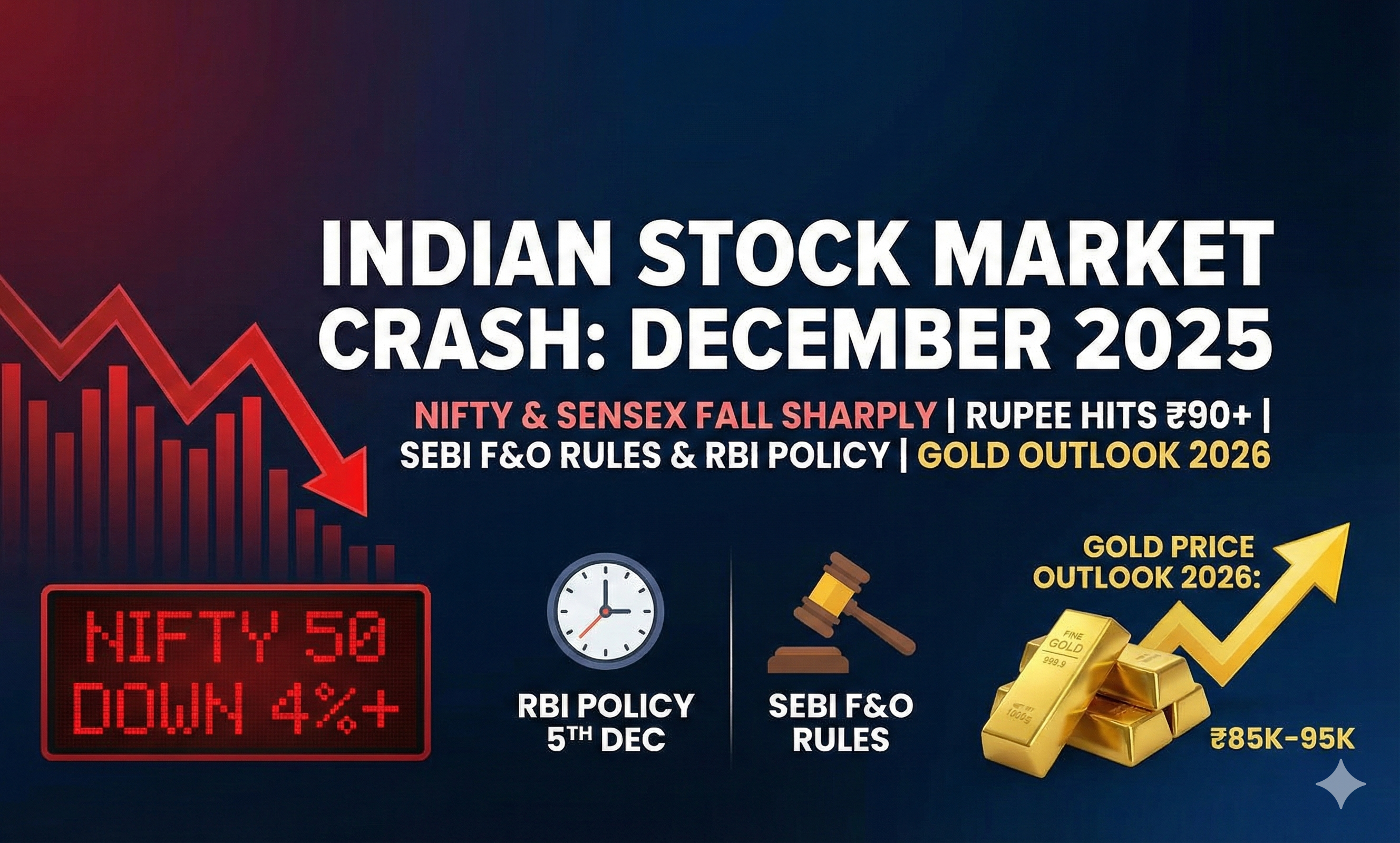
The Indian stock market witnessed a brutal correction in the first week of December 2025, with the Nifty 50 dropping over 4% in just three sessions and mid-cap & small-cap indices plunging 7–10%. The Indian Rupee breached the psychological ₹90 level against the US Dollar — its weakest in nearly two years.
Foreign Institutional Investors (FIIs) continued heavy selling, SEBI hinted at stricter F&O and digital gold regulations, and the much-awaited US-India mini trade deal remains delayed. Here’s a complete, in-depth breakdown of what actually happened, why it happened, and what investors should do next.
Why Did the Indian Stock Market Crash in December 2025?
The correction was triggered by a perfect storm of domestic and global factors:
- Sharp Rupee Depreciation From mid-November 2025, the INR weakened nearly 5% year-to-date and over 2% in less than 30 days. At ₹90.20+, it is now the worst-performing major Asian currency in 2025. Unlike other emerging-market peers (Korean Won, Taiwanese Dollar, Thai Baht), which strengthened against a softer US Dollar, the INR stood out as the outlier.
- Persistent FII Outflows FIIs pulled out more than ₹65,000 crore from Indian equities in the last 45 days alone. While debt (bond) markets still see inflows, equity outflows have accelerated because of relatively unattractive returns compared to AI-driven markets like the US, Taiwan, Japan, and China.
- Widening Trade Deficit & Gold Import Surge India’s November trade deficit ballooned to $41–42 billion — the highest in years — driven by record gold imports and lower-than-expected exports to the US. Delayed US-India trade deal announcements added further pressure.
- SEBI’s Upcoming F&O Overhaul Market participants panicked after reports that SEBI may link F&O trading eligibility to minimum equity/mutual fund holdings (rumored ₹10–15 lakh threshold). Brokerage stocks (Angel One, BSE, MCX) and exchange-linked stocks crashed 8–15% in a single session.
- RBI Monetary Policy Dilemma on 5th December Markets fear the RBI may skip a rate cut despite low inflation (sub-5%) because cutting rates now would widen the interest-rate differential with the US Fed, accelerating rupee depreciation and bond outflows.
Indian Rupee at ₹90: Is This the New Normal?
The INR’s slide is not just a “dollar strength” story anymore. The US Dollar Index actually weakened in November-December 2025 due to Trump’s tariff threats and US debt concerns, yet the INR fell harder than almost every comparable currency.
Key Reasons Behind INR Weakness in 2025–26
- Record gold imports draining forex reserves
- Equity FII outflows > $12 billion YTD
- Delayed US-India trade deal (now only ~20 trading days left in 2025)
- Global money rotating into AI themes (US, Taiwan, Japan, Korea, China)
Will the RBI Intervene? History shows the RBI has taken extraordinary steps during similar crises (2013 Taper Tantrum, 1999 sanctions). Options include special NRI bonds, forex swaps, or direct dollar sales. Most analysts expect verbal intervention first, followed by action only if INR crosses ₹92–93.
SEBI’s New F&O Rules 2026: What Traders Should Brace For
SEBI is reportedly finalizing one of the biggest structural changes in India’s derivatives market since 2001:
Expected Changes (Based on Consultation Paper & Media Reports)
- Minimum ₹10–15 lakh equity/MF portfolio required to trade F&O
- Higher lot sizes (already implemented in phases)
- Limited weekly expiries (only one benchmark index per week from 2026)
- Upfront margin collection and stricter risk disclosure
Impact on Retail Traders Over 65–70% of current retail F&O participants may lose direct access. This will drastically reduce liquidity and volatility but protect new traders from massive losses.
Impact on Broking Industry Angel One, Zerodha, 5Paisa, Upstox, and even BSE/MCX saw sharp sell-offs. Long-term, revenue from F&O may drop 30–50% unless brokers pivot aggressively toward cash equity and mutual funds.
Digital Gold Regulation: SEBI’s Next Big Move
SEBI released a discussion paper highlighting fraud and mis-selling in digital gold platforms. The regulator, along with IBJA, is pushing for:
- Mandatory hallmarked physical backing
- Custodian-only model (no fractional unallocated gold)
- Full KYC and transparency in buy-back pricing
This could clean up the sector but may increase costs for platforms like PhonePe, Google Pay, Paytm, and Jar.
RBI Policy on 5th December 2025: Rate Cut or Pause?
Market Expectation: 65–70% probability of status quo (repo rate remains 6.50%) Why a Pause Makes Sense
- Rupee already under pressure
- Bond inflows could reverse if rate differential narrows
- GDP growth still strong at 6.8–7% projected
If Surprise Rate Cut Happens (25–50 bps) It would be a massive short-term positive for rate-sensitive sectors (real estate, auto, banks), but the rupee could slide toward ₹92–94 quickly.
Gold Price Prediction India 2026: Where Is It Headed?
With the rupee at ₹90+ and global uncertainty high:
- Domestic gold prices have already crossed ₹78,000/10g
- Analysts forecast ₹85,000–₹95,000 by Diwali 2026
- Key drivers: Wedding season demand, safe-haven buying, rupee depreciation, and continued central bank purchases globally
Best Way to Invest in Gold Now
- Sovereign Gold Bonds (next tranche expected in Dec 2025–Feb 2026)
- Gold ETFs or Gold Bees (liquid and tax-efficient)
- Physical gold only if you need it for actual use
India-Russia Summit & Defence Deals: A Silver Lining?
Prime Minister Narendra Modi and President Vladimir Putin are meeting on 4th–5th December 2025. Expectations are high for:
- New defence co-production agreements
- Bilateral trade target raised from $68 billion to $100 billion by 2030
- Rupee-Ruble settlement expansion
Positive outcomes could provide sentimental support to defence and export-oriented stocks.
Should You Buy the Dip or Wait? – Final Investor Strategy
Short-Term (Next 3–6 Months)
- High volatility expected until US trade deal clarity and RBI/SEBI actions
- Avoid leverage and fresh F&O positions
- Keep 15–25% cash for staggered buying
Long-Term (2026–2027 Outlook)
- Every major institution (IMF, World Bank, Kotak MF, Motilal Oswal, Goldman Sachs) remains bullish on India
- Earnings growth expected to re-accelerate to 14–18% in FY27
- Mid-caps and small-caps likely to outperform large-caps once FII flows return
Best Sectors to Accumulate on Weakness
- Private Banks & NBFCs (HDFC Bank, Bajaj Finance, Kotak)
- IT Services (export beneficiaries of weak rupee)
- Defence (Bharat Electronics, HAL, Mazagon Dock)
- Consumption (Nestlé, HUL, Asian Paints – valuation comfort)
- Capital Markets Proxy (CAMS, CDSL – long-term winners despite F&O pain)
Final Verdict
The December 2025 crash is painful but not fatal. Indian fundamentals remain intact — strong GDP, controlled inflation, robust corporate balance sheets, and a young demographic. The current fall is largely sentiment-driven due to rupee weakness, FII outflows, and regulatory overhang.
This is a classic “buy fear” opportunity for long-term investors willing to stomach short-term volatility. Stay invested through SIPs, avoid panic selling, and use corrections to accumulate quality stocks at 15–25% lower valuations than September 2024 peaks.
The market will recover stronger in 2026 — history has proved it every single time.