
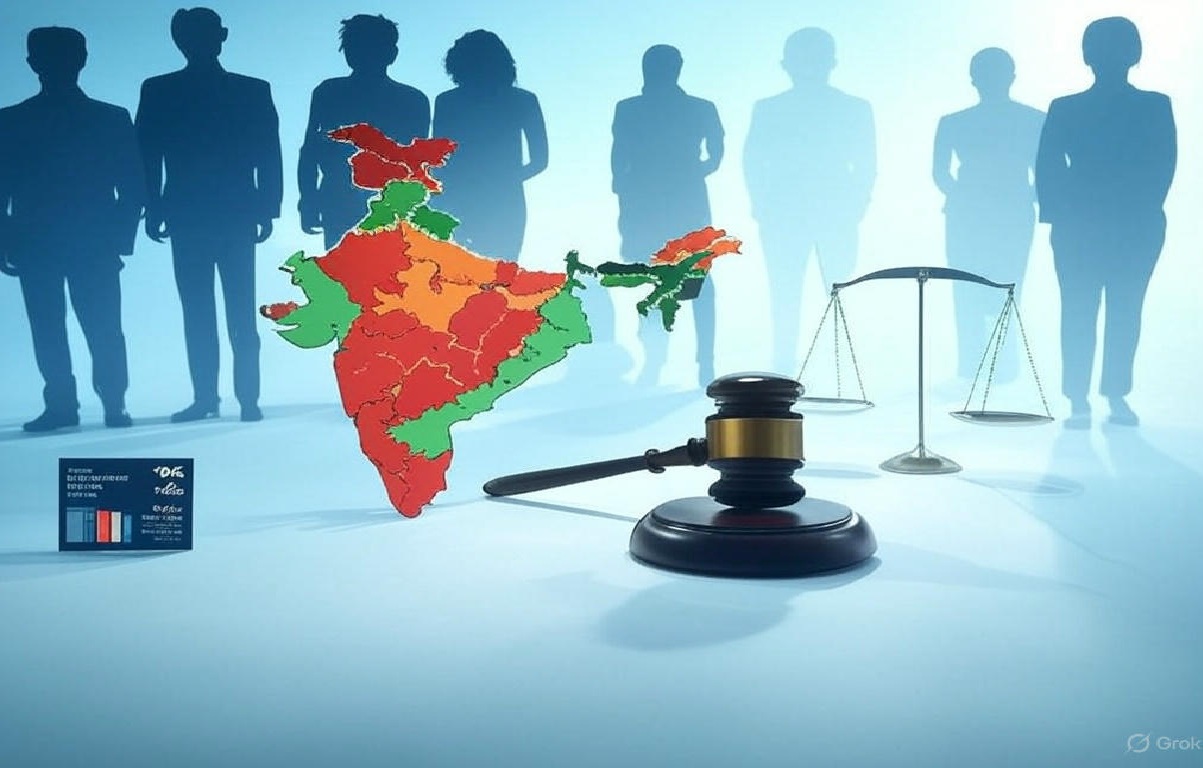
The Indian justice system stands at a crossroads, grappling with inefficiencies, underfunding, and regional disparities. The India Justice Report 2025, a data-driven assessment of the country’s legal, judicial, and policing frameworks, reveals a striking contrast: southern states like Karnataka, Andhra Pradesh, and Telangana dominate the rankings, while northern states, including Uttar Pradesh and West Bengal, struggle to keep pace. This article explores the reasons behind the South’s success, the North’s challenges, and the reforms needed to create a more equitable justice system. From judicial vacancies to undertrial prisoners, we unpack the data and propose solutions to ensure justice is swift, fair, and accessible for all.
The State of India’s Justice System: A Mixed Picture
India’s justice system is a complex web of courts, police, prisons, and legal aid services, each facing unique challenges. The India Justice Report 2025, published by a coalition of civil society organizations, evaluates these pillars using government data to measure capacity, diversity, and performance. The findings are both encouraging and sobering.
Key Highlights of the Report
- Judicial Shortages: India has only 15 judges per million people, far below the recommended 50. High courts operate at one-third of their required strength, and district courts face overwhelming caseloads, with judges handling up to 15,000 cases in states like Allahabad and Madhya Pradesh.
- Undertrial Crisis: A staggering 76% of India’s prison population comprises undertrials, up from 66% a decade ago. Many languish in jail for years, often due to lack of legal aid or slow judicial processes.
- Gender Disparity: Women make up just 14% of high court judges and only one female chief justice exists across 85 high courts. However, women now account for 38% of district court judges, signaling progress at lower levels.
- Regional Divide: Southern states lead in judicial performance, policing, and diversity, with Karnataka meeting diversity quotas for Scheduled Castes (SC) and Other Backward Classes (OBC) in both police and judiciary. Northern states, particularly Uttar Pradesh and West Bengal, rank lowest.
These statistics highlight the urgent need for systemic reforms to address capacity gaps, reduce pendency, and enhance inclusivity. But why do southern states consistently outperform their northern counterparts? Let’s explore the factors driving this divide.
Why Southern States Excel in Justice Delivery
The dominance of southern states in the India Justice Report 2025 is no coincidence. Karnataka, Andhra Pradesh, and Telangana have implemented strategies that enhance judicial efficiency, policing, and inclusivity, setting them apart from the rest of the country.
Higher Budget Allocations for Justice Systems
Southern states allocate more robust budgets to their justice systems, enabling better infrastructure, staffing, and technology. For instance, Karnataka’s per capita spending on judiciary and policing surpasses that of northern states like Uttar Pradesh and Bihar. This financial commitment translates into modernized court facilities, advanced case management systems, and adequate funding for legal aid services.
- Impact: Increased budgets reduce vacancies, improve court infrastructure, and support training programs for judges and police, leading to faster case disposal and better access to justice.
- Example: Telangana’s recent investments in digital court systems have streamlined case tracking, reducing delays and improving transparency.
Lower Vacancy Rates in Judiciary and Police
Southern states proactively address vacancies in both judicial and police forces. Karnataka, for instance, has lower vacancy rates in its lower and higher judiciary compared to Uttar Pradesh, where vacancies can exceed 50% in some districts. Similarly, Andhra Pradesh maintains a higher police-to-population ratio, ensuring more effective law enforcement.
- Data Point: Karnataka’s judiciary meets SC and OBC diversity quotas, reflecting a deliberate effort to fill positions with qualified candidates from underrepresented groups.
- Contrast: West Bengal struggles with high vacancies in both judiciary and police, leading to slower case processing and weaker law enforcement.
Emphasis on Diversity and Inclusivity
Diversity is a cornerstone of a fair justice system, and southern states lead the way. Karnataka is the only state to meet diversity quotas for SC and OBC communities in both police and judiciary, fostering trust among marginalized groups. Telangana has also made strides, with targeted recruitment drives to include women and minorities in law enforcement.
- Why It Matters: A diverse judiciary and police force better understand the needs of varied communities, reducing bias and improving public confidence in the system.
- Challenge: Northern states like Bihar and Uttar Pradesh lag in diversity, with underrepresentation of women and marginalized groups in key roles.
Effective Governance and Monitoring
Southern states exhibit stronger governance and continuous monitoring of their justice systems. Karnataka’s High Court, for example, uses data analytics to track case pendency and allocate resources efficiently. Andhra Pradesh has established robust Undertrial Review Committees (UTRCs) to monitor and recommend bail for eligible prisoners, reducing prison overcrowding.
- Result: Proactive governance leads to faster case disposal, reduced undertrial populations, and improved public trust.
- Contrast: West Bengal’s justice system suffers from inadequate monitoring, with UTRCs often failing to act on bail recommendations, exacerbating the undertrial crisis.
Cultural and Educational Factors
Southern states benefit from higher literacy rates and a culture of legal awareness. Kerala, often cited as India’s most literate state, has a populace that actively engages with the justice system, demanding accountability. This public pressure drives reforms and ensures resources are allocated effectively.
- Impact: Educated citizens are more likely to access legal aid, challenge injustices, and hold authorities accountable, creating a virtuous cycle of improvement.
- Northern Challenge: Lower literacy and awareness in states like Uttar Pradesh contribute to inefficiencies, as citizens may not know their rights or how to navigate the system.
Northern States: What’s Holding Them Back?
While southern states thrive, northern states like Uttar Pradesh, West Bengal, and Bihar face systemic challenges that hinder their justice delivery. Understanding these barriers is crucial for designing targeted reforms.
Chronic Underfunding
Northern states allocate insufficient budgets to their justice systems, leading to outdated infrastructure, understaffed courts, and poorly trained police forces. Uttar Pradesh, for instance, spends significantly less per capita on judiciary and policing than Karnataka, resulting in crumbling court facilities and overworked staff.
- Consequence: Underfunding exacerbates vacancies, delays case disposal, and limits access to legal aid, particularly for marginalized communities.
- Example: Bihar’s courts struggle with basic amenities like electricity and internet, hampering digital case management.
High Judicial and Police Vacancies
Vacancies plague northern states’ judiciary and police forces. Uttar Pradesh’s district courts often operate at half their sanctioned strength, with judges handling thousands of cases annually. West Bengal’s police force is similarly understaffed, with only 155 officers per lakh people, far below the national average.
- Impact: Vacancies lead to overwhelming caseloads, delayed trials, and weakened law enforcement, eroding public trust.
- Data Point: Allahabad’s judges handle up to 15,000 cases each, compared to Karnataka’s average of 2,000.
Overburdened Courts and Clogged Systems
Northern states face a deluge of cases, many of which are minor or repetitive. Bihar, for example, is inundated with excise cases related to bootlegging, which clog the system and divert judicial time from serious crimes. This inefficiency delays justice for all, particularly undertrials.
- Challenge: Without mechanisms to prioritize or dismiss frivolous cases, courts remain overwhelmed, prolonging wait times.
- Contrast: Southern states like Telangana use batch processing to dismiss outdated cases, freeing up judicial resources.
Weak Legal Aid and Undertrial Support
The undertrial crisis is acute in northern states, where 76% of prisoners await trial, often for years. Limited access to legal aid exacerbates this issue, as many undertrials cannot afford representation. West Bengal’s legal aid system is severely underfunded, spending just 7 rupees per capita annually, compared to the national average.
- Consequence: Undertrials languish in overcrowded prisons, often for minor offenses, due to lack of bail or legal support.
- Statistic: Only 50% of undertrials recommended for release by UTRCs are actually freed, highlighting systemic inefficiencies.
Governance and Political Will
Northern states often lack the political will to prioritize justice reforms. Corruption, bureaucratic inertia, and competing priorities divert attention from judicial and policing improvements. Uttar Pradesh, for instance, has faced criticism for political interference in judicial appointments, undermining independence.
- Impact: Weak governance perpetuates inefficiencies, discourages investment, and erodes public confidence.
- Contrast: Southern states benefit from proactive chief justices and administrators who champion numerical and qualitative justice.
The Undertrial Crisis: A National Shame
The rise in undertrial prisoners from 66% to 76% over the past decade is a glaring indictment of India’s justice system. With prisons projected to house seven lakh inmates by 2030 against a capacity of five lakh, the crisis demands immediate action.
Why Undertrials Languish
- Lack of Legal Aid: Many undertrials, especially from marginalized communities, cannot afford lawyers, leaving them at the mercy of overburdened public defenders.
- Slow Bail Processes: Courts often reject bail due to risk assessments, but UTRCs fail to follow through on recommendations, leaving eligible prisoners detained.
- Judicial Delays: With judges handling thousands of cases, trials can take years, prolonging detention for those awaiting verdicts.
Solutions to Reduce Undertrials
- Strengthen Legal Aid: Increase funding for legal aid to ensure every undertrial has access to competent representation. Southern states like Karnataka offer a model, with paralegal volunteers assisting in rural areas.
- Enhance UTRC Effectiveness: Mandate stricter oversight of UTRCs to ensure bail recommendations are acted upon promptly.
- Explore Alternatives to Incarceration: Community service, probation, and restorative justice programs can reduce prison overcrowding for minor offenses, as seen in Western jurisdictions.
- Fast-Track Minor Cases: Implement batch processing for petty cases, as practiced in Telangana, to decongest courts and prisons.
Gender Disparity in the Judiciary: Breaking the Glass Ceiling
Despite progress, women remain underrepresented in India’s higher judiciary, constituting only 14% of high court judges and one female chief justice across 85 high courts. Systemic barriers prevent women from ascending to leadership roles, but solutions exist to bridge this gap.
Barriers to Women in Higher Judiciary
- Structural Bias: Women lawyers often handle lower-profile cases, limiting their visibility and chances of elevation to high courts. High-profile corporate or political cases are typically assigned to male lawyers.
- Glass Ceiling: Fewer women reach senior leadership positions across industries, including law, due to societal and institutional biases.
- Age and Elevation: Women are often elevated to high courts at older ages, reducing their chances of further promotion to the Supreme Court.
Strategies for Change
- Mentorship Programs: Establish mentorship initiatives to guide young women lawyers toward high-profile cases and leadership roles.
- Diversity Quotas: Enforce gender diversity quotas in judicial appointments, similar to Karnataka’s SC/OBC quotas, to ensure equitable representation.
- Early Elevation: Prioritize elevating women to high courts at younger ages to increase their eligibility for Supreme Court roles.
- Public Awareness: Highlight successful women judges to inspire and normalize female leadership in the judiciary.
Lessons from the South: A Blueprint for Reform
Northern states can learn from the South’s success by adopting targeted strategies to improve their justice systems. Here’s a roadmap for reform:
Increase Budget Allocations
- Action: Allocate higher per capita budgets for judiciary, policing, and legal aid, prioritizing modern infrastructure and technology.
- Model: Karnataka’s investment in digital court systems and training programs.
Fill Vacancies Promptly
- Action: Launch recruitment drives to fill judicial and police vacancies, with a focus on diversity and merit.
- Model: Andhra Pradesh’s proactive approach to maintaining adequate police strength.
Enhance Governance and Monitoring
- Action: Implement data-driven monitoring systems to track case pendency, undertrial populations, and resource allocation.
- Model: Telangana’s robust UTRCs and case management systems.
Prioritize Legal Aid and Undertrial Reform
- Action: Increase funding for legal aid and strengthen UTRCs to reduce undertrial populations.
- Model: Karnataka’s use of paralegal volunteers to support rural litigants.
Foster Public Pressure
- Action: Encourage public discourse and activism to hold authorities accountable for judicial reforms.
- Model: Kerala’s literate and engaged populace driving systemic change.
The Role of Public Pressure in Accountability
Public pressure is a powerful catalyst for reform, as noted by Justice Sanjay Karol in the India Justice Report’s foreword. By raising awareness of judicial inefficiencies, corruption, and disparities, citizens can push for systemic change.
- Media Advocacy: Platforms like NDTV, which hosted discussions on the report, amplify critical issues, fostering public debate.
- Grassroots Movements: Community organizations can educate citizens about their rights, increasing demand for accessible justice.
- Technology: Social media and online petitions can mobilize public opinion, pressuring policymakers to act.
However, public discourse must be balanced. Sensationalizing judicial corruption or misuse of laws can erode trust disproportionately. Instead, focus on constructive criticism and data-driven solutions to enhance accountability.
Conclusion: Toward a Fairer, Faster Justice System
The India Justice Report 2025 is a wake-up call for India’s justice system. Southern states like Karnataka, Andhra Pradesh, and Telangana demonstrate that strategic investments, proactive governance, and inclusivity can transform justice delivery. Northern states, grappling with underfunding, vacancies, and inefficiencies, must adopt these lessons to bridge the gap. By addressing the undertrial crisis, increasing gender diversity, and fostering public pressure, India can build a justice system that is swift, fair, and accessible to all. The road ahead is long, but with political will and collective action, justice need not remain a distant dream.