India’s justice system remains a critical pillar of democracy, ensuring fairness, equality, and security for its citizens. The India Justice Report (IJR) 2025, now in its fourth edition, highlights the performance of states in delivering justice through four key components: police, judiciary, prisons, and legal aid. Southern states like Karnataka, Andhra Pradesh, Telangana, Kerala, and Tamil Nadu dominate the rankings, showcasing robust systems despite persistent challenges. However, nationwide vacancies in critical roles threaten to undermine progress, with projections indicating rising case backlogs and prison overcrowding by 2030. This article explores the IJR 2025 findings, offering insights into state performances, systemic gaps, and actionable solutions to strengthen India’s justice framework.
Southern States Lead Justice Delivery
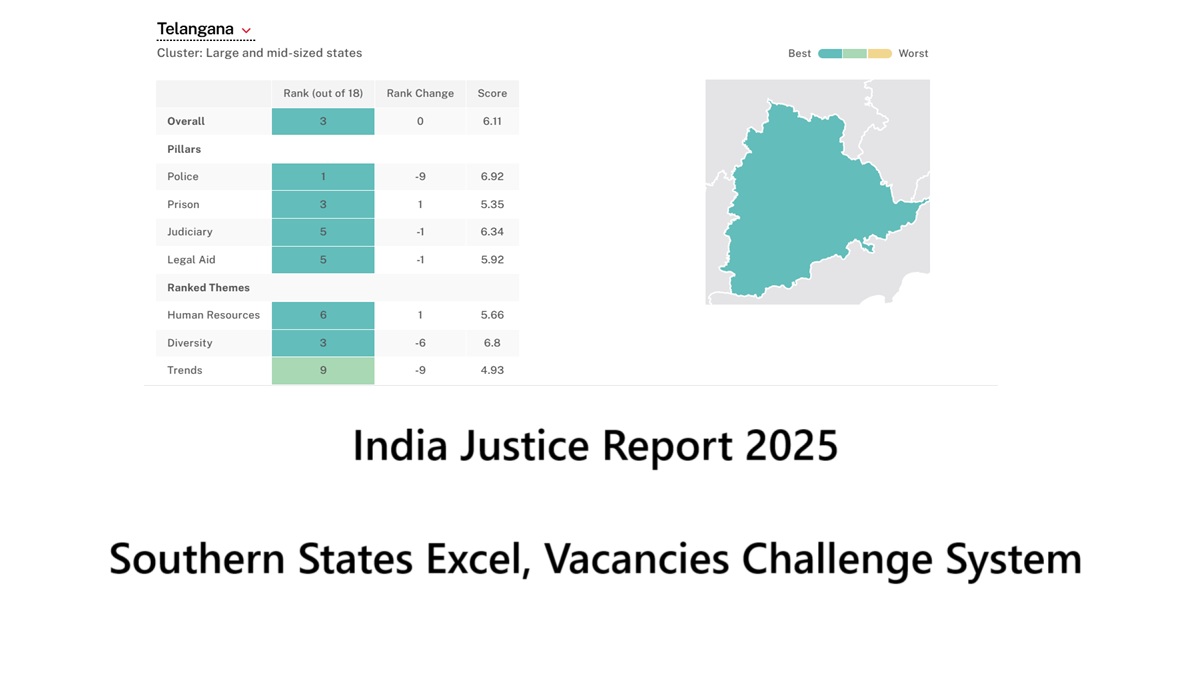
The IJR 2025 ranks Karnataka as the top performer among 18 large and mid-sized states, retaining its position from previous editions. Following closely are Andhra Pradesh, Telangana, Kerala, and Tamil Nadu, solidifying the southern region’s dominance in justice delivery. These states excel due to investments in infrastructure, diversity, and efficient resource allocation.
- Karnataka’s Excellence: Scoring 6.78 out of 10, Karnataka leads in legal aid, boasting the highest number of paralegal volunteers nationwide. It also maintains low police officer vacancies, ensuring effective law enforcement.
- Andhra Pradesh’s Rise: Climbing to second place from fifth in 2022, Andhra Pradesh shines in prisons, with low occupancy rates and minimal medical staff shortages.
- Telangana’s Police Strength: Ranking first in police performance, Telangana benefits from streamlined recruitment and supervision, though legal aid remains a weak point, placing 10th.
- Kerala’s Judicial Edge: Kerala tops the judiciary pillar, with only 4% judge vacancies in high courts and a high proportion of women judges.
- Tamil Nadu’s Prison Efficiency: Tamil Nadu leads in prisons, maintaining one of the lowest inmate populations relative to capacity.
In contrast, West Bengal ranks last among large states, struggling with high vacancies and limited investment. Uttar Pradesh, however, shows improvement, moving from 18th to 17th, driven by better legal aid access.
Among smaller states, Sikkim outperforms others, scoring 5.2 out of 10, while Goa lags at the bottom. States under the Armed Forces (Special Powers) Act—like Manipur, Assam, and Nagaland—were excluded, as were Union Territories.
Vacancies: A Nationwide Crisis
Despite progress, vacancies across police, judiciary, prisons, and legal aid remain a significant hurdle. The IJR 2025 projects dire consequences if these gaps persist:
- Subordinate Courts: A 15% increase in pending cases by 2030.
- High Courts: A 17% rise in case backlogs.
- Prisons: Occupancy rates could hit 133%, with a 20% surge in undertrial prisoners.
Causes of Vacancies
Experts identify several reasons for these shortages:
- Delayed Recruitment: Slow hiring processes, often spanning years, exacerbate staffing gaps.
- Gender Bias: Systemic barriers limit women’s representation, particularly in police and judiciary roles.
- Lack of Oversight: Inadequate monitoring fails to ensure timely vacancy fulfillment.
- Reservation Compliance: Many states fall short of mandated diversity targets.
Addressing these issues requires proactive recruitment, transparent timelines, and policies promoting inclusivity.
Judiciary: Strained by Shortages
India’s judiciary faces mounting pressure from vacancies and rising caseloads, undermining timely justice delivery.
High Court Challenges
One in three high court judge positions remains vacant, with Uttar Pradesh reporting a 50% shortage. Kerala, with only 4% vacancies, sets a benchmark. The appointment process, initiated by High Court Chief Justices and reviewed by the Supreme Court collegium, lacks fixed timelines, causing delays. In 2025, former Chief Justice D.Y. Chandrachud’s collegium proposed 168 judges, with 142 approved by the Union government.
High court staff vacancies also persist, with Gujarat at 47% and Kerala again leading with 4%. These gaps strain administrative efficiency, delaying case processing.
Subordinate Courts Struggle
Subordinate courts fare slightly better, with one in five judge positions vacant. Gujarat reports the highest shortage at 31%, while Uttarakhand excels at 9%. Despite a 6% increase in sanctioned judicial posts from 2020 to 2025, vacancies remain stubborn. India currently has 21 judges per million people, up from 14.7 in 2002, but this falls short of global standards.
Pending cases are a growing concern, with 45 million clogging district courts (73% over a year old) and 6.2 million in high courts (80% over a year old). Common delays stem from unavailable counsel, with 6.6 million district court cases stalled for this reason. The 2009 Law Commission suggested reducing judicial vacations by 10–15 days and extending court hours by 30 minutes to ease backlogs.
Police: Overworked and Understaffed
Police departments face critical staffing shortages, impacting law enforcement effectiveness.
Constabulary and Officer Vacancies
As of January 2023, seven large states reported over 25% vacancies in police constabularies, with West Bengal at 41%. Officer-level shortages are equally severe, with Rajasthan (52%) and Bihar (45%) leading. These gaps prevent optimal functioning, forcing personnel to work extended shifts and compromising supervision.
- Constabulary Impact: Vacancies hinder patrolling, response times, and case assistance.
- Officer Shortages: Reduced oversight leads to procedural lapses and overburdened investigators.
Recruitment Bottlenecks
Many states lack dedicated police selection boards, and recruitment cycles often take two to three years. For example, Madhya Pradesh’s 2020 cycle ended in November 2022, and Bihar’s concluded in September 2022. Irregular hiring exacerbates shortages, with 2 million penal code cases pending with police in 2022.
Forensic Gaps
Forensic capabilities are also strained, with nearly 50% of 10,000 sanctioned posts vacant. Telangana (91%) and Bihar (85%) face the highest shortages, delaying investigations and weakening evidence quality.
Prisons: Overcrowded and Underserved
India’s prisons grapple with overcrowding and staffing shortages, compromising inmate welfare and rehabilitation.
Medical Staff Crisis
In 2022, only two-thirds of 3,570 sanctioned medical staff positions were filled, leaving one medical worker for every 270 prisoners. Uttarakhand reported a 90% vacancy rate for medical officers, while Andhra Pradesh led with just 4.5%. Women prisoners face acute challenges, with an 81:1 ratio of female inmates to female medical staff.
Overcrowding Concerns
With 570,000 prisoners in 2022, prisons operated at 118% capacity. Andhra Pradesh, at 44% overcapacity, reported high inmate medical transfers. No large state achieved full staffing across prison roles, with Chhattisgarh facing 50% vacancies in multiple categories.
Spending Disparities
Andhra Pradesh spends the most on inmates, at Rs 2.6 lakh annually per prisoner, compared to Telangana’s Rs 33,277. These investments correlate with better prison conditions but highlight regional disparities.
Legal Aid: Access Under Strain
Legal aid is a constitutional right, but vacancies and resource constraints limit its reach, contributing to undertrial overcrowding (75% of prisoners).
District Legal Aid Gaps
The shortage of District Legal Aid secretaries dropped to 34 positions in 2025, but states like Tamil Nadu saw vacancies rise to 50% from 9.4% in 2022. Andhra Pradesh, Bihar, Kerala, and Odisha reported new shortages, reversing prior gains.
Paralegal Volunteer Decline
Nationwide, paralegal volunteers fell 38% to 43,050 since 2019. Only five regions, including Karnataka, saw increases, while seven reported over 60 facevano riduzione. Questi volontari sono fondamentali per la sensibilizzazione legale e il supporto.