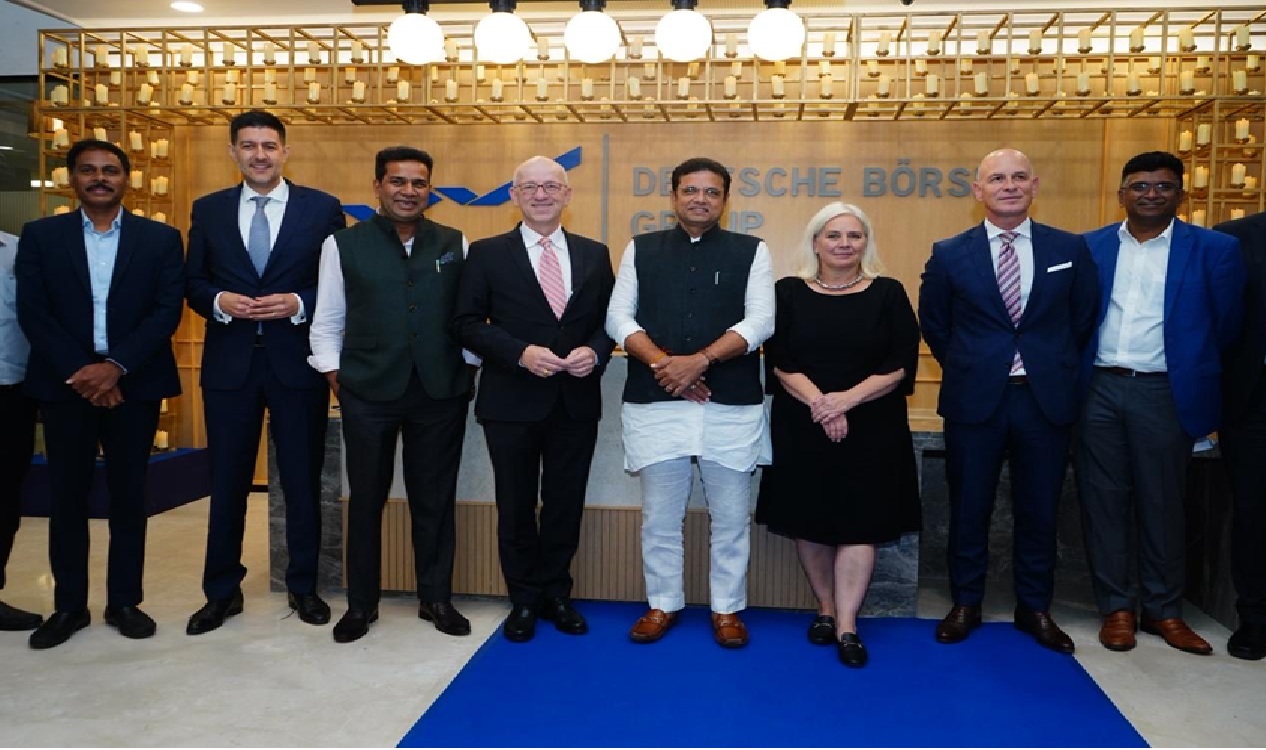
Hyderabad, the vibrant heart of Telangana, surges forward as a powerhouse in the world of financial technology. On a momentous day, Minister for IT and Industries Duddilla Sridhar Babu ignited the launch of Deutsche Börse Group’s cutting-edge Global Capability Centre (GCC) in the bustling Raidurg area. This bold move cements Hyderabad’s status as a beacon for capital formation, wealth generation, and premium financial services on the international stage. As global eyes turn toward this southern Indian metropolis, the minister boldly proclaimed that the city’s ecosystem now pulses with the energy of seven out of the world’s top 10 asset management giants, positioning it as an indispensable link in the global finance chain.
The inauguration wasn’t just a ribbon-cutting ceremony; it marked a pivotal shift. Deutsche Börse, a titan in the financial markets, steps into Hyderabad with ambitions that ripple across continents. Their new GCC stands ready to orchestrate operations for markets handling a staggering $24 trillion in assets. This influx promises 1,000 elite jobs in realms like artificial intelligence, cybersecurity, cloud engineering, and deep tech innovations—roles that demand the sharpest minds and are poised to double in the coming years.
Attendees, including German Consul General Michael Haspel, Special Chief Secretary Sanjay Kumar, Deutsche Börse’s CIO/COO Dr. Christoph Böhm, and Director Dr. Ludwig Heinzlmann, witnessed a fusion of German precision and Indian ingenuity. Minister Sridhar Babu praised Deutsche Börse as a cornerstone of global finance, underscoring how Telangana’s rock-solid policies, unwavering investor trust, and reservoir of skilled talent draw such luminaries to its shores.
But this event transcends a single inauguration. It signals Hyderabad’s ascent from a regional tech player to a commanding force in FinTech worldwide. As the city weaves deeper into the fabric of digital finance, it beckons innovators, entrepreneurs, and corporations to join a symphony of progress. In this comprehensive exploration, we delve into the layers of this transformation—unpacking the strategies, impacts, and visions that propel Hyderabad toward unchallenged leadership in FinTech.
Hyderabad’s FinTech Revolution: From Tech Incubator to Global Powerhouse
Hyderabad has long whispered promises of technological marvels, but today, it roars as a FinTech juggernaut. Developers craft algorithms that predict market fluxes, analysts harness data streams to democratize investments, and startups birth apps that redefine banking for millions. This revolution didn’t erupt overnight; it brewed through deliberate investments in infrastructure, education, and policy. The Telangana government, under visionary leadership, has sculpted an environment where FinTech flourishes, attracting over 200 FinTech firms that collectively employ thousands and process billions in transactions annually.
Consider the numbers: India’s FinTech sector, with Hyderabad as its pulsating core, eyes a revenue leap to $180-200 billion by 2030, fueled by a compound annual growth rate (CAGR) exceeding 20%. In Hyderabad alone, the sector contributes significantly to the state’s $50 billion IT exports, with FinTech carving out a 15-20% slice. Companies like Paytm, Razorpay, and Zeta—though headquartered elsewhere—maintain robust operations here, leveraging the city’s talent pool of over 800,000 IT professionals. Local stars such as Kaleidofin and Open Financial Technologies pioneer inclusive finance, serving underserved populations with AI-driven credit scoring and blockchain-secured loans.
What sets Hyderabad apart? Its ecosystem thrives on collaboration. T-Hub, Asia’s largest startup incubator, nests FinTech ventures alongside corporates and academia, fostering cross-pollination of ideas. Events like the Hyderabad FinTech Forum draw global experts, sparking dialogues on regulatory sandboxes and digital currencies. The city’s strategic location—bridging East and West—amplifies its appeal, with seamless connectivity via Rajiv Gandhi International Airport and a metro network that zips innovators to key districts like HITEC City.
Yet, challenges persist. Cybersecurity threats loom large in this digital frontier, demanding vigilant defenses. Hyderabad responds with fervor: The state pours resources into ethical hacking academies and partnerships with global firms like Cisco. As FinTech evolves, Hyderabad doesn’t just adapt—it leads, crafting policies that balance innovation with consumer protection. This proactive stance has earned it accolades as India’s “Silicon Valley of Finance,” a moniker that resonates far beyond borders.
Deutsche Börse’s Strategic Leap: Establishing a GCC in Hyderabad’s Thriving Ecosystem
Deutsche Börse Group, the Frankfurt-based behemoth that powers Europe’s financial heartbeat, chooses Hyderabad not by chance but by calculated precision. Their new Global Capability Centre (GCC) in Raidurg emerges as a nerve center for technological prowess, channeling expertise to manage $24 trillion in assets across 30 exchanges and clearing houses worldwide. Inaugurated with fanfare, this facility embodies the group’s commitment to digital metamorphosis, integrating AI for predictive analytics, blockchain for secure settlements, and cloud infrastructures for scalable operations.
Dr. Christoph Böhm, the group’s CIO/COO, articulated the vision: “Hyderabad’s blend of technical acumen and cost efficiency positions it ideally to accelerate our global ambitions.” The GCC will pioneer adaptive models that anticipate market volatilities, automate compliance workflows, and fortify data fortresses against cyber incursions. Initial hires—1,000 strong—span software architects, data scientists, and DevOps specialists, drawn from premier institutions like IIT Hyderabad and IIIT. Salaries, averaging ₹15-25 lakhs annually, reflect the premium on skills, with projections to scale to 2,000 roles within two years.
This isn’t Deutsche Börse’s first foray into India; their Manila and Eschborn hubs complement Hyderabad’s focus on high-value FinTech. Yet, the Indian outpost stands out for its emphasis on deep tech. Engineers here will tinker with quantum-resistant encryption and machine learning algorithms that detect fraud in real-time, safeguarding trillions in trades. The center’s state-of-the-art labs, equipped with NVIDIA GPUs and hybrid cloud setups, buzz with activity, fostering a culture of relentless innovation.
Local leaders hail this as a testament to Telangana’s allure. Minister Sridhar Babu emphasized, “Deutsche Börse’s trust validates our stable governance and talent reservoir.” Indeed, the group’s presence amplifies Hyderabad’s gravitational pull, inspiring peers like Vanguard, which recently unveiled its own GCC here, targeting investment tech innovations. As Deutsche Börse embeds deeper, it sparks supply chain growth—consultancies, vendors, and edtech firms spring up to support the ecosystem, multiplying economic ripples.
Unleashing High-Skilled Jobs: AI, Cybersecurity, and Cloud Engineering in FinTech
The promise of 1,000 jobs from Deutsche Börse’s GCC electrifies Hyderabad’s job market, but it represents just the tip of the iceberg. FinTech’s voracious appetite for talent propels demand for roles that blend finance with frontier tech. AI specialists, who train models to forecast economic trends, command top billing, followed by cybersecurity experts erecting digital bulwarks against ransomware and phishing. Cloud engineers, orchestrating AWS and Azure migrations, ensure seamless scalability for platforms handling petabytes of transaction data.
Hyderabad responds with a talent forge unmatched in scale. Universities like Osmania and JNTU churn out 50,000 engineering graduates yearly, many specializing in FinTech through electives in algorithmic trading and regtech. Bootcamps from UpGrad and Simplilearn, partnered with global giants, upskill mid-career professionals in Python for finance and ethical AI. The result? A workforce where 70% possess certifications in AWS or Google Cloud, ready to dive into Deutsche Börse’s projects.
Take cybersecurity: As FinTech breaches cost billions globally, Hyderabad’s experts deploy zero-trust architectures and AI sentinels that learn from anomalies. A local firm, Securonix, born in Hyderabad, now guards Fortune 500 FinTechs with its SIEM platforms. Similarly, AI drives personalization—chatbots that advise on robo-advisory, or neural networks that optimize portfolio risks. Deutsche Börse’s hires will amplify this, collaborating on projects that could redefine global clearing standards.
Deep tech, the GCC’s crown jewel, ventures into uncharted territories. Quantum computing simulations for portfolio optimization and blockchain consortia for cross-border payments beckon. These roles not only pay well but empower social mobility; women, comprising 35% of Hyderabad’s IT workforce, lead in these domains, shattering glass ceilings in boardrooms and codebases alike. As jobs double, so does the call for inclusive training—government scholarships target rural youth, ensuring FinTech’s bounty reaches far corners.
This job surge injects vitality into the economy. Each high-skilled position generates 2-3 ancillary jobs in hospitality, real estate, and services, boosting GDP by 1-2% annually. Families thrive, neighborhoods gentrify positively, and a virtuous cycle ensnares: More talent attracts more firms, birthing endless opportunities.
Telangana’s Bold Vision: Building the Global Innovation Hub for Emerging Technologies
Minister Sridhar Babu’s announcement of a Global Innovation Hub catapults Hyderabad’s ambitions skyward. This isn’t mere rhetoric; it’s a blueprint to morph the city from a tech nursery into a forge of world-altering ideas. Spanning 100 acres in the Genome Valley, the hub will house labs for AI, biotech, and sustainable finance, drawing $500 million in initial investments from public-private partnerships.
The hub’s pillars? Advanced research in emerging tech. AI wings will pioneer explainable models for financial audits, while quantum labs simulate unbreakable encryptions. Collaborations with MIT and ETH Zurich infuse global rigor, with startups gaining access to venture arms like T-Venture. By 2035, Telangana aims to rank among the top 20 AI hubs worldwide, a goal etched in policy.
Government catalysts accelerate this. The Telangana AI Mission allocates ₹1,000 crore for grants, targeting 500 AI startups by 2027. Regulatory sandboxes test FinTech prototypes risk-free, from DeFi platforms to CBDC pilots. Chief Minister Revanth Reddy courts international allies—recent pacts with Germany and Australia bolster life sciences and semiconductors, weaving FinTech into broader innovation tapestries.
Sustainability threads through: Green data centers powered by renewables host FinTech workloads, aligning with ESG mandates. The hub fosters breakthroughs—like AI for climate-risk modeling in investments—positioning Hyderabad as a thought leader. Events, from hackathons to summits, magnetize 10,000 innovators yearly, seeding the next unicorn wave.
Critics might question scalability, but precedents abound. Singapore’s FinTech hub scaled through similar hubs; Hyderabad emulates wisely, tailoring to its strengths in cost-effective R&D. This vision doesn’t isolate FinTech—it integrates, birthing hybrid solutions like AI-biotech for personalized insurance or blockchain-agri for supply-chain finance.
Power Players in Play: Seven of the Top 10 Asset Management Firms Anchor in Hyderabad
Hyderabad’s magnetic pull on asset managers underscores its FinTech primacy. Seven of the global top 10—BlackRock, Vanguard, Fidelity, State Street, BNY Mellon, JPMorgan Asset Management, and Northern Trust—operate robust centers here, managing over $50 trillion collectively. These behemoths didn’t flock randomly; they chase Hyderabad’s trifecta: Talent density, operational efficiency, and policy nimbleness.
BlackRock’s Hyderabad outpost, with 5,000 employees, deploys Aladdin—their AI platform—to dissect risks across equities and bonds. Vanguard’s fresh GCC, inaugurated mere days ago, innovates ETF tech, serving 30 million clients with low-cost indexing. Fidelity experiments with VR for investor education, while State Street’s Charles River suite streamlines trade compliance.
This concentration sparks synergies. Shared talent pools mean engineers hop between firms, carrying best practices. Vendor ecosystems bloom—Hyderabad’s 50+ regtech startups supply analytics to these giants. The city processes 40% of India’s mutual fund AUM from here, a testament to its nodal role.
Challenges? Data localization laws demand on-prem solutions, but firms adapt with hybrid clouds. Competition from Bengaluru intensifies, yet Hyderabad counters with lower costs (30% cheaper) and superior quality of life. As these firms expand—Vanguard eyes 2,000 hires—their footprint deepens, elevating Hyderabad’s global stature.
AI and Cybersecurity: The Twin Engines Driving FinTech’s Secure Future
In FinTech’s high-stakes arena, AI and cybersecurity form an unbreakable duo, propelling efficiency while shielding against shadows. AI sifts vast datasets to unveil patterns—detecting anomalous trades in milliseconds or tailoring micro-loans via behavioral analytics. In Hyderabad, firms like Fractal Analytics harness generative AI to simulate market scenarios, arming traders with foresight.
Cybersecurity, equally vital, erects moats around this digital realm. With breaches costing FinTechs $5.9 million on average, Hyderabad’s guardians deploy AI-driven threat hunting. SecuPi and Lucideus, homegrown, offer privacy-as-a-service, anonymizing data in real-time for GDPR compliance. Deutsche Börse’s GCC will amplify this, integrating homomorphic encryption to process sensitive data sans exposure.
The synergy shines: AI augments cyber defenses, learning from attacks to preempt them. Hyderabad’s Cyber Security Centre of Excellence trains 10,000 professionals yearly, partnering with EC-Council. Regulations like RBI’s cyber framework ensure resilience, while ethical AI guidelines prevent biases in lending algorithms.
Future-facing, quantum threats loom, but Hyderabad pioneers post-quantum cryptography. This duo not only secures but innovates—AI chat agents resolve disputes autonomously, cyber tools enable seamless KYC. As adoption surges, these technologies will underpin $1 trillion in annual FinTech value creation, with Hyderabad at the vanguard.
Policy Stability and Investor Confidence: Telangana’s Magnet for Global FinTech Giants
Telangana’s policies act as a lodestar for FinTech titans, blending incentives with foresight. Single-window clearances slash setup times to 15 days, while the TS-iPASS scheme waives approvals for investments over ₹50 crore. Tax rebates on R&D—up to 200% deductions—fuel innovation, drawing $2 billion in FinTech FDI last year alone.
Investor confidence soars on stability: No retrospective taxes, robust IP protection, and a pro-business ethos. The 2025 FinTech Policy targets 500 startups, offering equity-free grants and global market access. Minister Sridhar Babu’s engagements—recently with German delegates—secure MOUs worth €1 billion.
This framework lures diverse players: From McKinsey’s analytics hub to Marriott’s tech center, synergies spill into FinTech. Risks like talent poaching? Mitigated by retention bonuses and upskilling. As targets hit—120 GCCs by 2026, 1.2 lakh jobs—Telangana’s model inspires states nationwide.
Charting the Horizon: Future Prospects for Hyderabad’s FinTech Dominance
Hyderabad’s FinTech saga hurtles toward exhilarating peaks. By 2030, the sector could employ 500,000, contributing 25% to state GDP. Emerging frontiers—Web3 lending, metaverse banking—will bloom in the Global Innovation Hub. International ties deepen: ASEAN pacts open Southeast markets, while US collaborations advance regtech.
Sustainability integrates: Carbon-neutral exchanges and green bonds gain traction. Challenges like digital divides prompt inclusive drives—rural FinTech literacy programs reach 1 million. As pioneers like Deutsche Börse scale, Hyderabad doesn’t just host innovation; it authors it.
In this ascent, the city invites all: Entrepreneurs, code weavers, visionaries. Join the command center where finance meets the future—Hyderabad awaits.