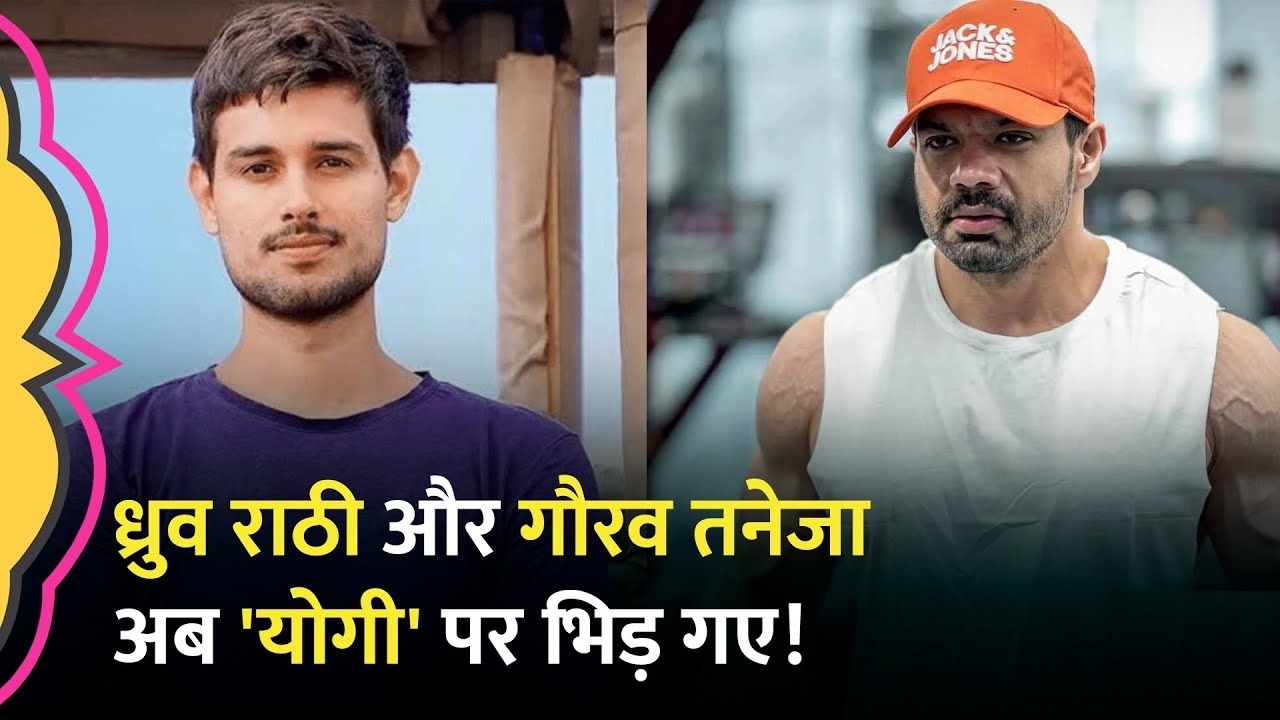
Uttar Pradesh Government’s Digital Media Policy Sparks Heated Debate Between Dhruv Rathee and Gaurav Taneja
The Uttar Pradesh government’s recent introduction of the Digital Media Policy, 2024, has ignited a fierce debate within the influencer community, particularly between popular YouTubers Dhruv Rathee and Gaurav Taneja. The policy, which offers financial incentives of up to ₹8 lakh per month for influencers to promote government schemes, has drawn both sharp criticism and robust defense.
Dhruv Rathee’s Critique: Legalized Bribery or Misuse of Funds?
Dhruv Rathee, a well-known content creator and social commentator, didn’t mince words when he expressed his disapproval of the new policy. Taking to the platform X (formerly Twitter), Rathee labeled the initiative as “legalized bribery,” arguing that it represents a blatant misuse of taxpayers’ money. His post, which has since gone viral with over 2.6 million views, highlights his belief that the government is essentially paying influencers to propagate its agenda, a move he finds deeply unethical.
Rathee’s stance is clear: any influencer who agrees to promote the government under this scheme should be publicly shamed. His argument hinges on the principle that public funds, collected from hardworking taxpayers, should not be used to pay for what he perceives as thinly-veiled propaganda.
Gaurav Taneja’s Defense: A Necessary Communication Strategy
On the other side of the debate is Gaurav Taneja, another influential YouTuber who is no stranger to public controversies. Taneja, a former pilot and IIT graduate, has defended the Uttar Pradesh government’s policy, offering a different perspective on the matter. He questioned Rathee’s condemnation by drawing parallels between this policy and traditional forms of paid media, such as advertisements in newspapers and on television.
Taneja’s counterargument suggests that if Rathee’s logic were to be applied consistently, then all forms of paid media—including government ads in newspapers and TV—should also be criticized. Taneja views the policy not as bribery but as a modern communication strategy that utilizes the reach and influence of social media to disseminate information about government schemes.
Social Media Reactions: A Divided Audience
The exchange between Rathee and Taneja has unsurprisingly led to a flurry of reactions on social media. Supporters of Rathee’s viewpoint argue that there is a fundamental difference between traditional advertisements and influencer promotions, emphasizing that the latter feels more personal and, therefore, more ethically questionable when it comes to promoting political agendas.
Critics of the policy fear that it opens the door to biased content, where influencers might prioritize financial gain over authenticity, thereby misleading their followers. On the other hand, those siding with Taneja believe that in the digital age, social media is a powerful tool for reaching the masses, and utilizing it for promoting government initiatives is a pragmatic approach.
Understanding the Uttar Pradesh Digital Media Policy, 2024
The policy at the center of this debate is part of the Uttar Pradesh government’s broader strategy to modernize its communication channels. The Uttar Pradesh Digital Media Policy, 2024, was approved by the state’s Cabinet with the goal of leveraging digital platforms to promote various government schemes.
According to the policy, influencers can receive payments depending on the platform and type of content they produce. For instance, YouTubers can earn up to ₹8 lakh per month for videos, while those active on platforms like X, Facebook, and Instagram can earn between ₹2 lakh and ₹5 lakh, depending on their reach and engagement.
The government’s rationale for this policy is rooted in the need to effectively communicate with the public, especially in a state as large and diverse as Uttar Pradesh. By engaging influencers who have substantial followings, the government aims to ensure that its messages reach a wider audience in a format that resonates with them.
The Broader Implications: Ethics and Influence in the Digital Age
The clash between Rathee and Taneja brings to the forefront larger questions about the role of influencers in shaping public opinion and the ethical considerations that come with it. In an era where social media holds significant sway over public discourse, the intersection of politics, money, and influence becomes increasingly complex.
Critics argue that policies like this could erode the trust between influencers and their audiences, as followers might question the authenticity of the content they consume. On the other hand, proponents suggest that as long as transparency is maintained—such as through clear disclaimers that content is sponsored—the practice is no different from traditional forms of advertising.
Conclusion: A Debate Far From Over
The debate sparked by Uttar Pradesh’s Digital Media Policy, 2024, and the ensuing exchange between Dhruv Rathee and Gaurav Taneja, reflects the growing pains of navigating ethics in the digital age. As influencers continue to play a pivotal role in shaping public opinion, the lines between promotion and propaganda are likely to blur further. Whether this policy will set a precedent for other states or lead to tighter regulations on influencer content remains to be seen. One thing is clear: the conversation around the ethical responsibilities of influencers is just beginning.