
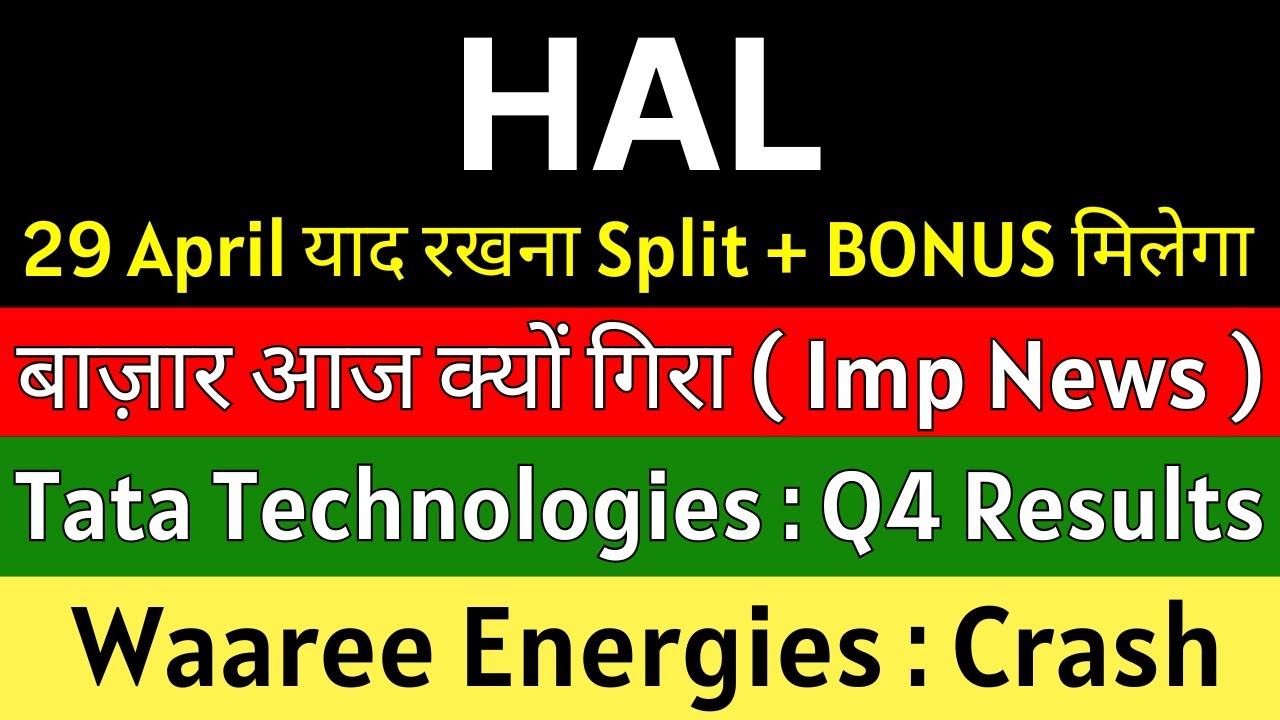
The Indian stock market is a dynamic ecosystem, influenced by global events, corporate developments, and macroeconomic trends. Today’s market landscape is no exception, with notable updates surrounding companies like Hindustan Aeronautics Limited (HAL), Waaree Energies, Tata Technologies, and Bajaj Finance. This article delves into the latest stock market news, analyzing key factors driving market movements, company-specific developments, and their broader implications for investors. By exploring these updates through a detailed lens, we aim to provide actionable insights for navigating the ever-evolving financial markets.
Understanding Today’s Market Volatility
The Indian stock market, represented by the Nifty 50 index, experienced a decline of approximately 0.62% today. However, when viewed from its intraday lows, the Nifty staged a recovery of about 1%, mitigating a potential drop of over 1.5%. Over the past week and month, the market has witnessed a sharp recovery from its bottom, following a period of sustained upward momentum. This recent volatility, however, has caught investors’ attention, as the market’s one-sided rally had conditioned participants to expect continuous gains.
Geopolitical Tensions: The Root of Market Jitters
The primary catalyst for today’s market downturn is heightened geopolitical tensions stemming from a recent terrorist attack in Pahalgam, Kashmir. This brutal incident prompted India to suspend the Indus Water Treaty, escalating tensions along the Line of Control (LoC) with Pakistan. Retaliatory firing from both sides has amplified concerns, contributing to a spike in the India VIX, a volatility index, which surged by nearly 6%. Geopolitical uncertainties often trigger risk-averse behavior in equity markets, as investors seek safer assets amid heightened uncertainty.
While these tensions have created short-term market turbulence, their long-term impact may be limited. India’s economic and military strength significantly surpasses Pakistan’s, suggesting that the current situation is unlikely to derail the broader market trajectory unless additional global players become involved. Historically, markets have absorbed similar geopolitical shocks, with corrections often presenting buying opportunities for long-term investors.
Small and Mid-Cap Stocks Bear the Brunt
The market’s decline was particularly pronounced in small and mid-cap segments. The BSE Small-Cap Index fell by 2.6%, while the Mid-Cap Index dropped by 2.3%. These indices reflect broader market sentiment, and their sharp declines indicate widespread selling pressure. Unlike large-cap stocks, which benefit from greater liquidity and stability, small and mid-cap stocks are more sensitive to market swings, making them vulnerable during periods of uncertainty.
Despite this correction, the fundamentals of many small and mid-cap companies remain robust. Investors should exercise caution but also consider evaluating undervalued opportunities in these segments, particularly in sectors with strong growth potential.
Company-Specific Updates: A Deep Dive
Let’s explore the latest developments surrounding HAL, Waaree Energies, Tata Technologies, and Bajaj Finance, analyzing their implications for investors and the broader market.
Hindustan Aeronautics Limited (HAL): Navigating Defense Sector Challenges
Hindustan Aeronautics Limited (HAL), a cornerstone of India’s defense sector, has faced headwinds amid today’s market downturn. The Nifty Defense Index, comprising 18 defense stocks, plummeted by over 4%, with all constituents trading in the red. Garden Reach Shipbuilders recorded the steepest decline, underscoring the sector’s vulnerability to external shocks.
Geopolitical Tensions and Defense Stocks
The defense sector’s underperformance is closely tied to the same geopolitical tensions impacting the broader market. While these tensions have triggered selling pressure, they could paradoxically benefit defense companies in the long run. Increased geopolitical risks often lead to higher defense budgets and contracts, bolstering order books for companies like HAL. For instance, in a hypothetical escalation scenario, HAL could secure additional contracts for aircraft and defense equipment, strengthening its financial position.
Valuation Insights for HAL
HAL’s valuation metrics provide further context. The company’s price-to-earnings (P/E) ratio currently stands at 35, reflecting a premium valuation driven by strong earnings growth. However, recent market corrections have brought HAL’s valuation closer to reasonable levels. If HAL sustains its earnings per share (EPS) growth, its P/E ratio could decline further, making the stock appear undervalued. Investors should monitor HAL’s order book and consistency in financial performance, as these factors will determine whether its current valuation remains attractive.
For long-term investors, HAL presents a compelling opportunity, given its strategic importance and potential for growth in a geopolitically sensitive environment. However, short-term volatility may persist until clarity emerges on the geopolitical front.
Waaree Energies: Profit Booking Post-Lock-In Period
Waaree Energies, a leading player in the renewable energy sector, has experienced significant selling pressure over the past two trading sessions. The stock plummeted by up to 9% in today’s morning session, later recovering to close with a 4-5% loss. This sharp decline follows a downgrade by Jefferies in the previous trading session, but the primary driver is the expiration of the lock-in period for pre-IPO shareholders.
Understanding the Lock-In Period Impact
When a company goes public, shares held by pre-IPO investors are typically subject to a lock-in period, during which they cannot be sold. For Waaree Energies, this period, which lasted three to six months, recently expired, unlocking approximately 150 million shares—equivalent to 53% of the company’s outstanding shares. These shares are now eligible for trading, prompting significant profit booking by early investors who benefited from the stock’s stellar post-IPO performance.
Waaree Energies’ IPO was a resounding success, delivering substantial gains to allottees. However, the influx of unlocked shares has created selling pressure, a phenomenon observed in other IPOs like Laxmi Organic, Mind Technologies, and CAMS. While this correction may unsettle short-term investors, it does not necessarily reflect a deterioration in Waaree Energies’ fundamentals.
Long-Term Prospects for Waaree Energies
Despite the current downturn, Waaree Energies remains well-positioned in the rapidly growing renewable energy sector. India’s push for clean energy, supported by government incentives and global demand for sustainable solutions, bodes well for the company’s future. Investors should view the current correction as a potential entry point, provided they conduct thorough due diligence on the company’s financial health and growth prospects.
Tata Technologies: Anticipating Q4 Earnings
Tata Technologies, a global engineering and product development company, is set to announce its Q4 earnings today. Market expectations are high, with analysts projecting an EPS of ₹4.32, signaling robust net profit growth compared to the previous quarter. While revenue is expected to remain relatively flat at ₹1,310 crore (compared to ₹1,320 crore in the prior quarter), year-on-year revenue growth may show a slight uptick.
Market Expectations and Performance Metrics
The anticipated jump in net profit reflects Tata Technologies’ operational efficiency and ability to capitalize on demand for engineering services, particularly in the automotive and aerospace sectors. However, muted revenue growth suggests challenges in scaling top-line performance, possibly due to macroeconomic headwinds or client-specific factors.
Investors should closely monitor Tata Technologies’ earnings report for insights into its margin profile, client acquisition strategy, and guidance for the upcoming fiscal year. A strong earnings beat could propel the stock higher, while any disappointment may trigger short-term volatility.
Strategic Positioning in a Competitive Landscape
Tata Technologies benefits from its affiliation with the Tata Group, a conglomerate with a strong track record of innovation and market leadership. The company’s focus on digital engineering and product development aligns with global trends toward automation and smart manufacturing. As industries increasingly adopt Industry 4.0 technologies, Tata Technologies is well-placed to capture market share, making it an attractive option for growth-oriented investors.
Bajaj Finance: Board Meeting Sparks Excitement
Bajaj Finance, a leading non-banking financial company (NBFC), has announced a board meeting scheduled for April 29, 2025, to discuss its Q4 earnings, a potential bonus issue, a stock split, and dividend declarations. This announcement has generated significant buzz among investors, as these corporate actions could enhance shareholder value.
Implications of Bonus Issues and Stock Splits
A bonus issue involves distributing additional shares to existing shareholders at no cost, typically funded by the company’s reserves. A stock split, on the other hand, increases the number of shares outstanding by reducing the face value of each share, making the stock more affordable to retail investors. Both actions can improve liquidity and attract a broader investor base, potentially driving stock price appreciation.
For Bajaj Finance shareholders, the prospect of a bonus issue and stock split, combined with a dividend announcement, signals confidence in the company’s financial health and growth trajectory. Investors should await further details from the board meeting to assess the magnitude of these actions and their impact on the stock’s valuation.
Bajaj Finance’s Market Leadership
Bajaj Finance has consistently outperformed its peers in the NBFC sector, thanks to its diversified loan portfolio, robust risk management practices, and strong digital capabilities. The company’s ability to navigate economic cycles and maintain healthy margins makes it a cornerstone of many investment portfolios. While the upcoming board meeting is a near-term catalyst, Bajaj Finance’s long-term growth story remains compelling, driven by India’s expanding consumer finance market.
Strategic Insights for Investors
Today’s market dynamics underscore the importance of a disciplined investment approach. Here are key takeaways for navigating the current environment:
- Geopolitical Risks Require Patience: While geopolitical tensions have triggered market volatility, their impact is likely to be short-lived unless the situation escalates. Investors should avoid knee-jerk reactions and focus on companies with strong fundamentals.
- Defense Sector Opportunities: Companies like HAL may face short-term pressure but stand to benefit from increased defense spending in a geopolitically sensitive environment. Long-term investors should evaluate HAL’s order book and earnings growth potential.
- Post-IPO Corrections in Waaree Energies: The expiration of Waaree Energies’ lock-in period has led to profit booking, but the company’s prospects in the renewable energy sector remain bright. Investors should monitor its financial performance and consider accumulating on dips.
- Tata Technologies’ Earnings Watch: Tata Technologies’ Q4 earnings will provide critical insights into its growth trajectory. A strong performance could reinforce its position as a leader in digital engineering, making it a stock to watch.
- Bajaj Finance’s Shareholder-Friendly Moves: The upcoming board meeting could unlock significant value for Bajaj Finance shareholders. Investors should stay tuned for updates on bonus issues, stock splits, and dividends.
Leveraging Resources for Informed Investing
To stay ahead in the stock market, investors should leverage reliable resources for real-time updates and analysis. Joining communities like Telegram channels hosted by SEBI-registered research analysts can provide valuable insights, including stock charts, trading calls, and market updates. These platforms offer free access to expert analysis, empowering investors to make informed decisions.
For instance, the Telegram channel mentioned in the original transcript collaborates with a SEBI-registered analyst, Kulneet Singh, offering subscribers access to detailed stock charts and trading recommendations. Investors can join such channels to enhance their market knowledge and stay updated on critical developments.
Conclusion: Navigating Opportunities in a Volatile Market
Today’s stock market landscape reflects a complex interplay of geopolitical risks, corporate developments, and sector-specific dynamics. While the Nifty’s decline and small/mid-cap corrections signal caution, companies like HAL, Waaree Energies, Tata Technologies, and Bajaj Finance present unique opportunities for discerning investors. By focusing on fundamentals, monitoring key announcements, and leveraging expert resources, investors can navigate volatility and position themselves for long-term success.
The Indian stock market remains a vibrant arena for wealth creation, driven by innovation, resilience, and growth. Whether you’re eyeing defense stocks, renewable energy plays, or financial giants, staying informed and strategic is the key to unlocking value in today’s dynamic environment.