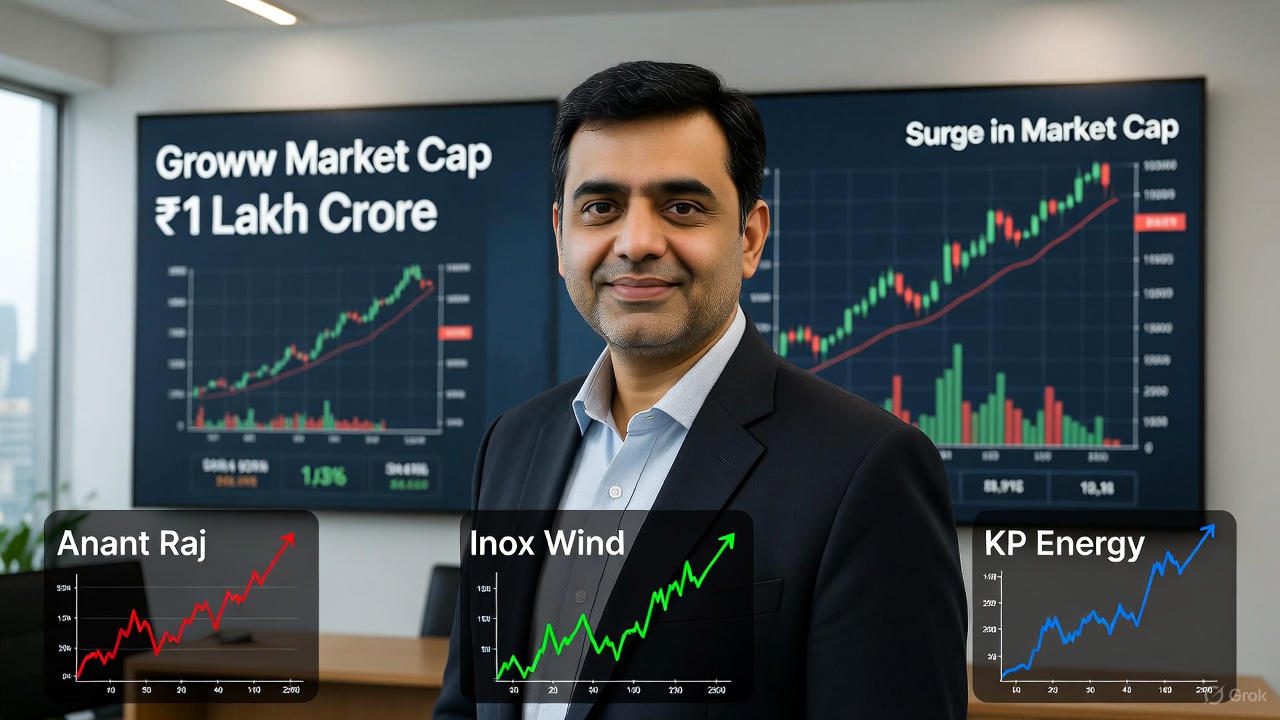
Groww, the leading stock broking platform that’s rewriting the rules of retail investing. As its shares continue their meteoric rise, the company has shattered records by crossing the ₹1 lakh crore market capitalization threshold. This surge not only highlights Groww’s dominance but also spotlights broader market trends, including undervalued stocks with impressive growth trajectories.
Investors seeking high-return opportunities often overlook beaten-down stocks—those temporarily down but backed by solid fundamentals. In this comprehensive guide, we dive deep into Groww’s triumphant journey, the inspiring rise of its founder, and three standout beaten-down stocks: Anant Raj, Inox Wind, and KP Energy. Discover how these entities blend resilience with innovation to promise substantial gains in the coming years.
Groww’s Explosive Stock Market Debut: A 46% Post-Listing Rally
Groww, powered by its parent entity Billion Brains Garage Ventures, has stormed the National Stock Exchange (NSE) with unrelenting momentum. Just a week after its highly anticipated listing, the shares marked their fourth consecutive day of gains on Monday afternoon. By 1 PM, they climbed another 13%, trading at a fresh all-time high of ₹168. This blistering performance propelled the company’s market value beyond the coveted ₹1 lakh crore mark, underscoring the insatiable investor appetite for fintech disruptors.
The journey began last Wednesday when Billion Brains Garage Ventures shares debuted with a 14% premium over the issue price. Priced at ₹100 during the initial public offering (IPO), the stock opened at ₹112 on the NSE—a solid 12% premium—and closed the day at ₹128.85.
Over the ensuing days, the shares rocketed nearly 46% from their listing price, reflecting unbridled confidence in Groww’s business model. This IPO, which raised ₹6,632 crore, opened for subscription on the 4th of the month with a price band of ₹95-100. The overwhelming response saw it subscribed 17.60 times, a testament to the platform’s appeal among retail investors.
Founded in 2016, Groww has evolved from a modest mutual fund investment app into India’s largest stock broker by user base and trading volume. By June 2025, it commands over 26% market share, outpacing traditional giants. This dominance stems from its user-friendly interface, zero-commission trades, and seamless integration of stocks, mutual funds, and gold investments.
As digital adoption accelerates—fueled by smartphone penetration and financial literacy drives—Groww positions itself as the gateway for India’s burgeoning middle class to wealth creation. Analysts predict that with regulatory tailwinds and expanding product suites, Groww’s revenue could double in the next fiscal year, making its shares a cornerstone for long-term portfolios.
Decoding the Surge: What Drove Groww Shares to ₹1 Lakh Crore Valuation?
Several factors converged to ignite this rally. First, the broader market sentiment favored growth-oriented fintechs amid easing inflation and robust GDP forecasts for FY26. Groww’s IPO timing capitalized on this, drawing institutional heavyweights who view it as a proxy for India’s digital economy boom. The platform’s asset under management (AUM) crossed ₹4 lakh crore in Q2 FY26, up 40% year-over-year, driven by active user growth from 50 million to over 70 million.
Moreover, Groww’s operational efficiency shines through its low customer acquisition costs and high retention rates. Unlike legacy brokers burdened by physical branches, Groww leverages AI-driven personalization to boost engagement. Its foray into fixed deposits and US stocks has diversified revenue streams, reducing dependency on broking fees. Post-listing, the stock’s price-to-sales ratio hovers at a reasonable 15x, attractive compared to global peers like Robinhood at 20x.
Yet, challenges loom. Intense competition from Zerodha and Upstox, coupled with SEBI’s margin regulations, could pressure margins. Still, Groww’s cash reserves from the IPO—bolstered by a debt-free balance sheet—provide ample runway for R&D and acquisitions. For investors eyeing Groww share price trends, technical indicators suggest sustained uptrend with support at ₹150 and resistance at ₹180. Long-term holders should monitor quarterly earnings for sustained AUM growth, positioning this as a blue-chip bet in the fintech space.
Lalit Keshre: From Rural Farmer’s Son to Billionaire CEO of Groww
At the heart of Groww’s success story beats the ambition of Lalit Keshre, its co-founder and CEO, who has ascended from humble beginnings to billionaire status. Hailing from Leepa, a remote village in Madhya Pradesh’s agrarian heartland, Keshre grew up in a family tilling the soil for survival. Yet, his intellect propelled him to IIT Bombay, where he honed skills in computer science and engineering.
Keshre’s professional odyssey kicked off at Flipkart, the e-commerce behemoth, where he contributed to scaling operations during its hyper-growth phase. In 2016, spotting a gap in accessible investing tools, he teamed up with peers to launch Groww. What started as a simple app for mutual funds ballooned into a full-spectrum platform, mirroring Keshre’s vision of democratizing finance.
The share surge catapults Keshre into the billionaire league. He holds 55.91 crore shares, equating to 9.06% ownership. At the latest price of ₹169, his stake valuations at ₹9,448 crore—surpassing the $1 billion threshold. This windfall not only validates his grit but also inspires a generation from Tier-2 and rural India. Keshre’s leadership philosophy emphasizes simplicity and trust, evident in Groww’s transparent fee structure and educational content.
Beyond numbers, Keshre’s story underscores social mobility in India’s startup ecosystem. He reinvests in rural education via Groww’s CSR arm, funding scholarships for underprivileged students. As he navigates billionaire responsibilities, expect Keshre to steer Groww toward IPO expansions like international markets and crypto integrations—provided regulatory nods align. For aspiring entrepreneurs, Keshre’s blueprint: Solve real problems with tech, stay customer-obsessed, and scale relentlessly.
Navigating Market Volatility: Why Beaten-Down Stocks Offer Hidden Value
While Groww’s ascent dazzles, savvy investors know true alpha lies in beaten-down stocks—those punished by market corrections despite stellar fundamentals. These gems often see sales and profits climb steadily over three years, yet share prices plummet over 30% recently. Is this mere sector rotation or a deeper business hiccup? Our analysis reveals three such stocks: Anant Raj, Inox Wind, and KP Energy. Each boasts expanding revenues, margin improvements, and ambitious expansion plans, making them prime recovery candidates.
In volatile markets like FY26’s—marked by geopolitical tensions and rate hike fears—beaten-down stocks with growing fundamentals shine. They trade at discounts to intrinsic value, offering asymmetric upside. Historical data from BSE Sensex corrections shows such picks outperform by 25-40% in rebounds. Key to spotting them: Scrutinize income statements for consistent top-line growth, balance sheets for healthy cash flows, and order books for future visibility. As we unpack these three, remember: Diversify, assess risks, and align with your risk tolerance.
Anant Raj: Real Estate Titan Pivoting to Data Centers for Explosive Growth
Anant Raj stands as a seasoned real estate developer with over five decades of expertise in the National Capital Region (NCR). The company transcends mere residential builds, crafting integrated townships, IT parks, malls, hotels, and warehouses that redefine urban living. Yet, its true game-changer emerges in the digital realm: a bold foray into data centers and cloud services.
In October 2024, Anant Raj unveiled Ashok Cloud, its proprietary platform delivering scalable storage and computing solutions. This infrastructure-as-a-service (IaaS) and colocation offering taps into India’s data explosion, projected to grow at 25% CAGR through 2030. Currently, 96% of revenues stem from real estate, with 4% from rental and allied services, but cloud ambitions could flip this script.
Financials paint a rosy picture. Over the past three years, sales quadrupled to 4.5x, while net profits octupled to 8x, propelled by margin expansion from 16% to 24%. Cost efficiencies in manufacturing and employee expenses fueled this leap. In Q2 FY26, revenues surged 23% year-over-year (YoY) to ₹631 crore, thanks to robust project responses. Operating profits leaped 49% to ₹168 crore, with margins expanding 500 basis points to 27%. Net profits followed suit, rising 30% to ₹138 crore, underscoring operational prowess.
Looking ahead, Anant Raj eyes diversification beyond bricks-and-mortar. Its data center arm operates 28 MW currently, with plans to scale to 307 MW in 4-5 years. Management targets ₹1,200 crore in segment revenues by FY27, potentially ballooning to ₹8,000-9,000 crore long-term. This aligns with India’s hyperscale data needs, driven by AI and 5G rollouts.
Cash flow dynamics merit attention. FY25’s operating cash flow (CFO) improved from negative ₹26 crore to positive ₹97 crore, with CFO-to-net profit ratio climbing from -10% to 23%. Receivables pressured flows, but inventory and payables provided buffers. Over three-year rolling trends, cash releases varied: FY19-21 averaged ₹192 crore CFO against ₹57 crore profits; FY20-22 dipped to ₹60 crore amid inventory buildup; FY22-24 stabilized at ₹143 crore CFO versus ₹207 crore profits. This build-up phase signals investment in expansions—liquidity will surge post-project deliveries.
Investor vigilance is key. Promoter holding dipped gradually from 64.99% in March 2022 to 57% by October 2025, while FII stakes rose from 6.35% to 13.68%, indicating institutional buy-in. At 10x price-to-sales and 46x P/E, valuations embed premium growth expectations. Risks include execution delays in data centers or softening real estate cycles, potentially derailing FY27 targets. Nonetheless, Anant Raj’s blend of legacy stability and tech disruption positions it as a beaten-down stock with multibagger potential. Track quarterly updates for order inflows and capex progress.
Inox Wind: Harnessing Renewable Energy Winds for Turnaround Triumph
Inox Wind emerges as India’s fully integrated wind energy powerhouse, mastering design, manufacturing, EPC (engineering, procurement, construction), installation, and O&M (operations and maintenance). By producing blades, towers, and nacelles in-house, the company achieves cost controls, quality assurance, and supply chain agility—critical in a sector prone to global disruptions.
Its flagship 3 MW wind turbine generator (WTG) suits Indian conditions perfectly, securing high orders and client loyalty. The FY22-25 arc tells a redemption tale: Revenues exploded 5.6x, flipping EBITDA and net profits from negative to positive. Backward integration slashed vendor dependencies, while large-scale execution and fewer delays plummeted costs. Operating leverage unlocked, margins soared.
Year-over-year, Q1 FY26 bucked seasonal slumps with strong execution. Management credits revenue quality and backlog clearances—prepped complete sets for swift deliveries. EBITDA and PAT outpaced topline growth, signaling leverage gains. Post a 3:1 bonus issue and merger, equity capital quadrupled, erasing long-term borrowings. Short-term debt lingers at ₹1,464 crore, incurring ₹170 crore annual interest— a profit drag to watch.
FY25 marked a cash inflection: CFO turned positive at ₹138 crore from prior negatives, though receivables and inventory tie up funds. Credit sales of ₹1,646 crore strain working capital, necessitating borrowings. Outlook gleams: 1.2 GW execution in FY26, scaling to 2 GW in FY27. Risks cluster around revenue concentration—three clients and government-linked projects contribute over 10%. Delays here could jolt earnings.
Inox Wind’s beaten-down status belies its renewable renaissance. With India’s 500 GW non-fossil target by 2030, wind capacity must triple. Inox’s order book brims with 2.5 GW, and hybrid wind-solar pilots enhance viability. Valuations at 8x sales offer entry points; monitor debt reduction and execution milestones for 50%+ upside.
KP Energy: End-to-End Wind Farm Developer Poised for Sustainable Surge
KP Energy rounds out our trio as an integrated wind power solutions provider, orchestrating site selection to grid connectivity. Its EPC expertise encompasses land development, infrastructure, electrical works, and tie-ins under one roof. Complementing this, an IPP (independent power producer) portfolio generates annuity-like revenues, while O&M services maintain over 500 MW assets long-term.
FY22-25 financials dazzle: Revenues grew 3.75x, but margins stole the show—EBITDA 5.24x and PAT 6.31x higher. Operational excellence drove 580 bps OPM gains. In Q2 FY26—a seasonally weak quarter—revenues jumped 51% YoY, powered by EPC commissioning and IPP ramp-up. IPP generation leaped from 69 crore units to 275 crore, turbocharging power sales. AI-driven NOC (network operations center), preventive maintenance, and resource optimization boosted efficiency and reliability.
Net profits rose 44%, tempered by a tax hike from 24% to 33%, compressing the bottom line slightly. Balance sheet expansion reflects aggression: Fixed assets surged 157%, with plant and machinery capex doubling from ₹159 crore to ₹400 crore in FY25. Growth levers include a 2+ GW order book, 4-5x MW WTG adoption, and grid expansions—100 MW ISTS (inter-state transmission system) approvals unlock interstate sales.
Risks persist: Pending litigations in Gujarat High Court (PILs and civil applications) pose contingent liabilities, though management deems immaterial. Revenue skew toward EPC heightens sector slowdown sensitivity; IPP’s high-margin growth offsets but remains nascent, amplifying diversification needs.
KP Energy’s beaten-down allure stems from its wind farm EPC leadership in Gujarat’s gusty corridors. As PLI schemes incentivize locals, KP’s end-to-end model captures 15% market share. At 12x P/E, it undervalues 30% CAGR projections. Investors should eye IPP capacity additions and litigation resolutions for catalysts.
Strategic Insights: Building a Portfolio with Groww and Beaten-Down Winners
Integrating Groww’s momentum with these undervalued picks crafts a balanced portfolio. Allocate 40% to high-growth fintech like Groww for beta exposure, 60% to cyclicals like Anant Raj (real estate/data), Inox Wind (renewables), and KP Energy (wind infra). Rebalance quarterly, using Groww’s analytics for real-time tracking.
Market headwinds—FII outflows, monsoon vagaries—affect beaten-down stocks, but fundamentals endure. Groww’s ecosystem aids: Zero-brokerage trades minimize costs, educational webinars demystify analysis. Future-proof by eyeing ESG trends; renewables dominate, data centers underpin AI.
In conclusion, Groww’s ₹1 lakh crore milestone heralds fintech’s golden era, while beaten-down stocks like Anant Raj, Inox Wind, and KP Energy whisper of untapped fortunes. Conduct due diligence, consult advisors, and invest wisely—past performance isn’t indicative, but growth stories like these fuel wealth creation. As India’s market cap eyes $10 trillion by 2030, position now for the ride.