
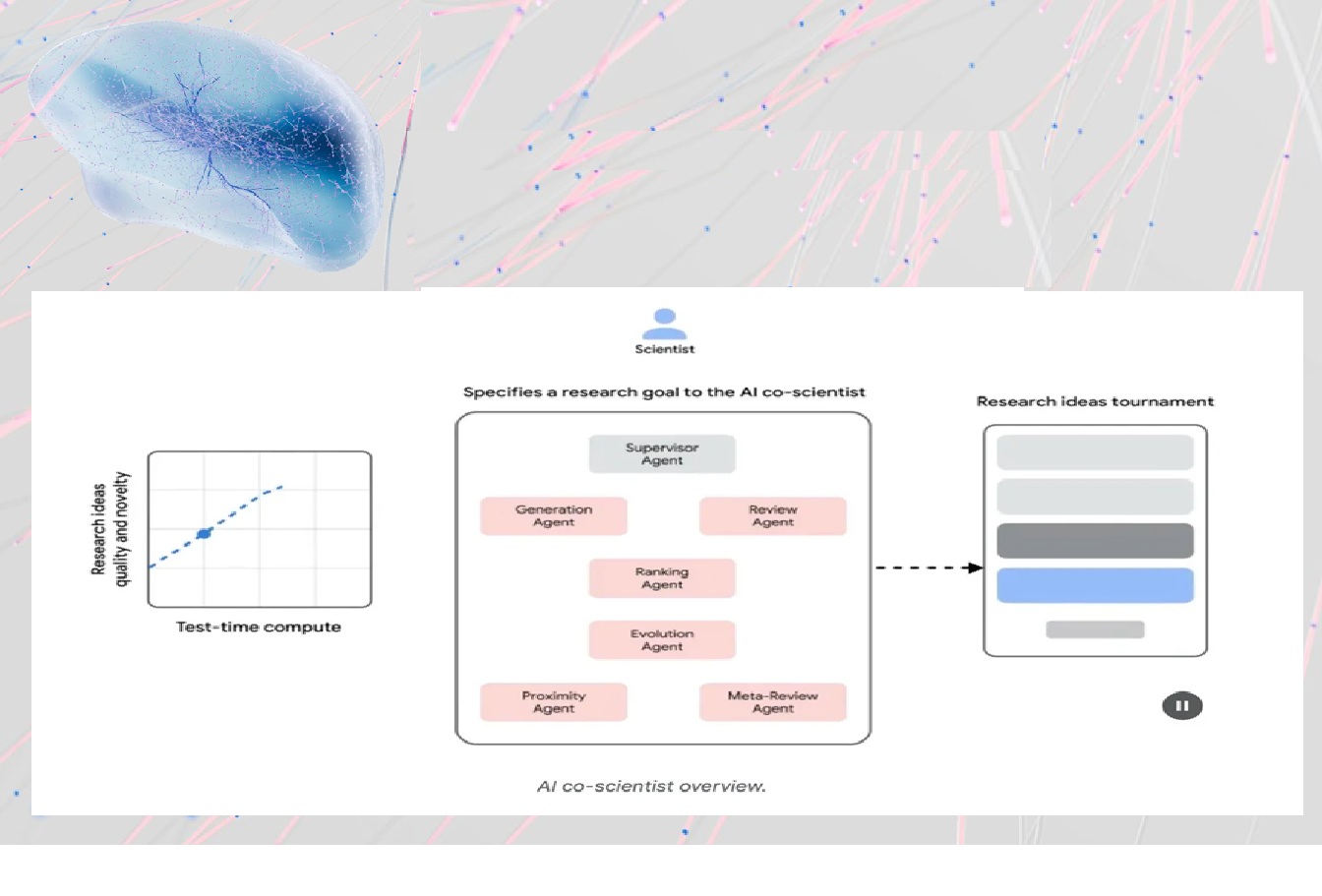
Google Unveils AI-Powered Co-Scientist
Google has introduced an advanced AI co-scientist built on its Gemini 2.0 platform, designed to revolutionize research methodologies by accelerating scientific discovery. This groundbreaking system has the potential to generate novel hypotheses and drastically reduce research timelines from years to mere days.
As reported by Computerworld, this AI-driven solution aims to streamline hypothesis generation and enhance scientific research efficiency. By integrating artificial intelligence into the scientific method, researchers can leverage AI-powered insights to refine their studies and improve experimental accuracy.
Key Features of Google’s AI Co-Scientist
Built on the Gemini 2.0 platform, the AI co-scientist employs a multi-agent system that mirrors human scientific processes. Key functionalities include:
- AI-Generated Hypotheses: The system formulates testable scientific hypotheses based on natural language queries.
- Tournament-Style Evaluation: Uses Elo rating systems to refine and rank hypothesis proposals.
- Integration with Scientific Databases: Analyzes vast amounts of scientific literature and public datasets.
- Human Feedback Mechanism: Researchers can provide direct input to enhance the AI’s accuracy and relevance.
This AI-driven approach significantly reduces hypothesis development timelines, accelerating early-stage research from weeks to just days.
Success Stories: AI Co-Scientist in Action
Google’s AI co-scientist has already demonstrated remarkable breakthroughs across various scientific disciplines. Early tests show its ability to match unpublished discoveries at Stanford University and Imperial College London, proving its potential as a game-changer in research.
Notable Scientific Achievements
- Antimicrobial Resistance Research: The AI discovered a previously unknown gene transfer mechanism, a significant breakthrough in bacterial resistance studies.
- Medical Research & Drug Discovery: The AI identified viable drug candidates for liver fibrosis treatment, expediting pharmaceutical development.
- Bacterial Evolution Studies: The system replicated a decade-long study on bacterial evolution in just two days, reinforcing its potential to fast-track biological research.
These early successes underscore the transformative potential of AI-assisted scientific discovery, reshaping how researchers develop hypotheses, analyze data, and draw conclusions.
Google’s Trusted Tester Program: Early Access for Researchers
To ensure responsible AI deployment, Google has launched a Trusted Tester Program, granting select research organizations early access to the AI co-scientist. Key aspects of the program include:
- Exclusive Access: Available to vetted research institutions worldwide.
- System Evaluation: Researchers can assess the AI’s strengths and limitations in different scientific fields.
- Ethical AI Implementation: Google prioritizes responsible AI-assisted research.
- Research Acceleration: Participants evaluate the system’s impact on research efficiency.
- Collaboration for AI Refinement: Feedback from scientists and researchers helps improve AI functionalities.
Interested organizations can apply through Google’s dedicated research portal, ensuring a controlled rollout while addressing ethical concerns and technological limitations.
Ethical Concerns & Challenges of AI in Scientific Research
Despite its promise, the AI co-scientist raises several ethical and technical concerns. Key challenges include:
1. Data Quality & Reliability
The AI’s effectiveness depends on high-quality input data. Poor or biased data can lead to inaccurate scientific conclusions.
2. Transparency & Reproducibility
The black-box nature of AI in scientific research poses concerns about how AI-generated hypotheses are formed. Transparency in AI decision-making is crucial for scientific credibility.
3. Privacy & Security Risks
With AI analyzing large datasets, risks related to data privacy, confidentiality, and misuse must be addressed. Ethical frameworks must protect sensitive research data.
4. Accountability for AI Errors
Who takes responsibility for errors or biases in AI-generated research? The involvement of multiple stakeholders, from developers to researchers, complicates accountability frameworks.
5. Bias & Fairness in AI Research
AI systems may perpetuate biases found in training data, affecting scientific integrity. Ensuring fair representation in datasets is critical to unbiased research outcomes.
6. Regulatory & Ethical Standards
The lack of universal regulations for AI in scientific research leads to inconsistencies in oversight and accountability. Standardized ethical guidelines are needed to ensure responsible AI deployment.
7. Impact on Traditional Research Practices
The integration of AI into scientific methodologies raises concerns about reliance on automation over human intuition. While AI can accelerate discovery, critical thinking and ethical considerations remain irreplaceable.
The Future of AI-Driven Scientific Discovery
As AI continues to reshape research methodologies, the role of human researchers remains crucial. Google emphasizes that its AI co-scientist is designed to augment, not replace, human expertise. Scientists must continue to provide oversight, ethical judgment, and critical analysis to ensure AI serves as a collaborative research tool rather than an autonomous decision-maker.
By addressing ethical concerns and improving AI transparency, Google’s AI co-scientist could redefine the future of scientific discovery, paving the way for faster, more accurate, and innovative research breakthroughs.
With the AI revolution in scientific research already underway, the balance between AI efficiency and human expertise will determine the success of future discoveries. As research institutions embrace AI-assisted methodologies, ensuring ethical integrity and accountability will be paramount in advancing scientific knowledge for the betterment of society.