
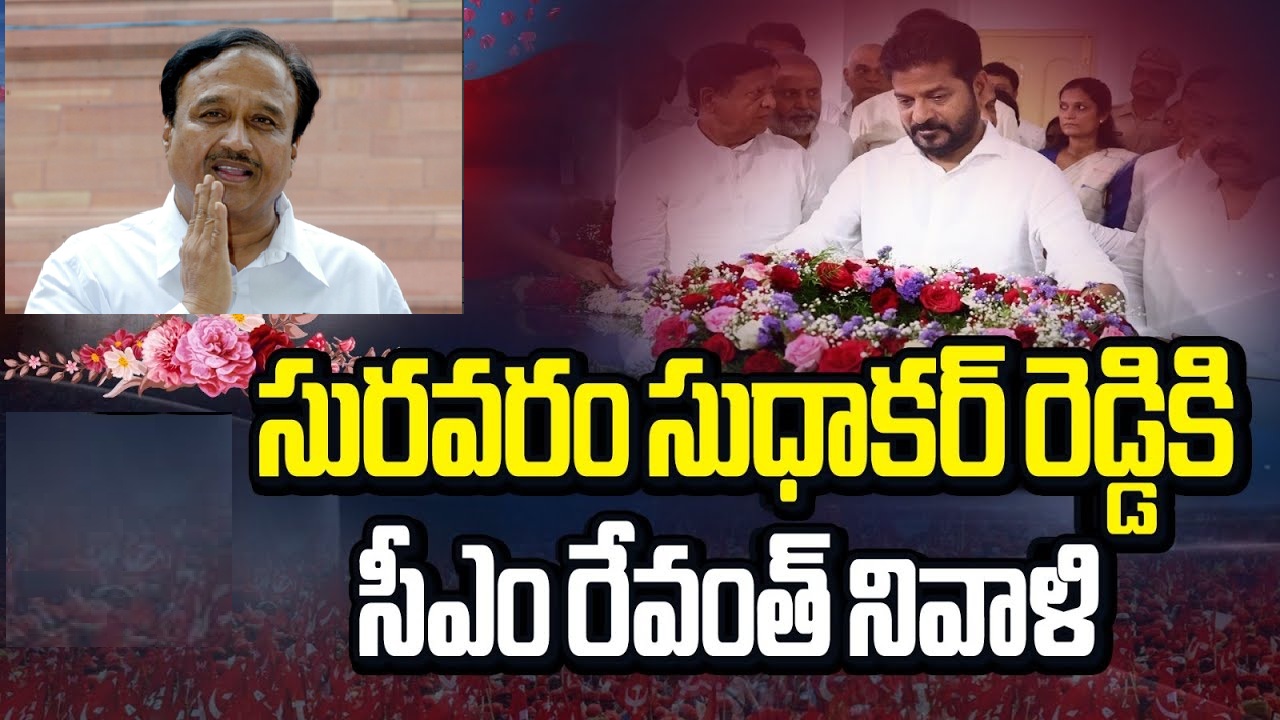
Telangana Chief Minister Revanth Reddy led a wave of tributes to the late Suravaram Sudhakar Reddy, the former national general secretary of the Communist Party of India (CPI) and ex-Member of Parliament, who passed away at the age of 83. Reddy visited Makhdoom Bhavan in Hyderabad to offer floral respects to the departed leader’s mortal remains. In a moving address to the media, he hailed Sudhakar Reddy as a towering figure who tirelessly fought for the poor and marginalized communities. This emotional homage underscores the enduring legacy of left-wing politics in Telangana and highlights Sudhakar Reddy’s unyielding commitment to his principles throughout a storied career.
As Hyderabad and the broader Telangana region grieve the loss of one of its most influential sons from Mahbubnagar district, political leaders across party lines unite in remembering a man who rose from humble beginnings to shape national discourse. This article delves into Sudhakar Reddy’s life, his political ascent, key contributions to India’s communist movement, the significance of Revanth Reddy’s tribute, and the lasting impact on Telangana politics and beyond.
Early Life and Education: Roots in Rural Telangana That Shaped a Revolutionary
Suravaram Sudhakar Reddy entered the world on March 25, 1942, in the quaint village of Kondravpalli, nestled in the erstwhile Mahbubnagar district—now known as Jogulamba Gadwal—of Telangana. Born into a family with deep intellectual and literary traditions, he grew up amid the agrarian landscapes that would later fuel his passion for farmers’ rights. His father, a respected local figure, instilled in him values of justice and equality, drawing from the region’s rich history of social reform movements.
From a young age, Sudhakar Reddy displayed a keen intellect and a rebellious spirit against injustice. He pursued his Bachelor of Arts degree at Osmania College in Kurnool, where he first encountered the ideologies of Marxism and socialism that would define his life. Later, he earned an LLB from Osmania University in Hyderabad, equipping him with legal acumen that proved invaluable in his advocacy for workers and the underprivileged. These formative years in educational hubs like Kurnool and Hyderabad exposed him to the socio-economic disparities plaguing rural India, particularly in drought-prone areas like Mahbubnagar.
During his student days, Sudhakar Reddy actively participated in campus debates and protests, honing his skills as an orator. He joined the All India Students Federation (AISF), the student wing of the CPI, marking the beginning of his lifelong association with communist ideals. This period in the 1960s coincided with turbulent times in Indian politics, including the split in the Communist Party and the Naxalite movement’s emergence. Sudhakar Reddy navigated these challenges with a pragmatic approach, focusing on grassroots mobilization rather than radical extremism. His early experiences in Telangana’s villages taught him the harsh realities of poverty, landlessness, and caste discrimination, themes that permeated his later political rhetoric.
Mahbubnagar, often called Palamuru, holds a special place in Telangana’s history as a cradle of peasant struggles. Sudhakar Reddy’s upbringing here not only grounded him in local issues but also inspired him to elevate regional concerns to the national stage. As he transitioned from academia to activism, he emerged as a voice for the voiceless, setting the stage for a career that spanned over five decades.
Political Journey: From Student Activist to CPI National General Secretary
Sudhakar Reddy’s political career ignited in the fiery crucible of student politics during the late 1960s. As a leader in the AISF, he organized rallies and strikes against fee hikes, unemployment, and educational inequalities. His charisma and eloquence quickly propelled him into the youth wing of the CPI, where he championed causes like land reforms and workers’ rights. By the 1970s, he had become a prominent figure in Telangana’s communist circles, leading protests against feudal landlords and advocating for fair wages in the agricultural sector.
The 1980s marked a pivotal turn when Sudhakar Reddy entered electoral politics. He contested and won a seat in the Lok Sabha from Nalgonda constituency in 1998, representing the 12th Lok Sabha. Nalgonda, a stronghold of left-wing politics in Telangana, provided the perfect platform for him to address national issues like poverty alleviation and anti-imperialism. During his tenure, he vocally opposed neoliberal economic policies, arguing they exacerbated inequality. He served on various parliamentary committees, including those on labor and agriculture, where he pushed for progressive legislation.
Sudhakar Reddy secured re-election in 2004 to the 14th Lok Sabha, further solidifying his reputation as a dedicated parliamentarian. In Parliament, he debated fiercely on topics ranging from farmers’ suicides to communal harmony, often drawing from his legal background to craft compelling arguments. His speeches resonated with the masses, earning him the moniker of an “orator par excellence.” Beyond domestic politics, Sudhakar Reddy represented India in over 40 international delegations, engaging with global communist parties and advocating for peace and disarmament.
The pinnacle of his career arrived in 2012 when the CPI elected him as general secretary, succeeding the legendary A.B. Bardhan. He held this position for three terms until 2019, steering the party through challenging times. Under his leadership, the CPI focused on coalition-building with other left and secular forces to counter right-wing dominance. He played a key role in the United Progressive Alliance (UPA) dynamics and later in opposing the Bharatiya Janata Party’s (BJP) policies on issues like demonetization and farm laws.
Throughout his journey, Sudhakar Reddy never compromised his principles, even when power eluded him. He faced electoral defeats, including in the 1994 assembly polls, but bounced back with renewed vigor. His tenure as CPI chief emphasized unity among left parties, youth engagement, and fighting corruption. In Telangana, he supported the statehood movement while cautioning against divisive politics, aligning with the region’s aspirations for equitable development.
Key Contributions to the Communist Movement and Social Justice in India
Sudhakar Reddy’s contributions extended far beyond party lines, leaving an indelible mark on India’s social fabric. He spearheaded numerous struggles for farmers, leading agitations against exploitative land policies in Telangana and Andhra Pradesh. In the 1980s and 1990s, he mobilized peasants in Mahbubnagar to demand irrigation projects and debt relief, directly influencing government schemes like the Indira Gandhi Canal.
As a champion of workers’ rights, Sudhakar Reddy advocated for minimum wages and labor unions in industries ranging from mining to textiles. His legal expertise helped in landmark cases defending trade unionists during the Emergency period (1975-1977), when civil liberties faced severe curbs. He also fought against caste-based discrimination, supporting Dalit and Adivasi communities in accessing education and land.
On the national front, Sudhakar Reddy critiqued economic liberalization, arguing it favored corporations over the common man. He co-authored reports on poverty and inequality, influencing CPI’s policy documents. Internationally, he fostered ties with communist parties in China, Cuba, and Vietnam, promoting anti-imperialist solidarity. His writings in party journals like “New Age” analyzed global events, from the fall of the Soviet Union to the rise of neoliberalism.
In Telangana, Sudhakar Reddy’s efforts bolstered the CPI’s presence amid the Telangana Rashtra Samithi (TRS, now BRS) dominance. He supported women’s empowerment, with his wife, Dr. B.V. Vijaya Lakshmi, often collaborating on health initiatives for rural women. His family life reflected his values—humble and committed to public service, with his two sons carrying forward the legacy.
Sudhakar Reddy’s oratory skills shone in public rallies, where he inspired thousands with calls for equality. He led youth movements against unemployment, organizing job fairs and skill programs in Hyderabad. His contributions to education included advocating for free schooling in backward districts like Mahbubnagar, helping reduce dropout rates.
Revanth Reddy’s Emotional Tribute: Honoring a Telangana Icon at Makhdoom Bhavan
In a poignant moment amid Hyderabad’s bustling streets, Telangana Chief Minister Revanth Reddy arrived at Makhdoom Bhavan to pay his respects to Suravaram Sudhakar Reddy’s mortal remains. He placed a floral wreath and observed a moment of silence, reflecting the deep admiration for the late leader. Addressing the gathered media, Revanth Reddy spoke passionately about Sudhakar Reddy’s life.
“He fought relentlessly for the poor and backward classes,” Revanth Reddy declared. “From his student days to becoming a national leader, Suravaram rose without compromising his ideals. As a son of Palamuru district, he brought immense pride to Telangana by achieving national stature. Whether in power or not, he never abandoned his principles.”
Revanth Reddy assured Sudhakar Reddy’s family of full government support and announced plans to commemorate his legacy. “We will discuss in the cabinet and initiate a meaningful program in his memory,” he said. “Our government has already named institutions after great leaders, and we will ensure Suravaram’s services inspire future generations.”
This tribute came shortly after Sudhakar Reddy’s passing on August 23, 2025, due to age-related ailments at a private hospital in Hyderabad. The Chief Minister directed state honors for the last rites, with the body donated for medical research as per family wishes. Other dignitaries, including former Vice President Venkaiah Naidu, CPI General Secretary D. Raja, and BRS leader K. Chandrashekar Rao, also paid homage, highlighting cross-party respect.
Revanth Reddy’s gesture symbolizes a bridge between Congress’s centrist politics and the left’s ideological fervor. As a former TDP and now Congress leader, Revanth has navigated Telangana’s complex political landscape, and this act reinforces his commitment to inclusive governance.
Legacy and Impact on Telangana Politics: A Beacon for Future Generations
Suravaram Sudhakar Reddy’s legacy endures in Telangana’s political ethos, where left-wing ideas continue to influence policy on land, water, and labor. His advocacy for irrigation in Mahbubnagar helped shape projects like the Krishna River diversions, benefiting thousands of farmers. In Hyderabad, his push for affordable housing influenced urban planning, addressing migrant workers’ needs.
The CPI, under his guidance, adapted to modern challenges like digital activism and climate change, engaging younger demographics. His international outreach strengthened India’s voice in global forums, promoting peace amid rising geopolitical tensions.
In contemporary Telangana politics, Sudhakar Reddy’s principles resonate amid debates on economic disparity. Revanth Reddy’s government, focusing on welfare schemes like Rythu Bandhu enhancements, echoes his calls for farmer support. The tribute event at Makhdoom Bhavan, a hub of communist activities in Hyderabad, reminds us of the city’s role as a center for progressive thought.
Broader implications for Indian left politics include the need for unity against polarization. Sudhakar Reddy’s pragmatic alliances offer lessons for today’s fragmented opposition. His life inspires activists in regions like Kerala and West Bengal, where CPI retains influence.
As Telangana mourns, communities in Mahbubnagar organize memorial meetings, sharing stories of his visits during floods and droughts. Educational institutions plan scholarships in his name, perpetuating his commitment to learning.
The Broader Context: History of CPI in India and Telangana’s Role
The Communist Party of India traces its roots to 1925, founded amid anti-colonial struggles. In Telangana, the party gained prominence through the 1946-1951 armed peasant uprising against the Nizam’s rule, known as the Telangana Rebellion. Leaders like P. Sundarayya built a strong base, fighting feudalism and inspiring figures like Sudhakar Reddy.
Post-independence, CPI split into CPI and CPI(M) in 1964, with Sudhakar Reddy staying with the former. The party influenced land reforms under Indira Gandhi and opposed the Emergency. In Telangana, CPI supported statehood, aligning with TRS in early agitations.
Today, amid BJP’s rise, CPI advocates secularism and economic justice. Sudhakar Reddy’s era saw coalitions like the Left Front, though electoral fortunes waned. In Hyderabad, the party’s headquarters at Makhdoom Bhavan remains a symbol of resistance.
Challenges and Future of Left Politics in India Post-Sudhakar Reddy
Sudhakar Reddy’s passing highlights challenges for India’s left: declining vote shares, youth disengagement, and ideological dilution. Yet, movements like anti-CAA protests show resurgence potential. In Telangana, CPI collaborates with Congress on issues like unemployment.
Future leaders must emulate Sudhakar Reddy’s blend of ideology and pragmatism. Digital tools can amplify grassroots voices, addressing urban-rural divides in places like Mahbubnagar.
Personal Reflections: Family, Colleagues, and Admirers Remember a Humble Giant
Sudhakar Reddy’s wife and sons recall a devoted family man who balanced politics with home life. Colleagues like D. Raja praise his mentorship, while admirers in Nalgonda credit him for infrastructure developments.
Venkaiah Naidu lauded his bipartisanship, and KCR acknowledged his statehood contributions. These reflections paint a portrait of a leader who transcended parties.
Conclusion: Immortalizing Suravaram Sudhakar Reddy’s Spirit in Telangana and Beyond
As Hyderabad bids farewell, Suravaram Sudhakar Reddy’s spirit lives on in the struggles he championed. Revanth Reddy’s tribute not only honors a personal hero but signals a commitment to his ideals. Telangana, from Mahbubnagar’s fields to Hyderabad’s avenues, owes much to this son who fought for equality.
In an era of rapid change, Sudhakar Reddy’s legacy reminds us that true leadership lies in unwavering principles. Governments may come and go, but the fight for the poor endures, inspired by icons like him.